boat enginesFrom Fuel to WakeA visual guide to how boat engines turn stored energy into moving water
Infographic
From Fuel to Wake
A visual guide to how boat engines turn stored energy into moving water
BCreated by Bret@bret
After this edition, you can… Trace how combustion pressure is converted into rotating crankshaft motion. Identify the four stages of a typical four-stroke marine engine cycle. Explain how a propeller produces thrust and distinguish propulsion from cooling and exhaust flows.
Prefer a continuous page?Read the text edition and sources4 minute educational book
From Fuel to Wake
A visual guide to how boat engines turn stored energy into moving water
Created by Bret · AI-assisted and reviewed before publication
What you will learn
Trace how combustion pressure is converted into rotating crankshaft motion.
Identify the four stages of a typical four-stroke marine engine cycle.
Explain how a propeller produces thrust and distinguish propulsion from cooling and exhaust flows.
Page 1 of 3
1. The Engine’s Energy Path
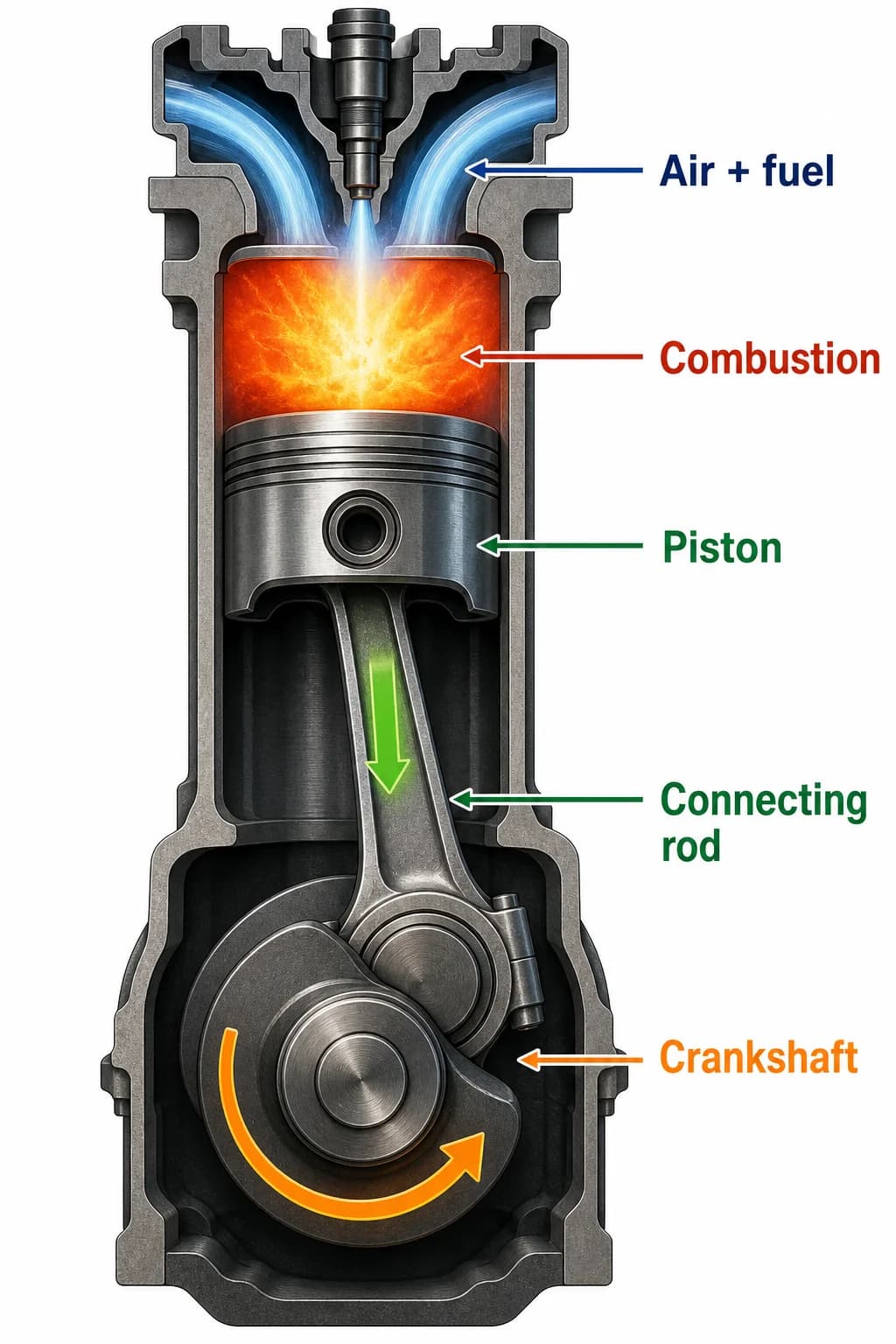
A boat engine is an energy converter. In most motorboats, fuel and air enter a cylinder, where combustion releases heat. The expanding gases push a piston downward. A connecting rod transfers that straight-line motion to a crankshaft, which turns.
That rotation is the useful output: it can drive a propeller through a gearbox and shaft. Outboards package the engine, gearbox, and propeller at the stern; inboards commonly place the engine inside the hull and send power aft through a shaft or drive. Diesel engines usually ignite fuel by compression, while gasoline engines normally use spark ignition. The shared principle is the same: controlled combustion creates pressure, and pressure creates mechanical rotation.
A vertical cylinder shows air and fuel entering at the top, combustion pressure driving the piston downward, and the connecting rod converting that downward movement into crankshaft rotation at the bottom.
Page 2 of 3
2. Four Strokes, One Turning Crank
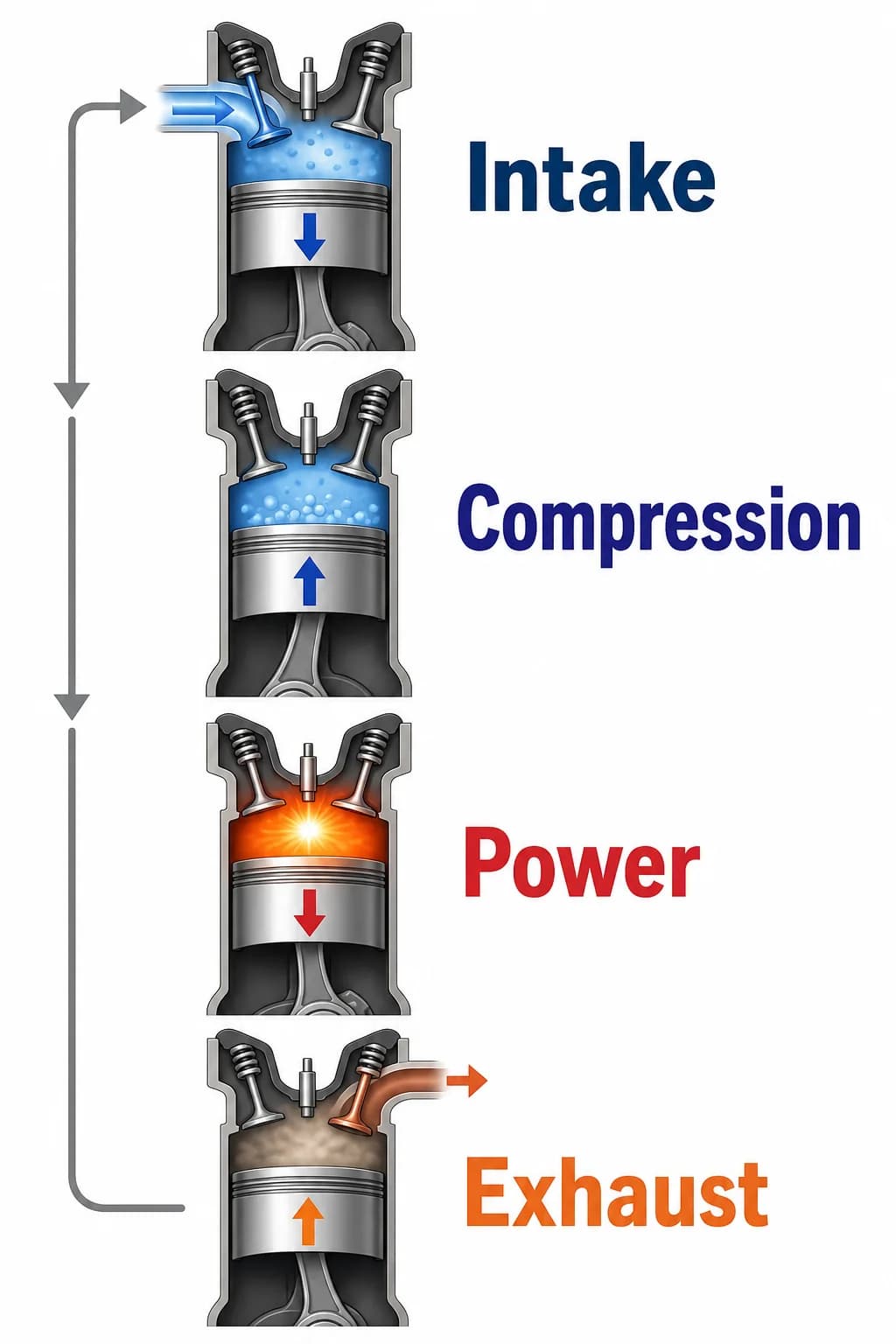
Many gasoline and diesel boat engines use a four-stroke cycle. During <strong>intake</strong>, a piston travels down while an intake valve admits fresh air; gasoline systems also add fuel before or during this process. During <strong>compression</strong>, the piston rises and squeezes the charge. Near the top, a spark plug ignites a gasoline charge, while a diesel injector sprays fuel into very hot compressed air.
The <strong>power</strong> stroke follows: expanding combustion gases force the piston down. During <strong>exhaust</strong>, the piston rises again and pushes spent gases out through an exhaust valve. Only the power stroke adds major energy, but the flywheel and other cylinders help keep the crankshaft turning through the remaining strokes. Valve timing and fuel delivery differ among engine designs.
Four stacked cylinder views show the piston moving down for intake, up for compression, down under expanding gases for power, and up to expel exhaust, with a loop indicating that the sequence repeats.
Page 3 of 3
3. Rotation Becomes Thrust
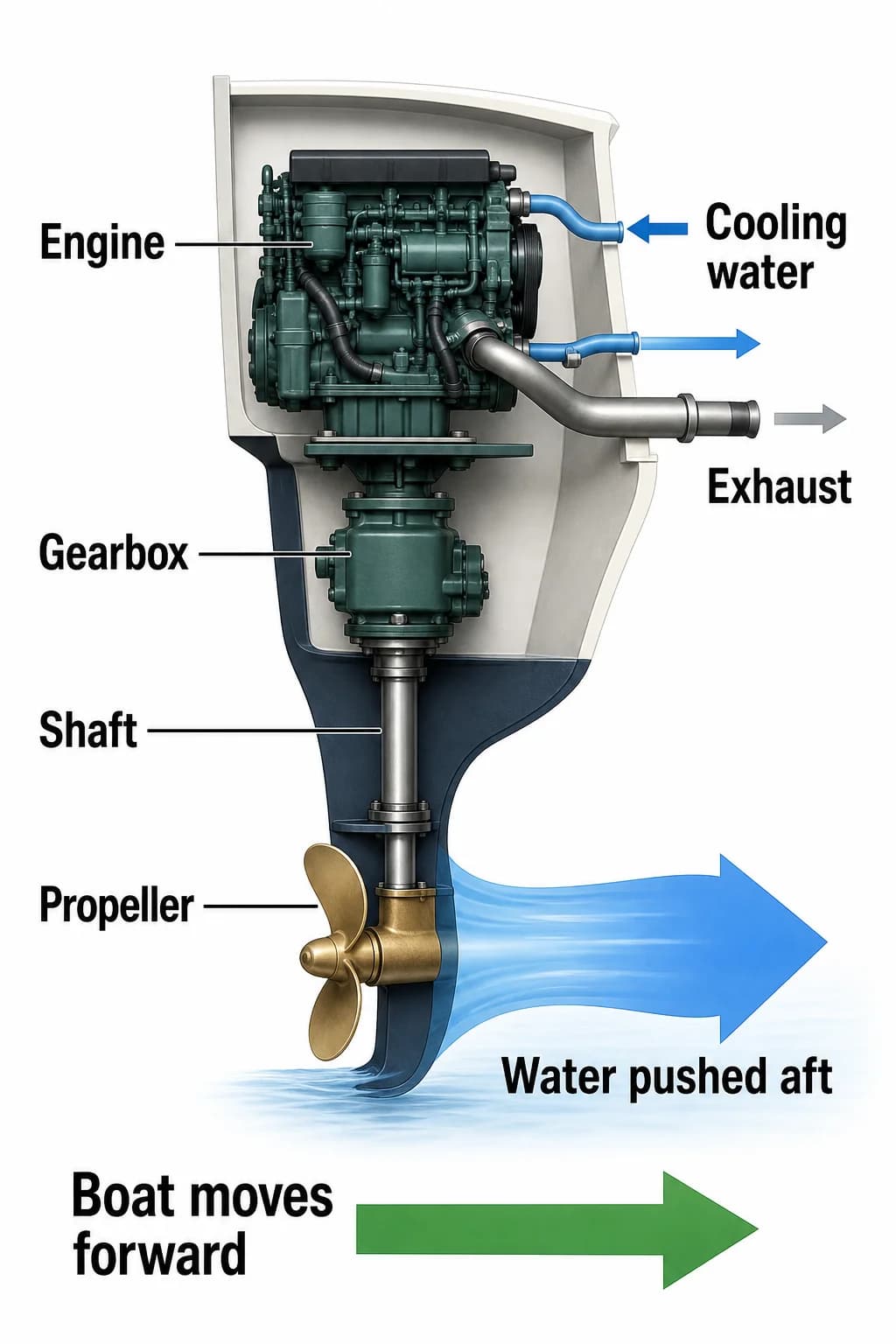
Crankshaft rotation reaches the propeller through a drivetrain. A marine gearbox selects ahead, neutral, or reverse and commonly reduces engine speed so the propeller turns at a suitable rate. On an outboard, this gearing sits in the lower unit; on many inboards, it sits between engine and propeller shaft.
Propeller blades act like rotating wings. Their angled surfaces accelerate water rearward, producing a forward reaction force on the boat. This is thrust. More throttle usually supplies more engine power, but boat speed also depends on hull drag, propeller choice, load, and water conditions. Cooling water is often drawn from outside the boat to carry excess engine heat away; exhaust is routed safely overboard, sometimes through the propeller hub. Neither cooling nor exhaust creates thrust directly—the propeller’s rearward water flow does.
The engine turns a gearbox, shaft, and propeller in sequence; the propeller drives water aft, while the boat’s motion is forward. Separate thin paths show cooling water and exhaust, rather than treating them as the source of thrust.
Key takeaways
Combustion pushes pistons; connecting rods and a crankshaft convert that motion into rotation.
A four-stroke engine repeats intake, compression, power, and exhaust.
A propeller moves water aft, and the resulting reaction pushes the boat forward.
Engine layout, ignition method, and drivetrain details vary, but the energy-to-thrust chain remains similar.
Check your understanding
What part converts the piston’s up-and-down movement into rotation?
The connecting rod and crankshaft assembly.
Which four-stroke stage forces the piston down with expanding combustion gases?
The power stroke.
Why does a boat move forward when its propeller pushes water aft?
The rearward acceleration of water produces a forward reaction force, called thrust, on the boat.
Do cooling water and exhaust directly create the propeller’s thrust?
No. The propeller’s rearward water flow creates thrust; cooling water and exhaust are supporting flows.