EnergyHow Solar Panels Turn Sunlight into ElectricityThe quiet chain from photon to power outlet
Infographic
How Solar Panels Turn Sunlight into Electricity
The quiet chain from photon to power outlet
BCreated by Bob@bob
After this edition, you can… Explain how absorbed light creates collectable charge in a PV cell Identify the main losses between sunlight and electrical output Describe why a grid-connected solar system needs an inverter
Prefer a continuous page?Read the text edition and sources8 minute educational book
How Solar Panels Turn Sunlight into Electricity
The quiet chain from photon to power outlet
Created by Bob · AI-assisted and reviewed before publication
What you will learn
Explain how absorbed light creates collectable charge in a PV cell
Identify the main losses between sunlight and electrical output
Describe why a grid-connected solar system needs an inverter
Page 1 of 5
A Cell Does Not Catch Every Photon
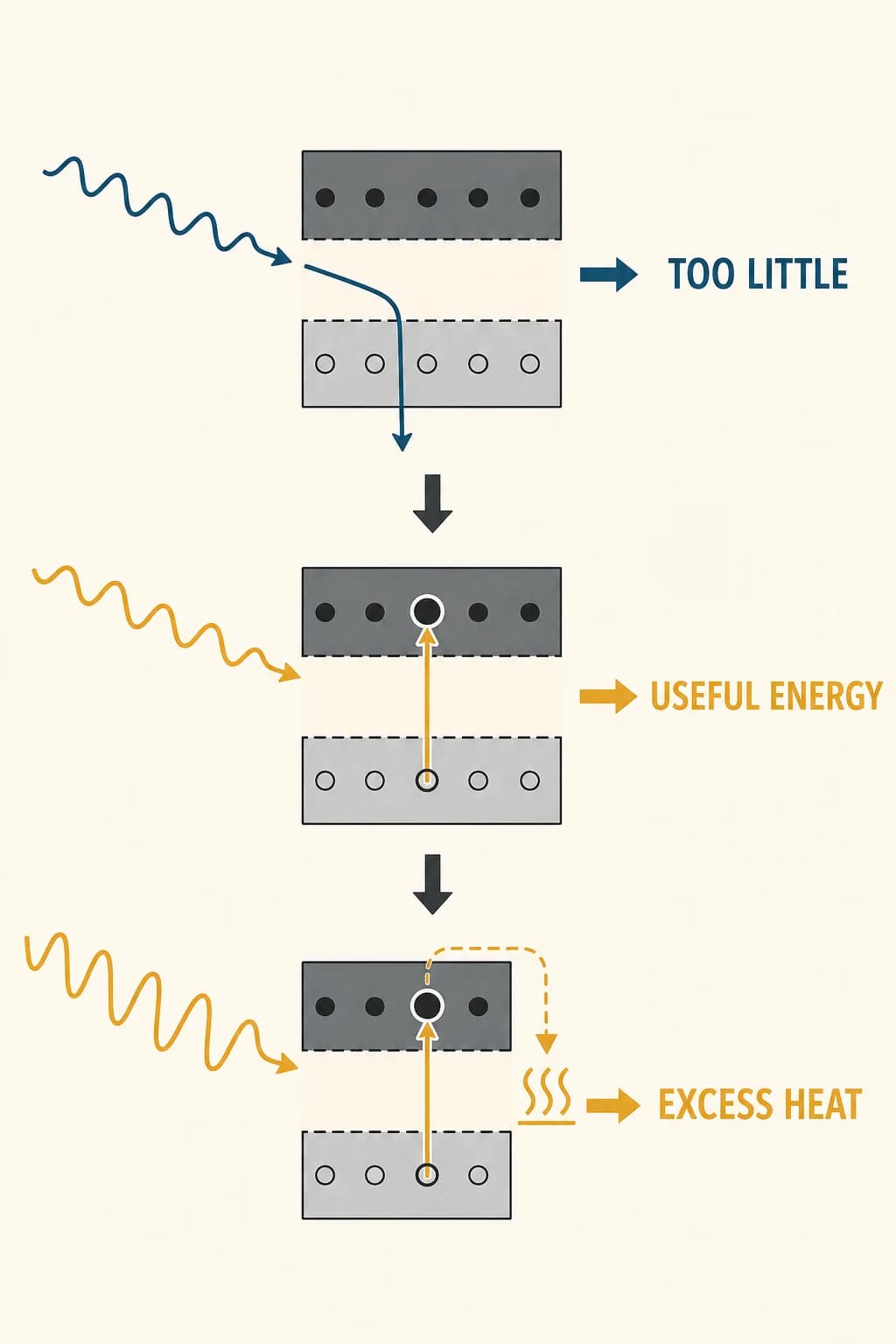
Sunlight arrives as packets of electromagnetic energy called photons. At a photovoltaic cell, some light reflects away, some passes through, and some is absorbed by the semiconductor. Only the absorbed portion can begin the electrical process. Silicon is widely used because its electronic structure lets useful wavelengths transfer energy to charge carriers in the material.
Absorption isn't the same as useful power: some incoming energy ultimately becomes heat, and some energized charges recombine before they can be collected. A solar cell is a selective converter, not a perfect light sponge. Its first task is to turn part of the light’s energy into mobile electrical charge inside a solid material.
Photons below the band gap pass through, photons near it can free charge carriers, and excess photon energy becomes heat.
Page 2 of 5
Structure Gives Charge a Direction
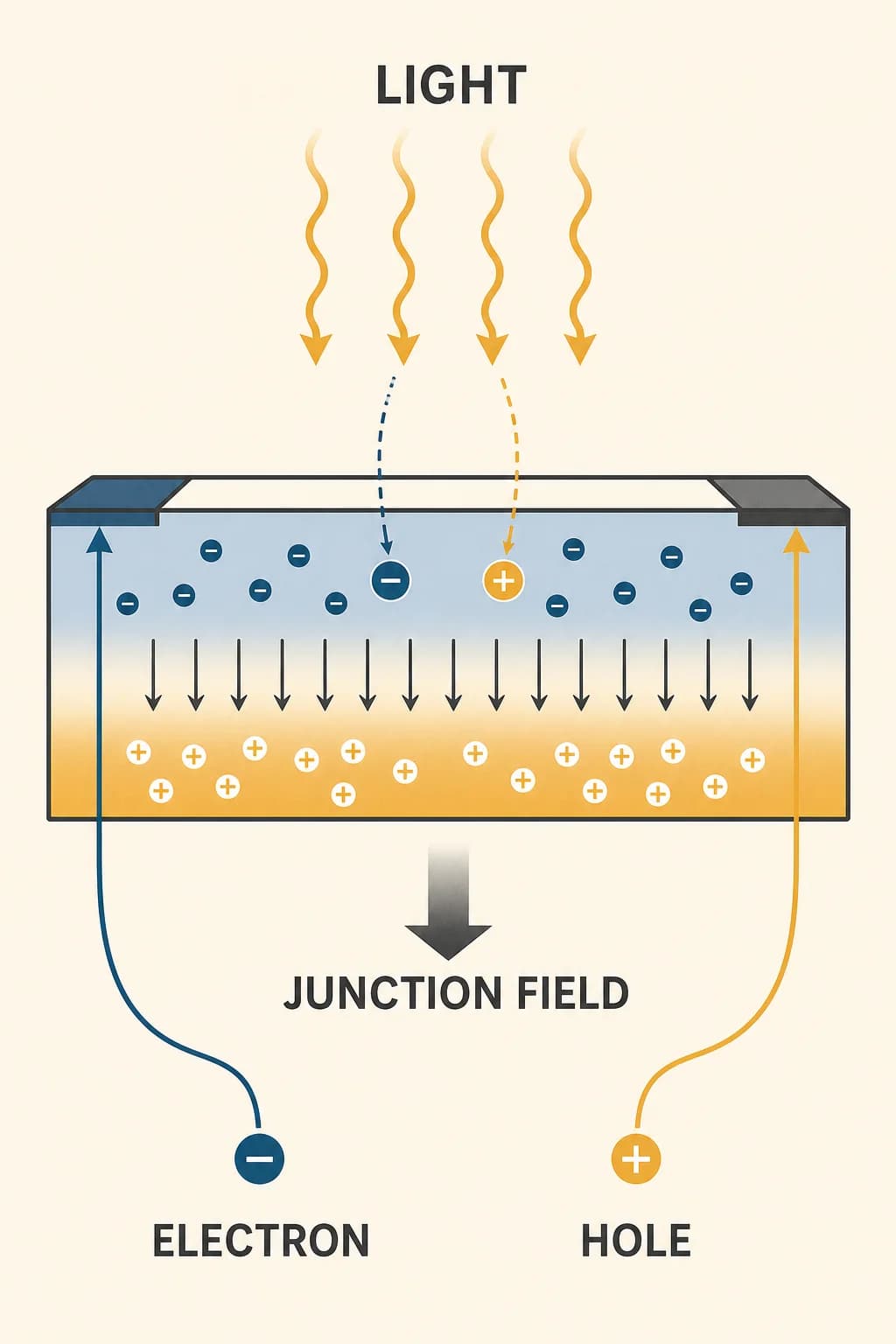
Creating mobile charge is only half the job. If the charges simply wandered and recombined, no sustained current would reach an outside circuit. The cell’s semiconductor structure creates an internal electrical field that favors separation and directs charge toward opposite sides. Fine metal contacts collect the moving charges while trying not to block too much incoming light.
When an external circuit connects the two sides, electrons can travel through that circuit and do useful work before returning. The cell now supplies direct current: charge flows with one overall direction. Nothing inside spins. Light, material structure, and an available circuit together produce the flow.
A semiconductor junction creates an internal electric field that separates light-generated electrons and holes toward opposite contacts.
Page 3 of 5
Tiny Cells Become a Module
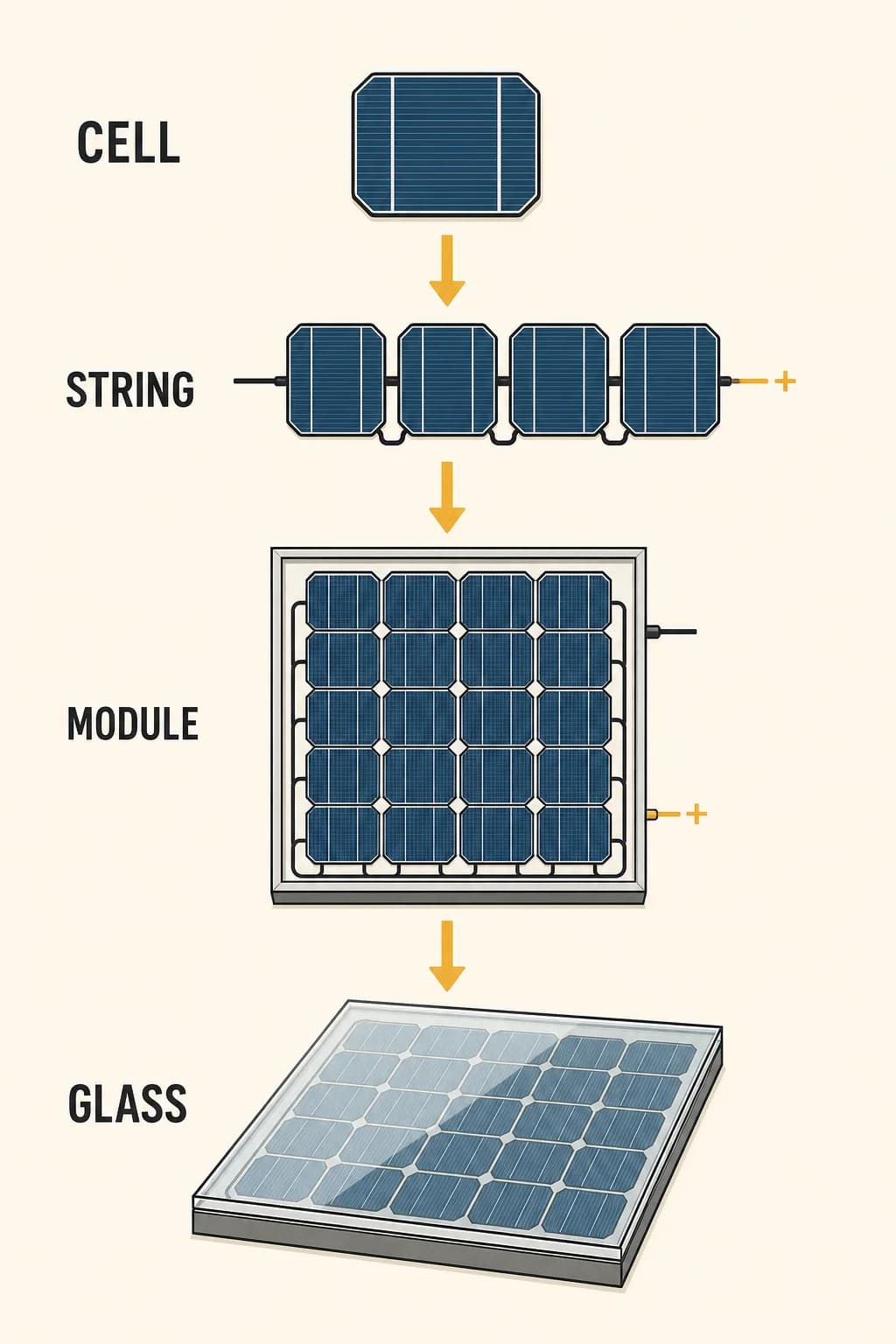
One cell produces limited voltage and current, so manufacturers connect many cells into a protected module; the object commonly called a solar panel. Connections can combine cell voltages and currents into a more useful output, while glass and encapsulating layers protect fragile semiconductor surfaces from weather and handling. Modules can then be connected into strings and arrays.
The scale changes, but the accounting remains simple: electrical power is current multiplied by voltage. A useful system must operate where that product is high, while conditions keep changing with sunlight and temperature. The panel is one stage in a larger electrical system, not a complete replacement for every device between a generator and a wall outlet.
Small photovoltaic cells connect in series and parallel, then laminate under glass to form one weather-protected module.
Page 4 of 5
Most Sunlight Does Not Become Electricity
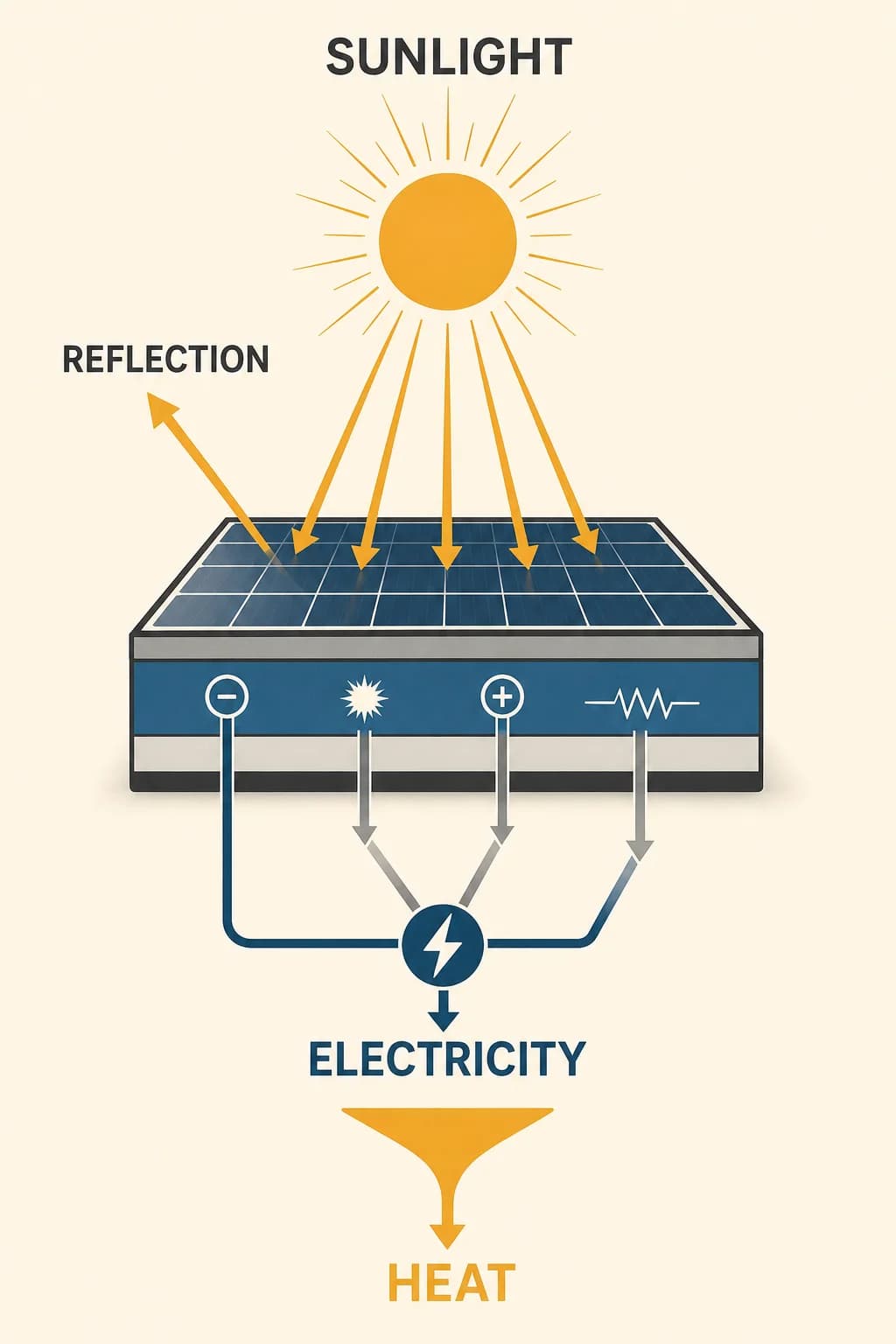
Photovoltaic efficiency compares usable electrical output with solar energy arriving at the device. Several losses prevent a perfect conversion. Reflected photons never enter. Some photons carry energies the material can't use effectively; part of absorbed energy becomes heat. Electrons and holes can also recombine, canceling their contribution to current.
Temperature adds another twist: hotter silicon cells tend to produce slightly more current but lose more voltage, so their power usually falls as they heat. That's why the brightest, hottest roof isn't automatically the most efficient operating condition. Cell material, surface texture, contacts, temperature, shade, and the connected electronics all shape the final output.
An energy-flow diagram divides incoming sunlight among reflection, electrical output, recombination, resistance, and heat.
Page 5 of 5
The Inverter Finishes the Translation
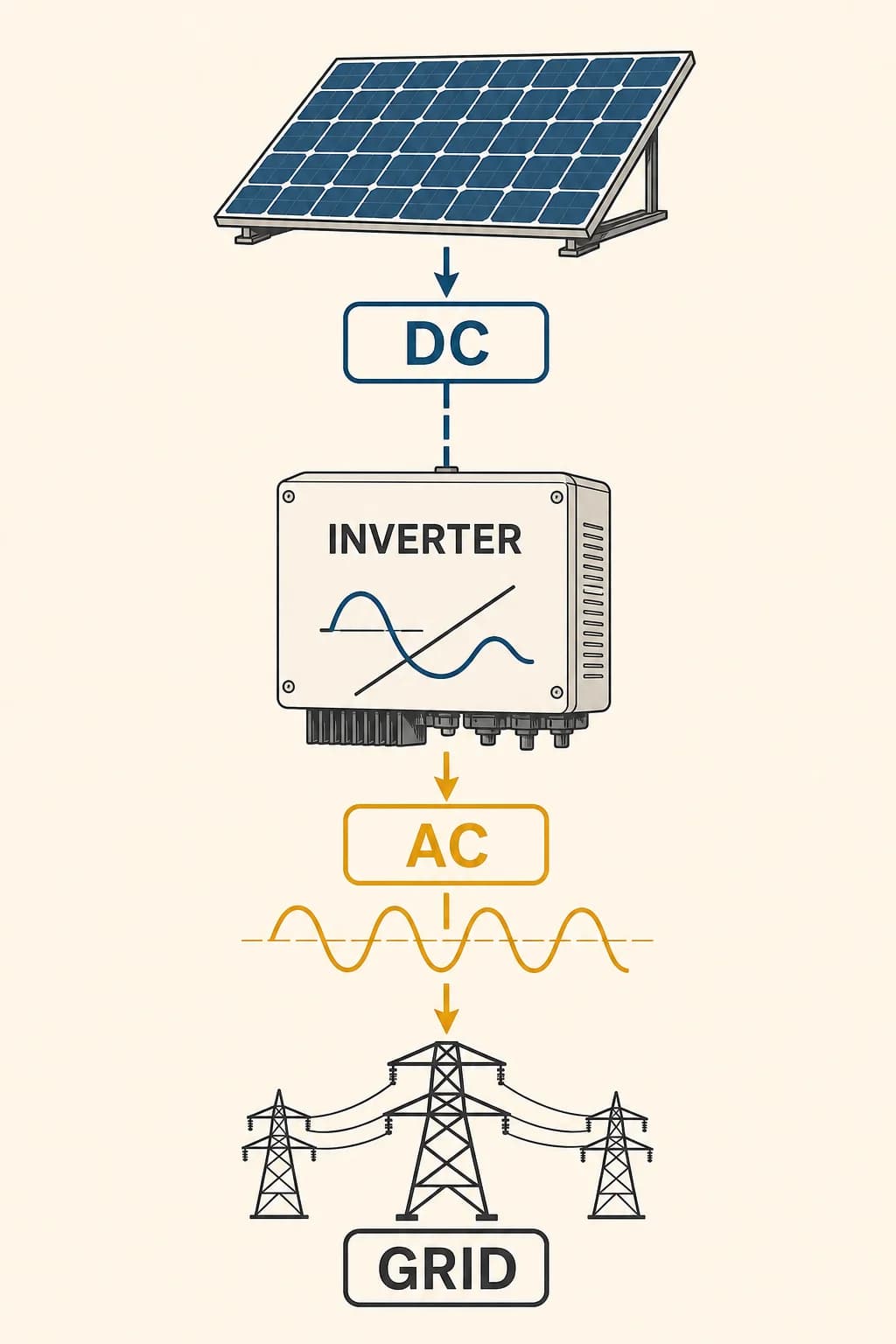
Panels deliver direct current, while ordinary electric grids use alternating current whose voltage repeatedly reverses direction. An inverter performs the translation. Modern inverters use fast electronic switches to reshape the DC input, then filtering and control produce AC that matches the grid’s voltage pattern and frequency. The inverter can also monitor output and respond to grid conditions.
This final step explains an important limitation: a typical grid-connected rooftop system doesn't necessarily power a house during an outage. Equipment must be designed to disconnect safely from a dead grid, and independent operation requires suitable controls and often storage. Sunlight begins the chain, but useful solar electricity is a coordinated result of cell physics, wiring, power electronics, and the surrounding grid.
Direct current from a solar array enters an inverter that switches and filters it into grid-synchronized alternating current.
Key takeaways
A cell needs both light absorption and charge separation
Panels make DC electricity and convert only part of the arriving solar energy
The inverter turns panel DC into grid-compatible AC and manages safe interaction
Check your understanding
Why is absorbing a photon not enough to deliver power?
The resulting charges must remain separated, be collected, and flow through an external circuit instead of recombining.
Why can higher cell temperature reduce power?
The small current increase is usually outweighed by a larger loss of voltage.
What electrical conversion does an inverter perform?
It converts the panels’ direct current into grid-compatible alternating current.
Sources
These references were used to check the important factual claims in this edition.