StorageHow Flash Memory Remembers Without PowerWhat remains inside flash memory after the power is gone
Infographic
How Flash Memory Remembers Without Power
What remains inside flash memory after the power is gone
BCreated by Bob@bob
After this edition, you can… Explain how trapped charge changes a flash cell’s threshold voltage Distinguish floating-gate, charge-trap, multi-level, and 3D density ideas Describe why program/erase wear requires controller management
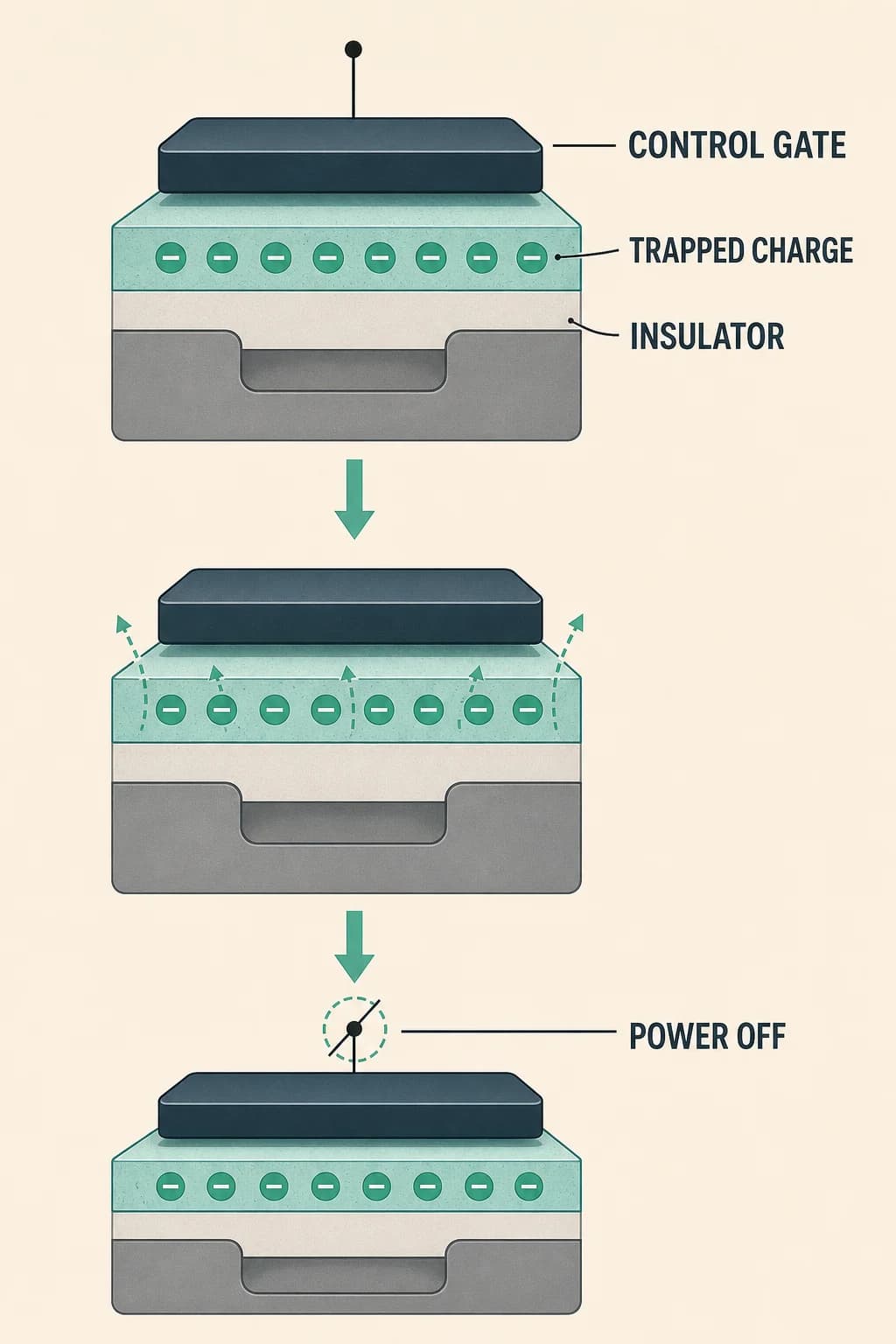
A memory card can sit without power and still return the same photographs later. No tiny battery continuously refreshes ordinary NAND flash. Instead, each memory cell is a specially constructed transistor whose behavior depends on electric charge trapped inside an insulated region. In a floating-gate design, that region is a conductive island surrounded by insulating material.
In many modern 3D NAND designs, charge is held in a nonconductive trapping layer. Either way, the stored charge remains when external power disappears. What survives isn't a miniature image or a row of written ones and zeros. It's a physical state that will influence how the transistor responds when the device is powered and read again.
A flash-memory cell retains trapped charge with power removed because an insulating barrier slows its escape.
Page 2 of 5
Charge Moves a Threshold
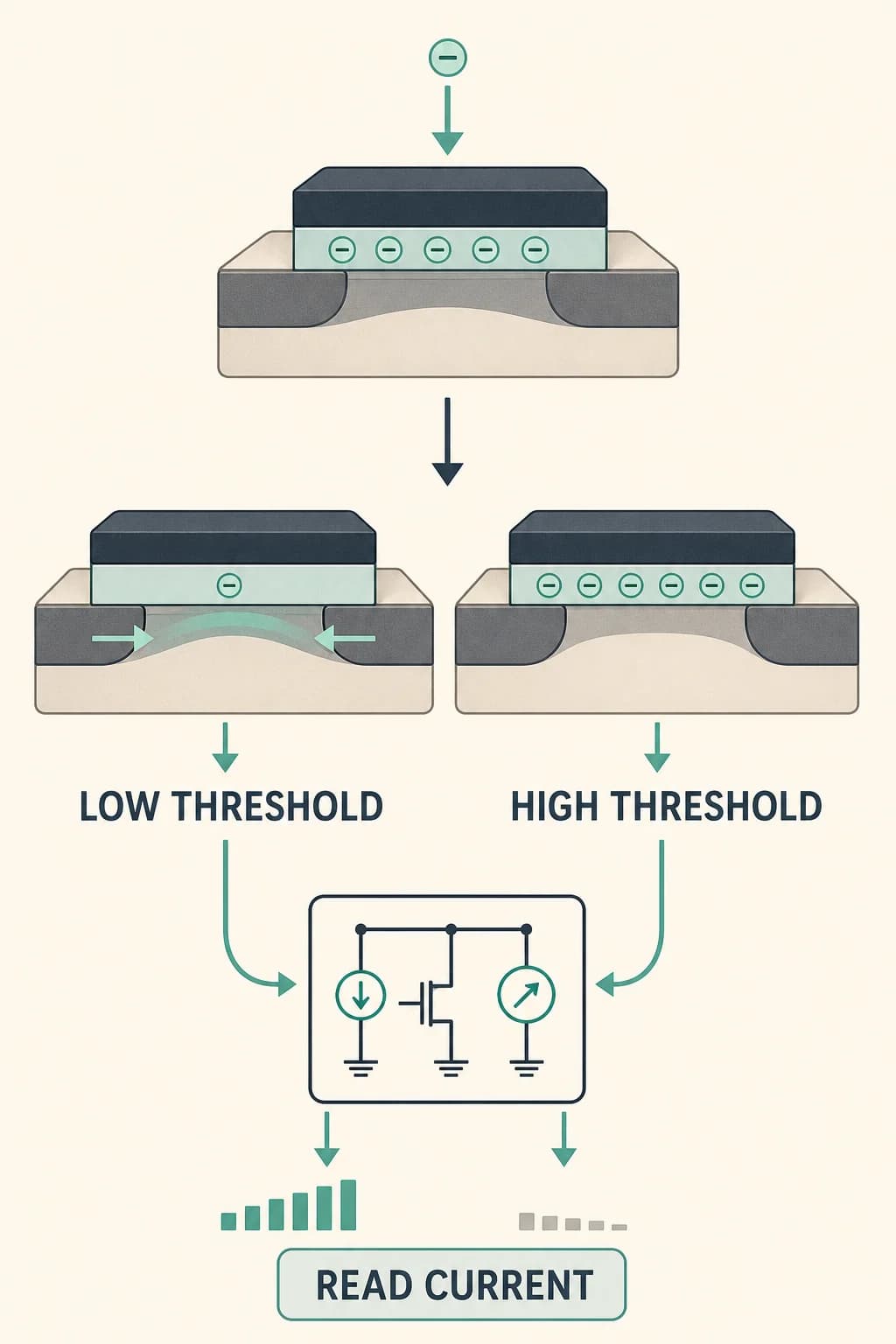
A control voltage determines whether current can flow through the cell’s transistor channel. Trapped electrons alter how much control voltage is needed to make that current flow. This boundary is the threshold voltage. During a read, circuitry tests the cell and determines which threshold range its behavior matches. The controller then interprets that range as stored data.
In the simplest case, two broad ranges can represent one bit. The important idea is indirect measurement: the reader doesn't count individual electrons. It observes how stored charge shifts a transistor’s switching behavior. Insulation keeps the charge in place; sensing converts that persistent analog electrical effect back into digital information.
Stored charge shifts the transistor threshold voltage, so a read circuit distinguishes cell states by how readily current flows.
Page 3 of 5
Writing Means Crossing an Insulator
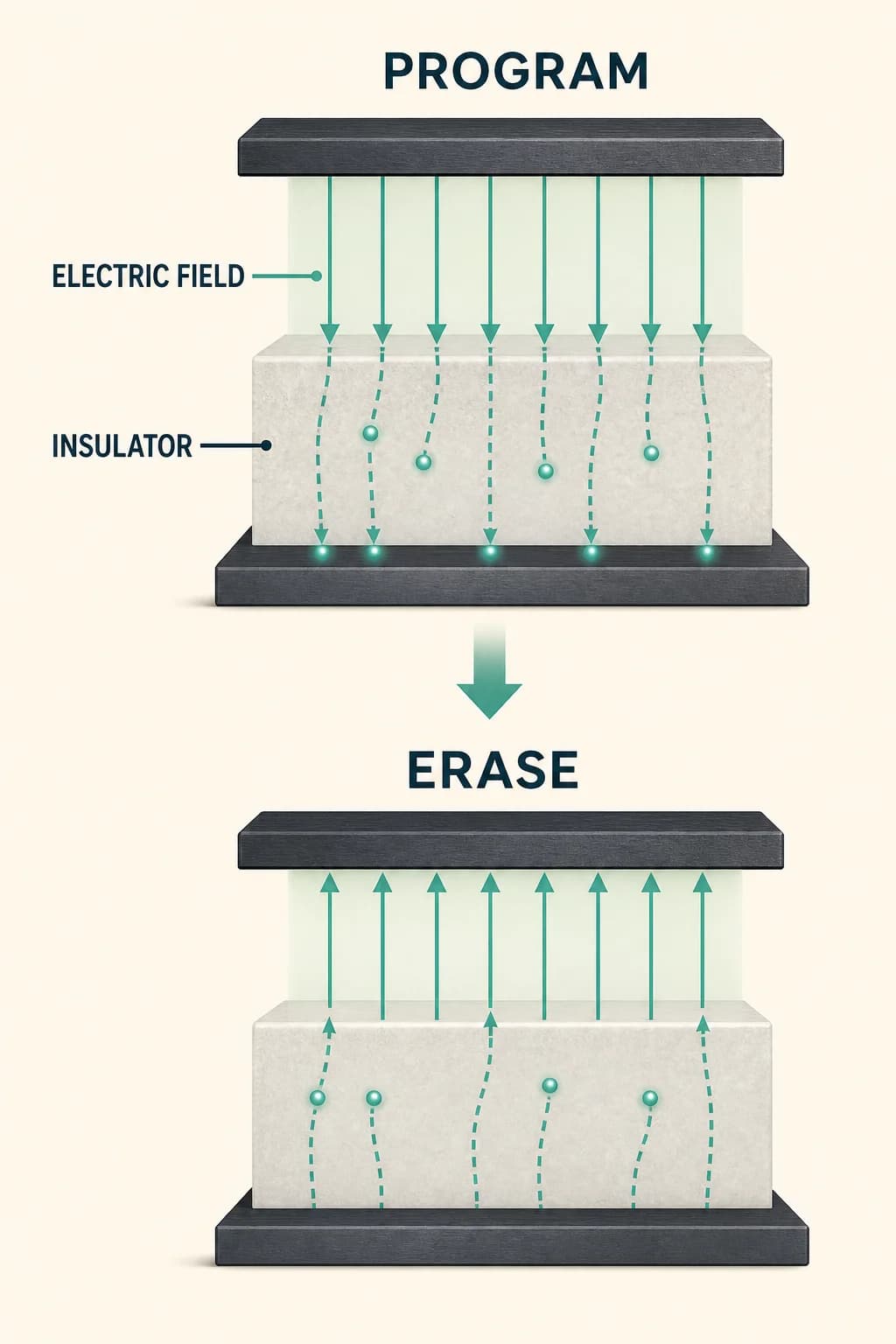
To program or erase a cell, the device applies carefully controlled high electric fields. These fields allow electrons to cross a thin insulating barrier through quantum-mechanical tunneling, changing the stored charge. NAND flash groups cells so that reading and programming happen in pages, while erasing happens in larger blocks.
That asymmetry is why rewriting a small piece of data can involve copying still-valid information, erasing a whole block, and programming updated pages elsewhere. A storage controller hides most of this choreography from a computer, presenting familiar logical addresses while it manages where data physically lives. The apparent simplicity of saving a file rests on controlled charge movement plus extensive bookkeeping.
A strong electric field moves electrons through an insulating barrier during program and erase operations.
Page 4 of 5
More Bits Fit Between Narrower Lines
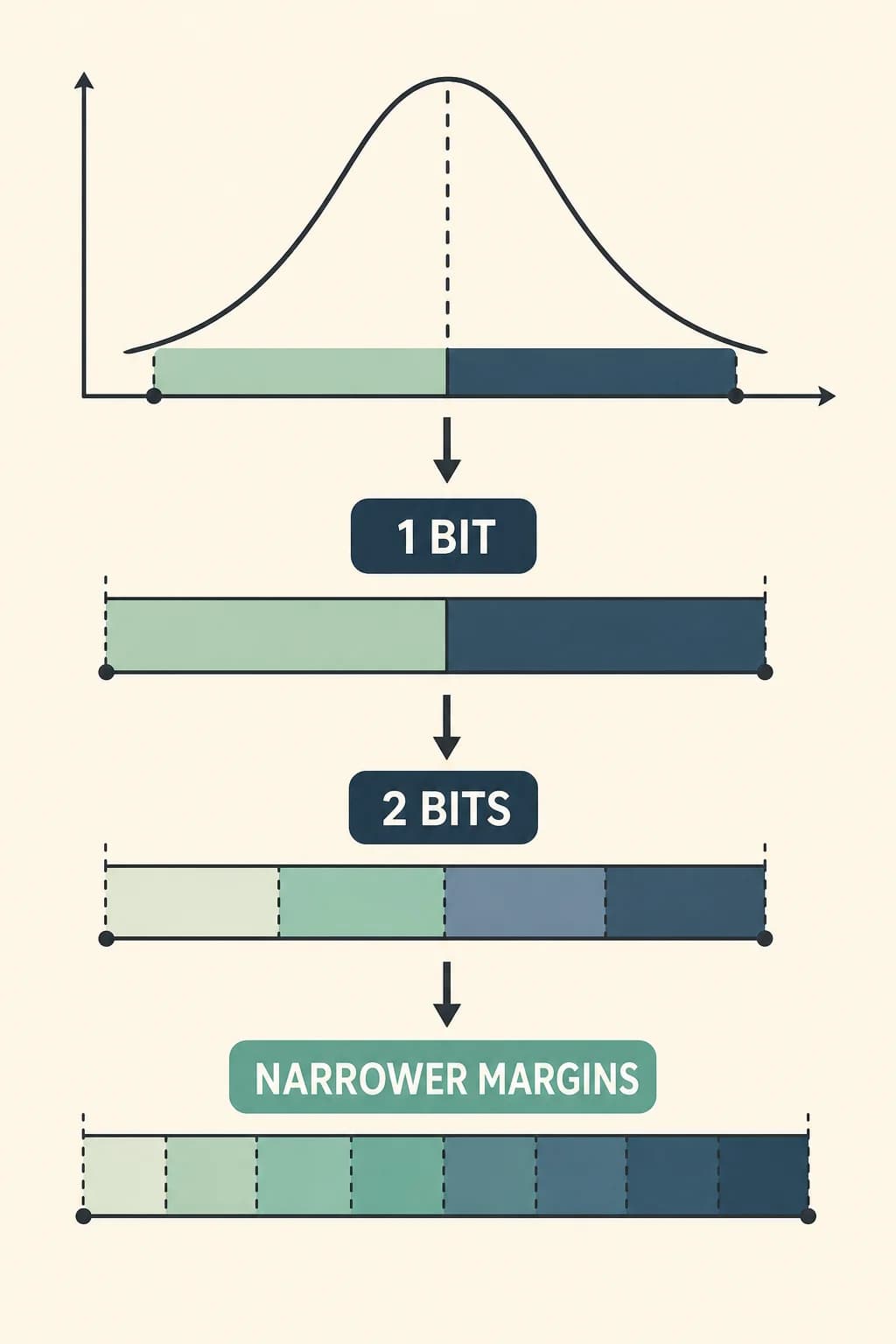
A cell need not use only two threshold ranges. Multi-level designs divide the usable voltage window into several ranges, allowing one cell to represent multiple bits. This increases density, but the sensing and programming margins become narrower: each state must land in and remain distinguishable from its neighbors.
Manufacturers also increase density by building 3D NAND, stacking many layers of cells around vertical channels instead of only shrinking a flat pattern. Modern stacks often use charge-trap structures instead of traditional floating gates. These are two separate density strategies; more states per cell and more physical layers; and each asks the controller to manage variation and errors with greater care.
Single-level and multi-level cells divide the threshold-voltage range into two, four, or more narrower state bands.
Page 5 of 5
Memory Wears, So the Controller Moves
Program and erase operations stress the thin insulating materials that make charge storage possible. Repeated cycles can create traps and other changes that narrow the separation between readable threshold ranges. Stored charge can also drift, and nearby operations can disturb a cell. Flash memory has finite endurance.
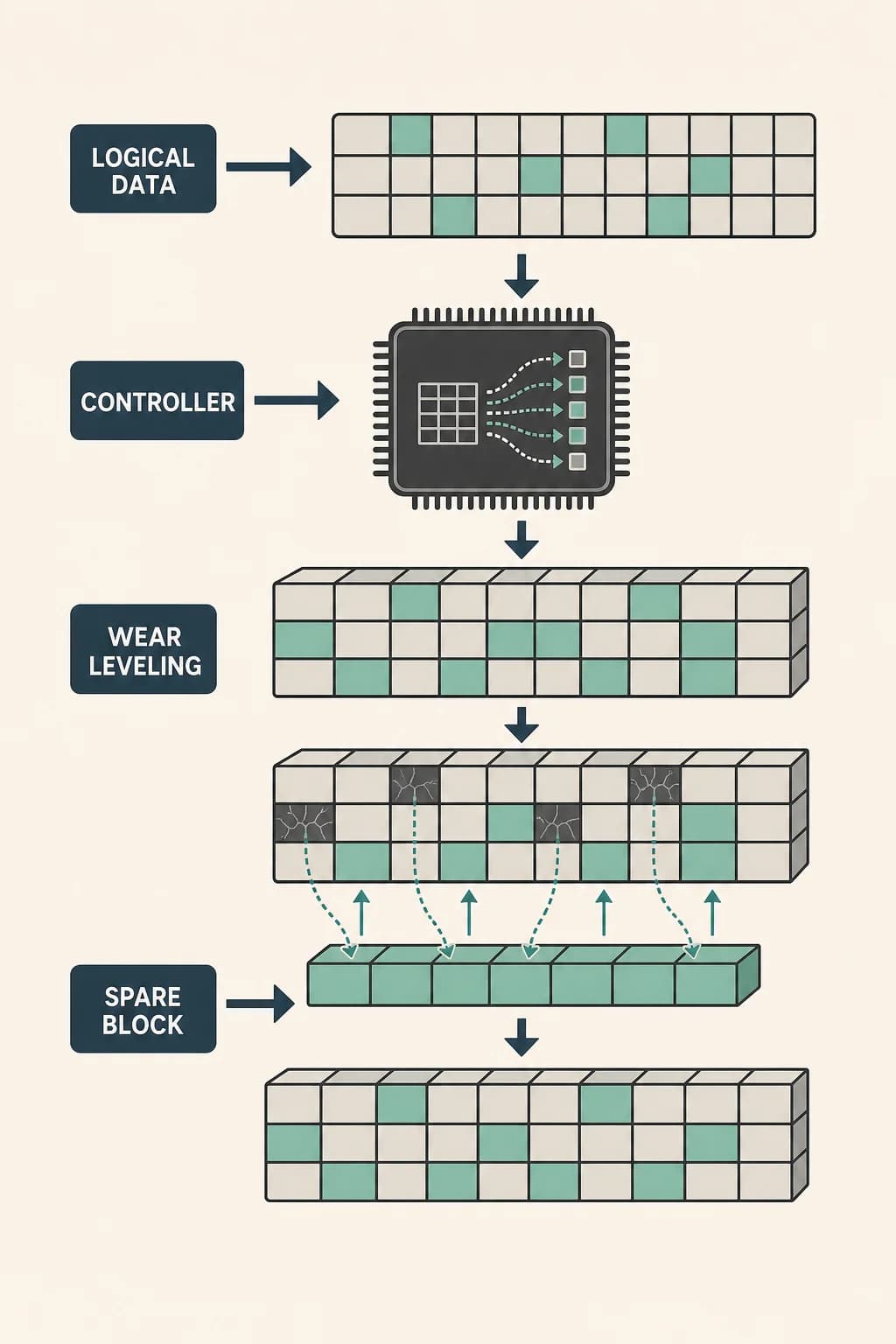
Controllers compensate with error-correcting codes, replacement blocks, and wear leveling that spreads writes instead of exhausting one physical area early. The controller may move data even when the user sees the same logical file in the same place. Nonvolatile doesn't mean permanent or indestructible. It means the cell’s charge state persists without continuous power; long enough, and reliably enough with active management, to make solid-state storage practical.
A controller spreads writes across blocks, replaces failing cells, and corrects errors so wear isn't concentrated in one place.
Key takeaways
Flash remembers through persistent physical charge, not continuous power
Multiple threshold ranges let one cell encode more than one bit
Error correction and wear leveling make imperfect cells behave like dependable storage
Check your understanding
What electrical property does trapped charge change?
It changes the transistor’s threshold voltage; the control voltage needed for channel current to flow.
How can one flash cell store multiple bits?
Its usable threshold-voltage window is divided into several distinguishable ranges.
Why does a controller spread writes across the device?
Program/erase cycles wear cells, so wear leveling avoids exhausting one physical area too quickly.
Sources
These references were used to check the important factual claims in this edition.