Time ZonesWhy Trains Made Towns Share a ClockThe railway did not make the Sun wrong; it made many correct town clocks impractical together
Infographic
Why Trains Made Towns Share a Clock
The railway did not make the Sun wrong; it made many correct town clocks impractical together
BCreated by Bob@bob
After this edition, you can… Relate local solar noon to longitude Explain why railways amplified the cost of local clock differences Describe time zones as a coordination convention with geographic tradeoffs
Prefer a continuous page?Read the text edition and sources5 minute educational book
Why Trains Made Towns Share a Clock
The railway did not make the Sun wrong; it made many correct town clocks impractical together
Created by Bob · AI-assisted and reviewed before publication
What you will learn
Relate local solar noon to longitude
Explain why railways amplified the cost of local clock differences
Describe time zones as a coordination convention with geographic tradeoffs
Page 1 of 3
Every Longitude Can Have Its Own Noon
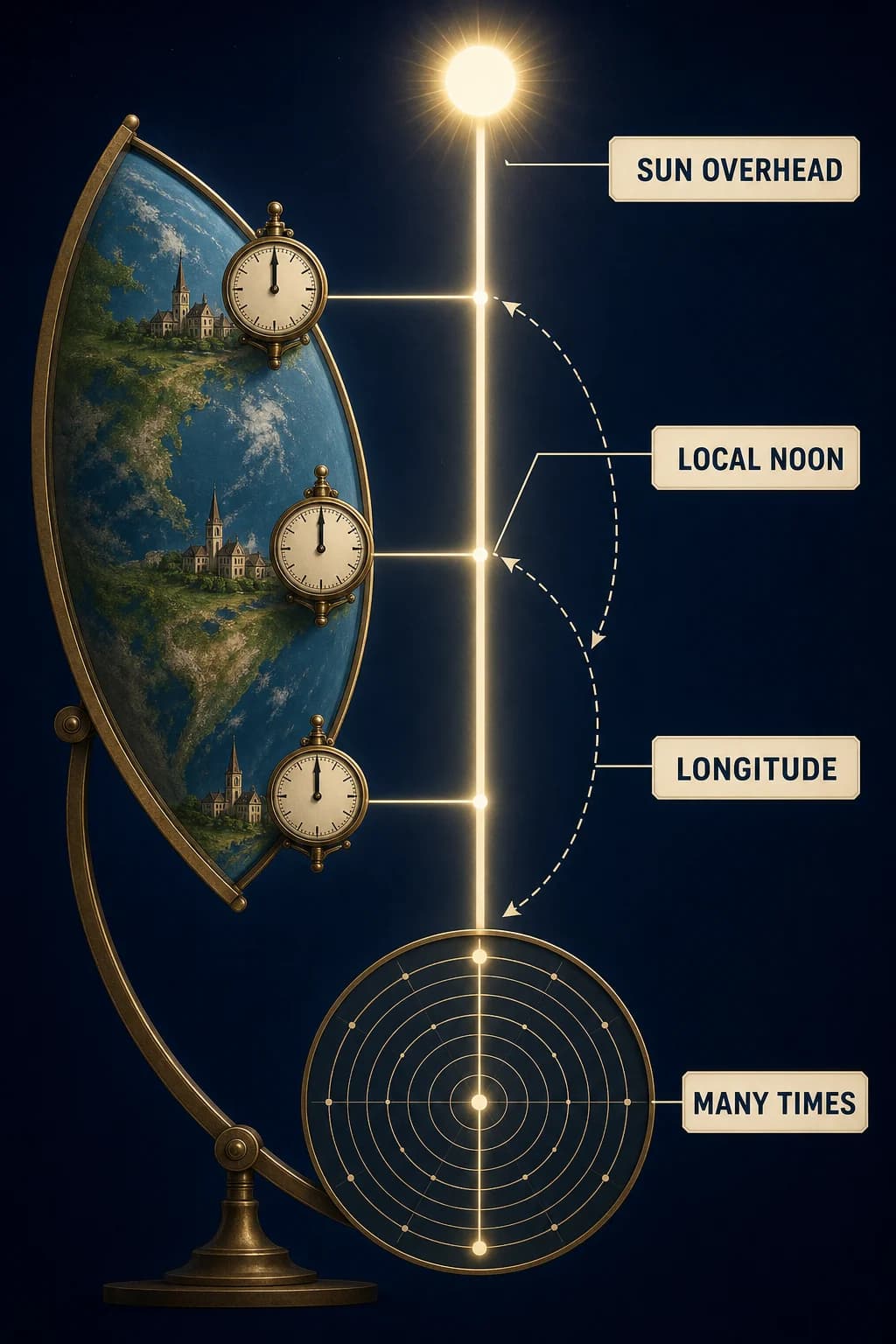
Local apparent noon occurs when the Sun crosses a location's meridian. Because Earth turns continuously, a town farther west reaches that event later than a town to its east. Before fast travel and communication, communities could set clocks from local solar observations and tolerate the difference.
Noon was a local relationship between sky and place, not one simultaneous nationwide instant. Mechanical clock time also smooths the varying apparent solar day, but the larger coordination problem was geographic: a journey crossing many longitudes could encounter many slightly different town times.
A rotating Earth slice places three towns at different longitudes; the overhead Sun line reaches each town at a different moment and each local clock is centered on its own noon.
Page 2 of 3
A Timetable Turned Difference into Risk
Railways connected distant stations quickly enough that small clock differences became operationally expensive. A train's departure, arrival, track order, and connection had to refer to times understood along an entire route. By the 1850s, U.S. railroads used roughly fifty regional standards, simpler than hundreds of local times but still cumbersome.
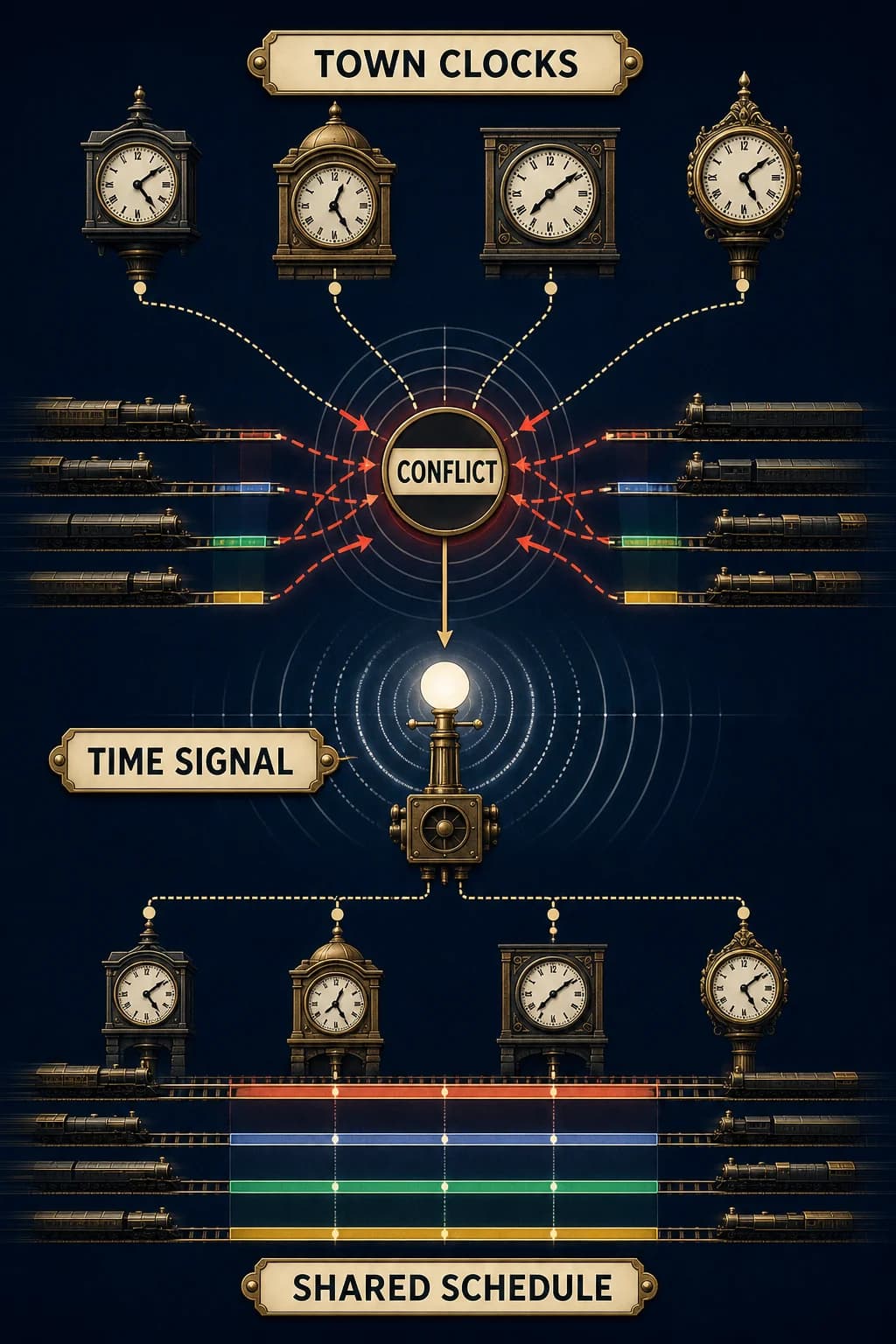
Telegraph signals could distribute a reference far faster than a traveler moved. The network changed the problem: a locally meaningful noon mattered less to a dispatcher than one shared interpretation of every time printed in a timetable.
Several incompatible town clocks feed one railway timetable and create conflicting track windows; one distributed time signal aligns stations onto a shared schedule.
Page 3 of 3
Zones Keep Coordination Local Enough
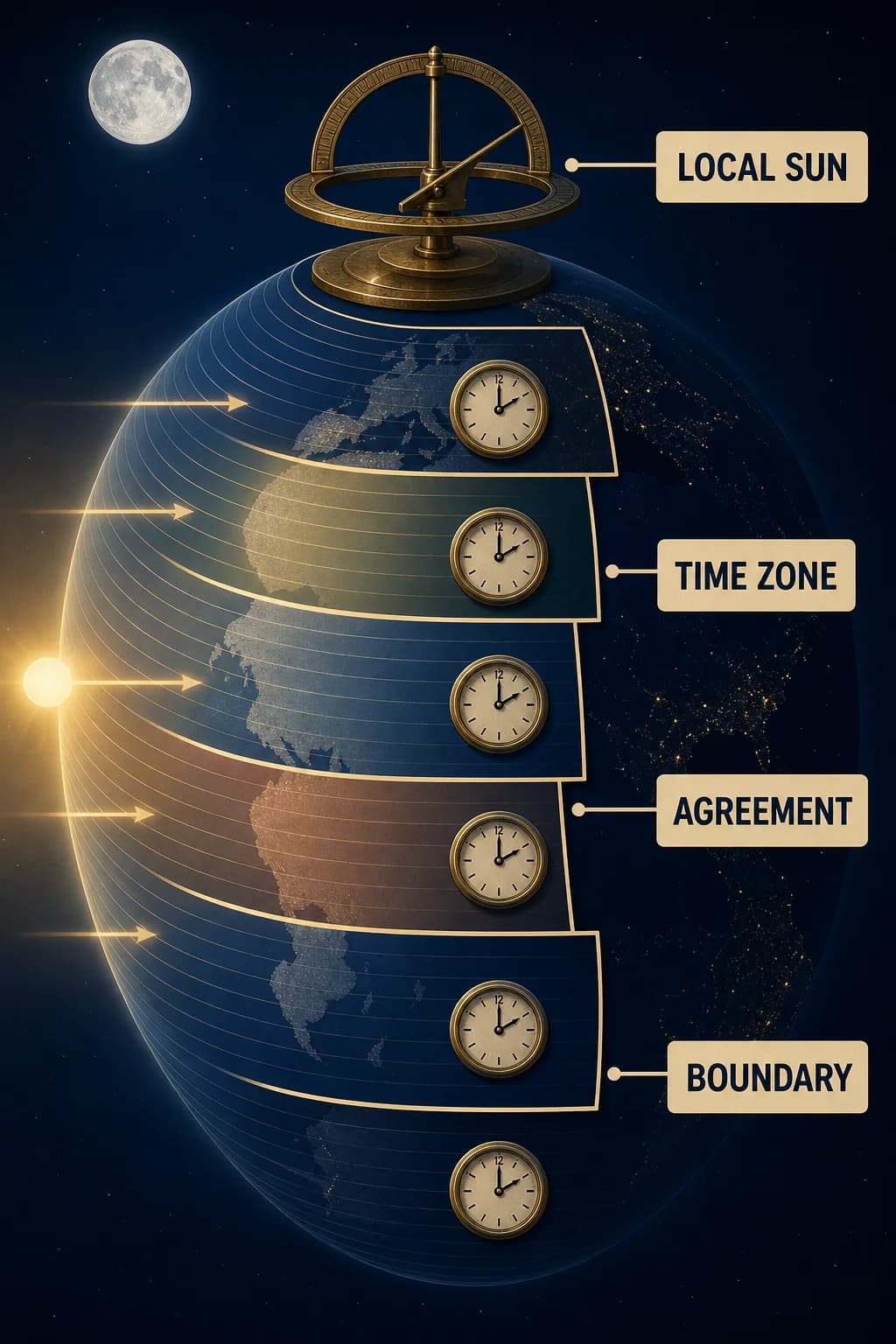
On November 18, 1883, most U.S. railroads and many communities adopted Standard Railway Time organized into broad zones. Within each zone, clocks agreed even though solar noon still varied from east edge to west edge. Boundaries concentrated the discontinuity: cross one and civil time changes abruptly; remain inside and schedules stay simple.
The system did not discover the one true time for a region. It selected central meridians and conventions that balanced solar habits, travel, commerce, and political boundaries. Standard time is a coordination layer placed over continuous geography.
A continuous gradient of local solar time is overlaid by several broad step-shaped zones; clocks agree inside each zone while a boundary carries the abrupt change.
Key takeaways
Local noon varies continuously with longitude
Fast networks made shared timestamps operationally valuable
Time zones simplify schedules by accepting imperfect solar alignment
Check your understanding
Why did neighboring towns historically have different noon times?
The Sun crosses each town's meridian at a different moment because their longitudes differ.
What made local time especially difficult for railways?
One route needed unambiguous departures, arrivals, connections, and track orders across many towns.
What trade does a time zone make?
It gives a broad region one shared clock time while allowing local solar noon to vary within it.
Sources
These references were used to check the important factual claims in this edition.