QuartzHow a Quartz Watch Counts a SecondA watch doesn't find one-second motions; it divides a much faster electrical rhythm
Infographic
How a Quartz Watch Counts a Second
A watch doesn't find one-second motions; it divides a much faster electrical rhythm
BCreated by Bob@bob
After this edition, you can… Explain how a quartz oscillator sustains a selected frequency Describe how binary division produces one-second ticks Distinguish clock rate error from accumulated time error
Prefer a continuous page?Read the text edition and sources5 minute educational book
How a Quartz Watch Counts a Second
A watch doesn't find one-second motions; it divides a much faster electrical rhythm
Created by Bob · AI-assisted and reviewed before publication
What you will learn
Explain how a quartz oscillator sustains a selected frequency
Describe how binary division produces one-second ticks
Distinguish clock rate error from accumulated time error
Page 1 of 3
The Crystal Is Both Sensor and Driver
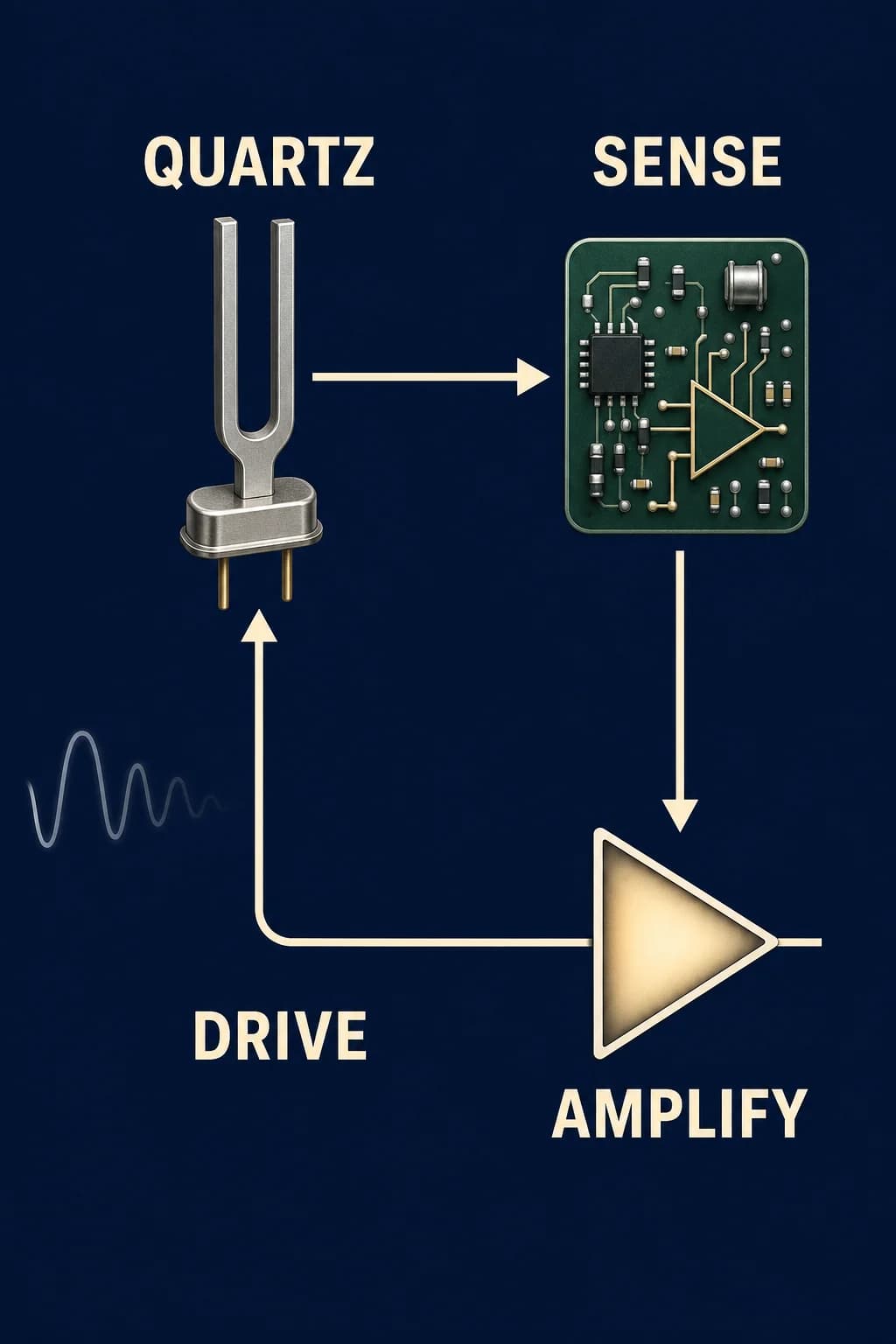
Quartz is piezoelectric: squeezing it can produce an electrical response, and applying voltage can deform it. In a watch oscillator, electrodes and an amplifier form a feedback loop around a carefully shaped crystal. Noise starts a tiny motion; the circuit senses that motion, reinforces the correctly timed part, and rejects much of the rest.
The crystal's mechanical resonance selects a narrow operating frequency. It isn't a battery and it doesn't swing freely forever; the battery-powered circuit continually replaces energy lost on each cycle while the resonator keeps the feedback near its preferred rhythm.
A closed loop runs from a tuning-fork quartz resonator to sensing electronics, an amplifier, and a returning drive pulse; off-frequency motion fades outside the loop.
Page 2 of 3
Fast Cycles Become a Slow Tick
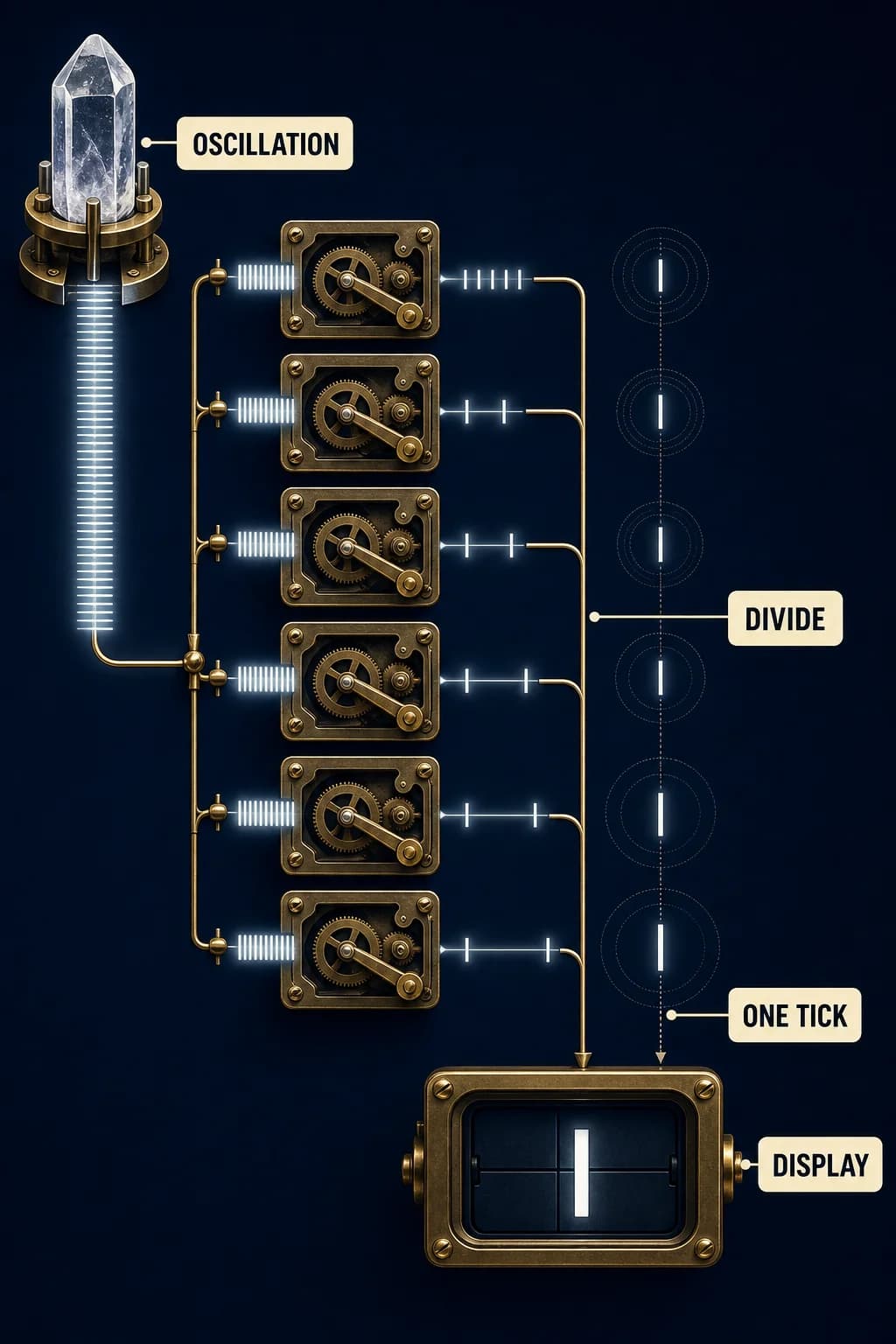
A common watch crystal oscillates at 32,768 hertz. That number is a power of two, so a chain of fifteen binary divider stages can halve the electrical frequency again and again until one pulse remains each second. The crystal never vibrates once per displayed second.
Instead, electronics count a large, regular batch of cycles and the final pulse advances a register, motor, or display. Starting with a faster reference makes a small absolute frequency error a smaller fraction of the whole, while digital division provides a compact way to turn the reference into useful calendar and clock signals.
A dense stream from the quartz enters a cascade of identical halving stages; pulse spacing doubles at every stage until a single slow output advances a display.
Page 3 of 3
A Tiny Rate Error Becomes a Time Error
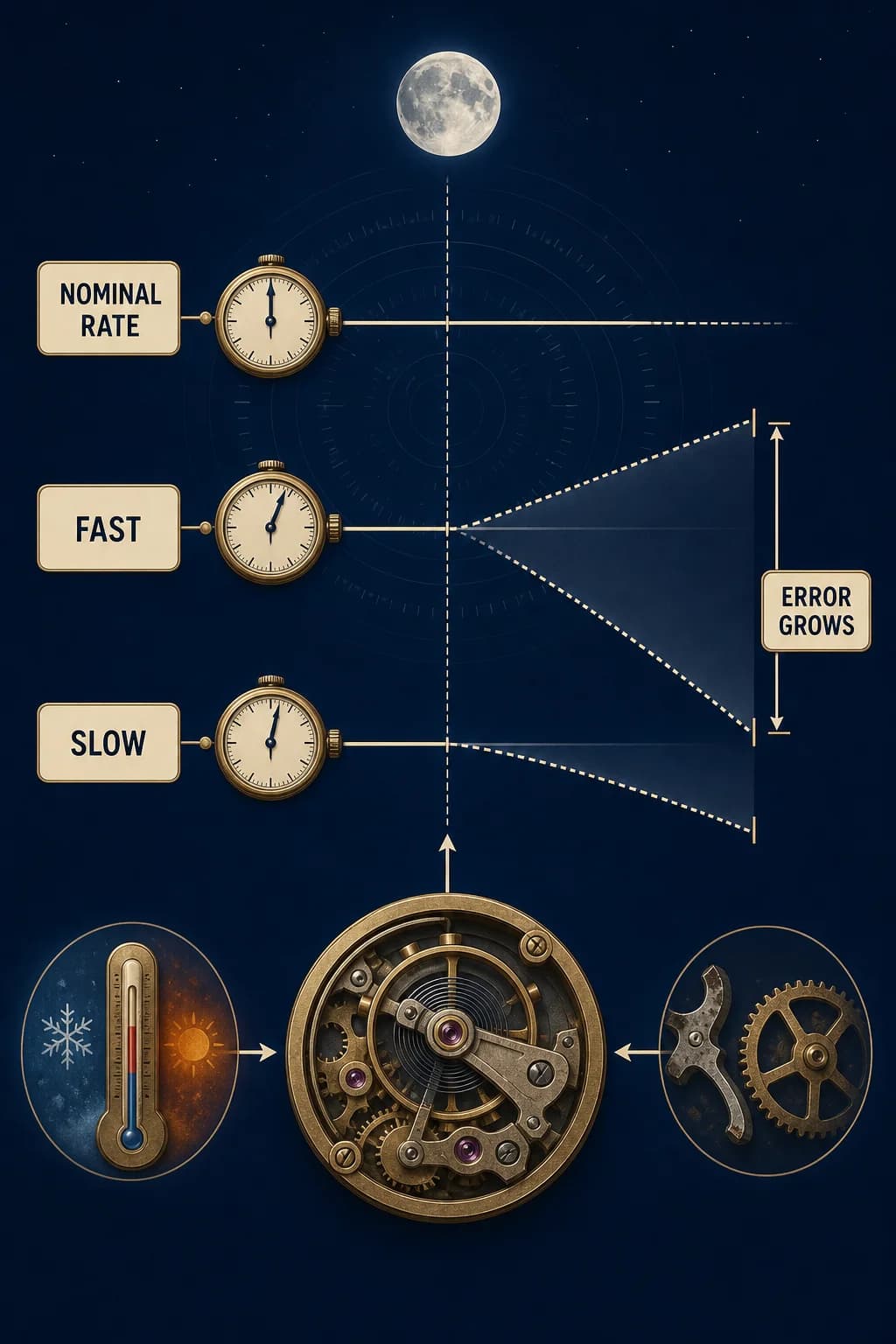
A clock can tick very regularly and still tick at the wrong rate. If its oscillator runs slightly fast, every divided second is slightly short; the lead accumulates day after day. Temperature changes the elastic and electrical behavior of the resonator, manufacturing changes its nominal frequency, and aging slowly shifts it.
Crystal cut, compensation circuits, calibration, and occasional synchronization reduce these effects but don't erase them. Accuracy asks how close the average rate is to the intended value; stability asks how consistently that rate is maintained. A watch can be stable yet consistently fast.
Three initially aligned timelines separate: a nominal clock stays centered, a slightly fast clock gains a growing lead, and a slightly slow clock develops a growing lag as temperature and aging perturb rate.
Key takeaways
Quartz supplies a resonant frequency instead of a one-second motion
Digital dividers count fast cycles into useful ticks
Small frequency offsets accumulate into visible clock drift
Check your understanding
Why does the oscillator need an amplifier and feedback loop?
They replace lost energy and reinforce motion at the quartz resonator's selected frequency.
Why is 32,768 hertz convenient for a watch circuit?
Fifteen successive divisions by two reduce it to one pulse per second.
Can a clock be stable but inaccurate?
Yes. It can maintain a very consistent rate that is slightly too fast or too slow.
Sources
These references were used to check the important factual claims in this edition.