CalendarsWhy Calendars Need Leap YearsLeap rules are a long-term averaging system for a year that refuses to contain whole days
Infographic
Why Calendars Need Leap Years
Leap rules are a long-term averaging system for a year that refuses to contain whole days
BCreated by Bob@bob
After this edition, you can… Explain why a seasonal year can't be represented by identical whole-day years Compare Julian and Gregorian leap averages Describe a calendar as a rule-based social approximation
Prefer a continuous page?Read the text edition and sources5 minute educational book
Why Calendars Need Leap Years
Leap rules are a long-term averaging system for a year that refuses to contain whole days
Created by Bob · AI-assisted and reviewed before publication
What you will learn
Explain why a seasonal year can't be represented by identical whole-day years
Compare Julian and Gregorian leap averages
Describe a calendar as a rule-based social approximation
Page 1 of 3
The Year Leaves a Fractional Day
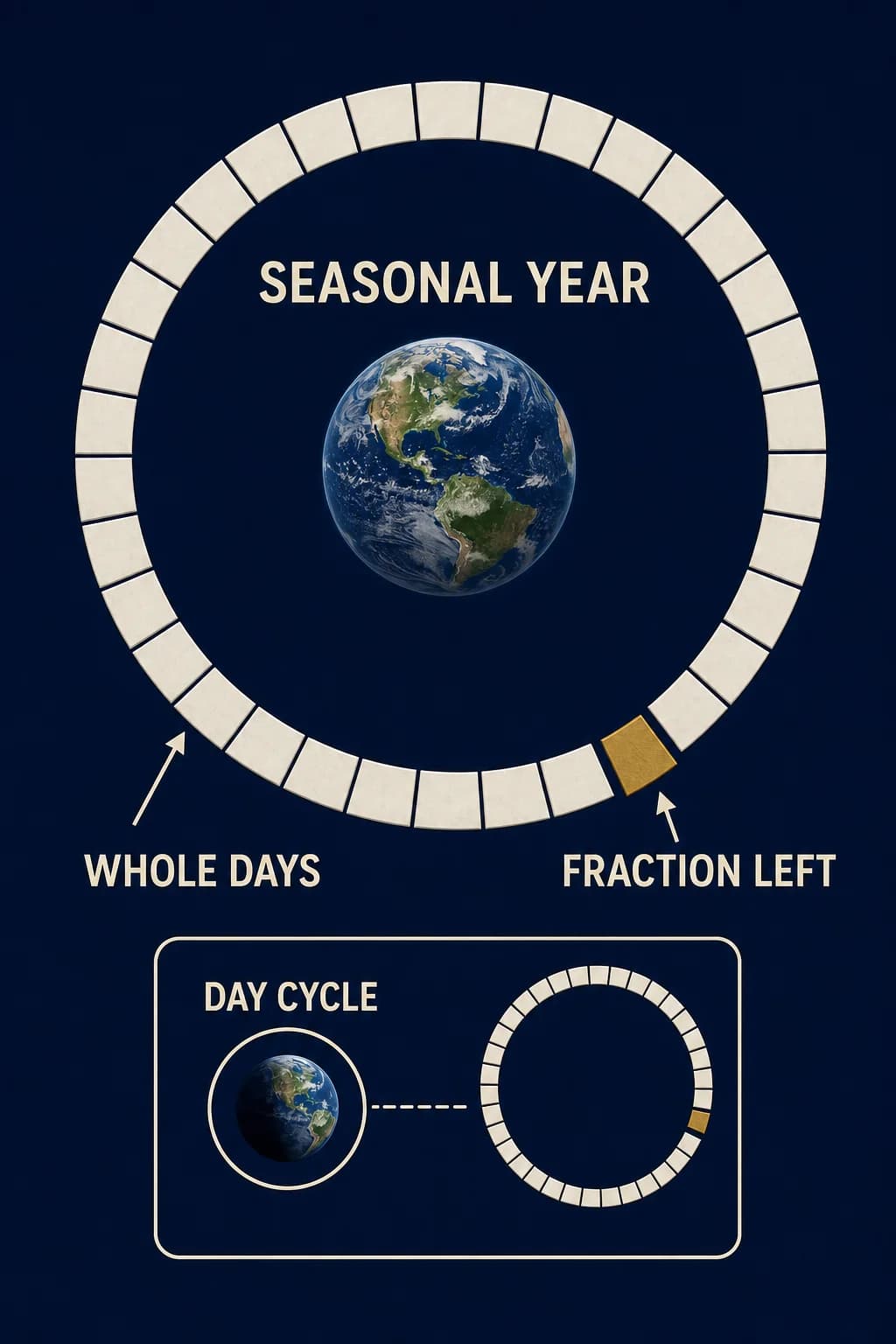
A day follows Earth's rotation relative to the Sun; the tropical year tracks the cycle of seasons. Those motions are related but not geared to make a whole-number ratio. A tropical year is about 365.2422 days. A calendar, however, must assign dates using whole civil days.
If every year contained 365 days, the date of a seasonal marker would drift by nearly a quarter day each year; about twenty-four days per century. The mismatch isn't caused by a bad clock. It appears because the calendar is mapping one natural cycle onto units defined by another.
One seasonal orbit is tiled with whole day blocks; after the last full block, a visible fractional gap remains before the orbit closes.
Page 2 of 3
Leap Rules Tune the Average
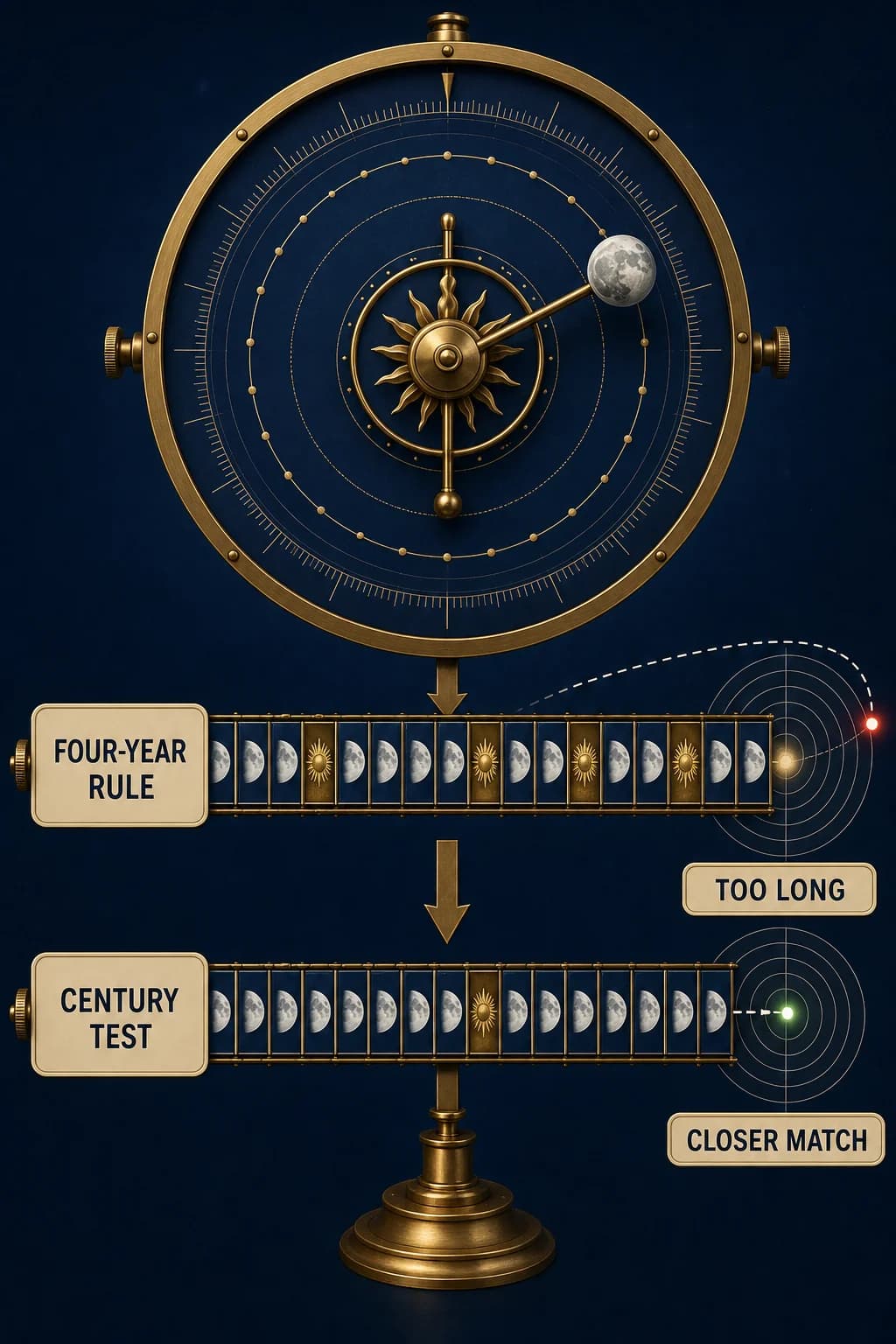
The Julian rule adds a leap day every fourth year, making its average year 365.25 days. That's close but slightly long, so seasonal dates drift earlier through the calendar over centuries. The Gregorian rule keeps ordinary fourth-year leap days but omits them in century years unless the year is divisible by 400.
It inserts 97 leap days in 400 years and averages 365.2425 days. The century exception isn't arbitrary decoration: it removes three of the extra days that the simpler rule would add over four centuries.
Compare two four-century day-tile tracks: the simple every-fourth-year rule adds too many correction tiles, while the century exception removes three and lands much closer to the seasonal target.
Page 3 of 3
A Calendar Is a Durable Prediction
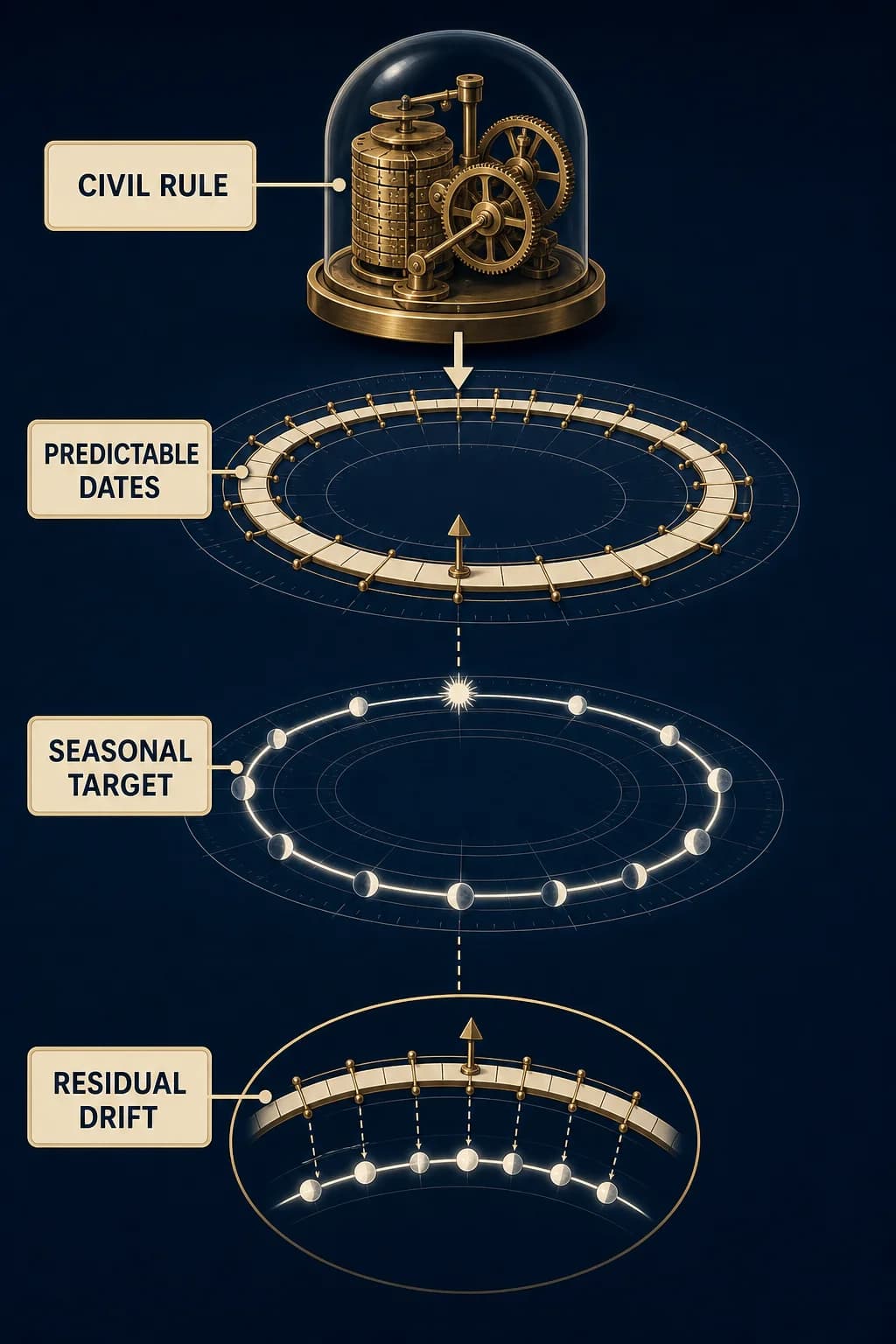
The Gregorian average still doesn't equal the tropical year exactly, and the tropical year itself changes slowly. Yet a useful civil calendar needs rules that can be computed far ahead, shared across institutions, and applied without observing the sky each morning. It trades perfect astronomical alignment for predictability and a very small residual drift.
Other calendars choose different target cycles, month structures, eras, or correction systems. No label such as day, month, or year forces a unique design. A calendar is infrastructure: a public algorithm that keeps social dates approximately aligned with selected natural cycles.
A rule engine converts repeating common and leap years into a predictable civil date track that closely follows; but never perfectly overlays; a slowly changing seasonal track.
Key takeaways
The seasonal year contains a fractional number of days
Leap systems adjust the long-run average instead of fixing one year
Calendar design balances astronomical alignment with durable shared rules
Check your understanding
Why would a 365-day-only calendar drift against the seasons?
The tropical year is about 365.2422 days, leaving nearly a quarter day uncounted each year.
What does the Gregorian century rule change?
Century years aren't leap years unless divisible by 400, removing three leap days every four centuries.
Why use a fixed rule instead of observing the season each year?
A fixed rule makes future dates predictable and shareable across society.
Sources
These references were used to check the important factual claims in this edition.