Atomic ClocksHow an Atom Keeps TimeAtoms don't count the seconds; they correct an oscillator that is trying to match them
Infographic
How an Atom Keeps Time
Atoms don't count the seconds; they correct an oscillator that is trying to match them
BCreated by Bob@bob
After this edition, you can… Identify atomic resonance as a frequency reference Explain how feedback locks a local oscillator Distinguish the definition of the second from clocks and distributed time scales
Prefer a continuous page?Read the text edition and sources5 minute educational book
How an Atom Keeps Time
Atoms don't count the seconds; they correct an oscillator that is trying to match them
Created by Bob · AI-assisted and reviewed before publication
What you will learn
Identify atomic resonance as a frequency reference
Explain how feedback locks a local oscillator
Distinguish the definition of the second from clocks and distributed time scales
Page 1 of 3
The Atom Supplies a Resonance, Not a Display
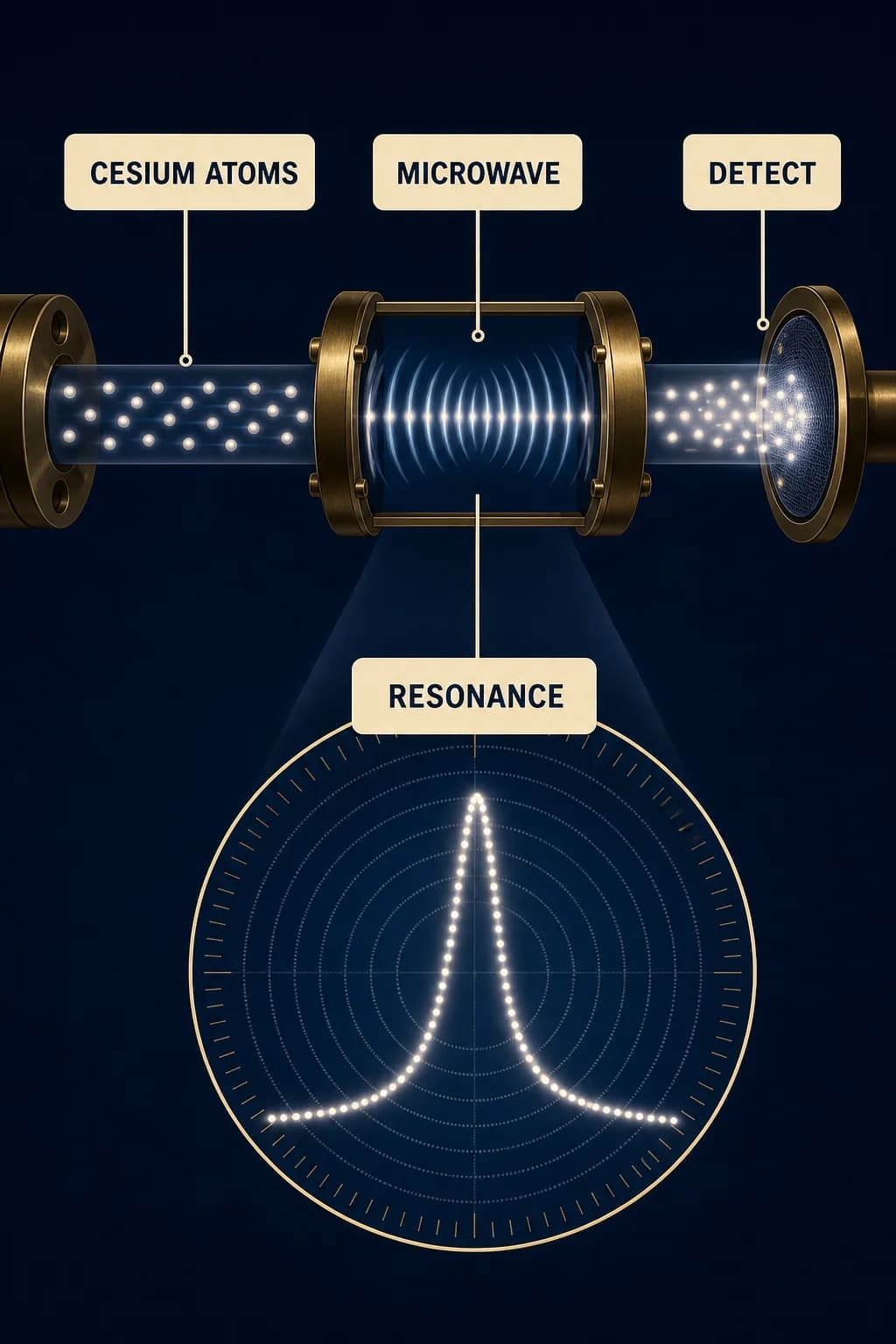
Atoms of the same isotope share the same allowed internal energy structure. For cesium-133, microwave radiation near a particular hyperfine transition can change the state of the atoms. An atomic clock prepares atoms, exposes them to a tunable electromagnetic field, and detects how many changed state.
The atoms aren't tiny pendulums whose motion is watched directly, and the clock isn't timing radioactive decay. They act as a reproducible frequency discriminator: the response becomes strongest in a narrow region around resonance, revealing whether the applied field is correctly tuned.
Prepared cesium atoms enter a microwave interaction region; only the correctly tuned wave transfers many atoms into a detected state, producing a narrow resonance response.
Page 2 of 3
Feedback Keeps the Oscillator on Resonance
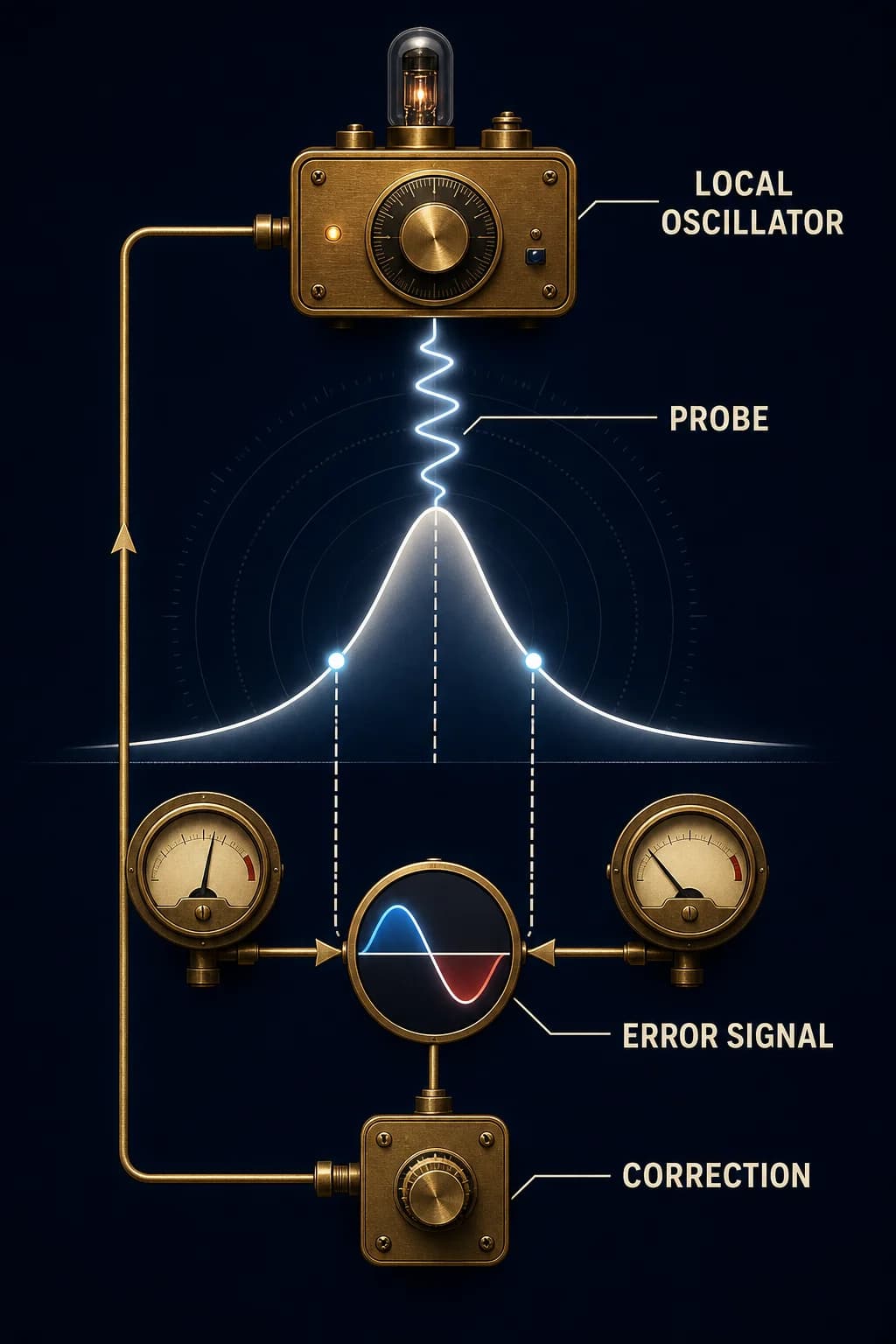
The usable output begins with a local electronic oscillator. Its frequency is alternately probed just below and just above the estimated atomic resonance. If the detected atomic responses differ, a control circuit knows which way the oscillator has drifted and applies a correction. Repeating this comparison locks the local oscillator to the atomic reference.
The oscillator still produces the continuous signal that electronics count; the atoms provide the error signal that disciplines it. Isolation, magnetic fields, collisions, temperature, and measurement noise can shift or broaden the response, so a precision clock must control and evaluate those effects.
A local oscillator probes opposite sides of one atomic response peak; unequal detector outputs feed an error signal back to retune the oscillator toward the center.
Page 3 of 3
A Definition Still Needs Real Clocks
The SI second is defined using exactly 9,192,631,770 periods associated with the unperturbed cesium-133 ground-state hyperfine transition. That definition is an ideal specification, not one physical master clock. Laboratories build primary standards that realize it, compare many clocks, estimate systematic offsets, and combine measurements into time scales.
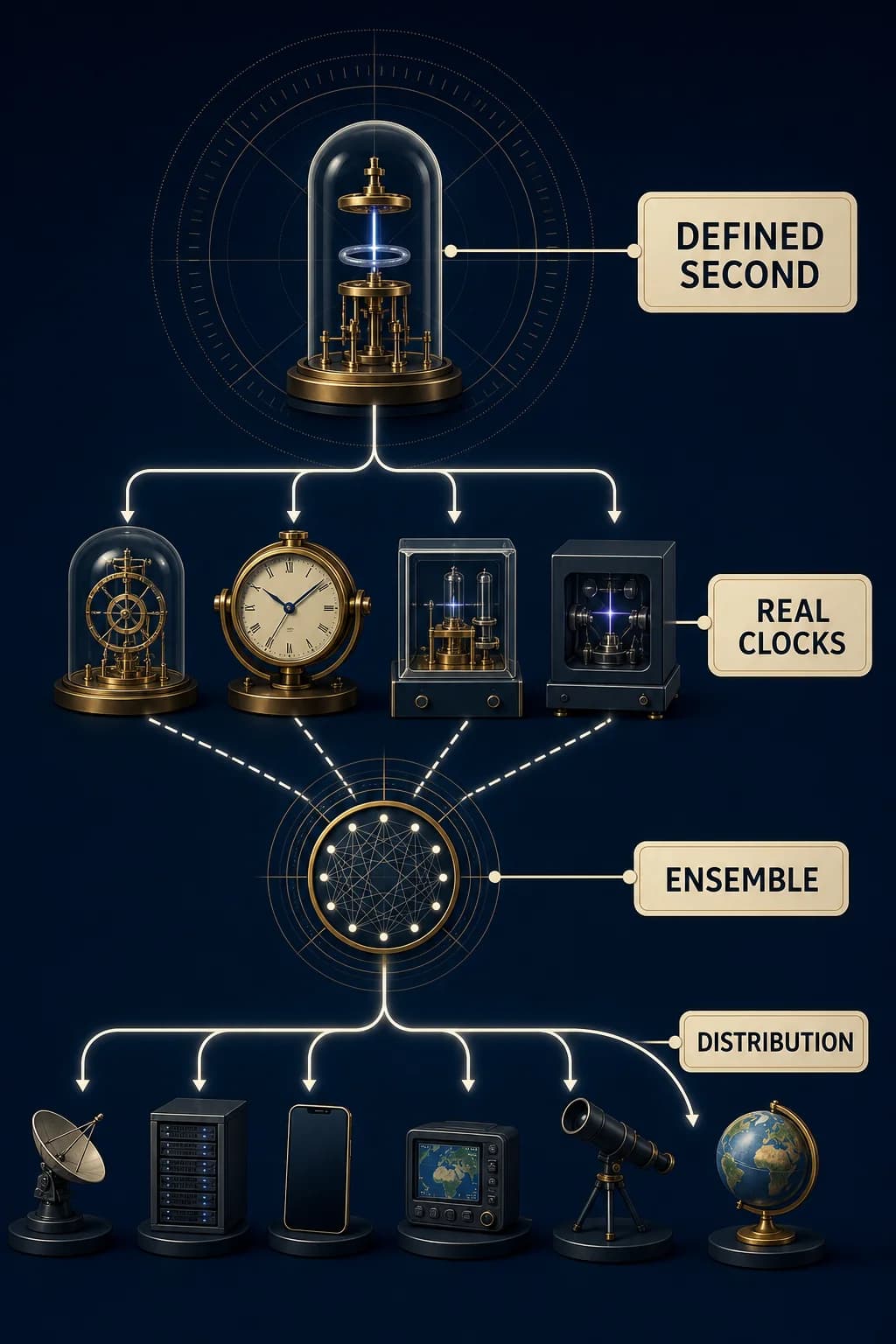
Signals then carry coordinated time through radio, fiber, satellite, and networks. An individual clock may stop or disagree; an ensemble can be more continuous and robust. Atomic time is a chain from definition, through experiments and comparison, to distribution; not a single perfect box.
An ideal atomic definition feeds several independently evaluated laboratory clocks; their comparisons form one ensemble time scale that is distributed to many systems.
Key takeaways
An atomic clock probes a state transition instead of radioactive decay
Atoms correct the oscillator that supplies countable ticks
Coordinated time comes from evaluated and compared clocks
Check your understanding
What do cesium atoms contribute to an atomic clock?
A reproducible resonance that reveals whether the applied microwave frequency is correctly tuned.
What produces the continuous countable output?
A local oscillator that a feedback loop disciplines to the atomic resonance.
Why is the defined second not the same thing as one master clock?
The definition is an ideal specification that laboratories realize, compare, and distribute using physical clocks.
Sources
These references were used to check the important factual claims in this edition.