SystemsWhy Traffic Jams Can Move BackwardCars go forward while a boundary of braking travels the other way
Infographic
Why Traffic Jams Can Move Backward
Cars go forward while a boundary of braking travels the other way
BCreated by Bob@bob
After this edition, you can… Explain how a demand-capacity mismatch creates a growing traffic queue Distinguish vehicle motion from the motion of a braking shockwave Read the opposite directions of car trajectories and a queue boundary on a space-time diagram
Prefer a continuous page?Read the text edition and sources5 minute educational book
Why Traffic Jams Can Move Backward
Cars go forward while a boundary of braking travels the other way
Created by Bob · AI-assisted and reviewed before publication
What you will learn
Explain how a demand-capacity mismatch creates a growing traffic queue
Distinguish vehicle motion from the motion of a braking shockwave
Read the opposite directions of car trajectories and a queue boundary on a space-time diagram
Page 1 of 3
A Queue Begins at a Mismatch
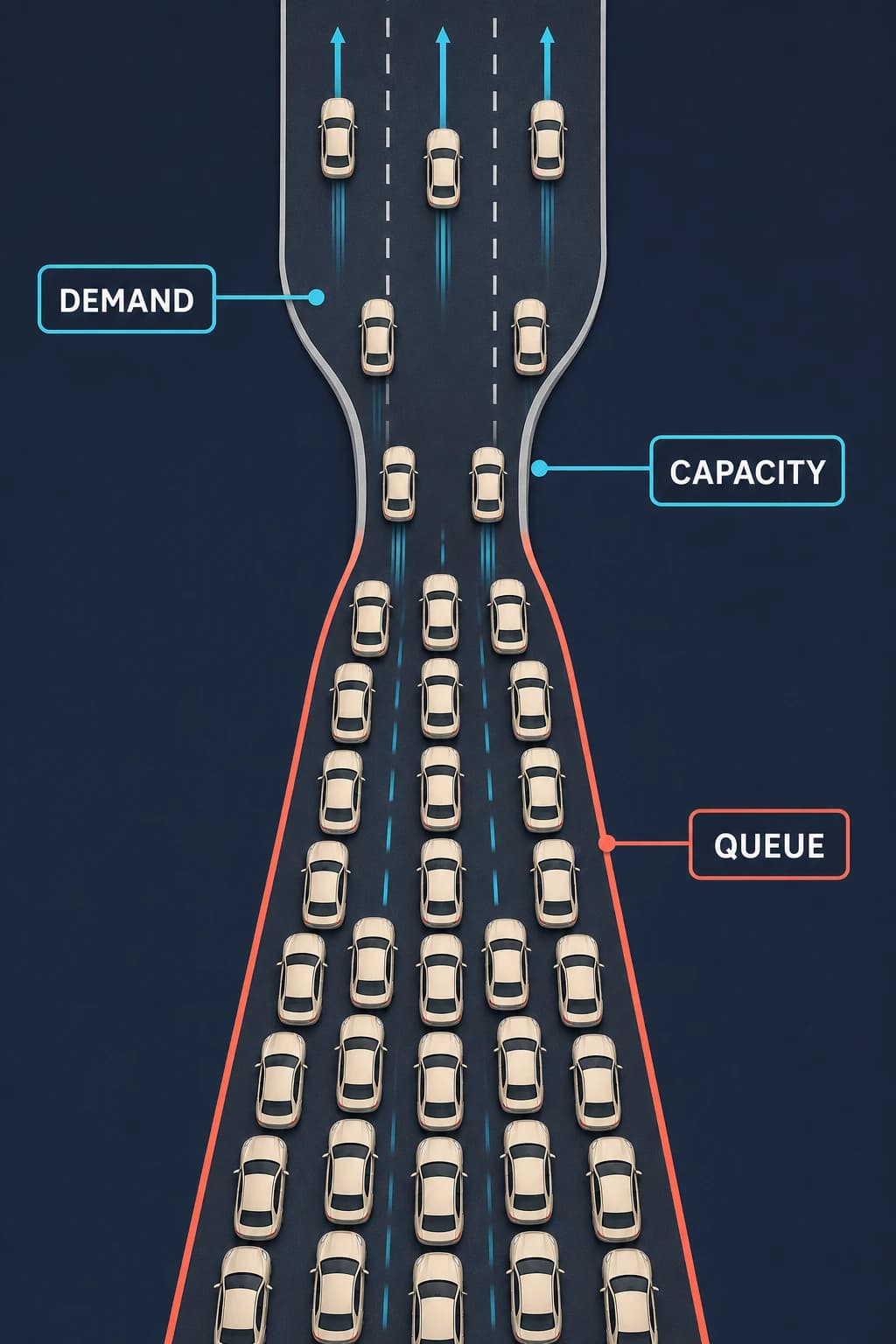
Road capacity is the greatest flow a section can sustain under its conditions: how many vehicles can pass a point during a period. Demand is the flow trying to use it. When demand exceeds available capacity; perhaps at a lane drop, busy merge, incident, or simply an overloaded section; vehicles arrive faster than they can leave.
Density rises, speeds fall, and a queue grows upstream from the bottleneck. This isn't the same as saying a road is physically full everywhere. The mismatch is local and dynamic. A restriction can also lower capacity while demand stays unchanged. Either way, the back of the queue marks a moving transition between faster, more widely spaced traffic and denser, slower traffic.
A three-lane stream of cars approaches a two-lane bottleneck; more cars arrive than pass, so a dense queue grows upstream below the narrowing.
Page 2 of 3
Braking Becomes an Accordion
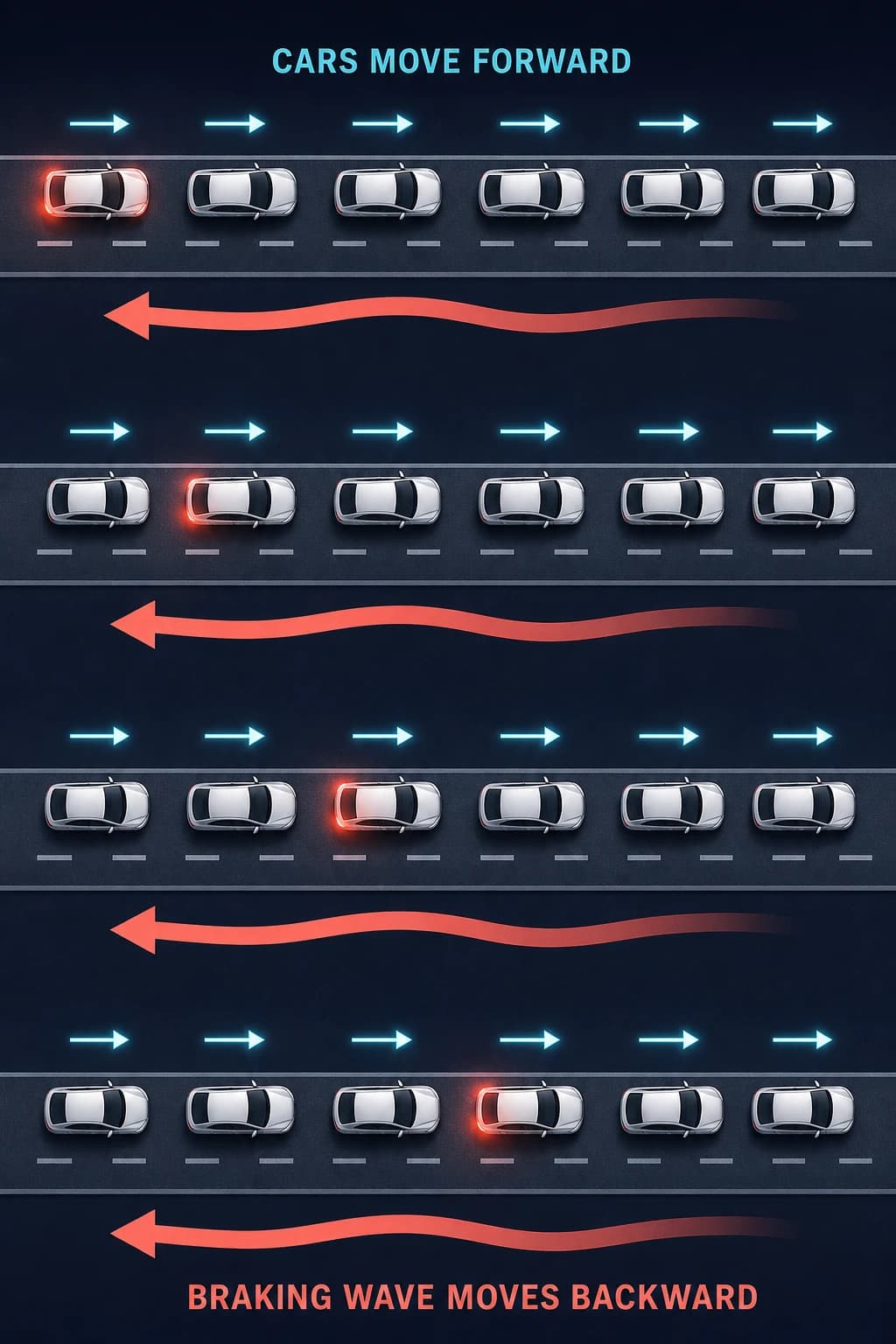
In dense traffic, one speed reduction can trigger a sequence. The next driver sees the gap shrink and brakes; the driver behind reacts later and may brake more sharply. That change can pass from vehicle to vehicle even though no car reverses. The moving transition is called a shockwave because speed, density, and flow change abruptly across its boundary.
FHWA describes a growing queue as a backward-forming shockwave, often visible as cascading brake lights. The word wave names the traveling pattern, not a material object moving through the road. Like a stadium wave moving around seated spectators, the state of each participant changes in sequence while each participant follows a different motion of its own.
Across four moments, every car’s arrow points forward while red brake lights appear successively farther upstream, creating a wave arrow that travels backward through the line.
Page 3 of 3
Separate the Cars from the Pattern
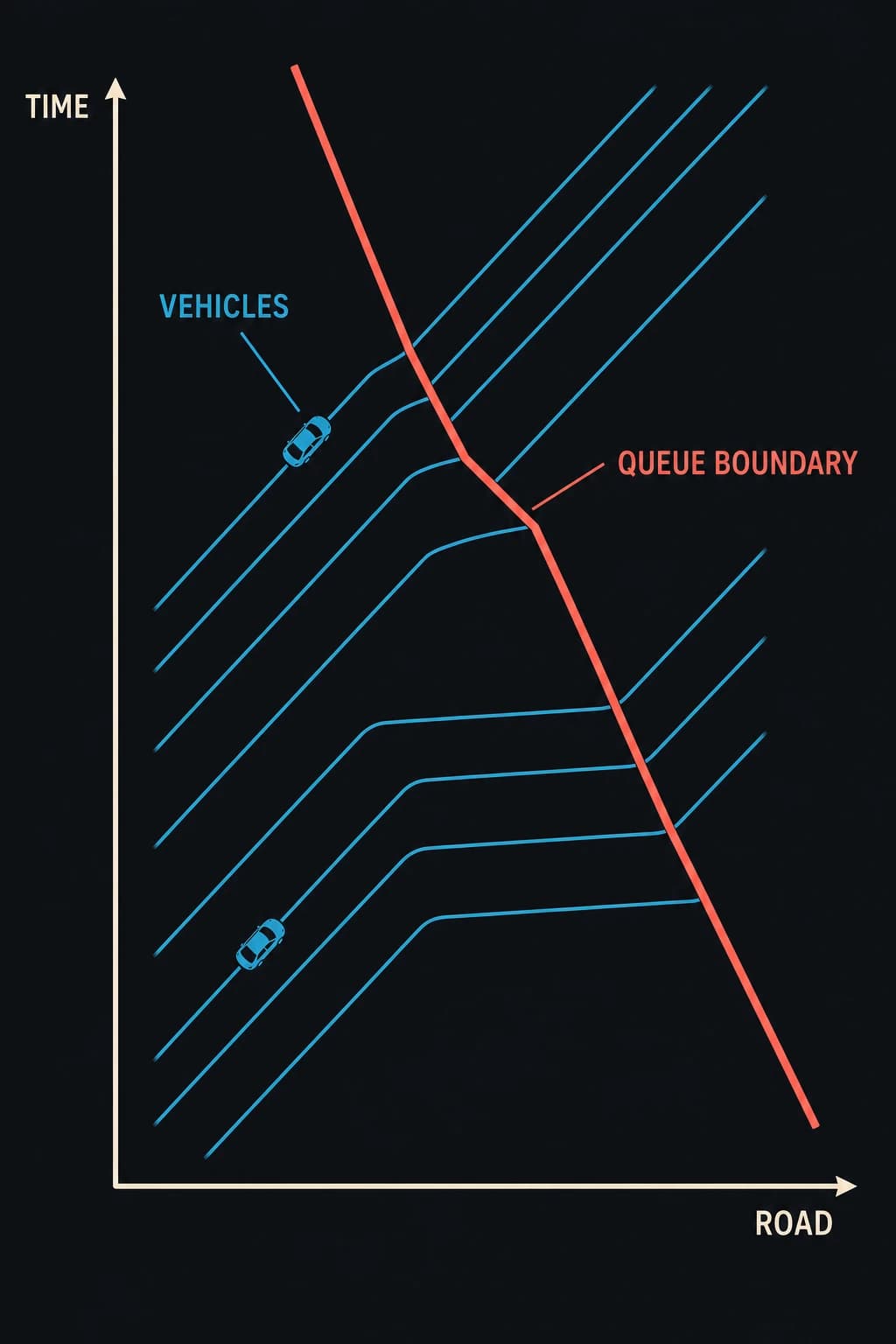
A space-time diagram makes the paradox precise. Put road position on one axis and time on the other. Each vehicle draws a forward-slanting trajectory as it travels down the road. When it reaches the queue boundary, its trajectory becomes less steep in position because the vehicle slows. Connect those transition points across many vehicles and the boundary can slope backward along the road.
The cars and the shockwave have different trajectories. Recovery adds another layer: a queue can begin dissolving from different ends depending on whether demand falls or lost capacity returns, so not every traffic boundary moves the same way. The durable insight is to track states separately from objects. A pattern can travel through a population in a direction no member travels.
On a road-versus-time graph, eight vehicle trajectories move toward increasing road position, but the line joining their slowdown points slopes toward decreasing position as time advances.
Key takeaways
A queue grows when vehicles reach a section faster than that section can pass them
A backward-forming shockwave is a moving change in traffic state, not a reversing car
Patterns can travel through a population in a direction none of its members travels
Check your understanding
What mismatch causes a queue to grow?
Demand exceeds the available capacity of a road section.
Do cars reverse when a braking wave travels backward?
No. Cars still move forward while the transition to slower, denser traffic propagates upstream.
What does the queue boundary connect on a space-time diagram?
The positions and times where successive vehicles enter a different traffic state, such as slowing into the queue.
Sources
These references were used to check the important factual claims in this edition.