Game TheoryHow Changing the Rules Changes the OutcomeChange what can be observed, promised, repeated, or enforced; and rational choices can change too
Infographic
How Changing the Rules Changes the Outcome
Change what can be observed, promised, repeated, or enforced; and rational choices can change too
BCreated by Bob@bob
After this edition, you can… Identify actions, information, timing, and payoffs as parts of a game Explain how repetition can support cooperation through future consequences Evaluate institutions as incentive changes with enforcement costs
Prefer a continuous page?Read the text edition and sources5 minute educational book
How Changing the Rules Changes the Outcome
Change what can be observed, promised, repeated, or enforced; and rational choices can change too
Created by Bob · AI-assisted and reviewed before publication
What you will learn
Identify actions, information, timing, and payoffs as parts of a game
Explain how repetition can support cooperation through future consequences
Evaluate institutions as incentive changes with enforcement costs
Page 1 of 3
A Game Includes Its Rules
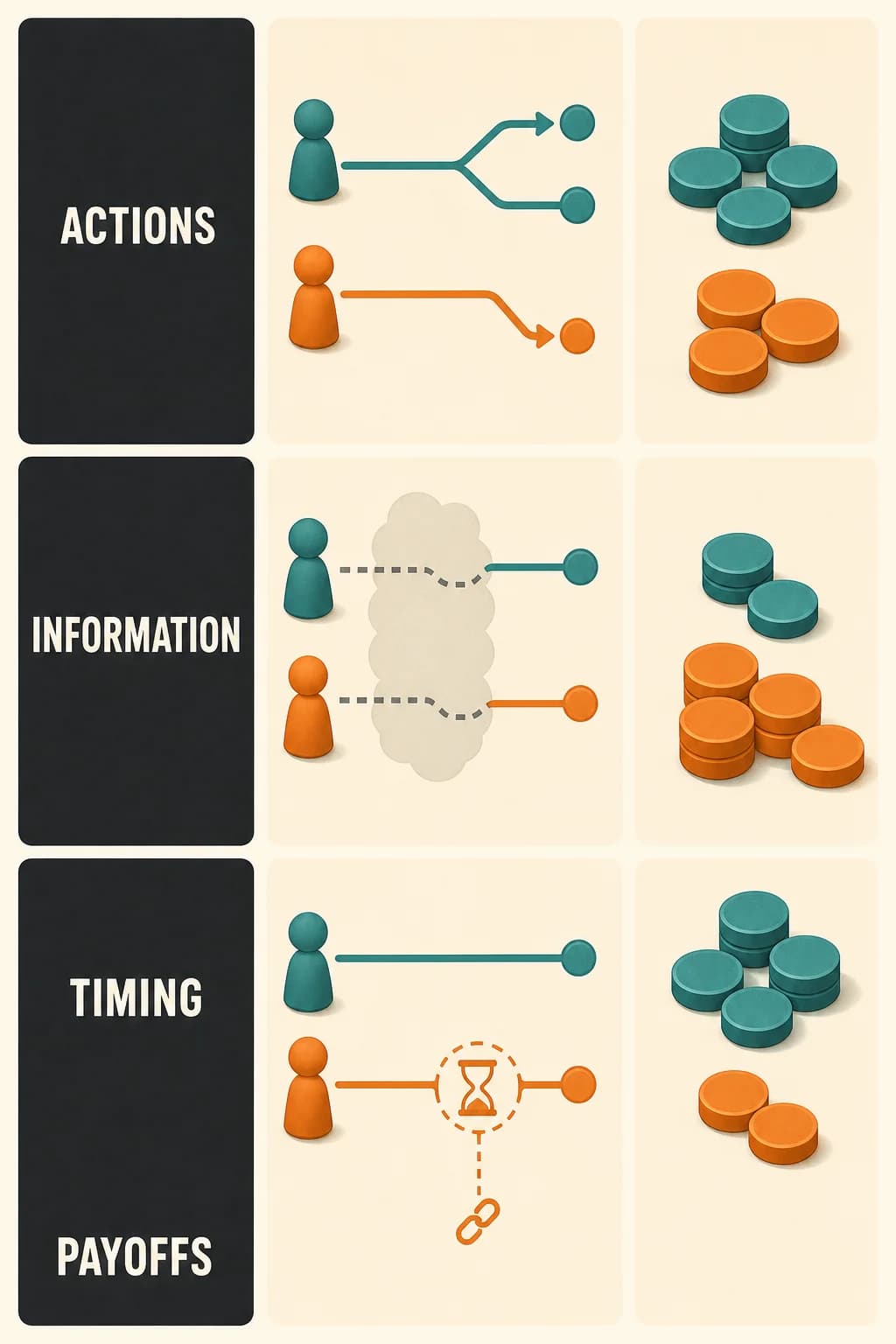
Game theory doesn't call an activity a game because it is playful. A game specifies participants, possible actions, information, timing, and how each outcome affects each participant. Change any of those and the strategic problem can change even when the people and physical resources stay the same.
A private action can become observable; a voluntary promise can become a binding contract; simultaneous choices can become sequential. Each rule changes which responses are possible and which expectations are credible. An outcome that looked individually rational under one design may disappear under another because the payoffs or information path has changed.
The same two participants and resources pass through three rule frames; hidden simultaneous choice, visible sequential choice, and binding commitment; producing different best-response paths.
Page 2 of 3
Tomorrow Can Enforce Today
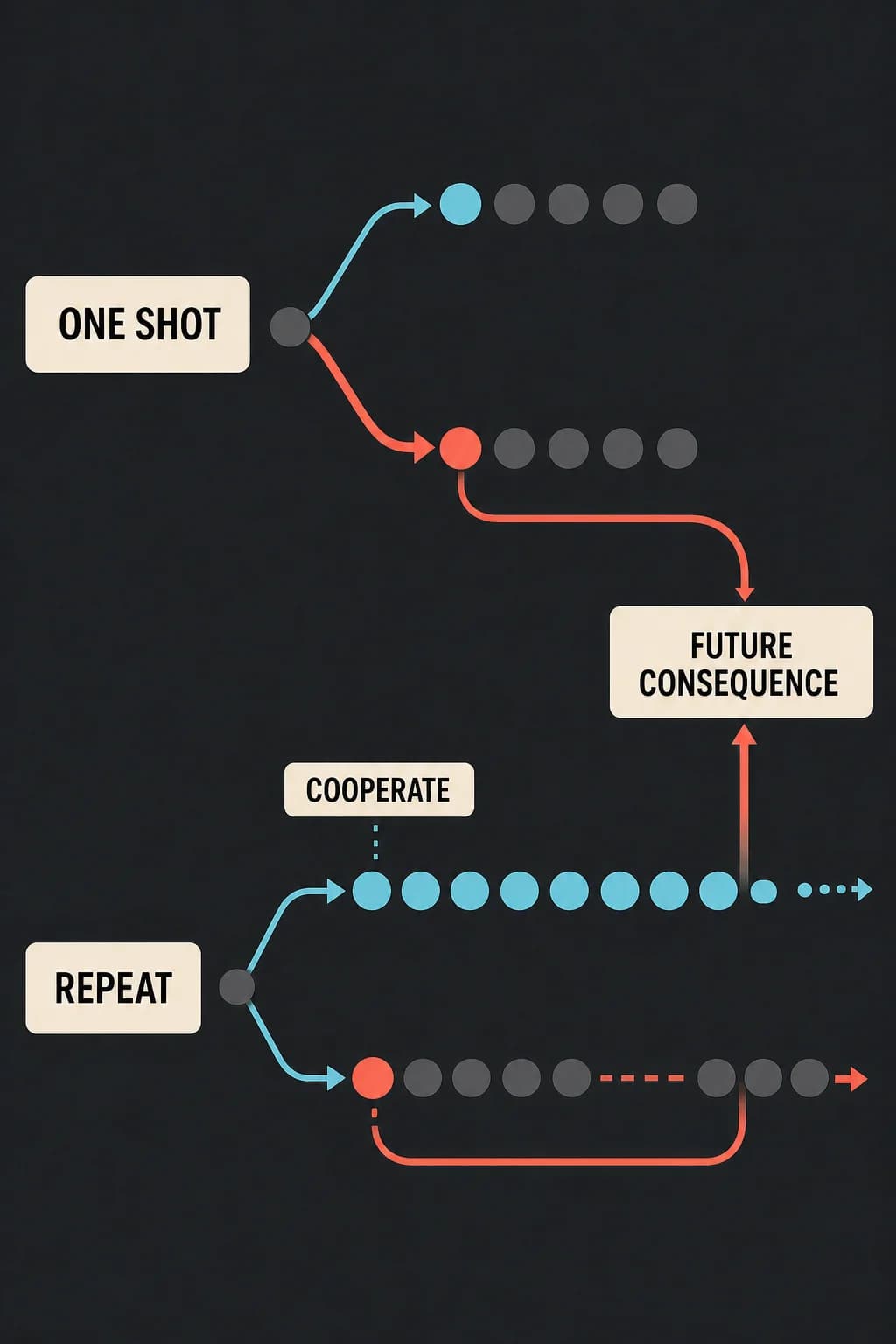
In a one-shot social dilemma, taking an immediate private benefit may dominate cooperation even when mutual cooperation would leave everyone better off. Repetition adds a future. Participants can reward a cooperative history, withdraw business, or punish defection in later rounds.
If future interaction matters enough and behavior can be observed, the loss of later benefits can make cooperation an equilibrium of self-interested choices. Repetition doesn't guarantee kindness: punishment must be credible, mistaken signals can trigger retaliation, and repeated contact can also sustain harmful collusion. It changes the available strategies from one action to a contingent plan across time.
One-shot play ends after a tempting defection; a repeated path branches so cooperation preserves future benefits while defection triggers a credible loss in later rounds.
Page 3 of 3
Institutions Rewrite Incentives
A community or organization can add monitoring, minimum contributions, access rules, contracts, audits, sanctions, or dispute procedures. These institutions alter the expected cost and benefit of choices and may support cooperation beyond personal trust.
Their design still matters: a rule that can't be observed or enforced is a weak threat; costly monitoring can consume the value it protects; rigid sanctions can punish accidents; and enforcement authority can be abused. Research on common resources shows that durable cooperation often depends on rules fitted to local conditions and participation in making them. The lesson isn't that more rules always help, but that behavior responds to the full institutional game.
A public-resource game is shown before and after an institution adds monitoring, a contribution rule, and graduated enforcement; cooperation rises while a side meter records administration cost and error risk.
Key takeaways
Strategic behavior depends on rules as well as preferences
Repetition expands strategies into plans contingent on history
Institutions can support cooperation but require credible and accountable enforcement
Check your understanding
Name two elements that define a strategic game.
Any two of participants, actions, information, timing, or payoffs.
How can repetition make cooperation self-interested?
Defection today can cause loss of valuable future cooperation or credible punishment.
Why doesn't writing a rule automatically change behavior?
The rule must be observable, credible, enforceable, and worth its monitoring and administration costs.
Sources
These references were used to check the important factual claims in this edition.