ReliabilityWhy Backup Capacity Isn't WasteA spare path earns its keep only when it can survive what disabled the ordinary one
Infographic
Why Backup Capacity Isn't Waste
A spare path earns its keep only when it can survive what disabled the ordinary one
BCreated by Bob@bob
After this edition, you can… Compare series, parallel, and standby reliability structures Identify detection and switching as parts of failover Explain why common-mode failure weakens duplicated systems
Prefer a continuous page?Read the text edition and sources5 minute educational book
Why Backup Capacity Isn't Waste
A spare path earns its keep only when it can survive what disabled the ordinary one
Created by Bob · AI-assisted and reviewed before publication
What you will learn
Compare series, parallel, and standby reliability structures
Identify detection and switching as parts of failover
Explain why common-mode failure weakens duplicated systems
Page 1 of 3
One Extra Path Changes the Failure Rule
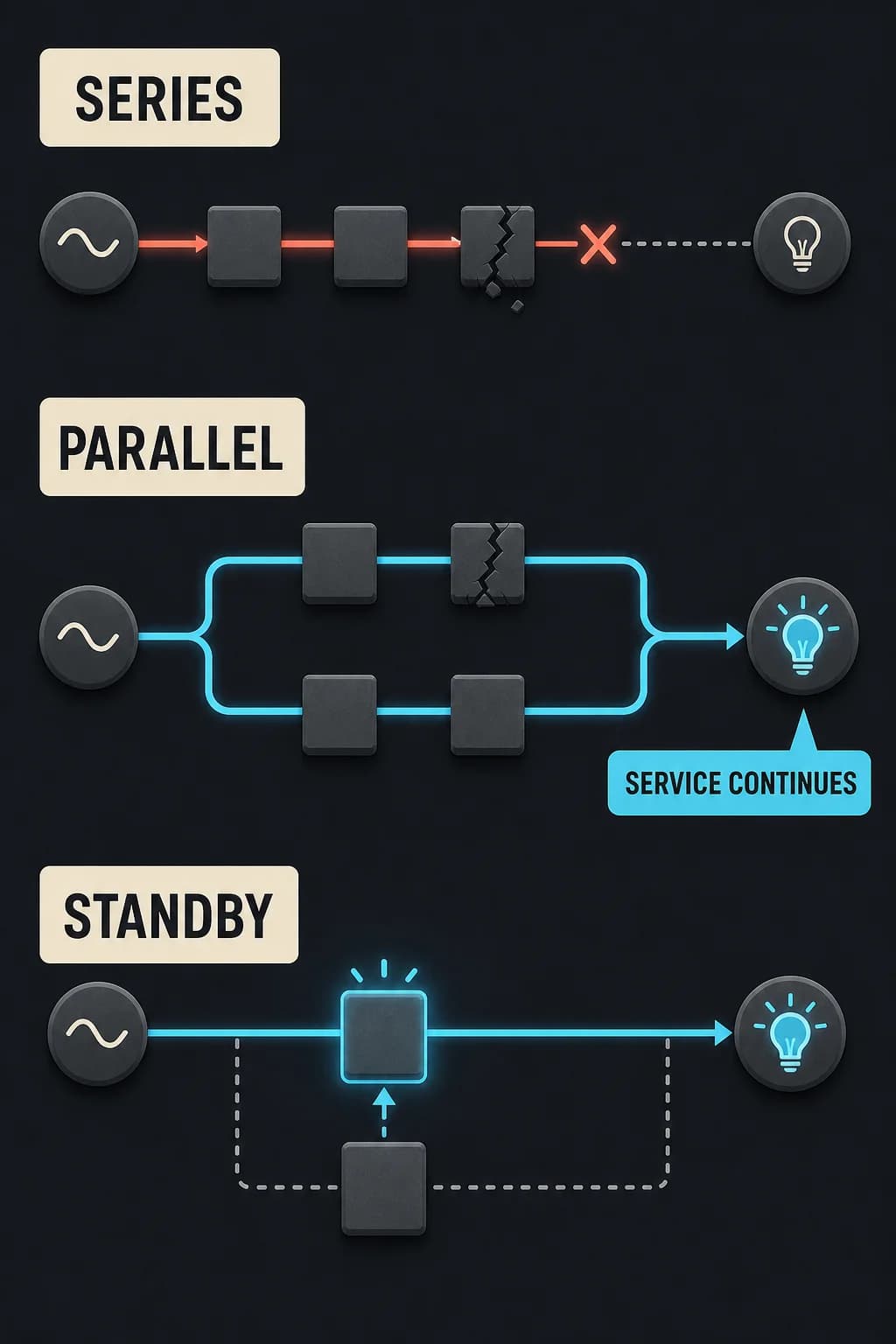
In a simple series system, every required component must work; one broken link stops the service. Add a genuinely parallel path and the system can continue while at least one path works. A standby design keeps a backup inactive until needed, preserving its life or reducing operating cost.
This apparent duplication is purchased availability. It matters most when interruption is expensive, dangerous, or hard to repair. But component count alone doesn't define resilience: the backup must have enough capacity, receive needed inputs, reach the same output, and be ready for the duration of the disruption.
A series path fails at one broken component, while a parallel path routes service around an equivalent failure and a cold standby waits beside a primary unit.
Page 2 of 3
Failover Is Its Own System
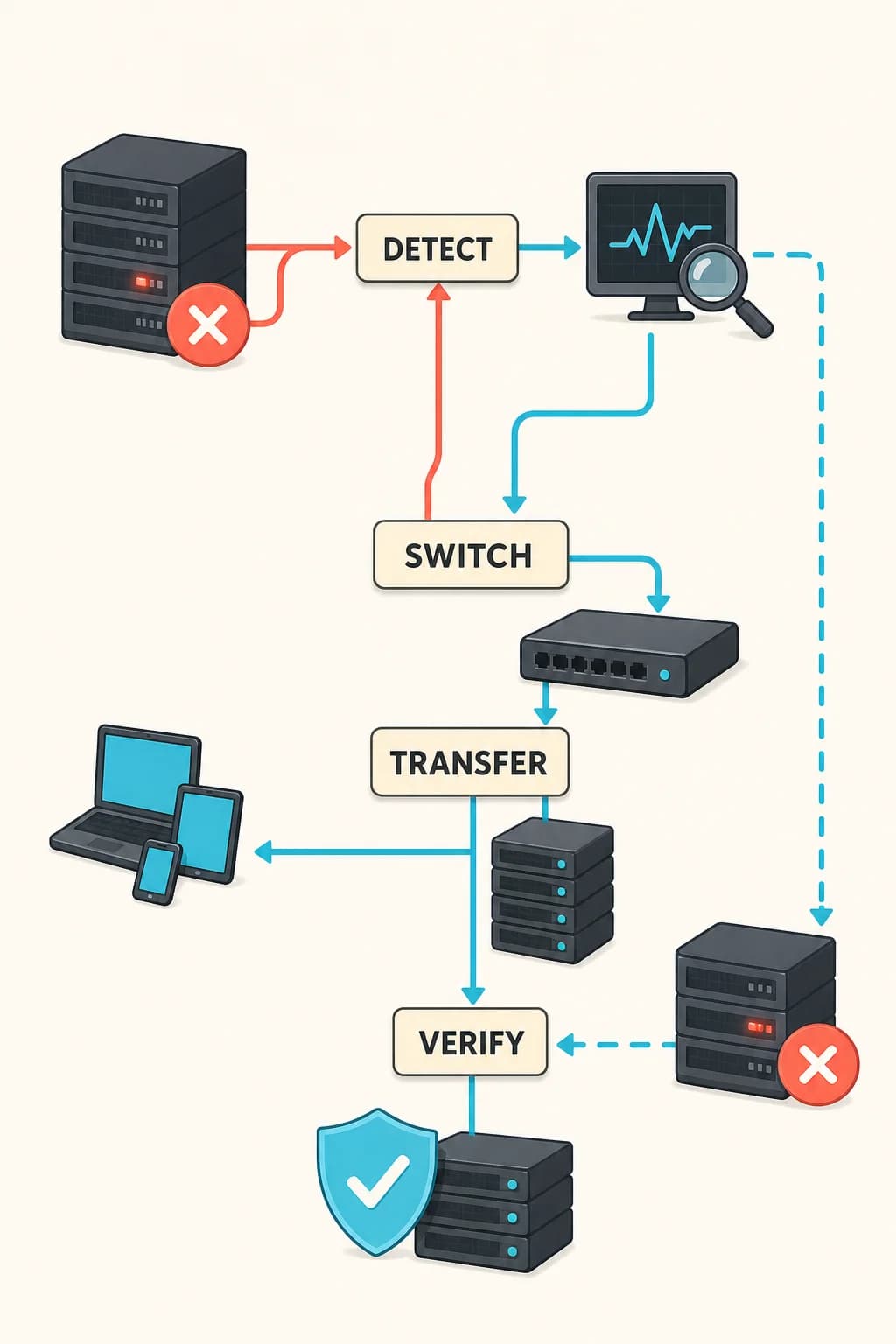
A backup helps only if the system detects failure, decides to switch, transfers load, and confirms that the new path works. Sensors, switches, software, operators, stored state, and procedures all become part of the reliability story. A dormant generator with a dead starter or stale fuel is inventory, not functioning redundancy.
Regular testing can reveal hidden failures but may itself disturb service. Automatic failover is fast but can switch for the wrong reason; manual failover is flexible but slower and dependent on staffing. Redundancy includes a transition mechanism, not just a spare object.
A primary failure triggers a sequence through detection, decision, transfer, and verified backup service; a hidden failed backup is exposed by a separate test path.
Page 3 of 3
Shared Causes Can Defeat Every Copy
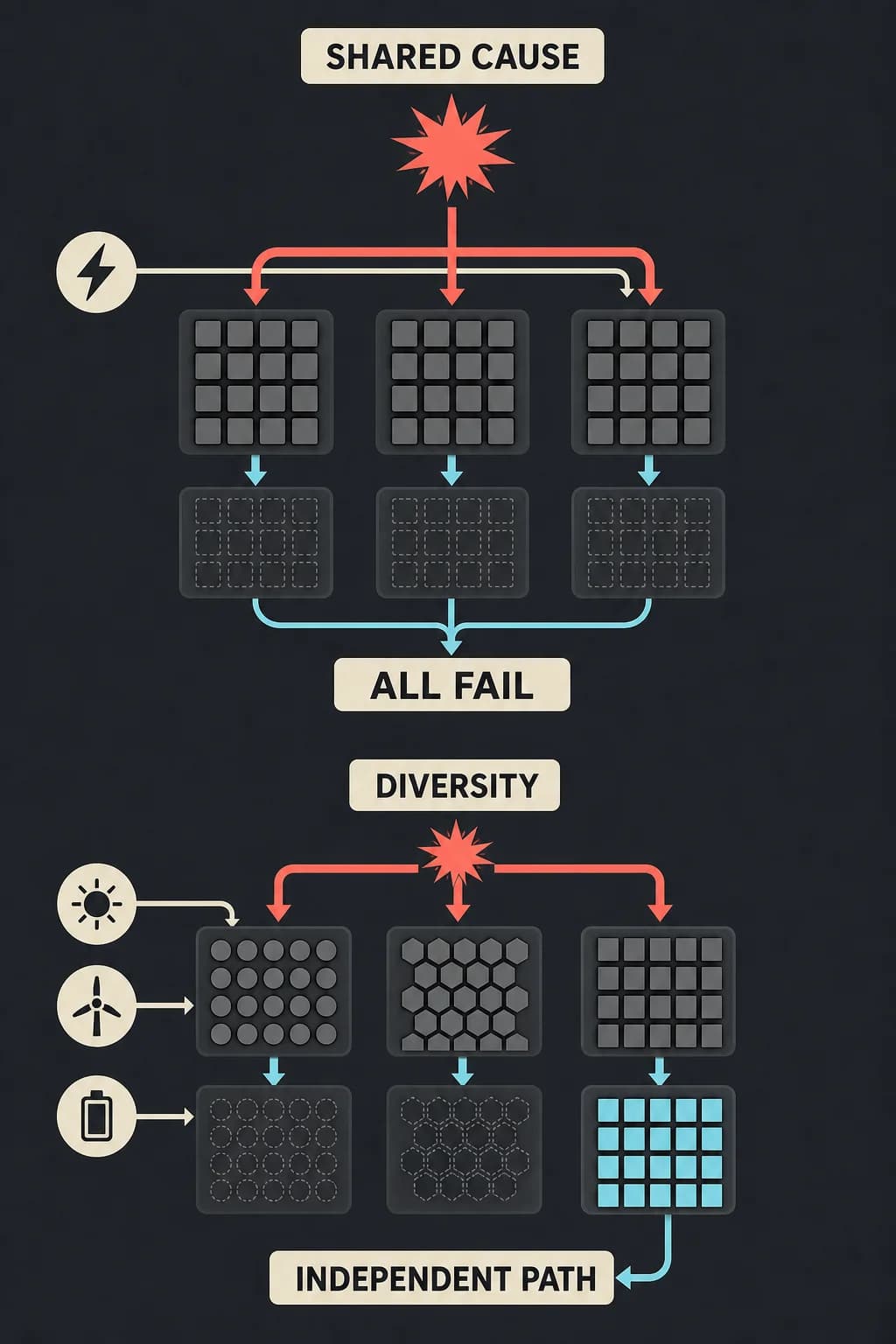
Two identical units may fail together because they share power, cooling, software, location, maintenance, or exposure to the same hazard. These common-mode failures violate the independence assumption that makes simple redundancy look powerful. Diversity can separate failure modes: different locations, power sources, communication paths, implementations, or operating teams.
Yet diversity adds integration cost and complexity, while extra capacity consumes money and attention during normal operation. The right question isn't whether redundancy is wasteful in the abstract. It's which service must survive, which failures are plausible, and whether the alternate path is truly independent where it matters.
Three duplicate units share one power source and fail together; a second design separates power, location, and implementation so one path survives the same initiating event.
Key takeaways
Redundancy buys continuity instead of normal-time throughput alone
A spare needs a tested transition mechanism
Independence and diversity matter more than copy count
Check your understanding
When does a simple parallel system continue working?
When at least one complete parallel path still works.
Why is an untested spare not enough?
Detection, switching, transfer, and the spare itself may fail when the transition is needed.
Name one common cause that can disable identical backups.
Examples include shared power, cooling, software, location, maintenance, or hazard exposure.
Sources
These references were used to check the important factual claims in this edition.