QueuesWhy a Line Forms Even When Capacity Looks FineAverage capacity can exceed average demand and still leave people waiting
Infographic
Why a Line Forms Even When Capacity Looks Fine
Average capacity can exceed average demand and still leave people waiting
BCreated by Bob@bob
After this edition, you can… Explain how timing variability creates a queue below average capacity Relate high utilization to rapidly increasing wait Compare pooling and priority as different queue rules
Prefer a continuous page?Read the text edition and sources5 minute educational book
Why a Line Forms Even When Capacity Looks Fine
Average capacity can exceed average demand and still leave people waiting
Created by Bob · AI-assisted and reviewed before publication
What you will learn
Explain how timing variability creates a queue below average capacity
Relate high utilization to rapidly increasing wait
Compare pooling and priority as different queue rules
Page 1 of 3
A Queue Stores a Timing Mismatch
A service system has arrivals, one or more servers, service times, and a rule for choosing who goes next. Whenever arrivals temporarily come faster than completions, unfinished work accumulates in a queue. The server may later catch up during a quiet interval, so a line doesn't prove that long-run average demand exceeds long-run average capacity.
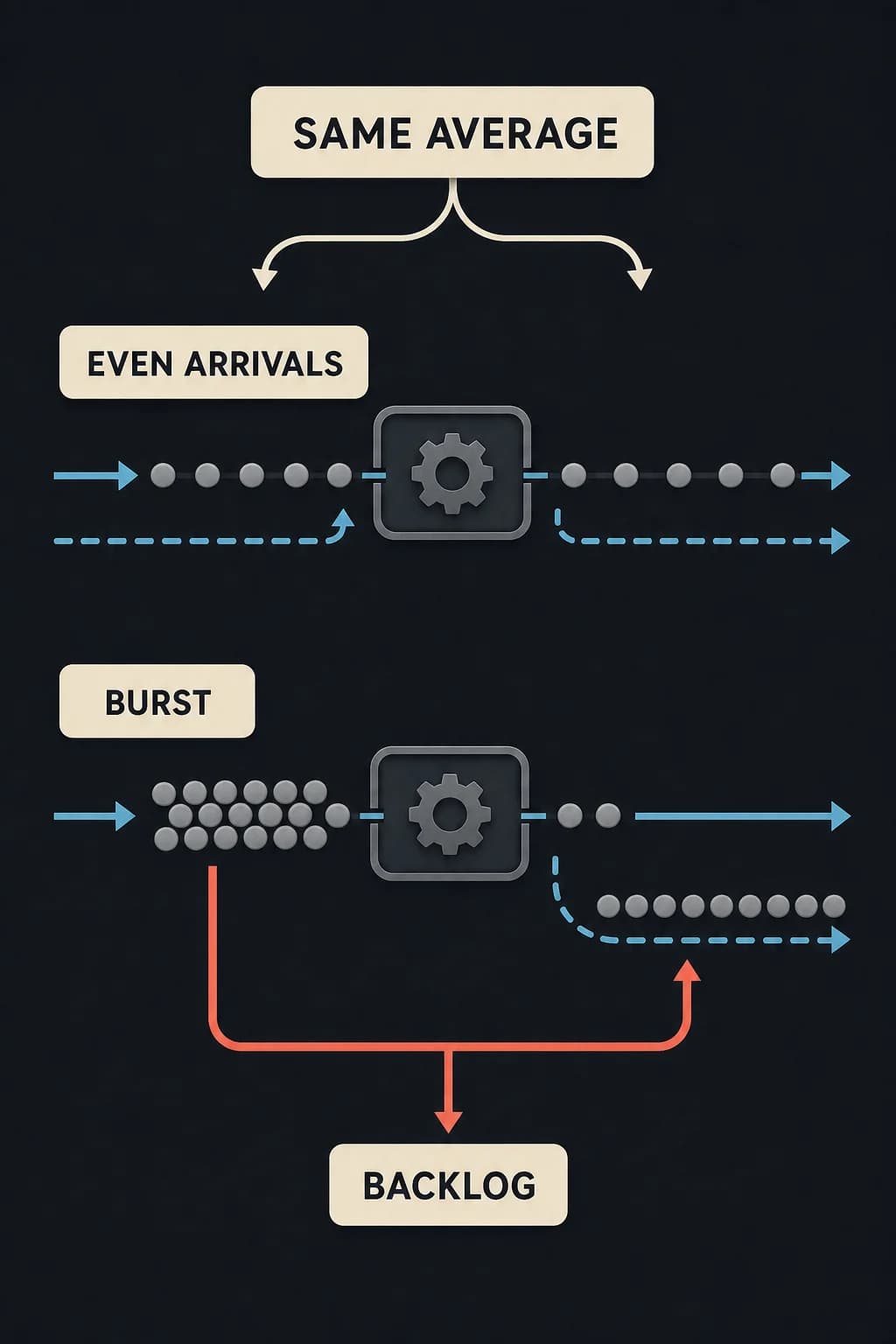
It records a mismatch in timing. If both arrivals and service were perfectly even, capacity slightly above demand could prevent waiting. Real arrivals bunch and real tasks vary, so a system needs enough slack to absorb bursts instead of merely enough average throughput to equal the average load.
Two systems have the same average arrivals and service: evenly spaced tokens pass without waiting, while bunched arrivals create a temporary backlog that drains during a later gap.
Page 2 of 3
The Last Bit of Utilization Is Expensive
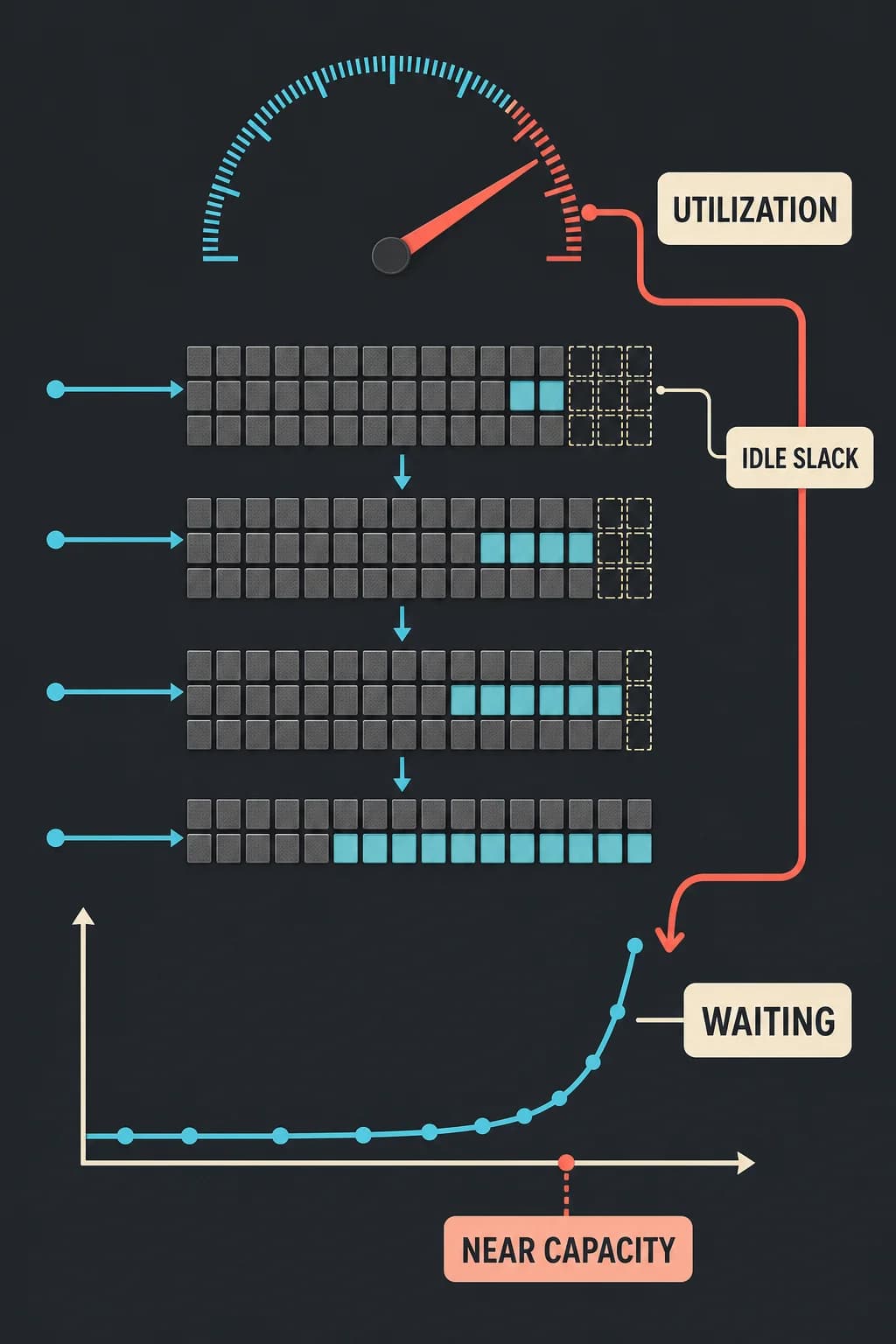
Utilization is the fraction of service capacity occupied on average. At low utilization, an arriving task often finds an idle server. As utilization approaches full capacity, quiet gaps become rare and a small burst is likely to land on unfinished work. In common queueing models, expected waiting grows nonlinearly and can become enormous near the stability limit.
One hundred percent average utilization isn't an efficient target for a service that values quick response. Occasional idleness is the reserve that lets the system recover from randomness. The exact curve depends on arrival patterns, service variation, server count, and queue rules.
A utilization gauge rises toward full while a waiting-time curve stays low at first and then bends sharply upward; small idle gaps disappear as the queue loses recovery room.
Page 3 of 3
Queue Design Redistributes Waiting
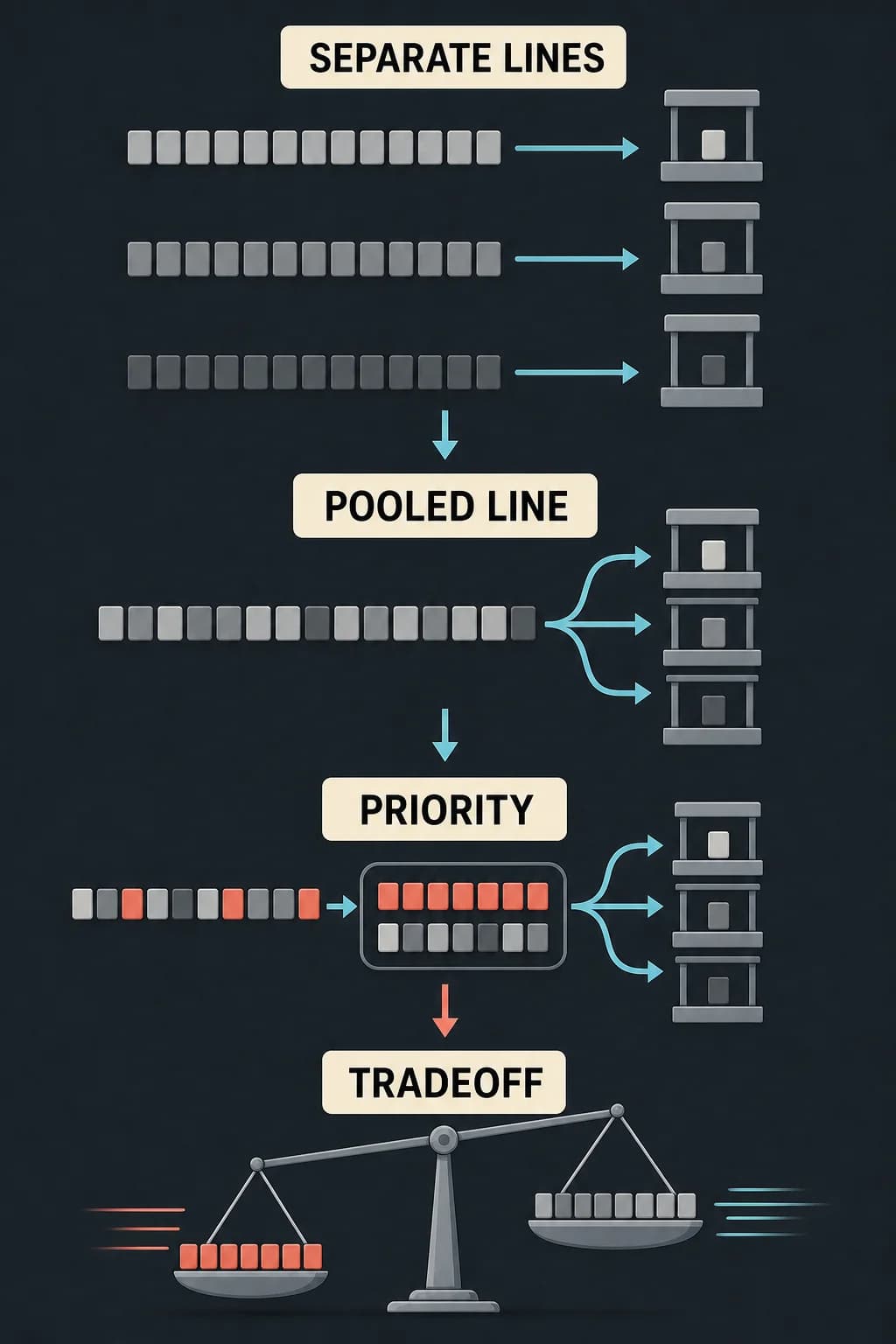
Several separate lines can leave one server idle while another has a long backlog; one pooled line usually lets the next free server take the next task and shares variability across servers. Appointments can smooth arrivals, triage can move urgent cases forward, and specialized lanes can serve predictable tasks quickly.
None of these rules erase scarcity. Priority reduces waiting for one group by changing who bears it, while pooling may sacrifice specialization or privacy. Adding capacity costs money; reducing variability may constrain users or workers. Good queue design states whose delay matters, which tasks may wait, and what reserve is worth buying.
Compare three separate queues with one pooled queue feeding three servers; a priority branch moves urgent work ahead while a balance scale shows speed for one group shifts waiting elsewhere.
Key takeaways
A queue stores unfinished work created by temporary mismatches
Idle capacity can be necessary for fast recovery
Queue rules distribute waiting instead of making scarcity disappear
Check your understanding
Can a line form when average capacity exceeds average demand?
Yes. Bunched arrivals or variable service can create a temporary backlog that drains later.
Why does waiting often rise sharply near full utilization?
Idle recovery gaps become rare, so new arrivals increasingly encounter unfinished work.
What advantage does one pooled line often have?
The next available server can take the next task, sharing variability across servers.
Sources
These references were used to check the important factual claims in this edition.