Electric GridWhy the Power Grid Has to Balance Right NowFrequency reveals the mismatch before operators can put it on a spreadsheet
Infographic
Why the Power Grid Has to Balance Right Now
Frequency reveals the mismatch before operators can put it on a spreadsheet
BCreated by Bob@bob
After this edition, you can… Explain why a live grid differs from ordinary inventory Use frequency direction to diagnose net supply-demand imbalance Order major balancing responses from fast local action to slower reserves
Prefer a continuous page?Read the text edition and sources5 minute educational book
Why the Power Grid Has to Balance Right Now
Frequency reveals the mismatch before operators can put it on a spreadsheet
Created by Bob · AI-assisted and reviewed before publication
What you will learn
Explain why a live grid differs from ordinary inventory
Use frequency direction to diagnose net supply-demand imbalance
Order major balancing responses from fast local action to slower reserves
Page 1 of 3
The Network Has Almost No Checkout Counter
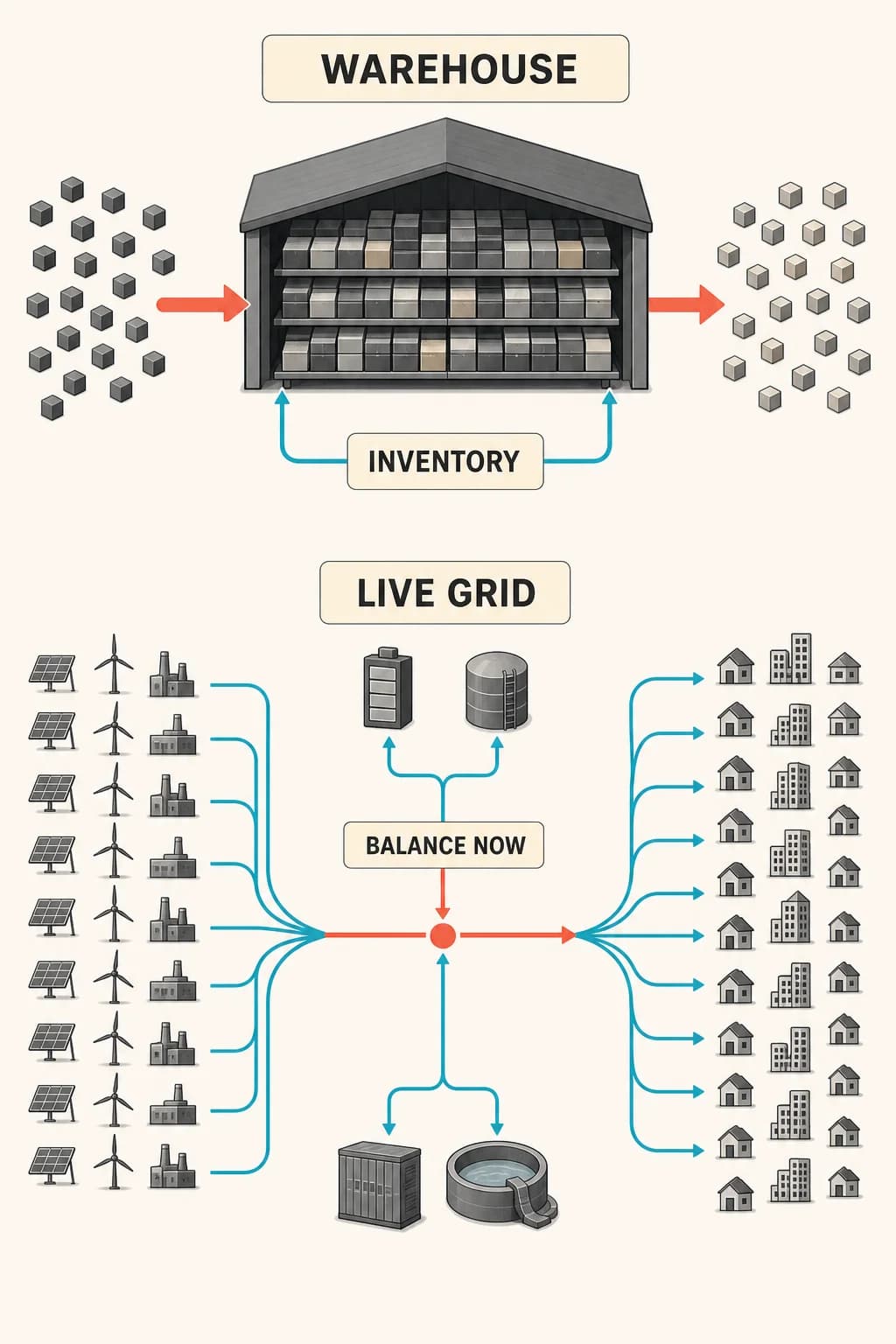
A warehouse can receive goods today and ship them tomorrow from inventory. An electric interconnection historically stores little energy in the transmission network itself. At every moment, generators, storage discharging, and imports must match loads, storage charging, exports, and losses closely enough to keep voltage and frequency within limits.
Demand changes continuously and equipment can trip without warning, so scheduled energy alone is insufficient. The grid needs resources able to change output or consumption on different time scales. Batteries and reservoirs add explicit storage, but they participate as controlled resources; they don't remove the need for real-time balance.
A warehouse buffers mismatched boxes in inventory; beside it, a live electric network has generation and demand connected directly through a narrow balance point with only explicit storage branches.
Page 2 of 3
Frequency Is a System-Wide Clue
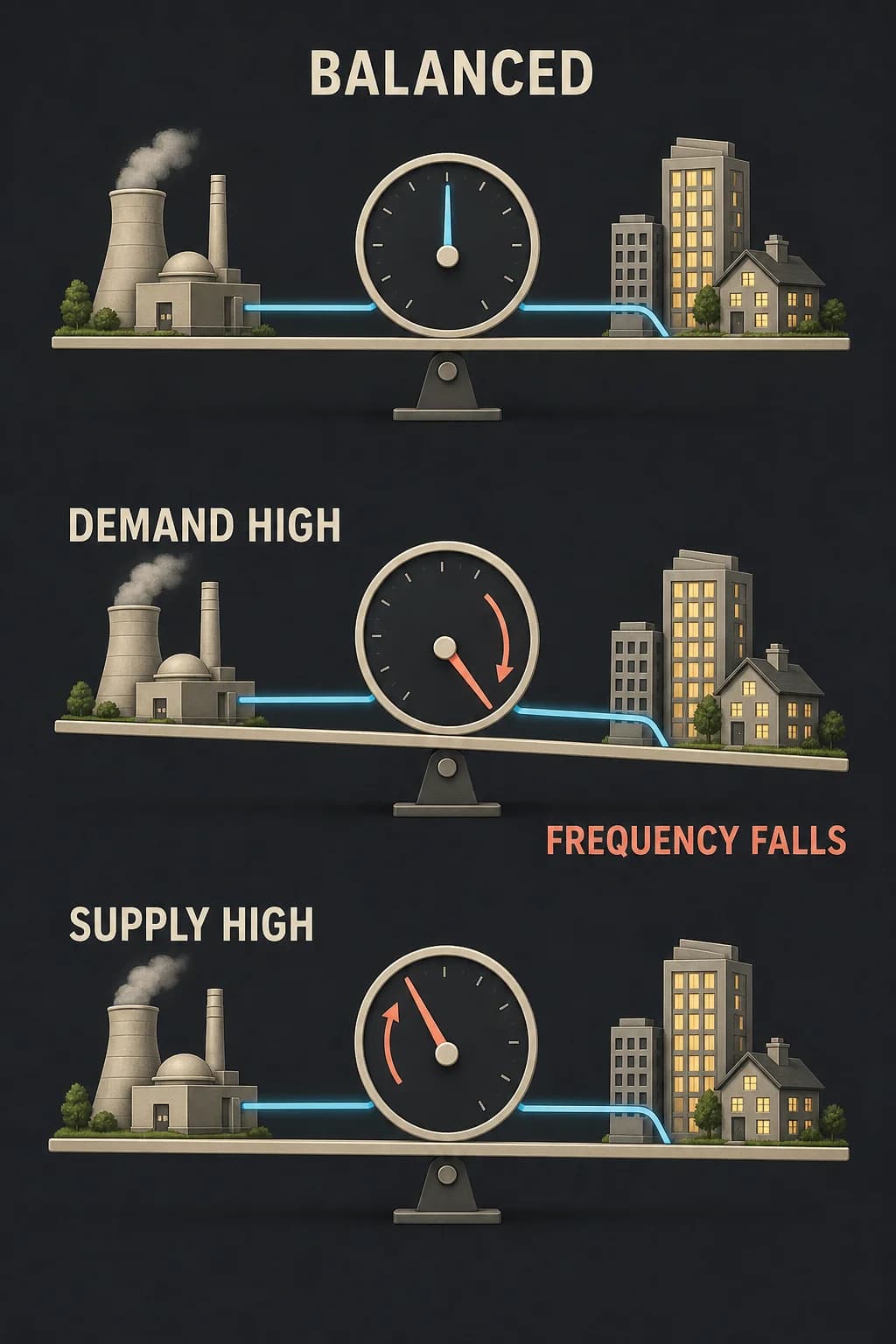
In a synchronous alternating-current interconnection, many rotating machines move in step. If electrical demand suddenly exceeds mechanical power input, the system draws kinetic energy from rotating equipment and frequency begins to fall. If supply exceeds demand, frequency tends to rise.
Frequency isn't a meter that identifies the exact failed plant or overloaded line, but it quickly reveals a net power imbalance across the interconnection. Very large deviations can damage equipment or trigger protective separation and load shedding. Holding frequency near its target is evidence that fast controls are continually reconciling countless changing injections and withdrawals.
A balanced generator-load seesaw holds a central frequency wheel steady; excess demand drains rotating energy and tips frequency down, while excess supply tips it up.
Page 3 of 3
Control Arrives in Layers
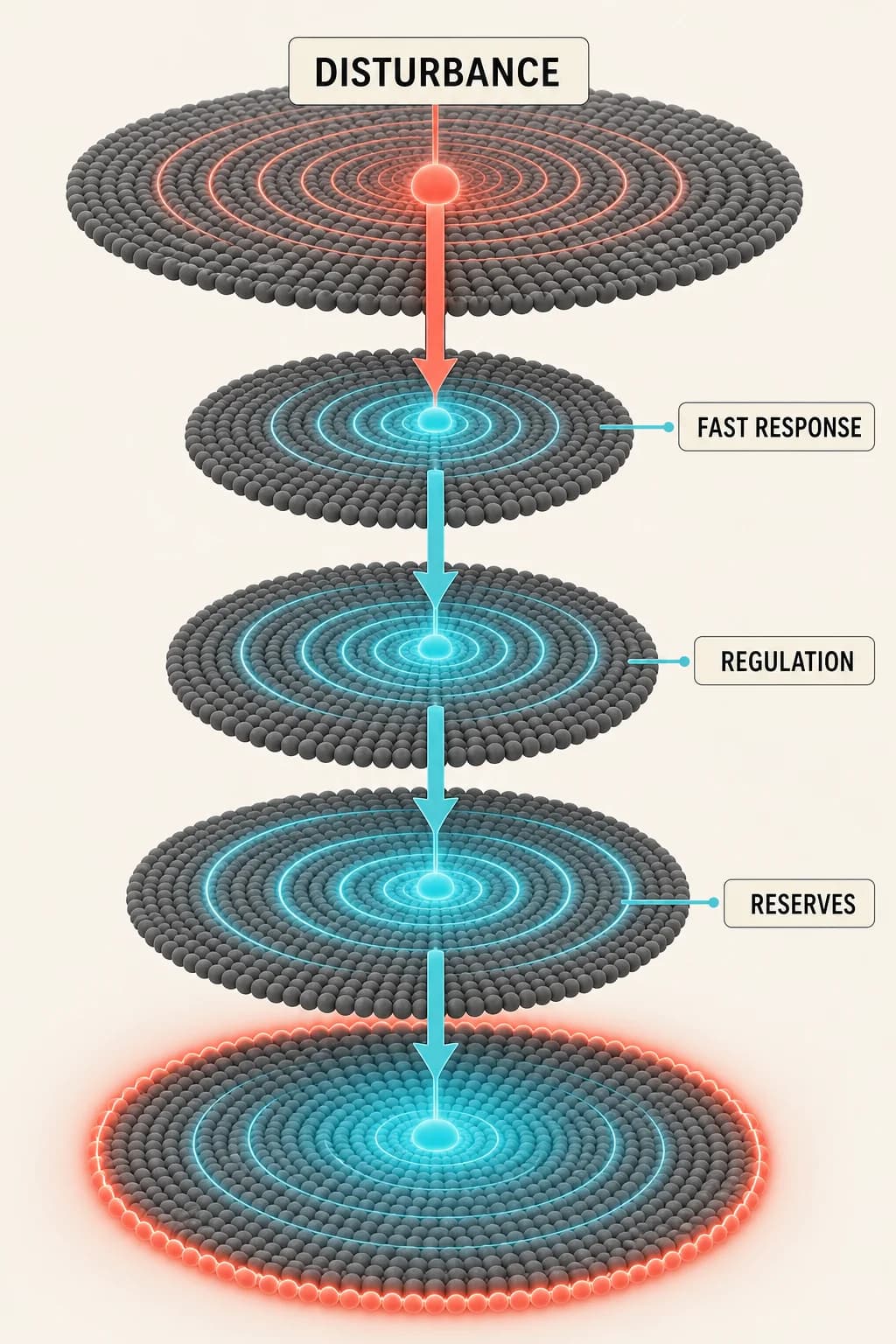
The first response to a sudden imbalance can come automatically from generator governors, inverter controls, responsive loads, and storage. These actions arrest the frequency change within seconds. Central automatic generation control then adjusts selected resources over seconds to minutes to restore frequency and scheduled power exchanges.
Operators commit and dispatch slower reserves over longer intervals, while protection may shed load when balance can't be recovered safely. Each layer buys time for the next. Flexibility can come from supply, storage, interconnection, or demand; but every response needs capacity, ramp speed, energy duration, communication, and incentives before the disturbance occurs.
One disturbance launches concentric response bands: immediate autonomous response, coordinated regulation, slower reserves, and emergency protection, each handing a stabilized system to the next time scale.
Key takeaways
Electrical balance is a continuous physical requirement
Falling frequency usually signals demand exceeding supply in a synchronous system
Grid reliability depends on layered flexible resources prepared in advance