FeedbackWhy Slow Feedback Makes Systems Swing Too FarA correction based on yesterday's error can become today's disturbance
Infographic
Why Slow Feedback Makes Systems Swing Too Far
A correction based on yesterday's error can become today's disturbance
BCreated by Bob@bob
After this edition, you can… Trace information and action around a feedback loop Explain why delay can turn correction into overshoot Describe the speed-stability trade made by controller tuning
Prefer a continuous page?Read the text edition and sources5 minute educational book
Why Slow Feedback Makes Systems Swing Too Far
A correction based on yesterday's error can become today's disturbance
Created by Bob · AI-assisted and reviewed before publication
What you will learn
Trace information and action around a feedback loop
Explain why delay can turn correction into overshoot
Describe the speed-stability trade made by controller tuning
Page 1 of 3
Feedback Acts on an Error
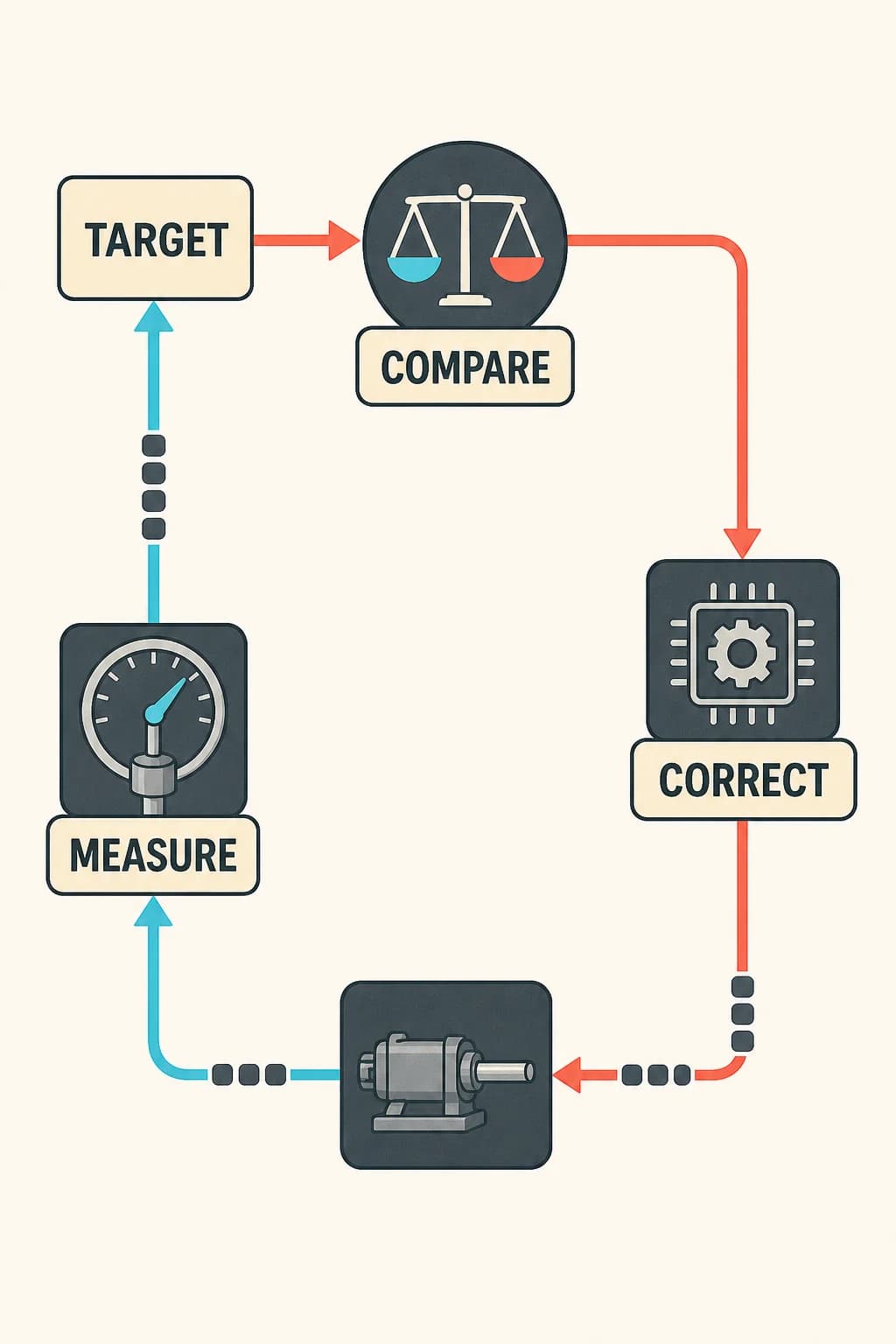
A feedback controller measures a system's output, compares it with a target, and uses the difference to choose an input. A thermostat compares temperature with a setpoint; a vehicle controller compares motion with a commanded path. The loop can reject disturbances and correct uncertain behavior without knowing every cause in advance.
But the measurement, computation, actuator, and physical process each take time. By the moment a correction changes the output, the error that requested it may already be smaller, larger, or reversed. Feedback isn't just information returning; it is information returning with dynamics and delay.
A simple closed loop runs from target to comparison, controller, physical process, measurement, and back; small delay marks accumulate along sensing and actuation paths.
Page 2 of 3
The System Keeps Moving During the Delay
Imagine heating a room whose sensor and heater respond slowly. Temperature remains below target, so the controller continues asking for heat. Yet energy already in the heater and room keeps raising temperature after the measured error reaches zero. The output overshoots.
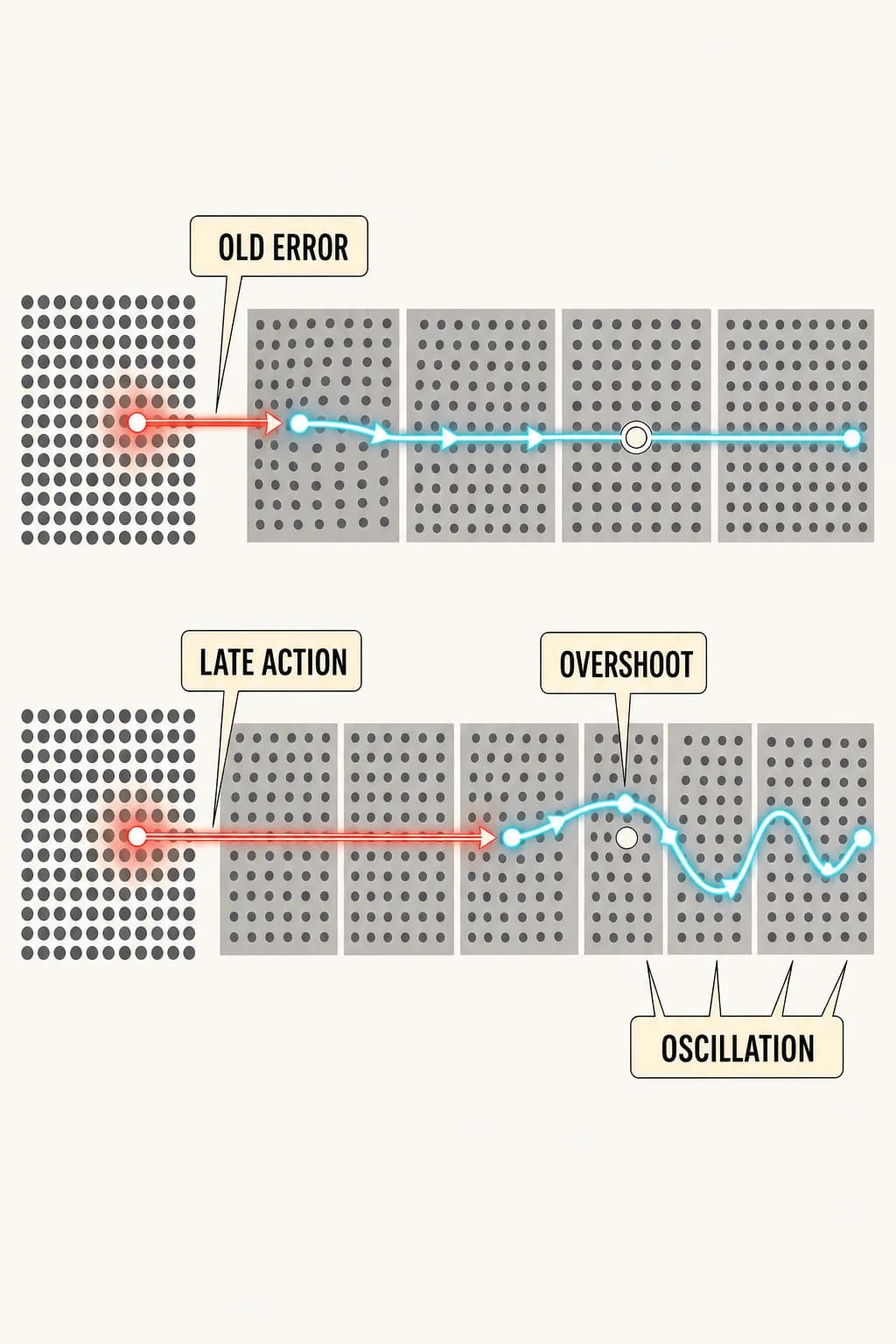
The controller then reverses, but cooling and measurement are delayed too, so it can undershoot. Repetition produces a damped oscillation, sustained cycling, or instability depending on the process and controller. The critical mistake is temporal: the latest action is chosen from a state that no longer describes the system when that action takes effect.
Two aligned timelines compare immediate and delayed feedback after the same disturbance; the delayed path continues correction past the target, then reverses late and oscillates around it.
Page 3 of 3
Faster Correction Can Reduce Stability
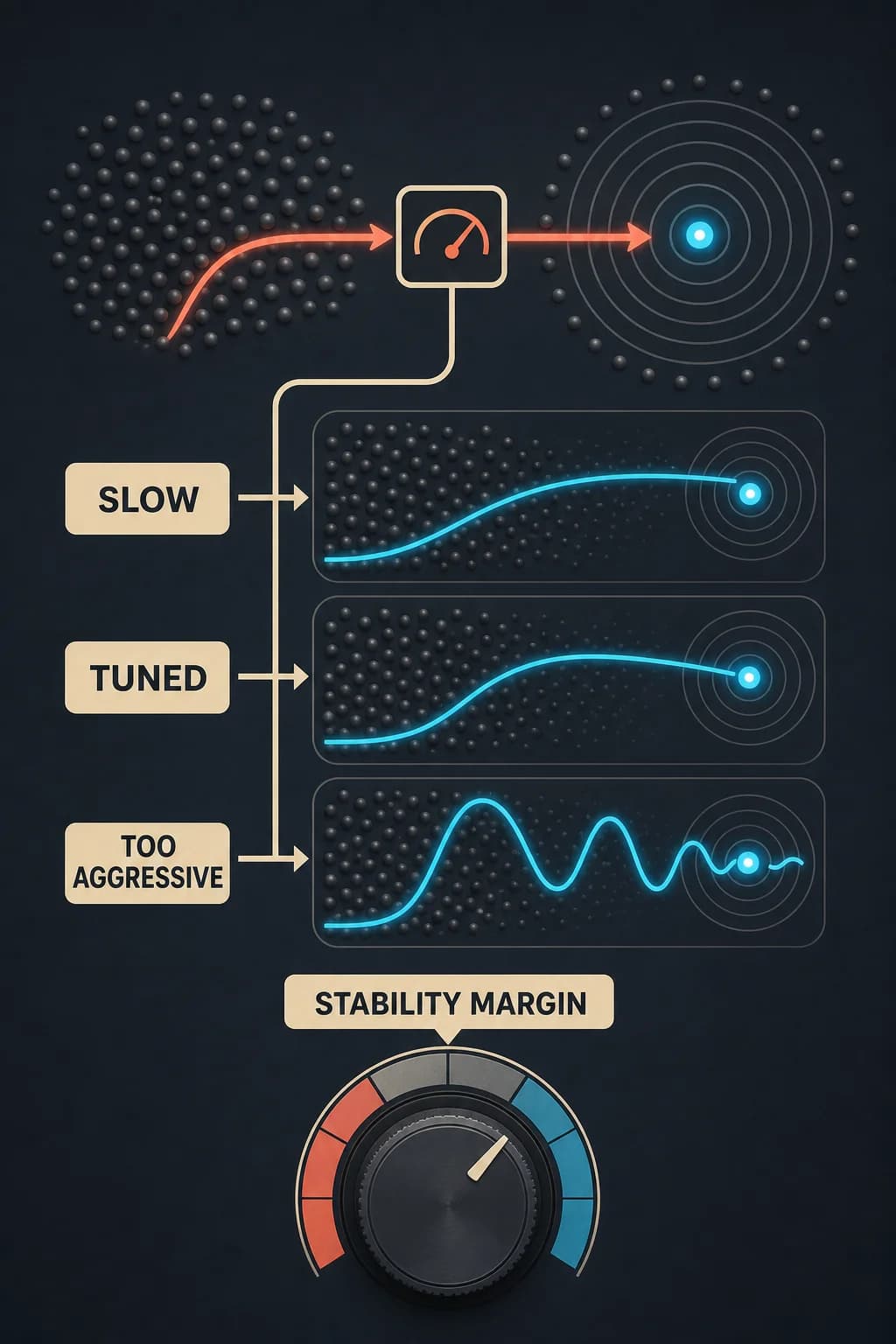
Increasing controller gain makes a given error command a larger correction. That can shorten response time when delay is small, but with delay it can drive the system farther before new information arrives. Engineers add damping, reduce gain, filter noise, estimate the current state, anticipate known dynamics, or redesign sensing and actuation to reduce delay.
Each remedy has a cost: slower response, less disturbance rejection, more model dependence, or more hardware. A well-tuned loop isn't the one that always reacts hardest. It balances speed, accuracy, noise, uncertainty, and the phase lag introduced by every component in the loop.
Three response curves share one target: low gain approaches slowly, tuned gain settles quickly, and high gain with delay overshoots repeatedly; a controller tradeoff dial sits below.
Key takeaways
Feedback acts on measured error instead of directly on causes
A delayed correction may arrive after the error has changed sign
More aggressive response isn't automatically better control
Check your understanding
What does a feedback controller compare?
It compares a measured output with a target and acts on their difference.
Why can heating continue after the target is reached?
Stored energy and delayed sensing or actuation mean earlier correction is still affecting the process.
What risk can accompany higher controller gain when delay is present?
Larger overshoot, oscillation, or instability because each late correction is stronger.
Sources
These references were used to check the important factual claims in this edition.