Wi-FiWhy Wi-Fi Waits Before SendingA shared radio channel works because devices pause, listen, and gamble on timing
Infographic
Why Wi-Fi Waits Before Sending
A shared radio channel works because devices pause, listen, and gamble on timing
BCreated by Bob@bob
After this edition, you can… Explain why Wi-Fi listens before transmitting Trace how randomized backoff allocates a turn Explain why acknowledgments and retries remain necessary
Prefer a continuous page?Read the text edition and sources5 minute educational book
Why Wi-Fi Waits Before Sending
A shared radio channel works because devices pause, listen, and gamble on timing
Created by Bob · AI-assisted and reviewed before publication
What you will learn
Explain why Wi-Fi listens before transmitting
Trace how randomized backoff allocates a turn
Explain why acknowledgments and retries remain necessary
Page 1 of 3
First, Listen
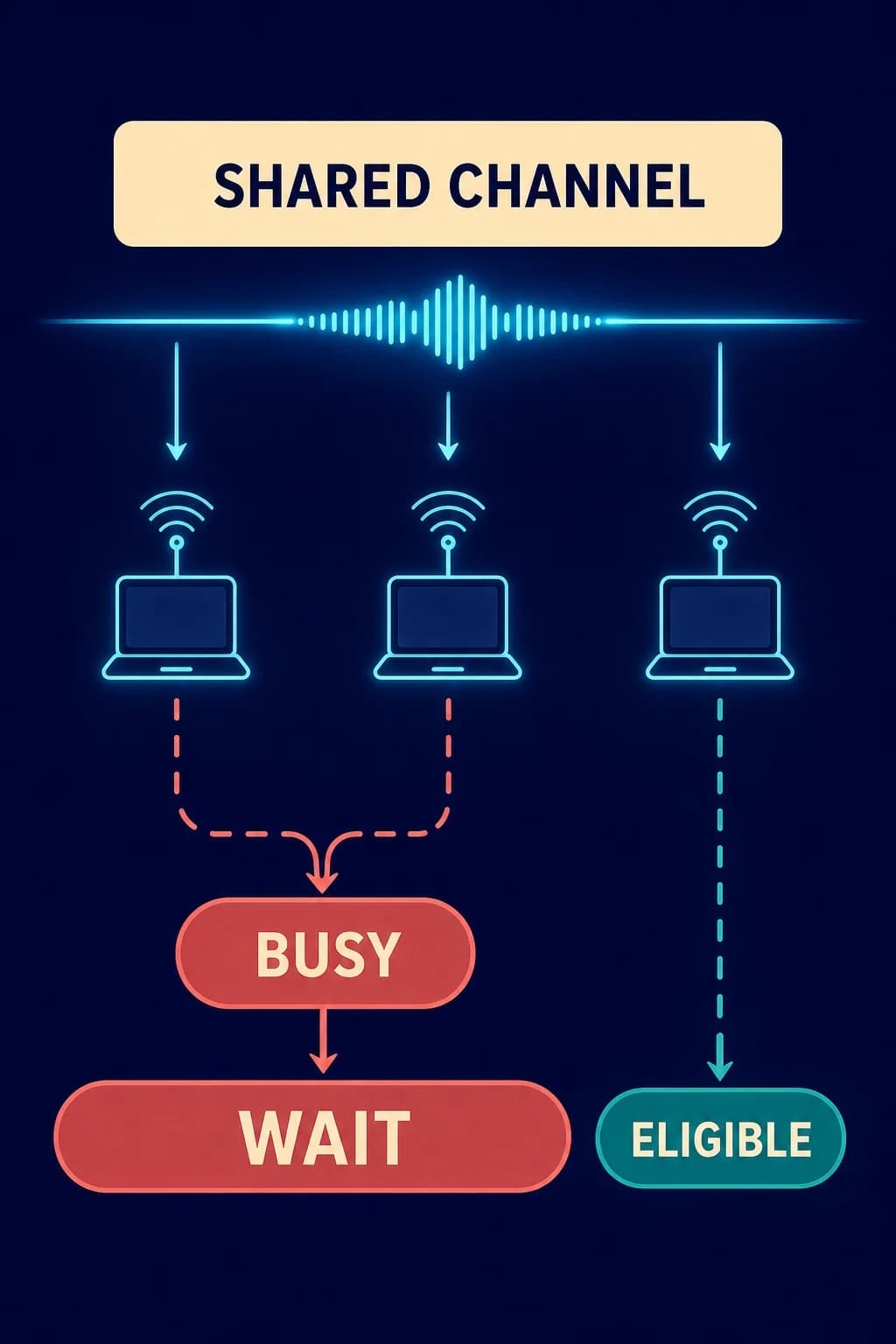
Wi-Fi devices usually share unlicensed spectrum with no single controller assigning every turn. Before transmitting, a device senses whether the channel appears busy. It can detect radio energy and also honor timing information announced in frames it has decoded. If the medium is occupied, the device waits.
This is carrier-sense multiple access with collision avoidance: access is distributed, and the goal is to reduce overlapping transmissions instead of pretend collisions are impossible. Listening is local, so two transmitters may hear different conditions, especially when walls or distance hide them from one another.
Three devices sense one shared channel. A single WAIT callout spans the two devices that detect an active transmission; one ELIGIBLE callout marks only the device with a clear idle observation. don't repeat any callout.
Page 2 of 3
The Countdown Is Random
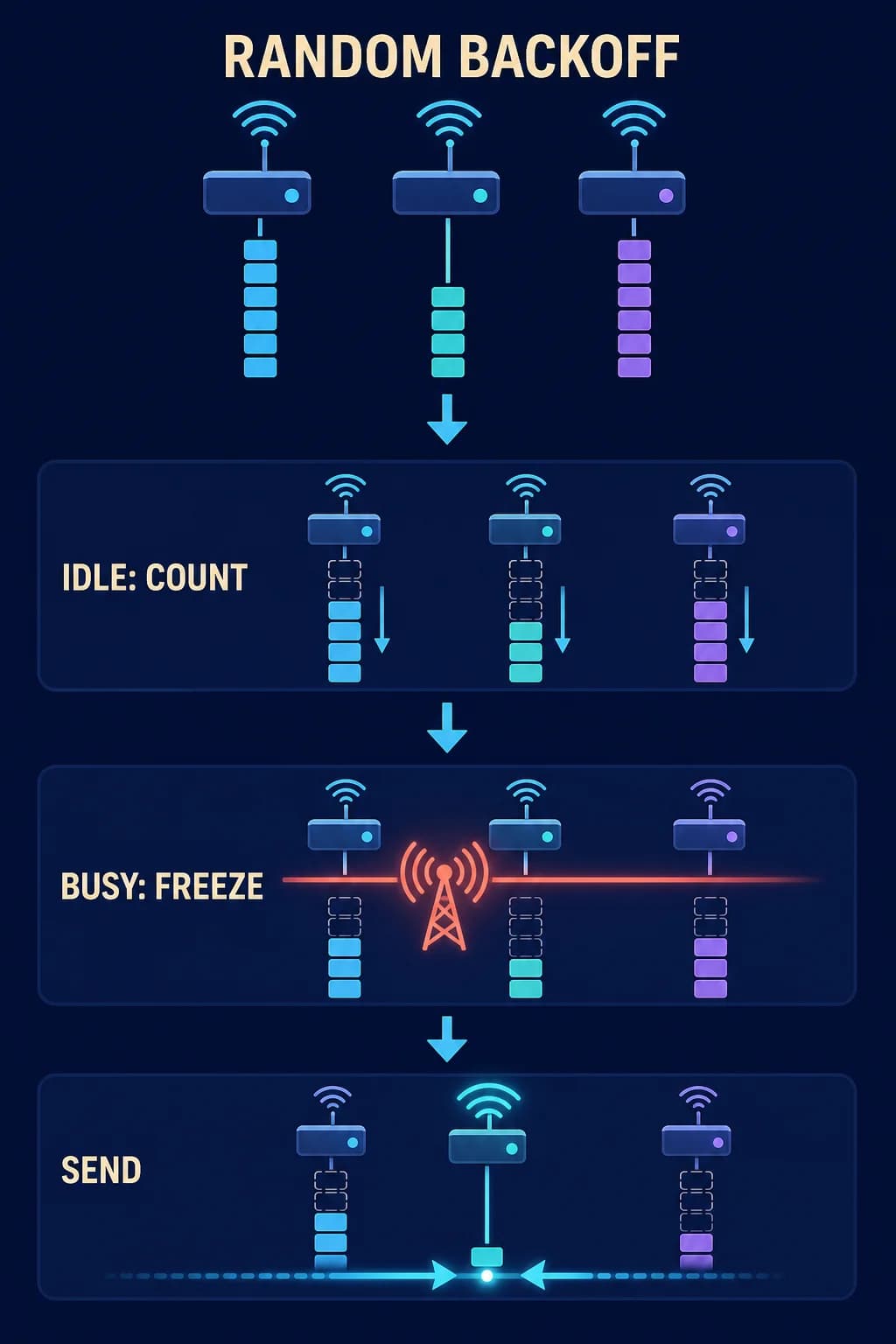
When the channel becomes idle, every waiting device doesn't transmit immediately. Each chooses a random backoff value from a contention window and counts down through idle time slots. A device freezes its countdown whenever another transmission begins, then resumes after the channel is clear again.
The first counter to reach zero gets the next attempt. Randomization makes an exact tie less likely. After a failed attempt, the contention window can grow, spreading later choices across more possible slots. The process trades some delay for a much lower chance that many eager devices speak at once.
Three waiting devices choose different random countdown lengths; counters fall only during idle slots, freeze during a busy interval, and the shortest remaining counter wins the next transmission.
Page 3 of 3
Silence Does Not Prove Success
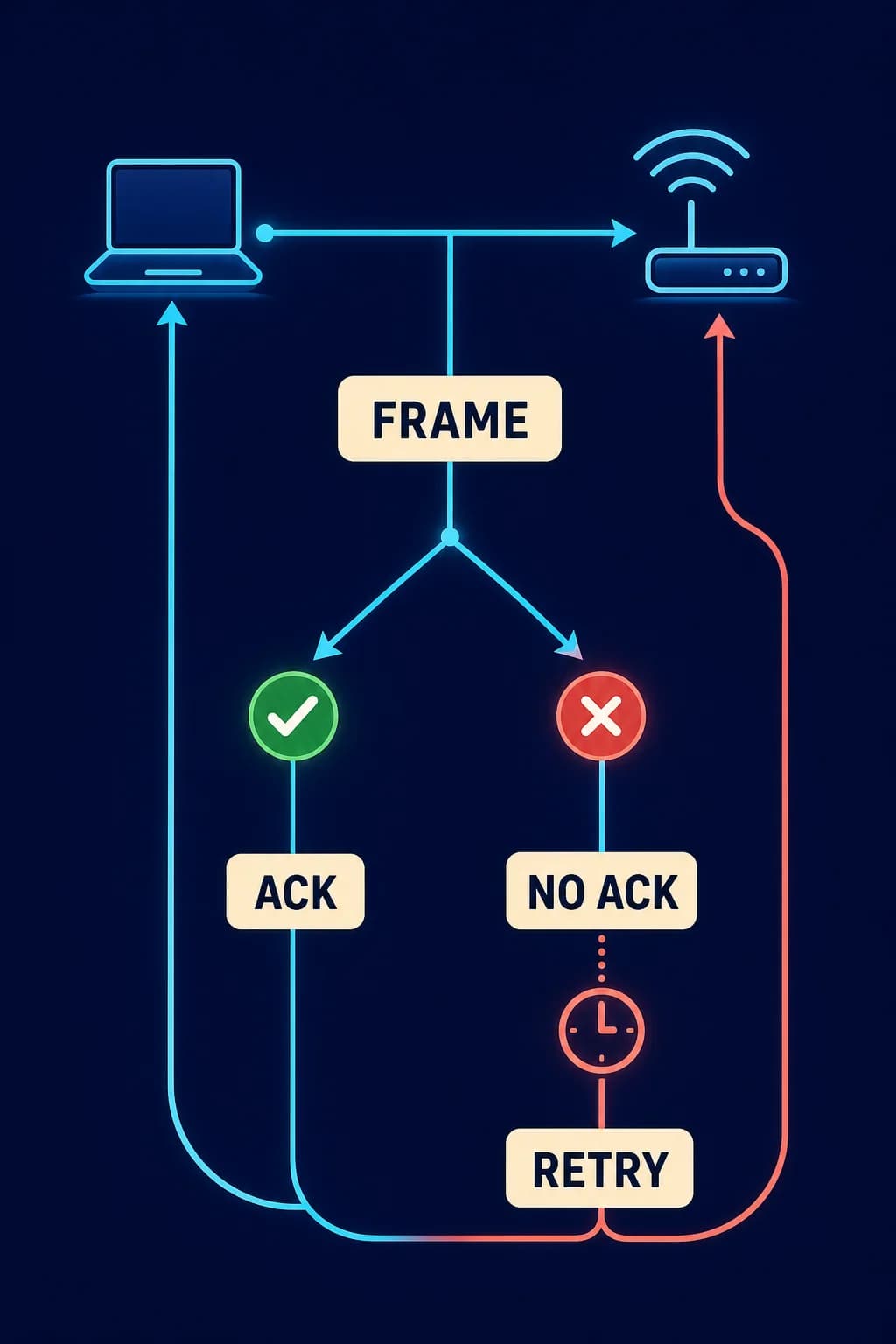
A sender normally expects an acknowledgment after a unicast frame. If that acknowledgment doesn't arrive, the sender treats the attempt as failed and tries again later with another backoff. Failure might mean overlapping frames, interference, fading, or a damaged acknowledgment; the sender can't diagnose all of those from silence alone.
Hidden nodes remain a classic difficulty because two senders can each hear the receiver yet not hear one another. Wi-Fi coordinates through sensing, short reservations in some cases, acknowledgments, and retries. It's a resilient negotiation over uncertain local evidence, not a perfectly collision-free schedule.
One sender-to-access-point path branches into success and failure outcomes. Put the single FRAME callout before the branch; ACK labels the success return, while NO ACK leads to a timed RETRY loop. don't duplicate FRAME or any callout.
Key takeaways
Wi-Fi channel access is distributed instead of centrally scheduled
Backoff counters pause when the channel becomes busy
Missing acknowledgment triggers another randomized attempt
Check your understanding
Why do waiting devices choose random backoff values?
To reduce the chance that they all begin transmitting at the same moment.
What happens to a backoff counter while another device transmits?
It freezes and resumes after the channel becomes idle again.
Does carrier sensing eliminate every collision?
No. Interference, fading, and hidden nodes can still cause failed frames.
Sources
These references were used to check the important factual claims in this edition.