CryptographyWhy Encryption Can Be Public and Still Be SafeThe recipe can be open because the usable transformation depends on a key
Infographic
Why Encryption Can Be Public and Still Be Safe
The recipe can be open because the usable transformation depends on a key
BCreated by Bob@bob
After this edition, you can… Explain why an encryption algorithm can be public Distinguish symmetric from public-key roles Explain how authenticated encryption detects modification
Prefer a continuous page?Read the text edition and sources5 minute educational book
Why Encryption Can Be Public and Still Be Safe
The recipe can be open because the usable transformation depends on a key
Created by Bob · AI-assisted and reviewed before publication
What you will learn
Explain why an encryption algorithm can be public
Distinguish symmetric from public-key roles
Explain how authenticated encryption detects modification
Page 1 of 3
Hide the Key, Not the Recipe
A modern cryptographic design is expected to remain secure even when an attacker knows how the algorithm works. The secret is a key selected from a very large space. Publishing the method lets researchers test assumptions, find weaknesses, and build compatible implementations; hiding a home-made method often hides flaws only temporarily.
Security still depends on correct implementation, unpredictable key generation, and protection of key material. A public algorithm isn't an unlocked system. It's a known transformation whose useful inverse or authentication behavior is infeasible without the right secret input.
An open transparent encryption machine is visible to an observer, but two identical messages produce protected output only when the correct secret key enters the designated key port.
Page 2 of 3
One Key or a Related Pair
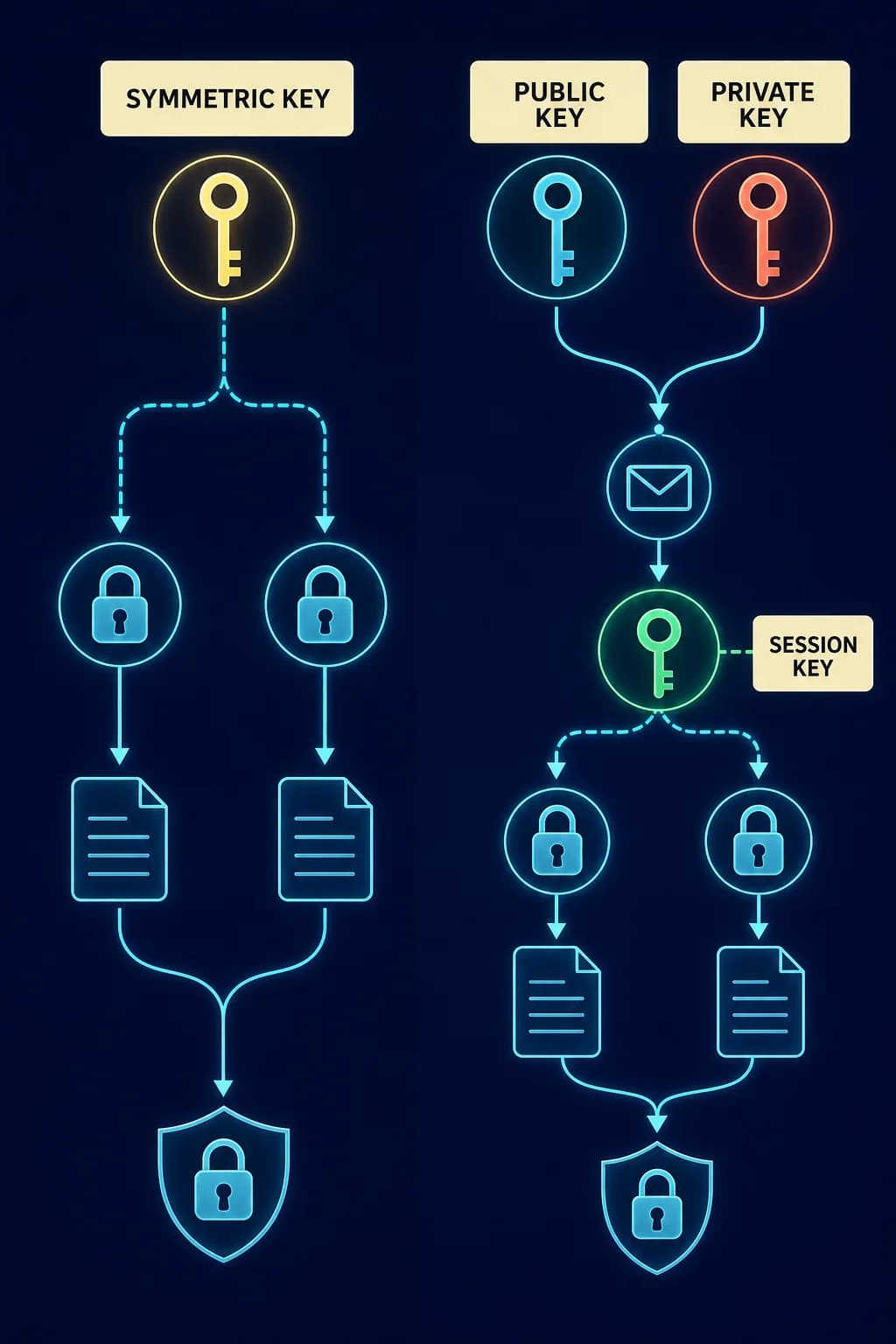
Symmetric encryption uses the same secret key, or directly related secret material, for protection and recovery. It's efficient, but the communicating parties must establish that secret safely. Public-key cryptography separates a publishable public key from a private key that must remain controlled.
Others can use the public key for operations such as encrypting to its owner or checking a digital signature, while only the private key performs the complementary secret operation. Real protocols combine these tools: public-key methods establish or authenticate a session, then symmetric keys protect the bulk data.
A split comparison shows one shared symmetric key used at both ends, and a public-private key pair that establishes a session key before fast symmetric data protection begins.
Page 3 of 3
Secrecy Is Not Enough
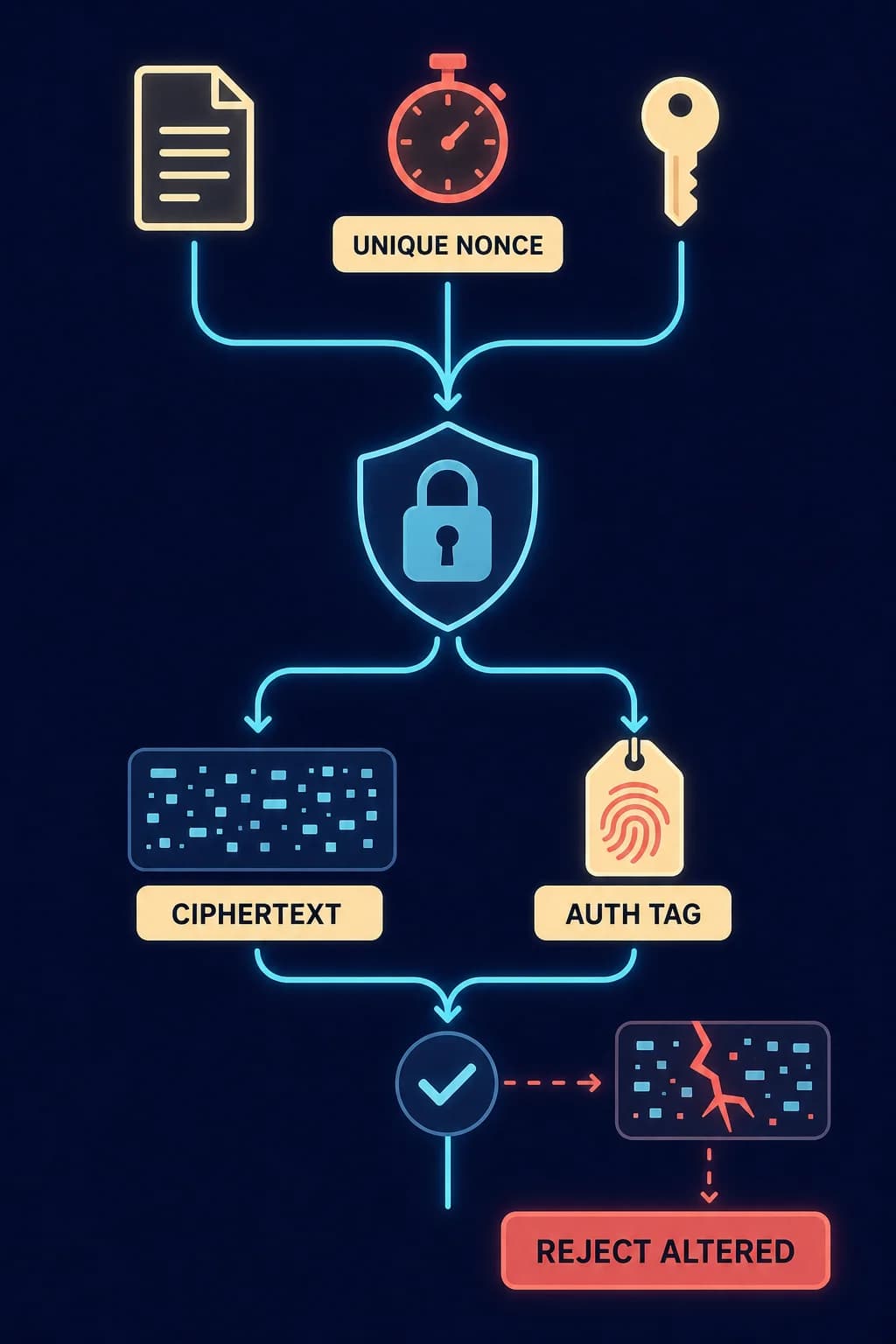
Encryption can hide content while still allowing undetected modification if it is used without integrity protection. Authenticated-encryption schemes combine confidentiality with an authentication tag. A unique nonce or initialization value is also required by many schemes; reusing it under one key can reveal relationships or break security.
The receiver checks the tag before accepting the plaintext, rejecting altered data instead of delivering plausible garbage. Keys also need a life cycle: generation, storage, rotation, revocation, and deletion. The algorithm may be public, but security is an entire system of key and nonce discipline around it.
A sender combines plaintext, secret key, and unique nonce to produce ciphertext plus a tag; the receiver verifies the tag and rejects a visibly altered packet.
Key takeaways
Modern cryptography concentrates secrecy in keys instead of algorithms
Public-key and symmetric methods commonly work together
Confidentiality needs nonce discipline and integrity checking
Check your understanding
What must remain secret when the encryption algorithm is public?
The cryptographic key, especially private or symmetric key material.
Why do protocols often switch to symmetric encryption after a public-key exchange?
Symmetric encryption efficiently protects the bulk session data.
What does an authentication tag add?
A way for the receiver to detect that protected data was altered or forged.
Sources
These references were used to check the important factual claims in this edition.