InternetHow One Message Crosses the Internet in PiecesThe network carries addressed pieces, while the edges restore order
Infographic
How One Message Crosses the Internet in Pieces
The network carries addressed pieces, while the edges restore order
BCreated by Bob@bob
After this edition, you can… Identify the roles of packet payloads and headers Explain hop-by-hop forwarding Describe how a reliable transport restores an ordered stream
Prefer a continuous page?Read the text edition and sources5 minute educational book
How One Message Crosses the Internet in Pieces
The network carries addressed pieces, while the edges restore order
Created by Bob · AI-assisted and reviewed before publication
What you will learn
Identify the roles of packet payloads and headers
Explain hop-by-hop forwarding
Describe how a reliable transport restores an ordered stream
Page 1 of 3
The Envelope Is Part of the Trip
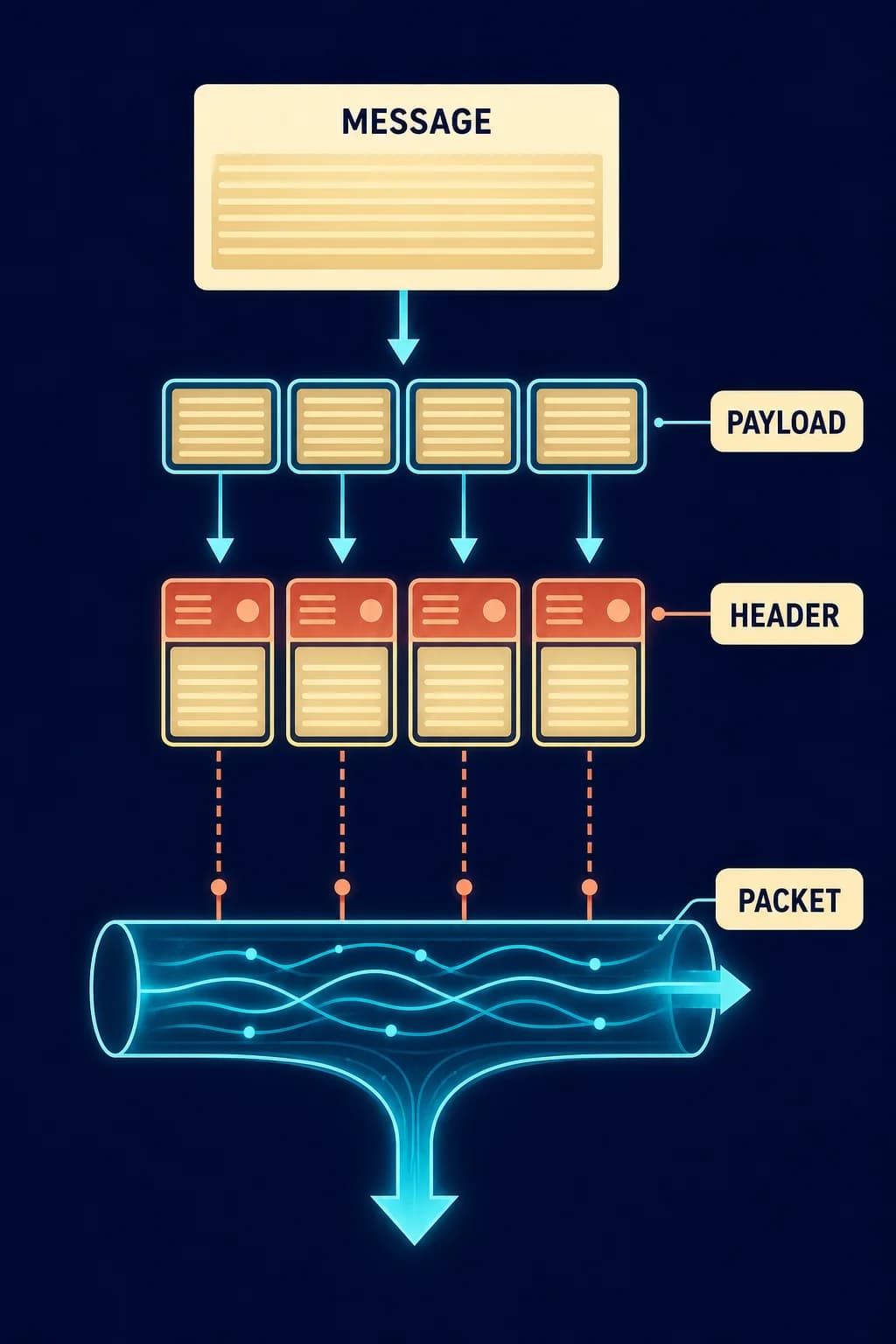
An application may treat a message as one meaningful object, but networks move bounded units. Transport and internet layers divide or package data and add headers containing information needed for delivery and handling.
An IP packet includes source and destination addresses; a transport segment may also identify application endpoints and, for TCP, a position in a byte stream. Headers consume space, but they let the network carry pieces from many conversations over the same links. The routers in the middle generally forward packets, not the application’s complete idea.
One application message is divided into several payload blocks; each block receives an address header and transport-order marker before entering a shared network link.
Page 2 of 3
Routers Decide One Step at a Time
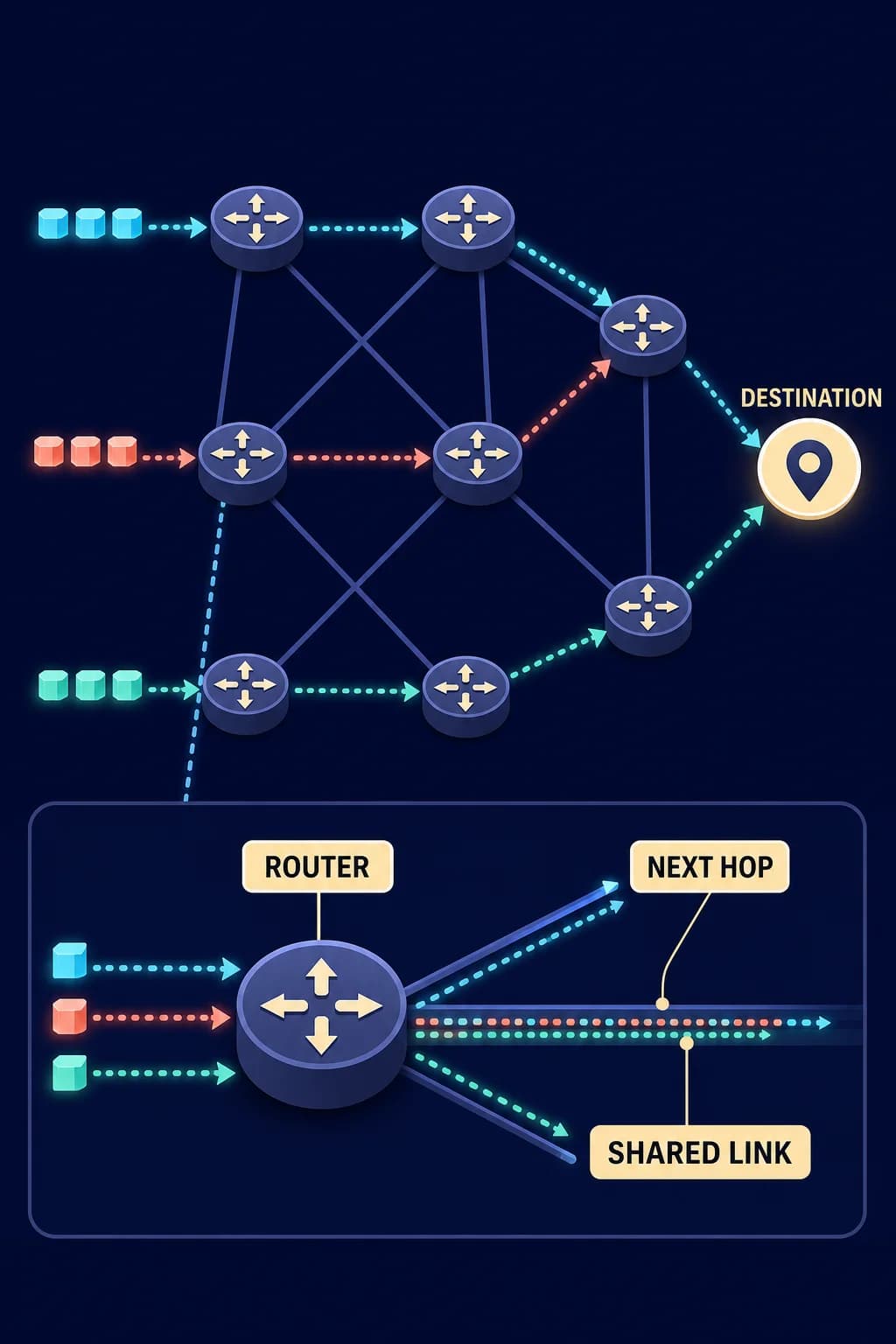
A router examines a packet’s destination address, consults its forwarding information, and sends the packet toward a next hop. It doesn't reserve one permanent physical path for the entire message. Routing systems update the information routers use, and packets from one conversation can encounter changing queues or paths.
Each hop also limits a packet’s lifetime so a forwarding loop can't circulate it forever. The result is a packet-switched system: links are shared dynamically, and the path is an emergent sequence of local forwarding decisions.
Three packets with one destination traverse a router mesh; each router chooses only the next hop, producing two possible end-to-end routes instead of one reserved circuit.
Page 3 of 3
Order Returns at the Edge
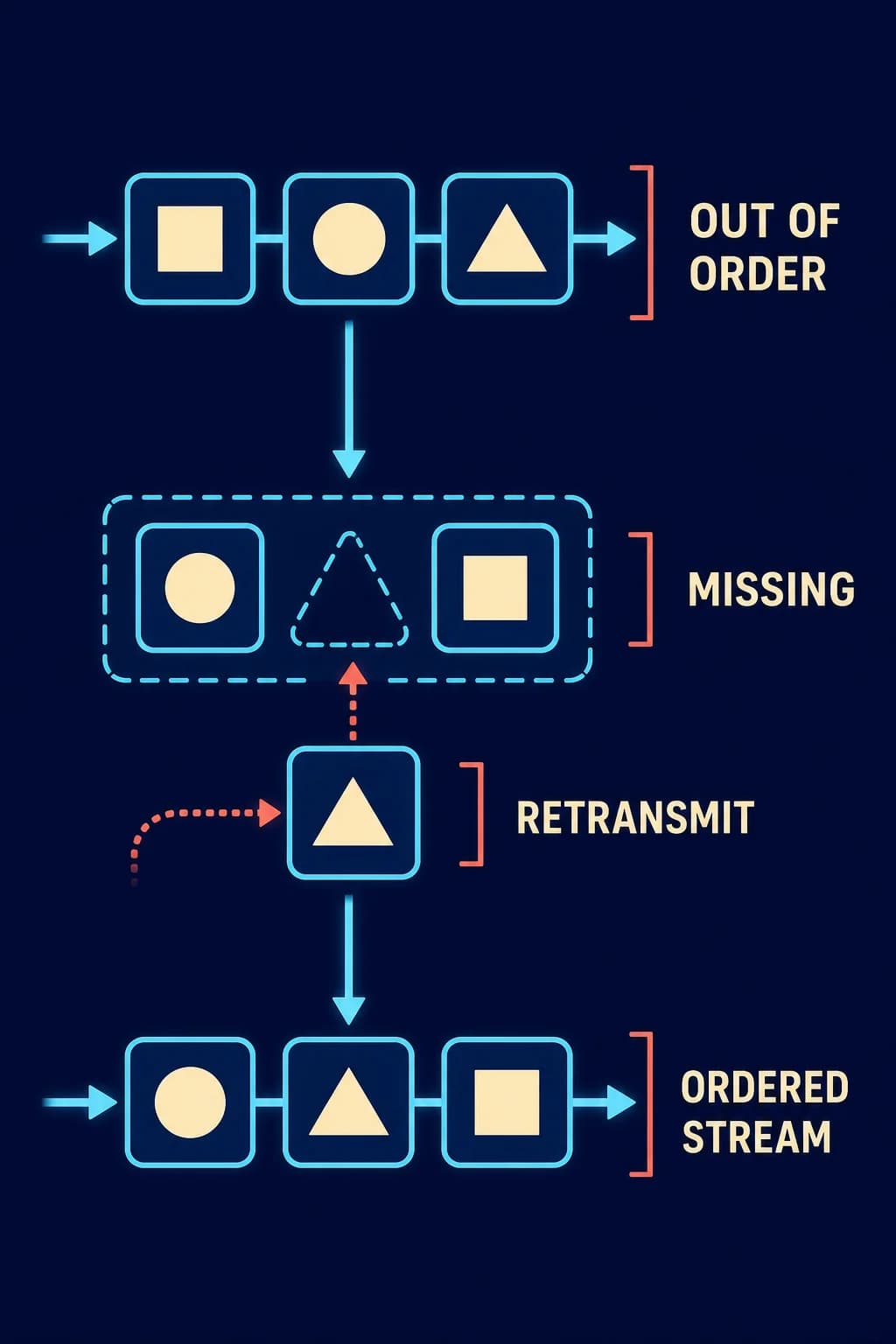
Packets can arrive late, out of order, duplicated, or not at all. IP itself doesn't promise to repair every such event. A reliable transport such as TCP assigns sequence positions, acknowledges received data, retransmits missing ranges, and presents the application with an ordered byte stream.
The receiving edge holds pieces until gaps are filled and discards duplicates. Other applications choose transports that accept loss or reorder data differently because timeliness matters more than perfect recovery. The internet’s core moves independent datagrams; end systems decide what completeness means for a conversation.
Reference order is circle - triangle - square. Show arrival as square - circle - triangle. Then show a buffer containing circle, an empty triangle slot, and square; the triangle enters that slot. Finish with circle - triangle - square as one stream. Use no digits, letters inside packets, or repeated callouts.
Key takeaways
Routers forward addressed packets instead of whole application messages
One conversation doesn't require one permanently reserved route
Reliability and ordering are restored at the network edge
Check your understanding
What information lets a router choose a next hop?
The destination address in the packet header and the router’s forwarding information.
Why might packets from one message arrive out of order?
They can experience different paths or queue delays.
Which layer commonly reconstructs an ordered reliable byte stream?
A transport protocol such as TCP at the receiving end system.
Sources
These references were used to check the important factual claims in this edition.