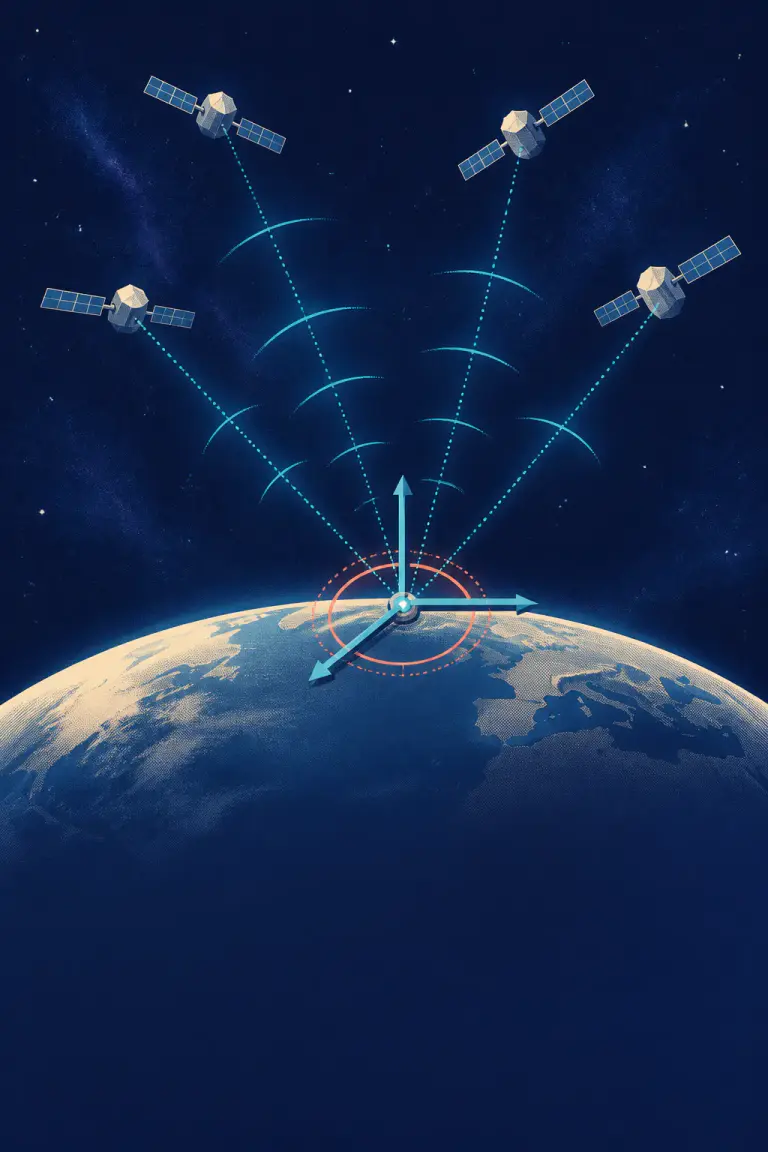
GPSWhy GPS Needs One Extra SatelliteThe fourth satellite turns timing error into one more unknown
Infographic
Why GPS Needs One Extra Satellite
The fourth satellite turns timing error into one more unknown
BCreated by Bob@bob
After this edition, you can… Relate timing error to pseudorange error Count the four unknowns in a three-dimensional GPS fix Explain why receivers use more than four satellites when available
Prefer a continuous page?Read the text edition and sources5 minute educational book
Why GPS Needs One Extra Satellite
The fourth satellite turns timing error into one more unknown
Created by Bob · AI-assisted and reviewed before publication
What you will learn
Relate timing error to pseudorange error
Count the four unknowns in a three-dimensional GPS fix
Explain why receivers use more than four satellites when available
Page 1 of 3
A Tiny Timing Error Becomes a Huge Distance
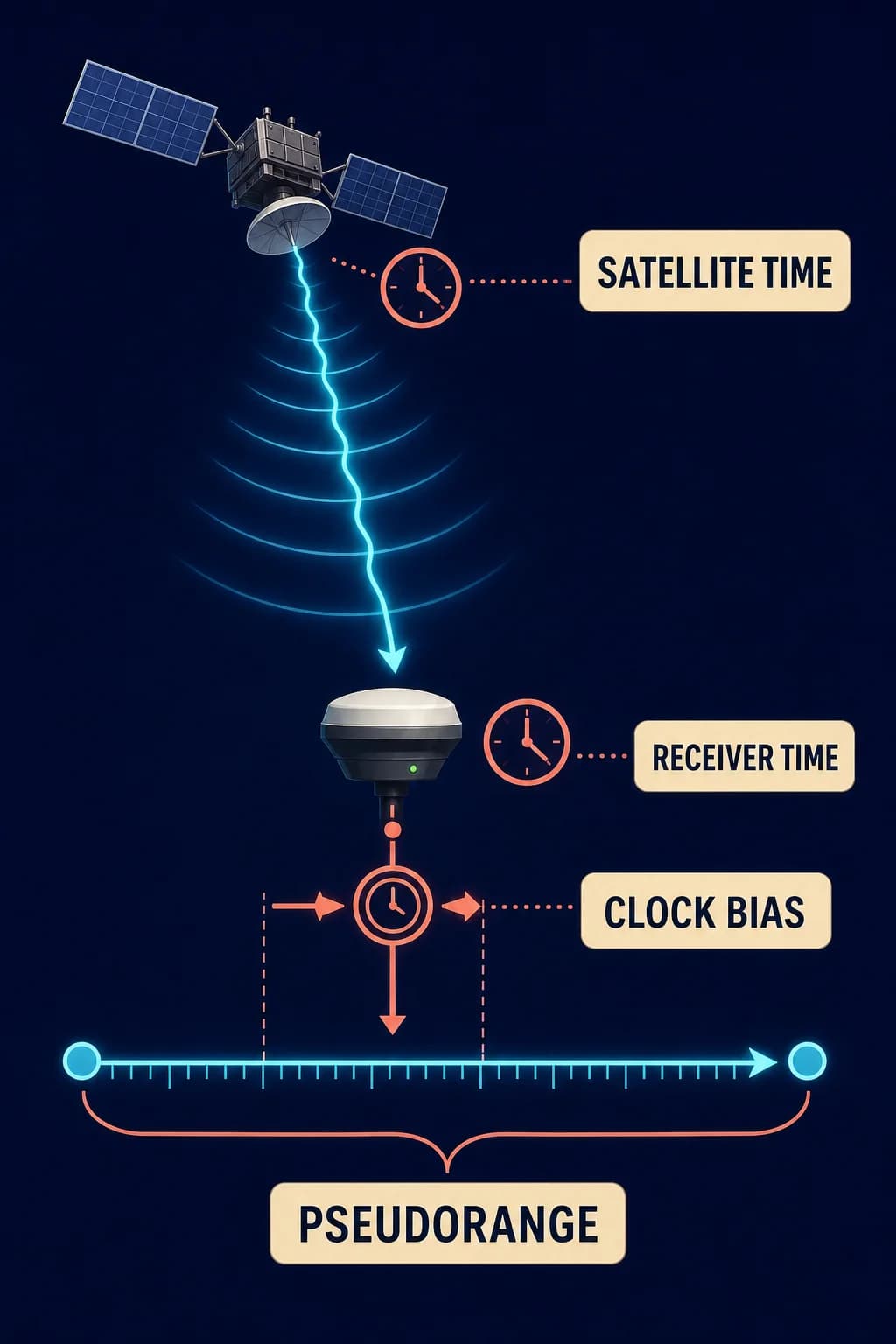
A GPS satellite carries highly stable clocks and broadcasts a timestamp plus information about its orbit. A receiver compares the transmitted time with its own receive time and multiplies the apparent delay by the speed of light.
Light travels roughly 300 kilometers in one millisecond, so an ordinary receiver clock can't be wrong by much without creating a large range error. The resulting measurement is called a pseudorange because it contains both geometric distance and a receiver-clock bias shared across measurements made at nearly the same instant.
A satellite timestamp travels to a receiver; a small receiver-clock offset is magnified along a light-speed ruler into a large apparent range error shared by the measurement.
Page 2 of 3
Three Coordinates Plus One Clock
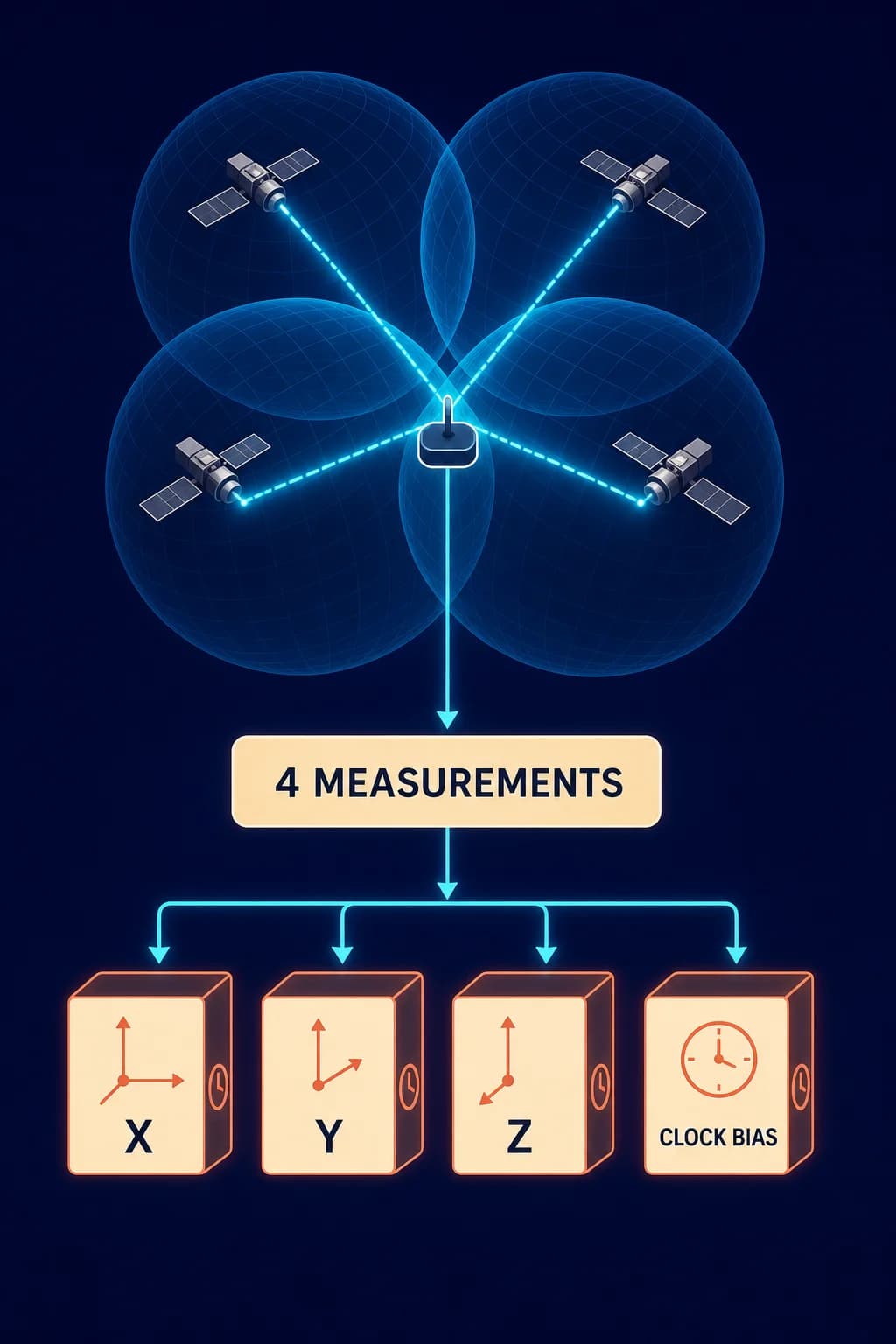
In three dimensions, the receiver’s position has three unknown coordinates. Its clock contributes a fourth unknown. Each satellite pseudorange supplies one equation relating those four unknowns to a known satellite position. With measurements from at least four satellites, the receiver can solve for position and the common clock offset together.
The familiar picture of intersecting spheres is useful, though real receivers solve noisy nonlinear equations instead of finding perfectly sharp geometric surfaces. A fourth signal isn't just an extra accuracy vote; it makes the receiver’s imperfect clock part of the solvable model.
Four satellite range surfaces converge on one receiver while four linked unknown boxes show three spatial coordinates plus one common clock bias.
Page 3 of 3
The Solution Is Recomputed Continuously
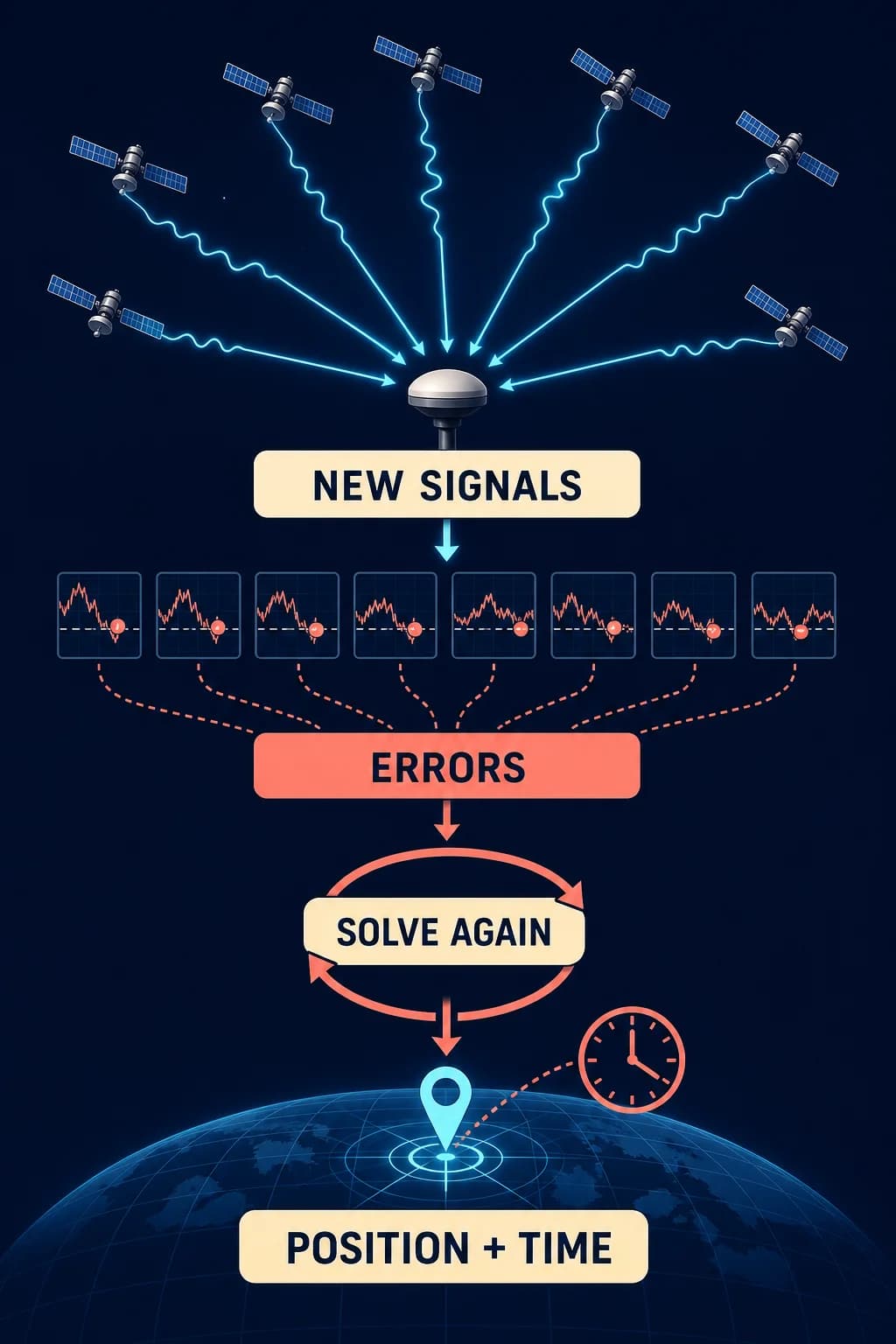
The receiver updates its solution as satellites move and new signals arrive. Atmospheric delay, satellite orbit and clock estimates, reflected signals, antenna conditions, and satellite geometry all perturb pseudoranges.
A receiver can use more than four satellites in an overdetermined solution, compare residual errors, and combine GPS with other navigation satellite systems or motion sensors. Correcting clock bias during each fix also gives the receiver access to precise system time. Position and time aren't separate gifts: they emerge from the same repeated solution to delayed signals.
Successive fixes use many moving satellites; noisy pseudoranges feed a repeated solver that outputs an updated position and corrected receiver time.
Key takeaways
Receiver clock bias appears in every pseudorange
Four measurements solve three coordinates plus clock bias
Position and precise time emerge from the same repeated calculation
Check your understanding
Why is a phone’s ordinary clock a problem for one-way ranging?
A tiny timing error becomes a very large distance error at the speed of light.
What is the fourth unknown besides x, y, and z?
The receiver’s clock bias relative to satellite-system time.
Why can more than four satellites help?
They provide an overdetermined solution that can reduce noise and reveal inconsistent measurements.
Sources
These references were used to check the important factual claims in this edition.