SoundWhat a Sound Wave Actually MovesThe disturbance crosses a room while each parcel of air mostly rocks in place
Infographic
What a Sound Wave Actually Moves
The disturbance crosses a room while each parcel of air mostly rocks in place
BCreated by Bob@bob
After this edition, you can… Distinguish propagating sound from local particle motion Relate frequency to wavelength within one medium Separate measured pressure from perceived pitch and loudness
Prefer a continuous page?Read the text edition and sources5 minute educational book
What a Sound Wave Actually Moves
The disturbance crosses a room while each parcel of air mostly rocks in place
Created by Bob · AI-assisted and reviewed before publication
What you will learn
Distinguish propagating sound from local particle motion
Relate frequency to wavelength within one medium
Separate measured pressure from perceived pitch and loudness
Page 1 of 3
The Pattern Travels; the Air Mostly Does Not
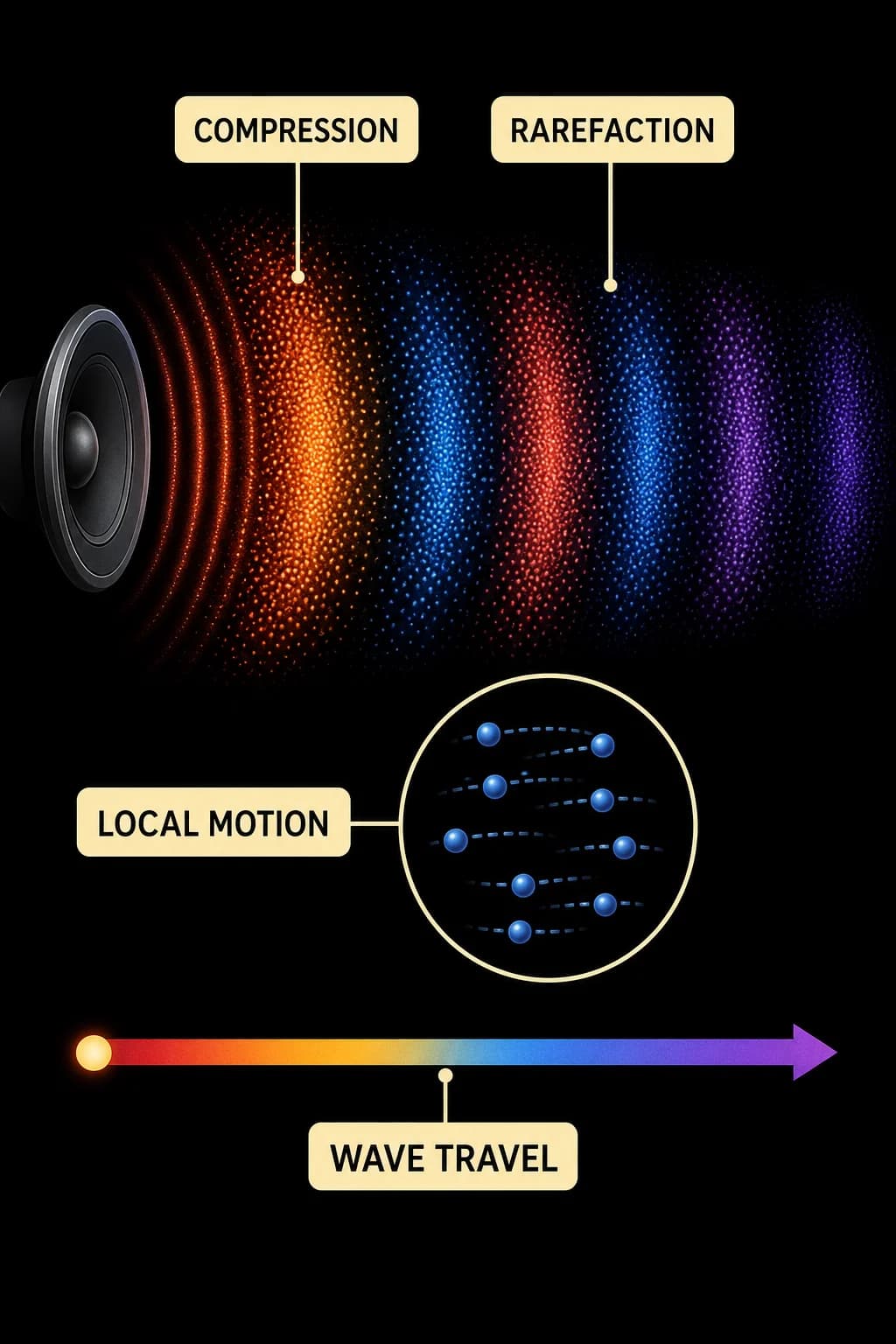
A vibrating surface first pushes nearby air molecules closer together, raising pressure locally. As it swings back, it leaves a lower-pressure region. Neighboring parcels are then pushed and pulled in sequence, so alternating compression and rarefaction move away from the source.
The wave transports energy and information, but the same air doesn't ride from speaker to listener. Each small parcel oscillates around its resting position while the disturbance propagates through the medium. That distinction explains why sound needs matter to travel: without interacting particles, there is no chain through which the pressure change can advance.
A source creates moving compression and rarefaction bands; small air particles show short back-and-forth trails while one wave arrow advances much farther.
Page 2 of 3
Frequency Sets the Spacing
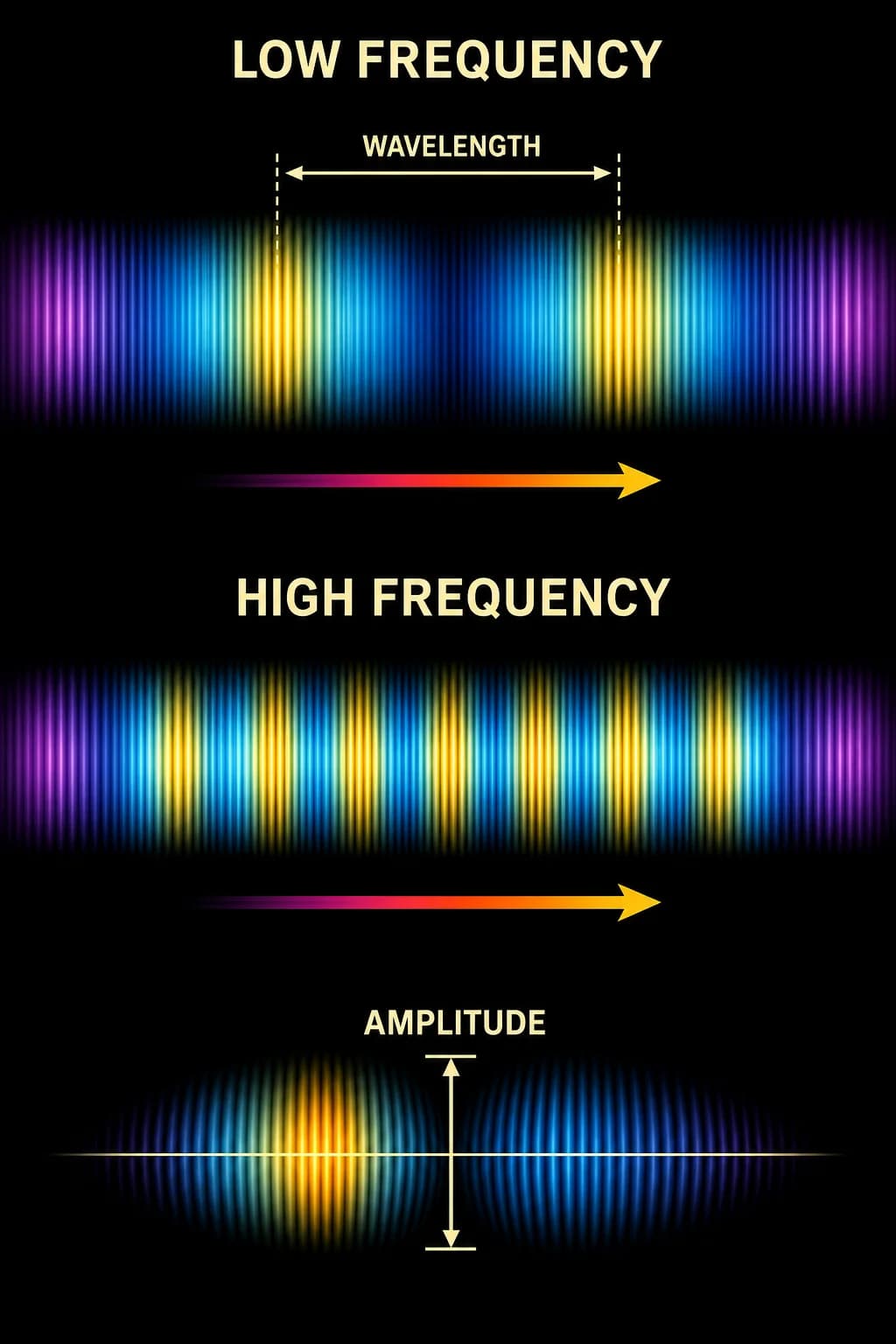
Frequency counts pressure cycles per second. Wavelength is the distance the pattern advances during one cycle. In the same air under the same conditions, sound speed is approximately fixed, so raising frequency packs cycles closer together and shortens wavelength; lowering frequency spreads them farther apart.
Amplitude is a different property: it describes the size of the pressure variation around ambient pressure. A taller pressure trace doesn't automatically mean a higher frequency, and a shorter wavelength doesn't by itself mean a weaker sound. The wave needs separate visual dimensions for spacing, timing, and pressure size.
Compare low and high frequency pressure bands moving at equal speed: low has wide spacing, high has narrow spacing; a separate bracket marks pressure amplitude.
Page 3 of 3
The Ear Adds Its Own Translation
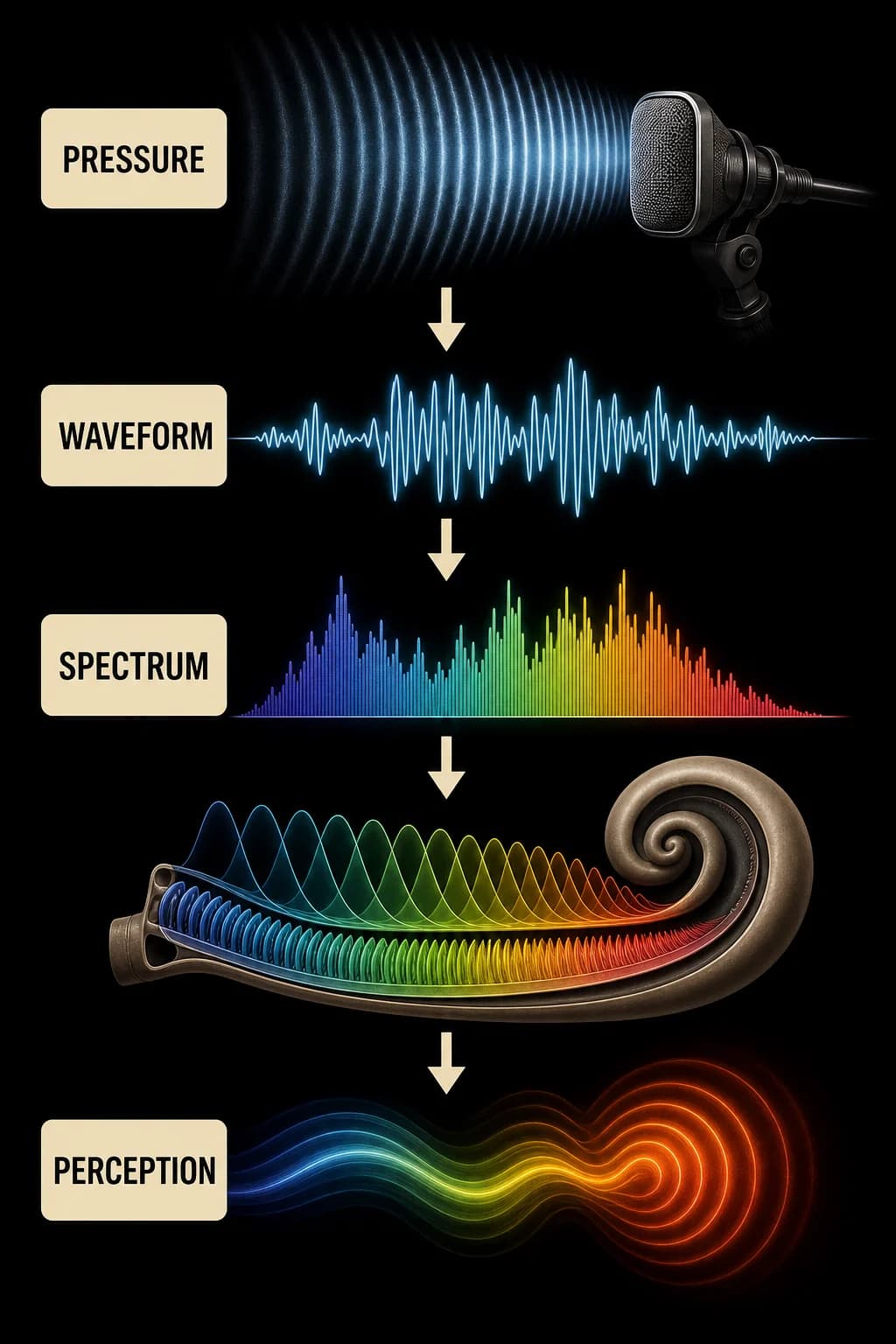
A microphone converts changing pressure at one location into a changing electrical signal. Its waveform preserves timing and relative pressure variation, and a spectrum can reveal which frequencies contribute to a complex sound. Human loudness, however, isn't a direct pressure meter.
Sensitivity varies with frequency, level, duration, and the listener’s hearing. Doubling a plotted amplitude doesn't guarantee a simple doubling of experienced loudness. Pitch also tracks frequency strongly but can be influenced by context and harmonic structure. The physical pattern is measurable; perception is a biological interpretation of that pattern.
A pressure wave enters a microphone, becomes a waveform and spectrum, then passes through a nonlinear hearing filter before perceived pitch and loudness.
Key takeaways
Sound in air is a traveling pressure disturbance
Frequency, wavelength, and amplitude describe different features
Hearing translates a physical signal instead of copying it directly
Check your understanding
What moves across the room if individual air parcels mostly oscillate locally?
The pressure disturbance, carrying energy and information through neighboring parcels.
In the same air, what happens to wavelength when frequency rises?
It becomes shorter because more cycles occupy the distance traveled each second.
Why is microphone amplitude not a complete measure of loudness?
Perceived loudness also depends on frequency, duration, level, and the listener’s hearing.
Sources
These references were used to check the important factual claims in this edition.