LanguageHow Sign Language Uses Space as GrammarHands, faces, locations, and movement can organize language without copying speech
Infographic
How Sign Language Uses Space as Grammar
Hands, faces, locations, and movement can organize language without copying speech
BCreated by Bob@bob
After this edition, you can… Recognize ASL as a complete language distinct from English Identify manual and nonmanual components of sign structure Explain how signing-space locations can maintain reference
Prefer a continuous page?Read the text edition and sources5 minute educational book
How Sign Language Uses Space as Grammar
Hands, faces, locations, and movement can organize language without copying speech
Created by Bob · AI-assisted and reviewed before publication
What you will learn
Recognize ASL as a complete language distinct from English
Identify manual and nonmanual components of sign structure
Explain how signing-space locations can maintain reference
Page 1 of 3
A Signed Language Is Not Spoken Language in Mime
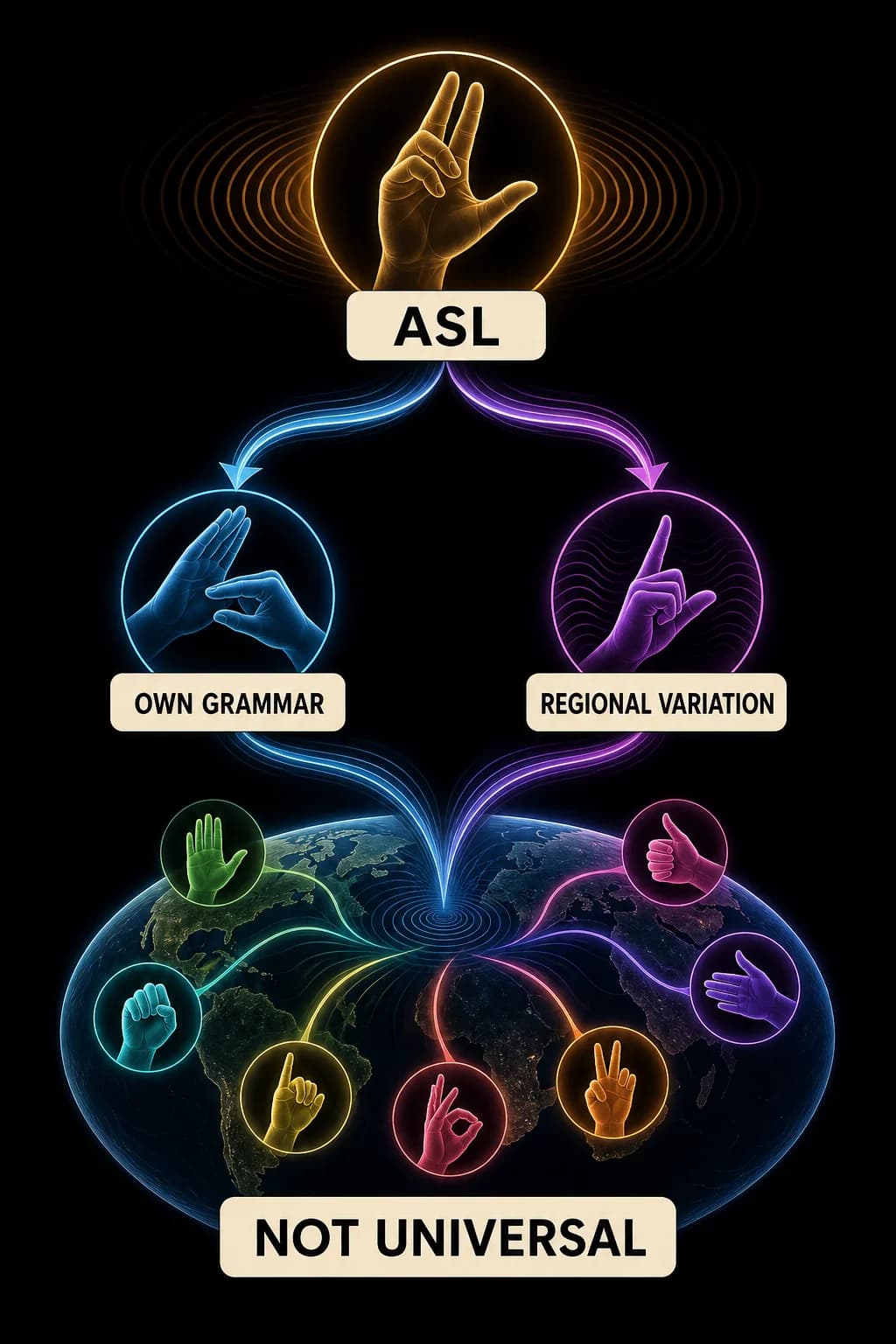
American Sign Language is a complete natural language with its own patterns for forming words and sentences. It isn't English translated one word at a time into gestures, and it wasn't designed by a committee. ASL also isn't universal: British Sign Language and other signed languages have distinct histories and structures.
Its visual-manual channel changes what can be expressed simultaneously, but it still supports vocabulary, grammar, storytelling, abstraction, humor, and regional variation. The important comparison is between languages using different physical channels, not between language and an improvised game of charades.
One ASL language tree branches into grammar and regional variation; separate colored hand nodes across a globe show multiple signed languages. No second tree label or other language name.
Page 2 of 3
Small Form Changes Can Change Meaning
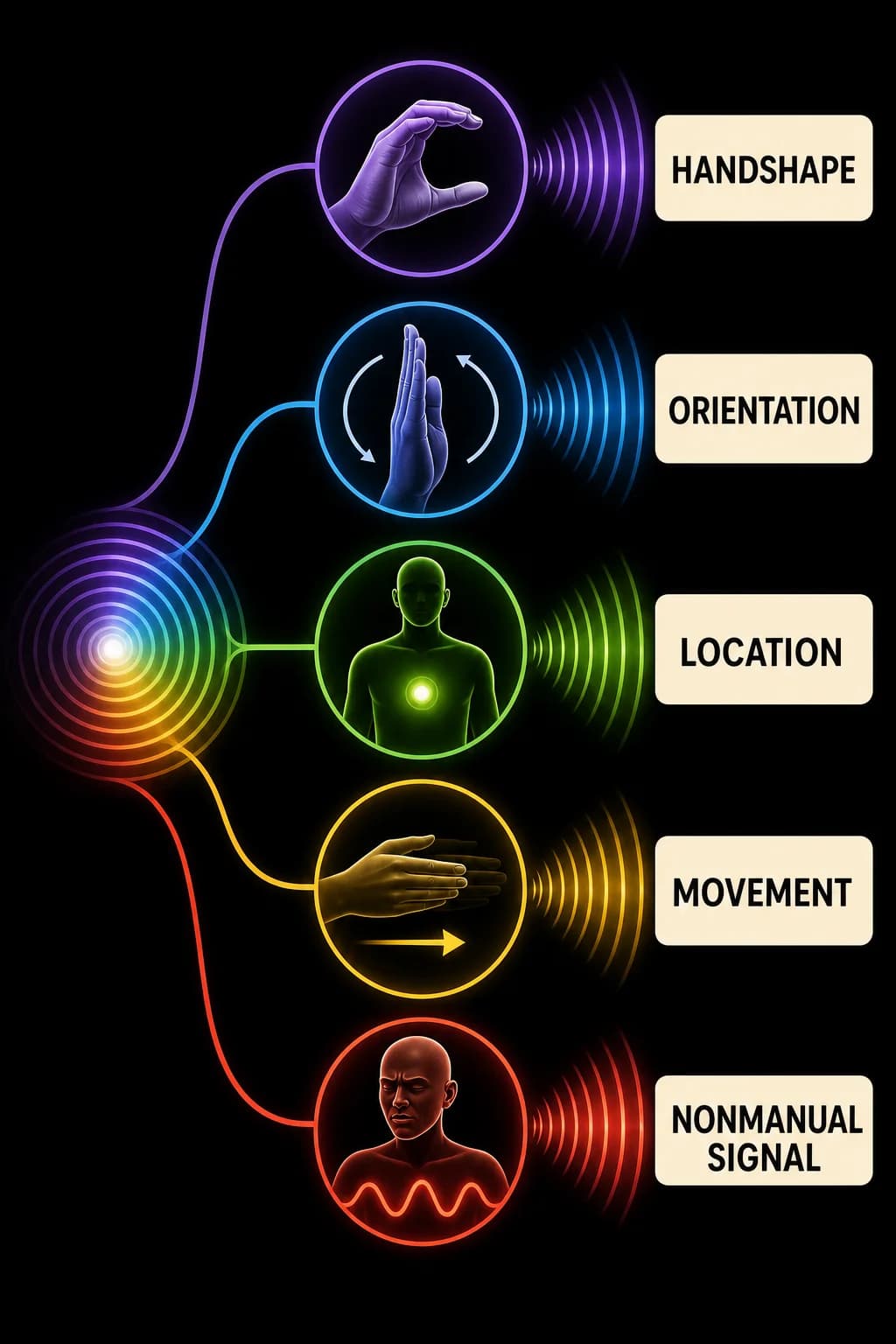
A lexical sign is structured from interacting parameters such as handshape, palm orientation, location, and movement. Changing one parameter can produce a different sign, much as changing a sound can distinguish spoken words. The face and body carry linguistic information too.
Eyebrows, head position, gaze, mouth movement, and timing can mark sentence type, topic structure, intensity, or other grammatical and discourse functions. Calling these features mere emotion misses their coordinated role. A signer produces several synchronized channels, and a fluent viewer reads the pattern as one linguistic event instead of adding a hand message to a facial decoration.
Five abstract tiles, never real lexical signs, separately show handshape, orientation, location, movement, and a face-and-body timing track for nonmanual grammar.
Page 3 of 3
A Location Can Become Part of the Sentence
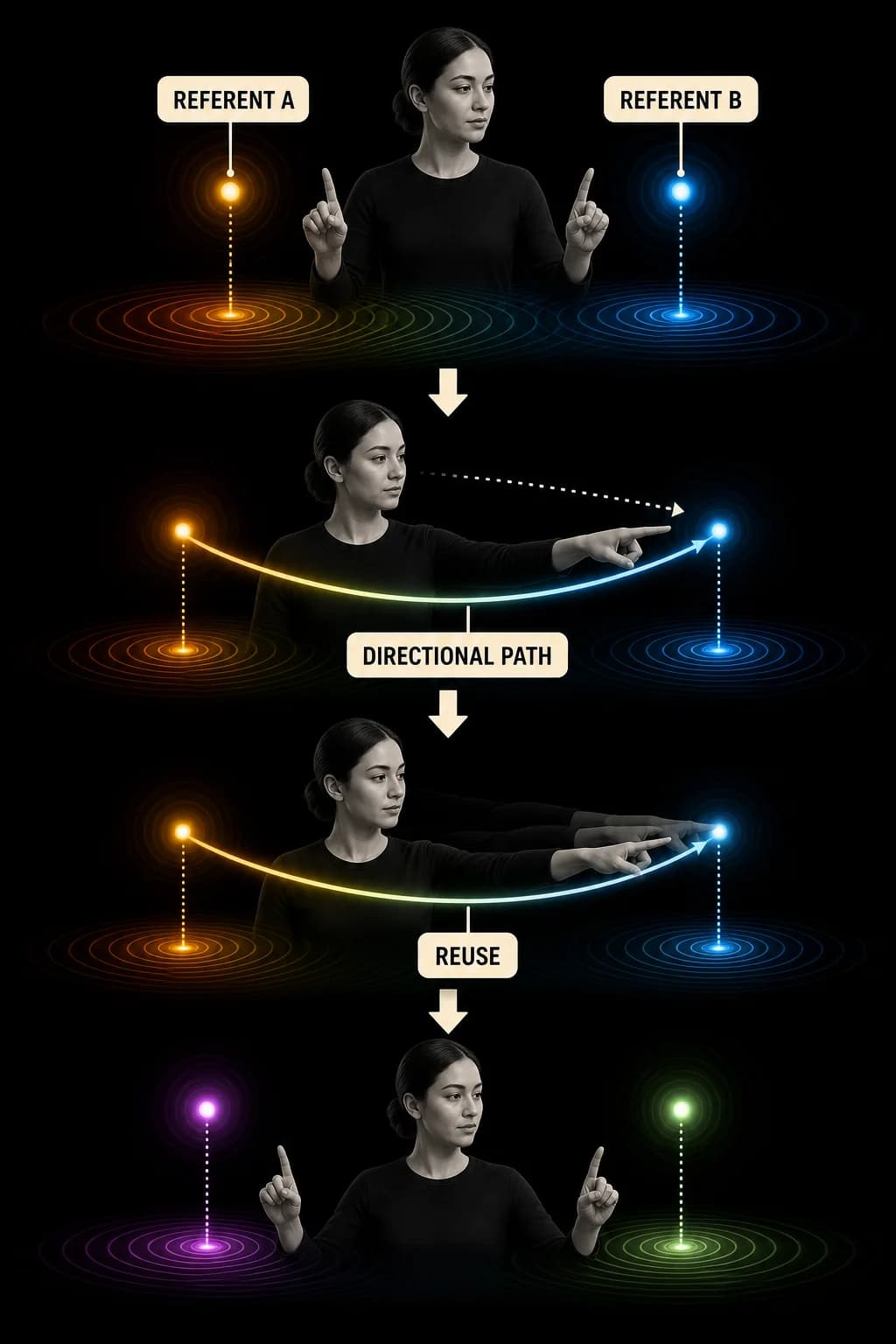
In ASL discourse, a signer can associate people or things with locations in signing space and later point toward those loci to maintain reference. Some verbs change their movement path or orientation to relate grammatical participants; spatial classifier constructions can also depict categories of objects, their placement, or motion.
The space isn't a miniature stage with one fixed meaning. Locations are established by discourse, reused, contrasted, and cleared as communication continues. Eye gaze, torso shift, and hand movement help coordinate those references. Grammar can use direction and location as organized linguistic resources, not just as pictures of where physical objects happen to be.
Two abstract referent nodes are established in signing space; a neutral signer reuses them with pointing, gaze, and a directional path, then resets the space for a new contrast. Avoid depicting named signs.
Key takeaways
Signed languages are diverse natural languages
Hands, face, gaze, and body can carry synchronized linguistic structure
Locations and directions in signing space can function grammatically
Check your understanding
Why is ASL not just English performed with the hands?
It has its own vocabulary, formation rules, grammar, history, and regional variation.
Name two components that can distinguish sign forms.
Any two of handshape, palm orientation, location, movement, or coordinated nonmanual signals.
How can a signer reuse a location in signing space?
By associating it with a referent and later pointing or directing movement toward that locus.
Sources
These references were used to check the important factual claims in this edition.