PerspectiveHow a Flat Picture Tricks You into Seeing DepthA flat picture becomes spatial only after it commits to a viewpoint
Infographic
How a Flat Picture Tricks You into Seeing Depth
A flat picture becomes spatial only after it commits to a viewpoint
BCreated by Bob@bob
After this edition, you can… Describe a picture as projection from one viewpoint Associate each vanishing point with a spatial direction Predict how moving the viewpoint changes horizon and convergence
Prefer a continuous page?Read the text edition and sources5 minute educational book
How a Flat Picture Tricks You into Seeing Depth
A flat picture becomes spatial only after it commits to a viewpoint
Created by Bob · AI-assisted and reviewed before publication
What you will learn
Describe a picture as projection from one viewpoint
Associate each vanishing point with a spatial direction
Predict how moving the viewpoint changes horizon and convergence
Page 1 of 3
One Viewpoint Turns Rays into a Picture
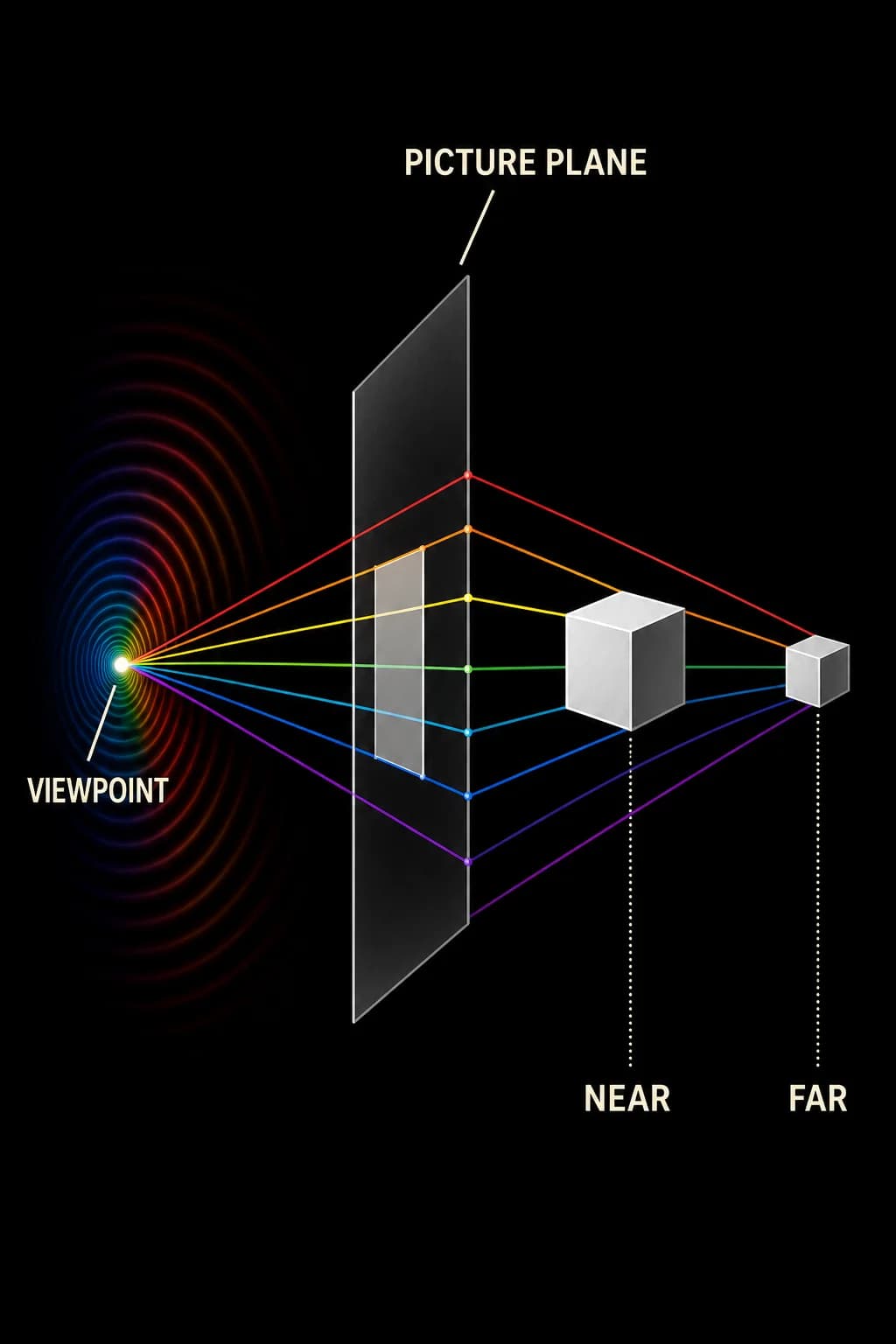
Linear perspective models a scene from one center of projection. Imagine straight rays from visible points passing through a picture plane toward one eye or pinhole. Where each ray meets the plane determines the drawn point. A same-sized object farther away occupies a smaller angle at the viewpoint, so its projection becomes smaller.
Straight world lines remain straight in the ideal central projection, but lengths, angles, and parallelism are generally not preserved. The picture isn't a miniature copy laid flat. It's a map of directions from one chosen location.
A single viewpoint sends rays through a picture plane to identical near and far objects; the farther object projects smaller while straight edges stay straight.
Page 2 of 3
A Vanishing Point Belongs to a Direction
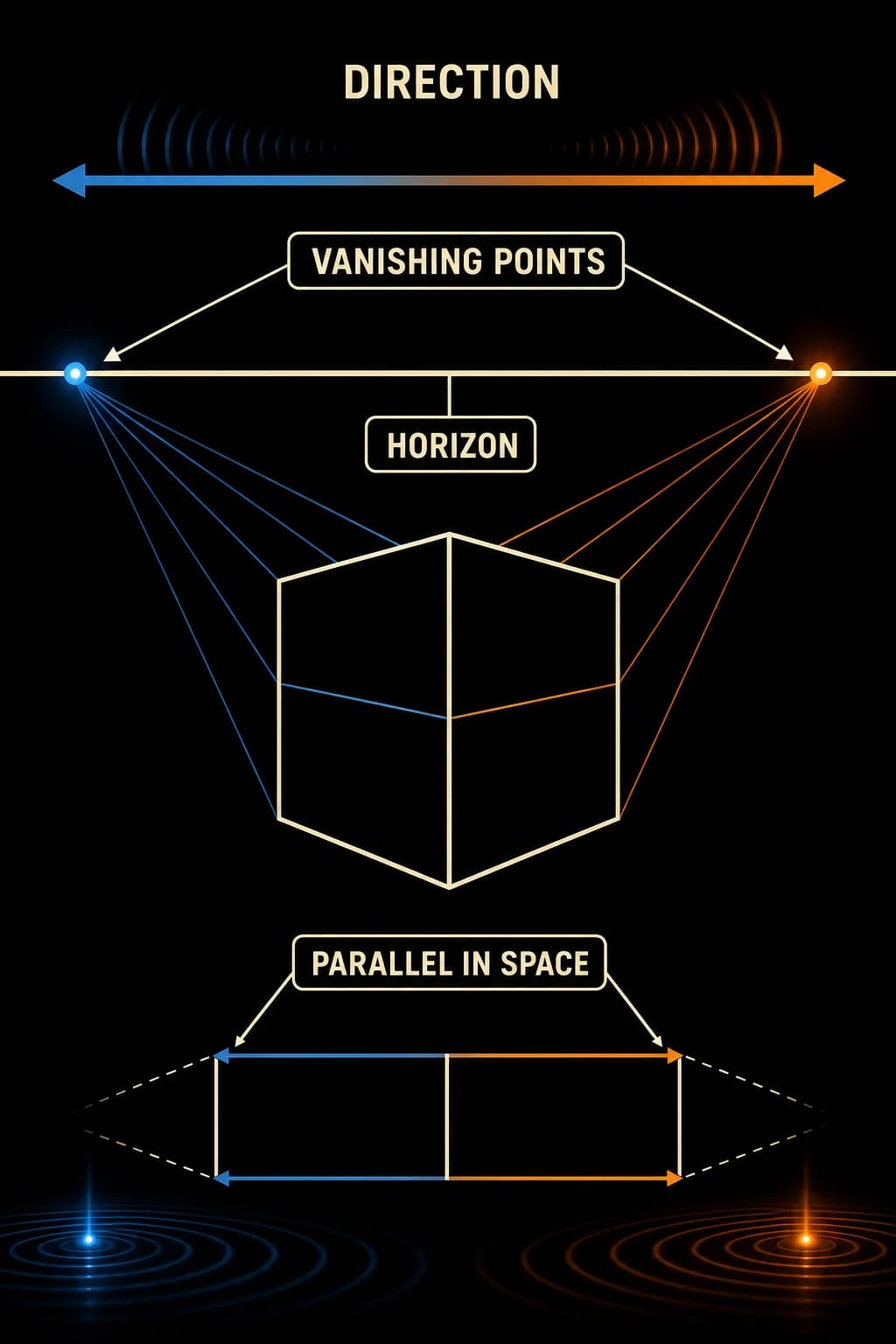
Parallel lines that recede in the same three-dimensional direction project toward a common vanishing point, unless that direction is parallel to the picture plane. Railroad rails illustrate the effect: their separation remains constant in the world while their images approach one point.
Different sets of parallel directions have different vanishing points. For directions lying in a level ground plane, those points lie on a common horizon line corresponding to the viewer’s eye height. One-point, two-point, and three-point perspective are arrangements of object directions relative to the picture plane; not different laws of vision.
Two-point perspective only. Put blue left and orange right dots directly ON one bold cream horizontal horizon. Receding box edges converge to those dots; vertical edges stay vertical. Label both dots once as VANISHING POINTS.
Page 3 of 3
Move the Eye and the Whole Construction Changes
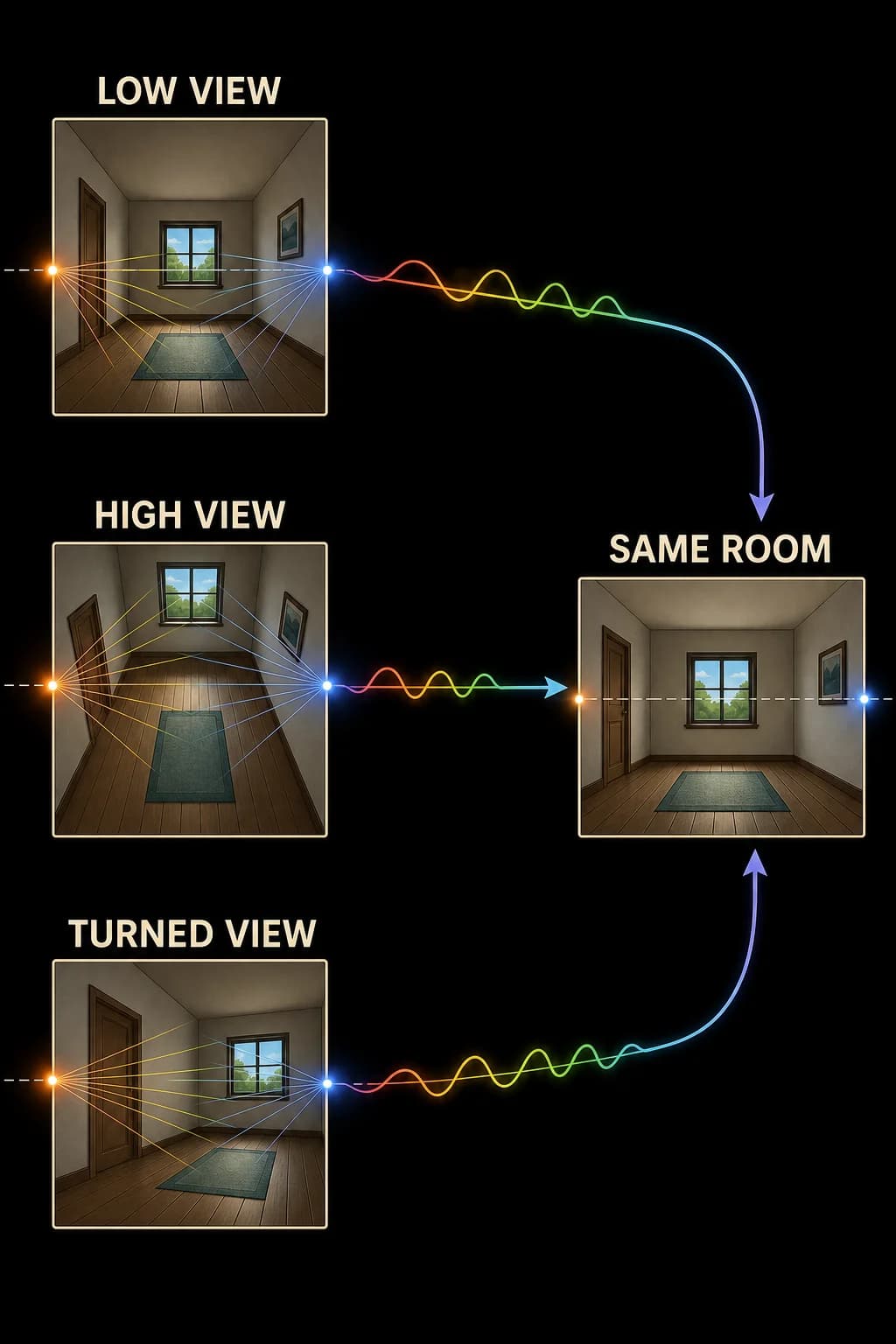
The horizon rises or falls with viewpoint height, and vanishing points shift when the viewer turns or the picture plane rotates. Looking upward can make vertical building edges converge; holding the image plane level can keep them parallel. A geometrically consistent perspective is most convincing when viewed from its intended center, because that position reverses the original projection.
Artists and designers may deliberately bend the system, combine viewpoints, or move vanishing points for clarity and composition. Those choices can be effective, but they are choices to depart from one-camera geometry instead of hidden properties of the depicted objects.
The same room is projected from low, high, and turned viewpoints; horizon height and vanishing points move together while the room itself remains unchanged.
Key takeaways
Perspective maps viewing rays instead of preserving physical measurements
Parallel lines share a vanishing point only when they share a direction
The viewpoint is part of every perspective construction
Check your understanding
Why does an equally sized far object appear smaller in perspective?
It occupies a smaller angle at the viewpoint and a smaller span on the picture plane.
Does every parallel line in a scene meet the same vanishing point?
No. Only parallel lines sharing one spatial direction share a vanishing point.
What happens to the horizon when the viewpoint rises?
The horizon rises with the viewer’s eye height in the picture.
Sources
These references were used to check the important factual claims in this edition.