ColorWhy Mixing Light Is Different from Mixing PaintEmitters add spectral power; pigments remove parts of the light already present
Infographic
Why Mixing Light Is Different from Mixing Paint
Emitters add spectral power; pigments remove parts of the light already present
BCreated by Bob@bob
After this edition, you can… Distinguish additive emission from subtractive reflection Trace how pigment absorption changes returned light Explain why illumination can change a paint color match
Prefer a continuous page?Read the text edition and sources5 minute educational book
Why Mixing Light Is Different from Mixing Paint
Emitters add spectral power; pigments remove parts of the light already present
Created by Bob · AI-assisted and reviewed before publication
What you will learn
Distinguish additive emission from subtractive reflection
Trace how pigment absorption changes returned light
Explain why illumination can change a paint color match
Page 1 of 3
Lights Add What Reaches the Eye
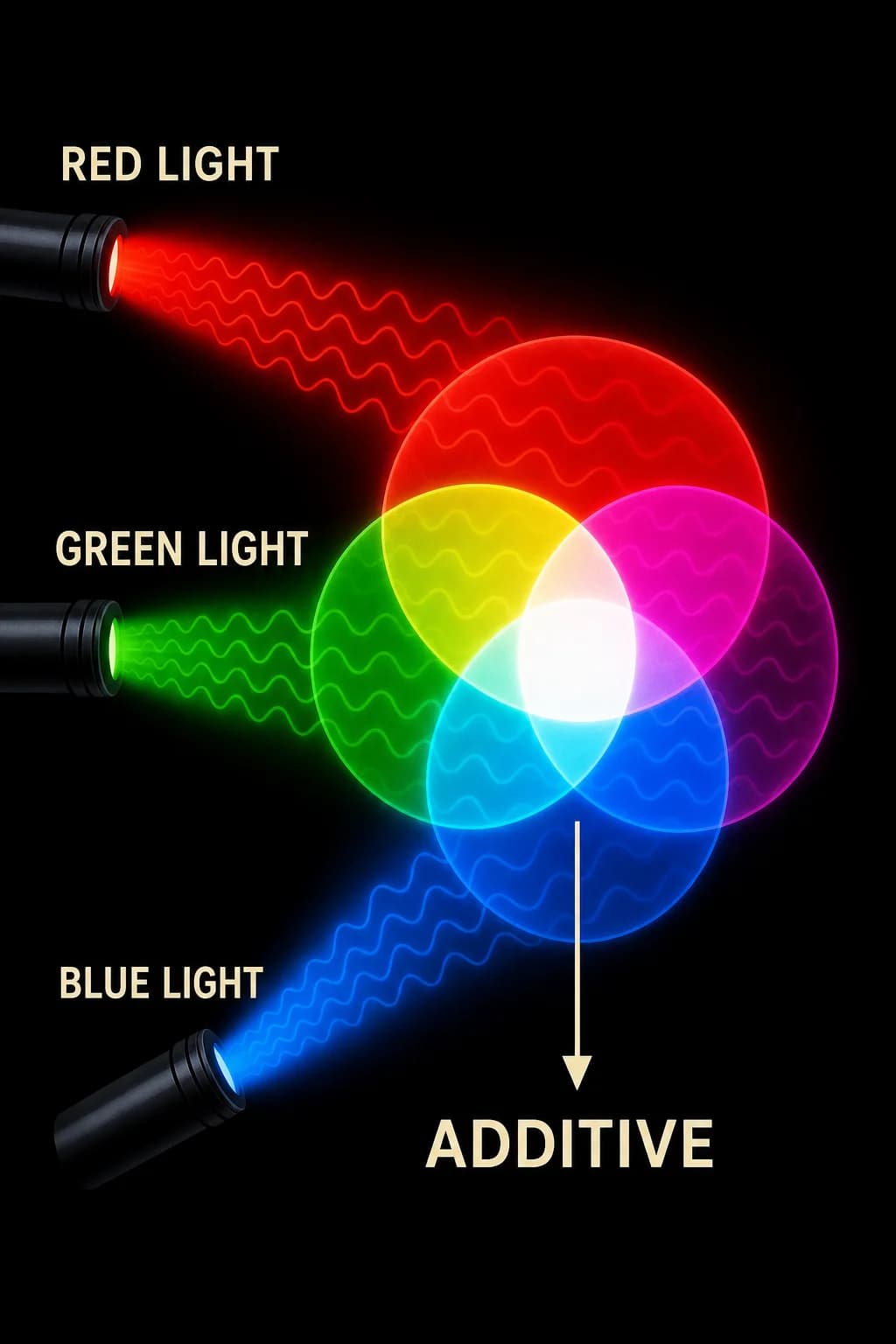
When two projected lights overlap on a pale screen, their spectral power adds at each wavelength. Red and green primary lights can stimulate the cone system in a combination perceived as yellow, even though no narrow yellow spectral line was added. Red, green, and blue display primaries can together produce a white or neutral response when their intensities are balanced for that display and observer.
The overlap grows brighter because more light reaches the eye. Additive mixing begins with darkness and builds a signal from emitting sources; its primary choices are engineered around human color matching, not universal labels attached to wavelengths.
Three emitted beams overlap on a dark field: pairs create cyan, magenta, and yellow response regions, while all three meet in one bright neutral center.
Page 2 of 3
Pigments Subtract from Illumination
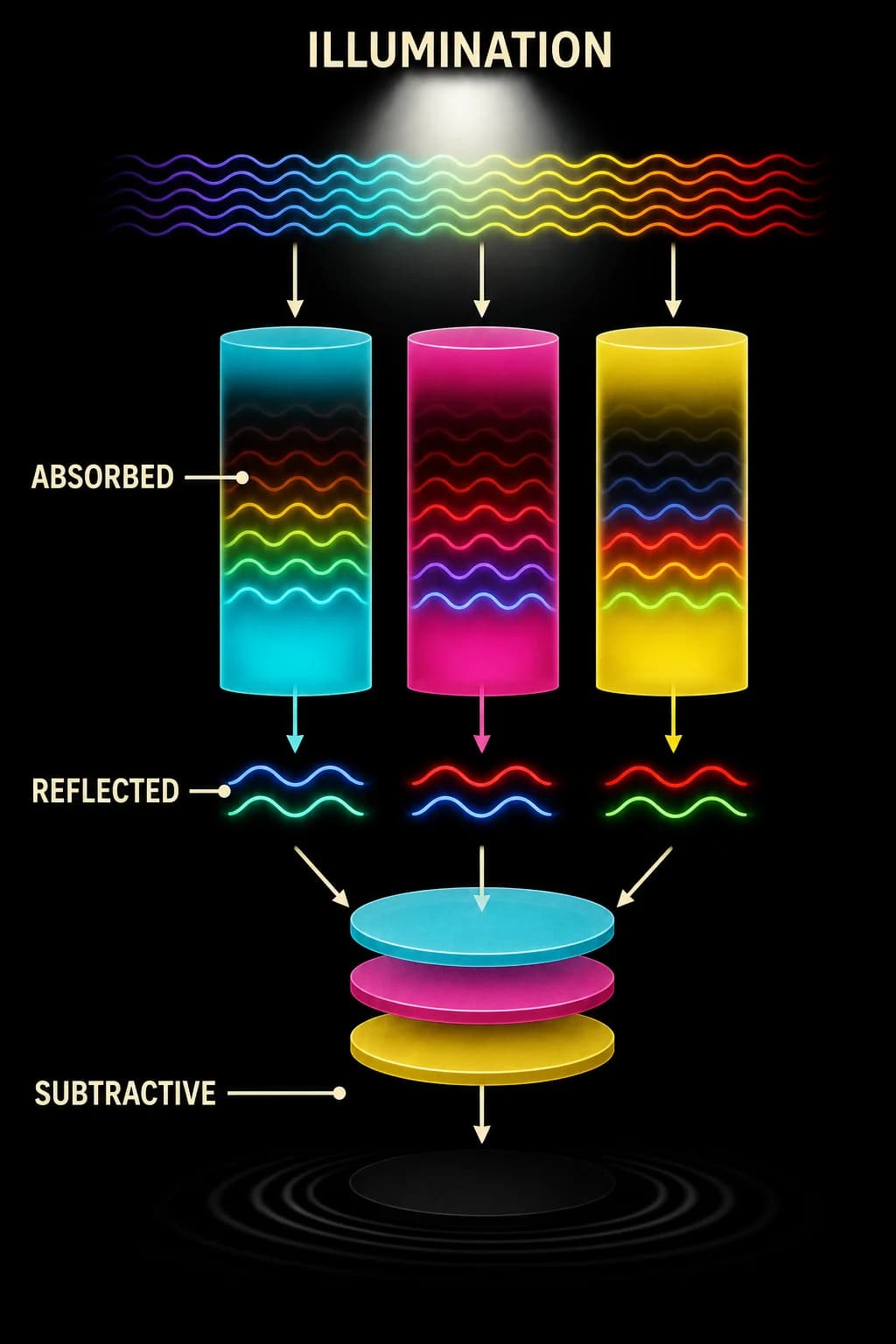
A painted surface doesn't usually emit its own visible light. Illumination enters the paint layer, where pigment particles absorb some wavelengths and scatter or reflect others back out. Mix two pigments and light encounters both sets of absorptions, so fewer spectral regions may survive the round trip.
Ideal cyan, magenta, and yellow colorants are often used to diagram this subtractive logic. Their overlap tends toward darkness because each removes a different part of an initially broad source. Real paint also scatters, layers unevenly, and contains imperfect pigments, so mixtures rarely behave like clean geometric filters.
Ideal pigment chart: white light enters cyan, magenta, and yellow columns. Cyan reflects blue+green; magenta reflects red+blue; yellow reflects red+green. A combined CMY stack returns almost no light, never a full rainbow.
Page 3 of 3
The Lamp Is Part of the Paint Mixture
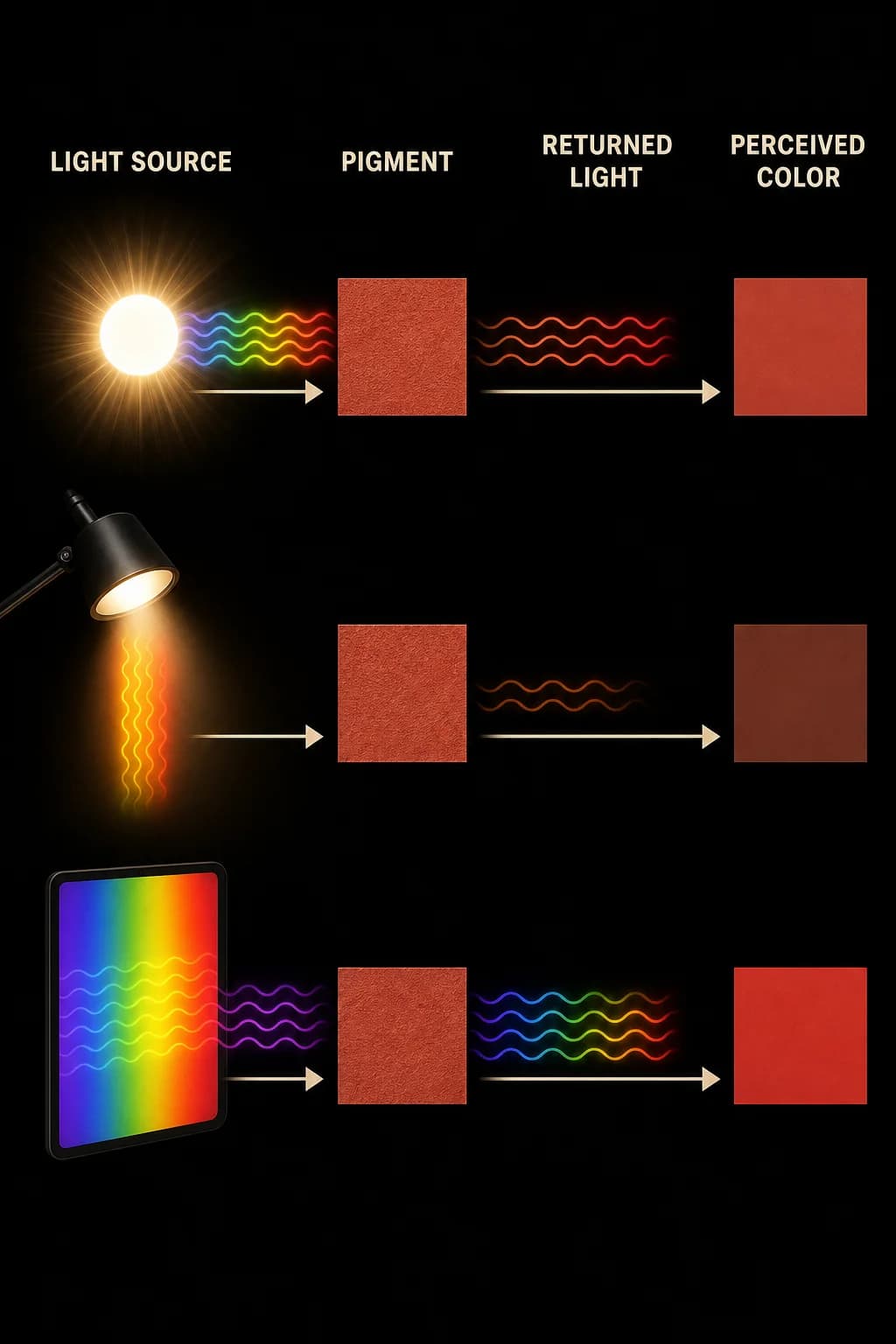
A pigment can only reflect wavelengths supplied by its illumination. A red surface under a source with little long-wavelength output may appear dark, not vividly red. Two samples that match under daylight can separate under another lamp because their reflectance spectra differ even if they produced the same cone responses before.
Screens avoid this particular dependency by emitting their own primary mixture, but they have their own gamut and viewing constraints. The practical rule is to trace the whole chain: source spectrum, material absorption and scattering, light reaching the eye, and visual-system comparison. The named color belongs to that interaction.
The same pigment swatch sits under broad daylight and a narrow lamp; returned spectra and perceived patches differ, while a self-emitting screen forms a third path.
Key takeaways
Overlapping lights add spectral power at the eye
Pigments combine by absorbing parts of the available illumination
Color appearance depends on the source, material, observer, and context
Check your understanding
Why does overlapping projected light usually become brighter?
The sources add spectral power in the overlap, sending more light toward the eye.
What does a pigment do to incoming illumination?
It absorbs some wavelengths and scatters or reflects others back out.
Why can two paints match under one lamp but not another?
Their reflectance spectra may differ, so a new source spectrum produces different cone responses.
Sources
These references were used to check the important factual claims in this edition.