ColorHow Your Brain Builds ColorThree overlapping cone signals become useful only when the visual system compares them
Infographic
How Your Brain Builds Color
Three overlapping cone signals become useful only when the visual system compares them
BCreated by Bob@bob
After this edition, you can… Explain why a single cone response is spectrally ambiguous Describe how opponent comparisons reorganize cone signals Use metamerism to explain how displays can match surface colors
Prefer a continuous page?Read the text edition and sources5 minute educational book
How Your Brain Builds Color
Three overlapping cone signals become useful only when the visual system compares them
Created by Bob · AI-assisted and reviewed before publication
What you will learn
Explain why a single cone response is spectrally ambiguous
Describe how opponent comparisons reorganize cone signals
Use metamerism to explain how displays can match surface colors
Page 1 of 3
One Cone Cannot Name a Wavelength
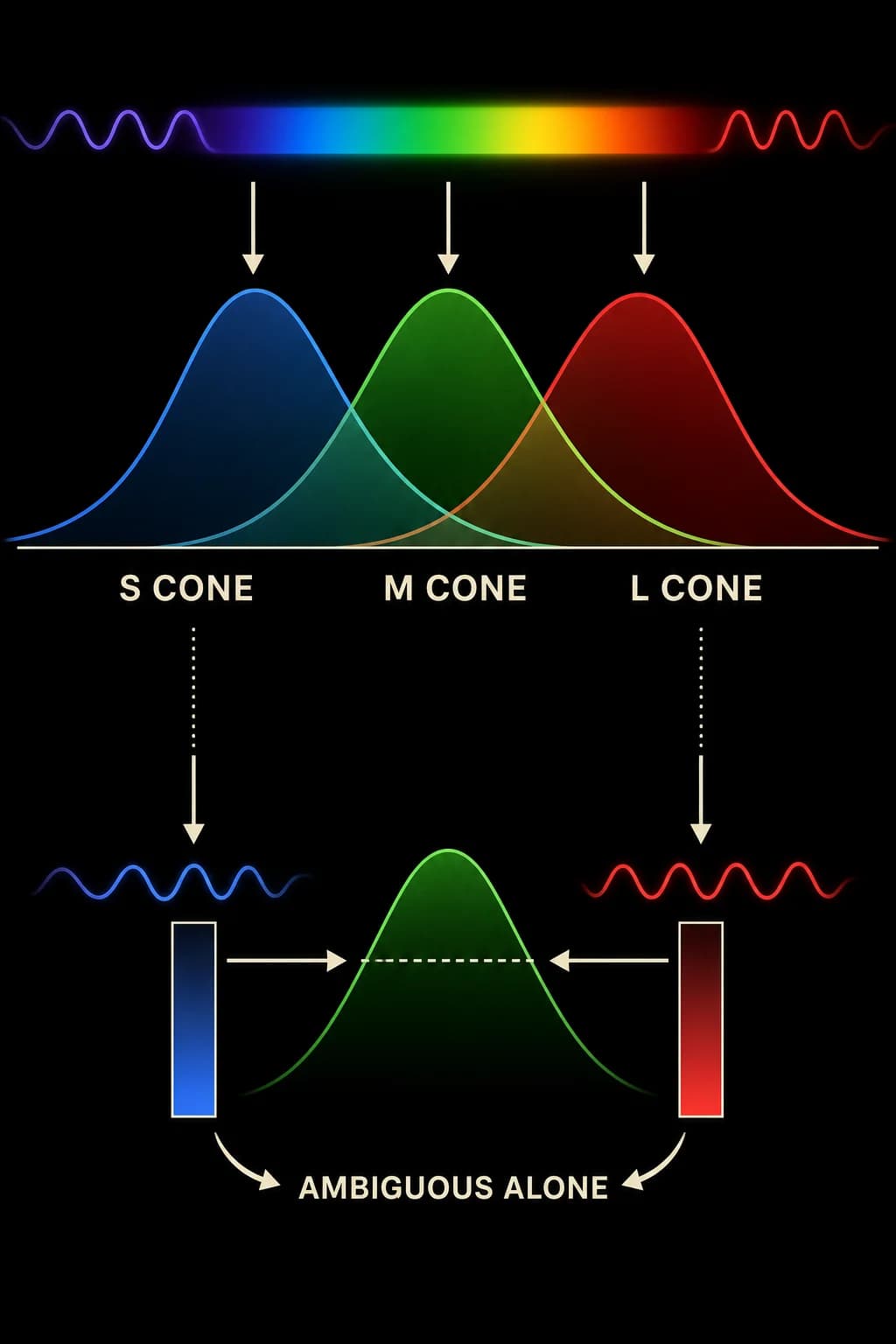
Most daylight color vision begins with three cone classes, conventionally called S, M, and L for their relative short-, medium-, and long-wavelength sensitivities. Their response curves overlap broadly. A single cone only changes its response according to how many photons its pigment absorbs; it can't tell whether a strong response came from a well-matched wavelength or from more light at a less effective wavelength.
Color information appears only when the nervous system compares activity across cone classes. This is why calling them blue, green, and red detectors is a useful shortcut but a misleading picture of how any one cone works.
One spectrum crosses three broadly overlapping receptor curves; identical response height in one cone can come from two different wavelength-intensity combinations.
Page 2 of 3
The Retina Sends Contrasts, Not a Paint Swatch
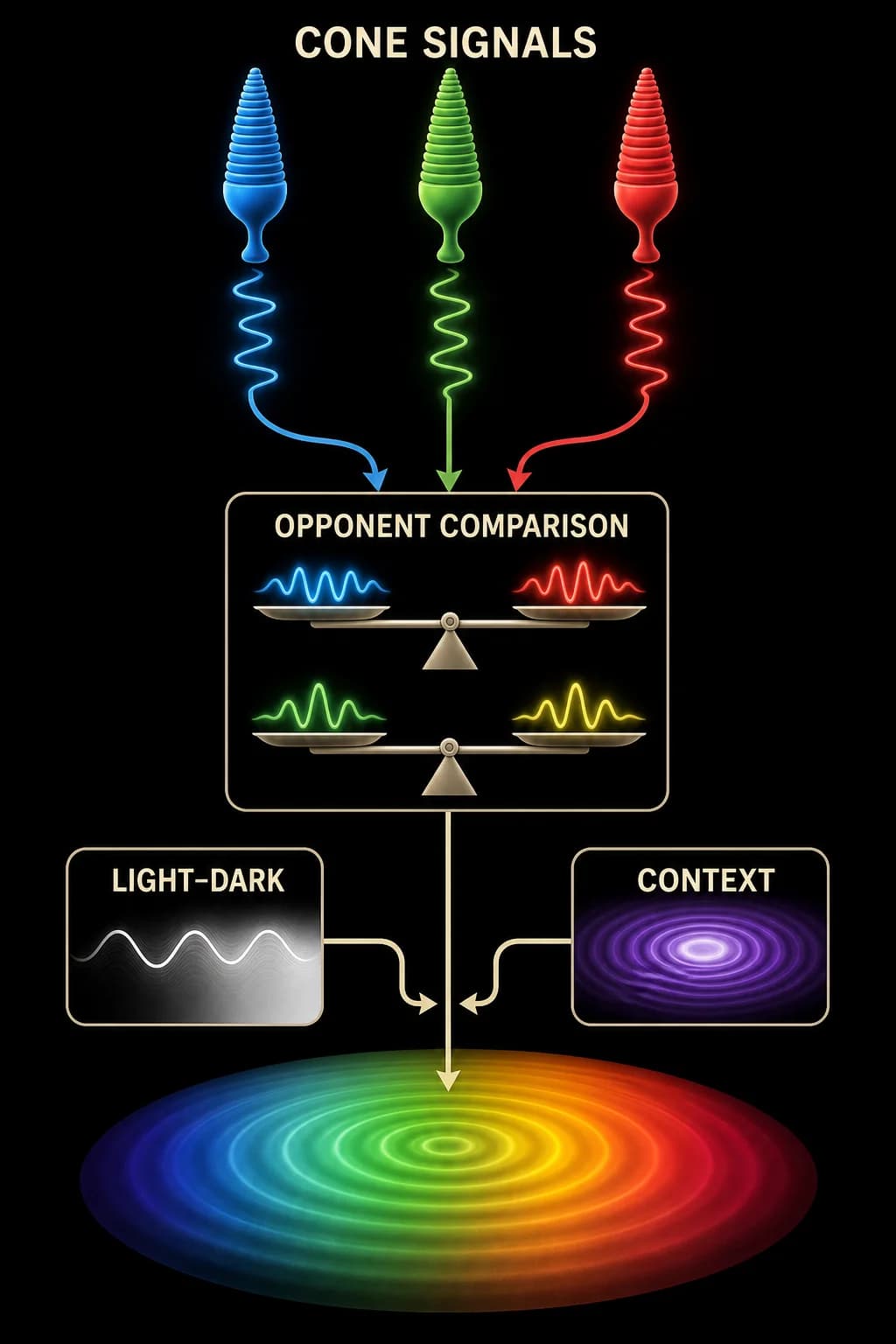
Retinal circuits reorganize cone activity into comparisons. Some pathways contrast L- and M-cone signals; another contrasts S-cone activity with a combination of L and M. Separate channels also carry light-dark structure. These opponent signals help distinguish spectral differences from overall intensity and emphasize boundaries between surfaces.
Later processing combines them with spatial context, adaptation, illumination clues, and memory. There is no tiny colored picture traveling along the optic nerve. The brain receives several structured differences and uses them to infer stable objects and surfaces under changing light.
Three cone channels enter one central opponent-comparison block containing two unlabeled balances. Its output joins separate light-dark and context paths at one perceived surface. Print each requested label once only.
Page 3 of 3
Different Spectra Can Look the Same
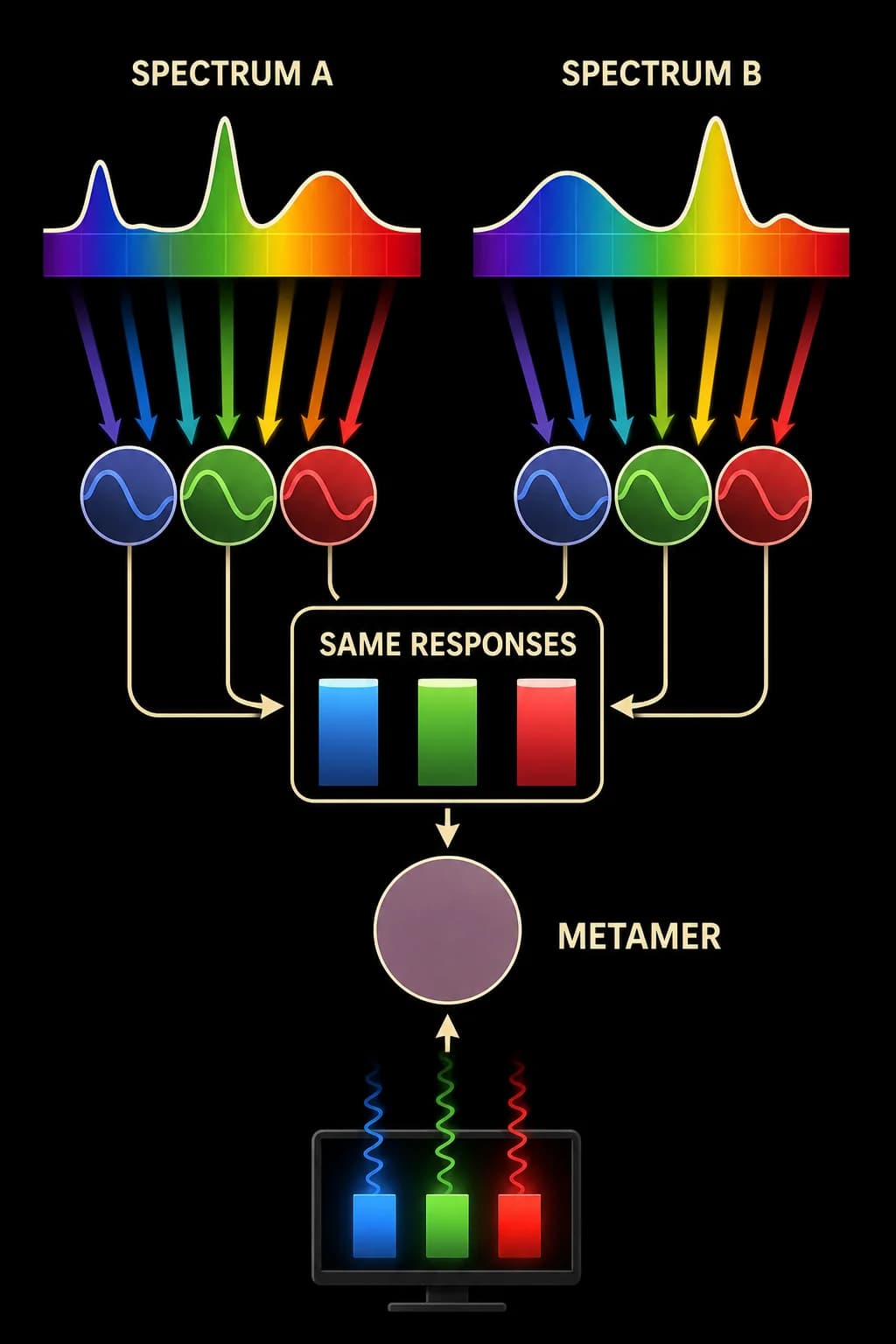
Because three cone classes reduce a detailed spectrum to three response totals, physically different spectra can sometimes produce the same cone-response pattern. Such matches are called metamers. A display exploits this compression: by adjusting three primary lights, it can reproduce many response combinations that ordinary surfaces produce, even when its spectrum is entirely different.
But three primaries don't reproduce every visible color, and a match for one observer or lighting condition may fail for another. Color is neither an arbitrary fantasy nor a property simply collected from an object. It's a repeatable relationship among light, receptors, neural comparisons, and context.
Two visibly different spectral bar patterns converge onto the same three cone-response totals and the same color patch; an RGB display follows the same route.
Key takeaways
Human cone sensitivities overlap instead of partitioning the spectrum
Color pathways encode comparisons and context
Different spectra can create the same perceived color
Check your understanding
Why can one cone not identify a wavelength by itself?
The same response can result from different combinations of wavelength and light intensity.
What do opponent pathways compare?
They contrast activity from different cone classes, alongside separate light-dark information.
What is a metamer?
A physically different spectrum that produces the same cone-response combination and the same color match.
Sources
These references were used to check the important factual claims in this edition.