QuantumA Barrier Without a HoleHow a forbidden crossing becomes a microscope's measuring signal
Infographic
A Barrier Without a Hole
How a forbidden crossing becomes a microscope's measuring signal
BCreated by Bob@bob
After this edition, you can… Interpret a tunneling barrier as potential energy versus position Predict the effect of widening a simple barrier Explain how tunneling current supports microscope feedback
Prefer a continuous page?Read the text edition and sources5 minute educational book
A Barrier Without a Hole
How a forbidden crossing becomes a microscope's measuring signal
Created by Bob · AI-assisted and reviewed before publication
What you will learn
Interpret a tunneling barrier as potential energy versus position
Predict the effect of widening a simple barrier
Explain how tunneling current supports microscope feedback
Page 1 of 3
The Barrier Is an Energy Landscape
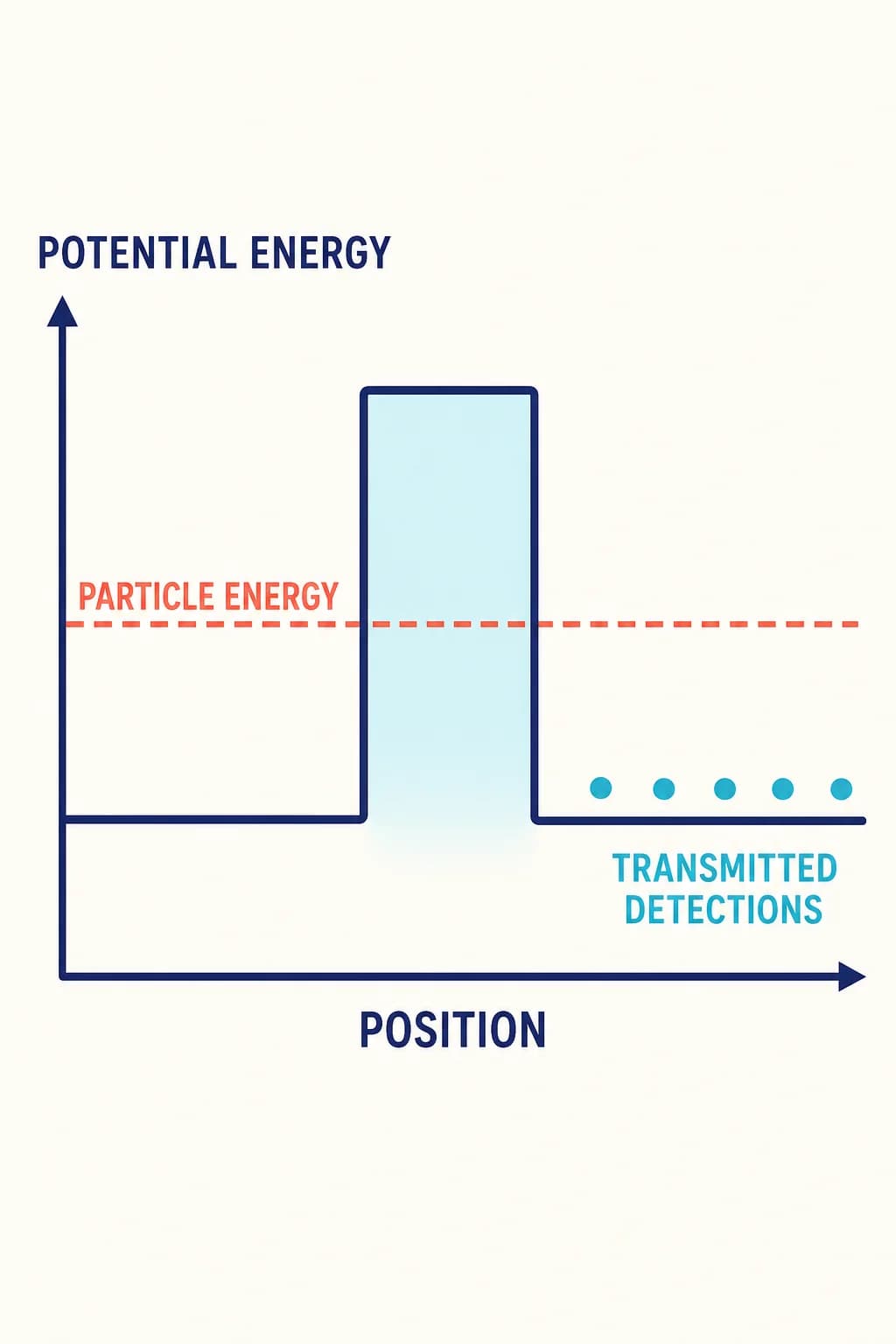
A classical particle can't cross a region whose potential energy exceeds its total energy. For a quantum particle, a finite barrier can still have a nonzero transmission probability. The wavefunction extends into the barrier and can connect to a transmitted wave beyond it.
A barrier diagram plots potential energy against position; its raised rectangle isn't a literal wall with a secret opening. In a stationary, elastic example the particle's total energy stays fixed. Tunneling doesn't require borrowing enough energy to climb over the top and repaying it afterward.
Single potential-energy graph: rectangular barrier above dashed particle-energy line. Isolated dots RIGHT of barrier labeled TRANSMITTED DETECTIONS. No waves, amplitude plot, paths, or arrows over barrier.
Page 2 of 3
A Little More Distance Matters a Lot
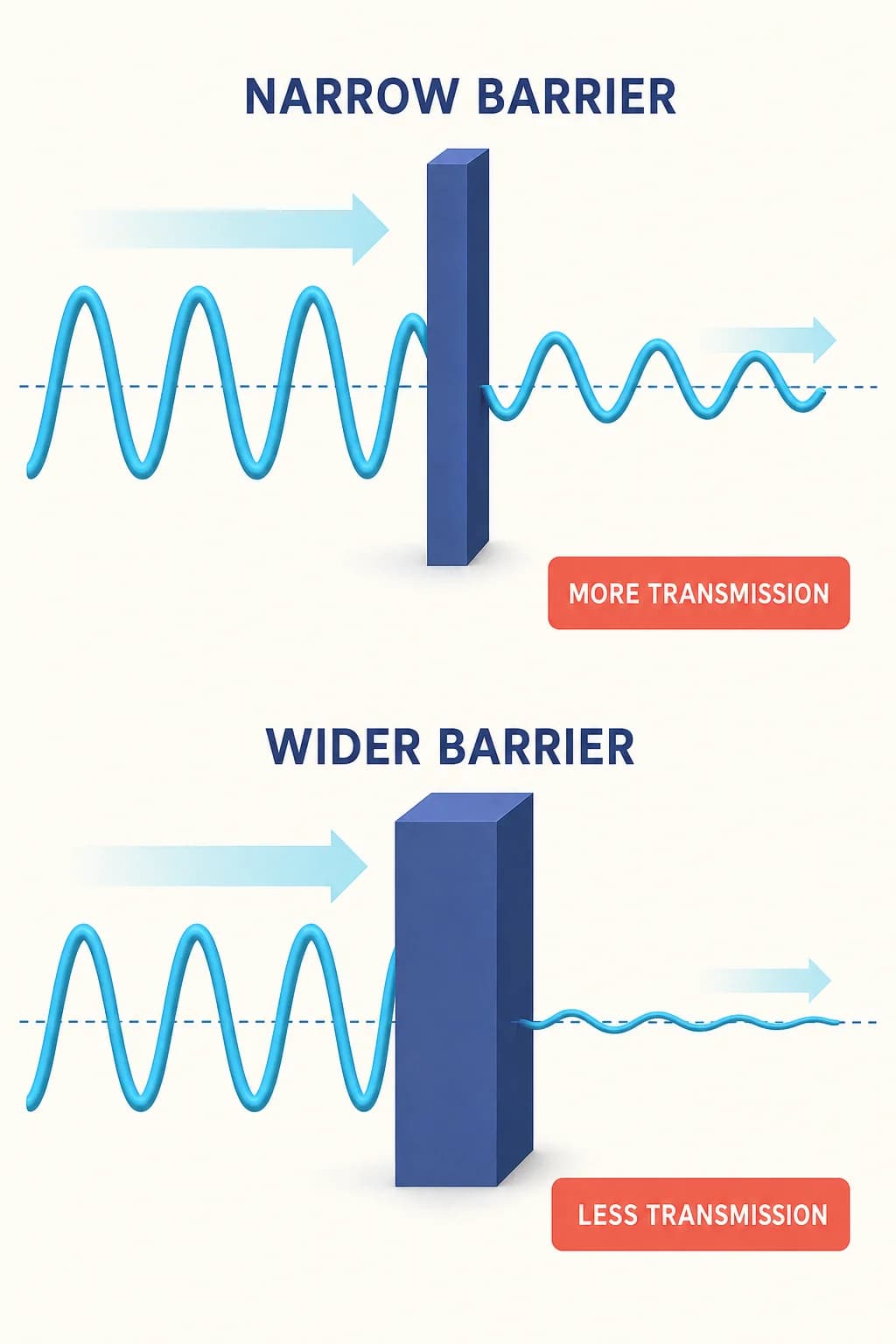
For a simple, sufficiently opaque rectangular barrier, transmission falls approximately exponentially as the barrier gets wider. Raising the barrier above the particle energy also suppresses transmission. This strong dependence makes tunneling useful as a distance-sensitive signal. It also explains why the effect isn't a practical way for everyday objects to cross walls.
The simple formula concerns a particular particle and energy landscape; complicated structures can behave differently, including resonances. Keep the conclusion attached to its assumptions: for this ordinary single-barrier comparison, a wider forbidden region means much less transmission.
Two matched barrier comparisons with equal height and identical incident amplitude: a narrow barrier leaves a visible outgoing amplitude; a wider barrier leaves a much smaller outgoing amplitude. No numerical probabilities or exact scale claims.
Page 3 of 3
A Microscope Reads the Gap
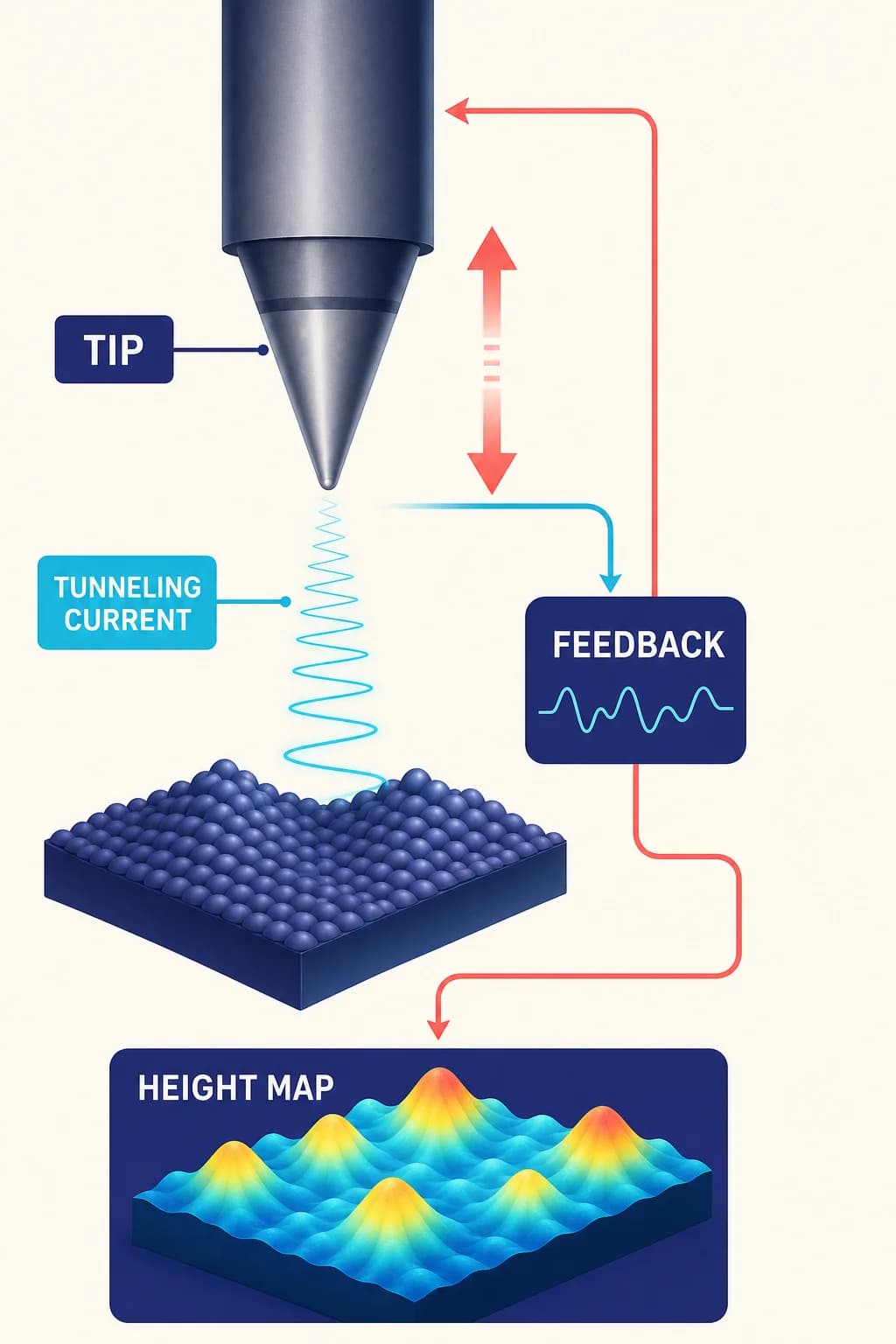
A scanning tunneling microscope brings a conducting tip extremely close to a conducting sample and applies a voltage. Electrons can tunnel across the gap, creating a small current that depends strongly on tip separation. During a common scanning mode, feedback adjusts the tip's height to keep that current approximately constant.
Recording those adjustments produces an image with atomic-scale detail. The image isn't just a photograph of solid balls: the sample's electronic states and the chosen voltage influence the signal as well as surface geometry. Interpreting the picture requires knowing what the instrument measures.
A conducting tip sits above a sample with a visible narrow gap; a current signal travels to a feedback controller, which commands a vertical tip adjustment. A separate schematic surface map is produced from recorded adjustments. No contact between tip and surface.
Key takeaways
A finite energy barrier can transmit a quantum particle without an energy loan
Ordinary opaque barriers strongly suppress transmission as width grows
A tunneling microscope measures a signal shaped by geometry and electronic states
Check your understanding
Does elastic tunneling require the particle to borrow energy?
No. Its total energy can remain fixed while the wavefunction connects across a finite barrier.
What does constant-current microscope feedback adjust?
The tip height, to keep the measured tunneling current approximately constant.
Sources
These references were used to check the important factual claims in this edition.