QuantumThe Same Odds Can Hide Different StatesA change of measurement reveals what a fifty-fifty result leaves out
Infographic
The Same Odds Can Hide Different States
A change of measurement reveals what a fifty-fifty result leaves out
BCreated by Bob@bob
After this edition, you can… Explain why identical standard measurement odds can hide different relative phases Describe how changing basis distinguishes plus and minus states Explain why tomography needs repeated preparations
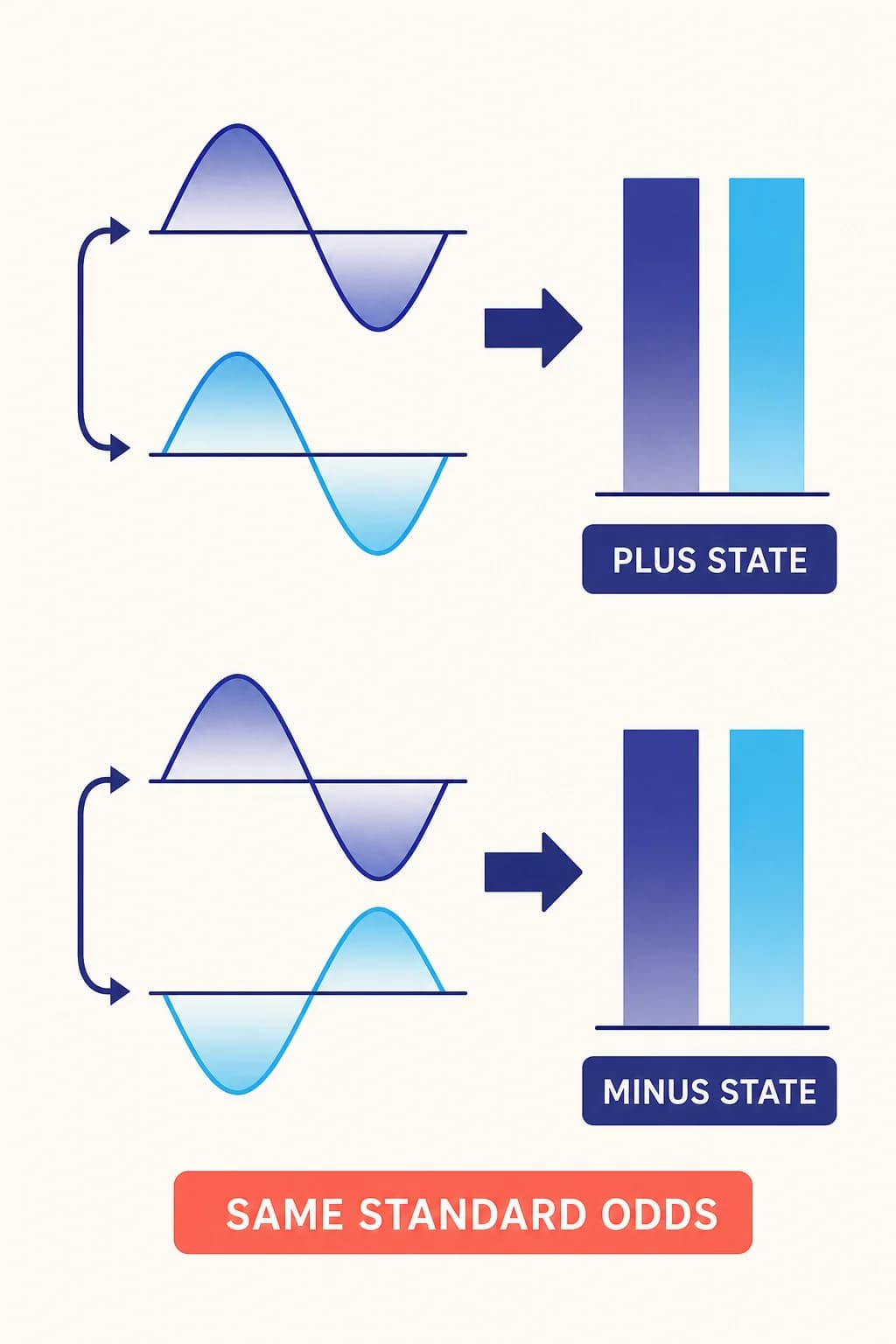
Prepare one qubit in a plus state and another in a minus state. A standard zero-or-one measurement gives equal odds for both preparations. Yet these are different quantum states: the relative sign between their two amplitudes differs.
Equal outcome probabilities in one measurement don't guarantee identical states. This is a useful test of the phrase 'both at once.' It leaves out phase, the relationship that controls how amplitudes combine. The state describes more than the odds printed in a single measurement's results table.
Two abstract amplitude pairs: one pair aligned, the other oppositely oriented. Beside each pair, an identical equal-height two-bar outcome chart. No Bloch sphere, numerals, or equations.
Page 2 of 3
Choose a Measurement That Sees the Difference
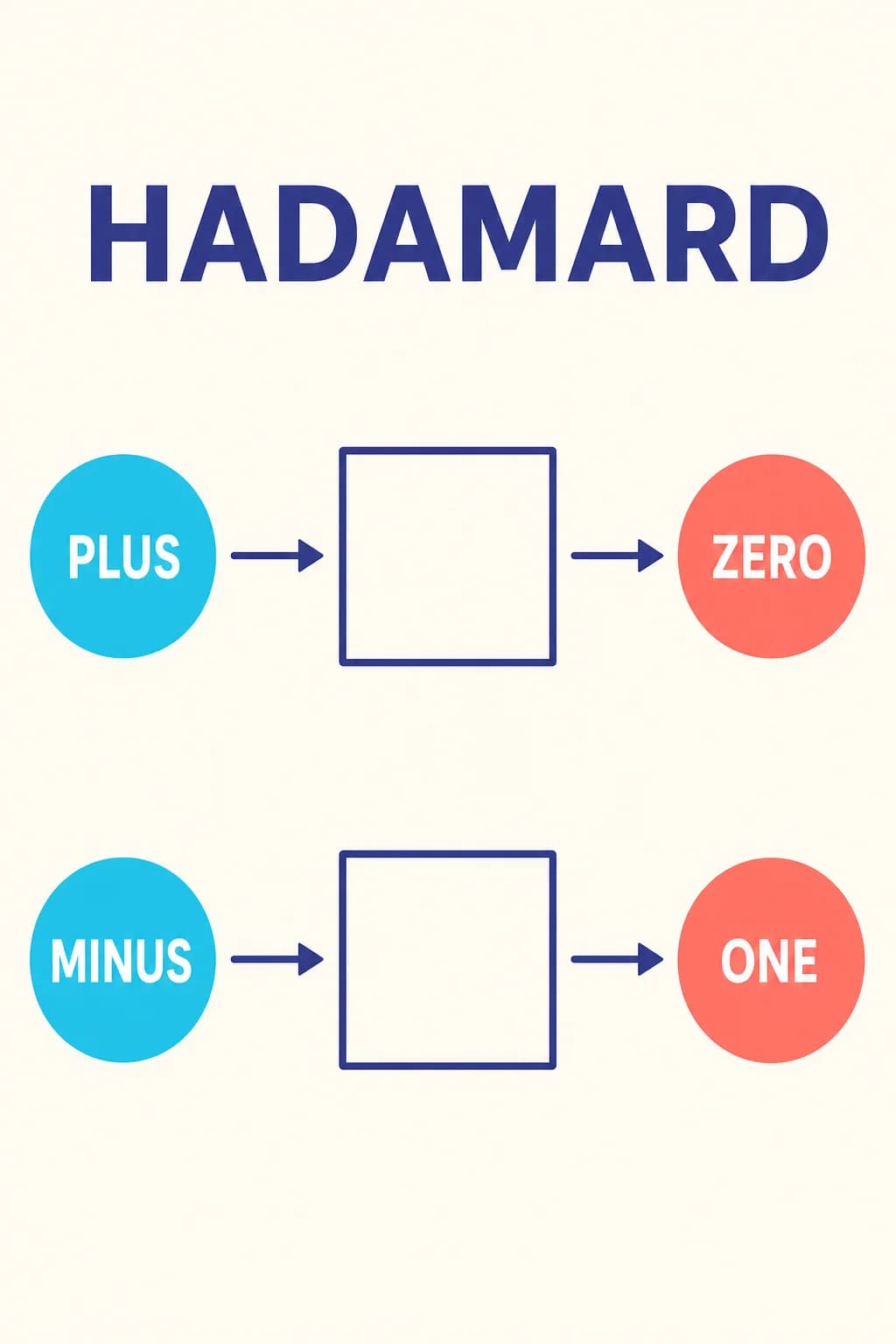
Apply the same Hadamard operation to either preparation before measuring. In the ideal case it converts the plus state into zero and the minus state into one. The phase difference now produces different outcomes with certainty. Equivalently, we have chosen a different measurement basis: a different pair of alternatives for the apparatus to distinguish.
This doesn't extract two answers from one qubit. It answers a specific question about the preparation. A measurement that distinguishes these two known candidates isn't a universal machine for identifying every possible unknown state.
HADAMARD appears once as a heading. Below are TWO DISCONNECTED horizontal rows: PLUS → a blank square → ZERO; MINUS → a blank square → ONE. Draw plain arrows without arrow text. No links between rows, waves, central shared block, or extra symbols.
Page 3 of 3
One Click Is Not a State Scan
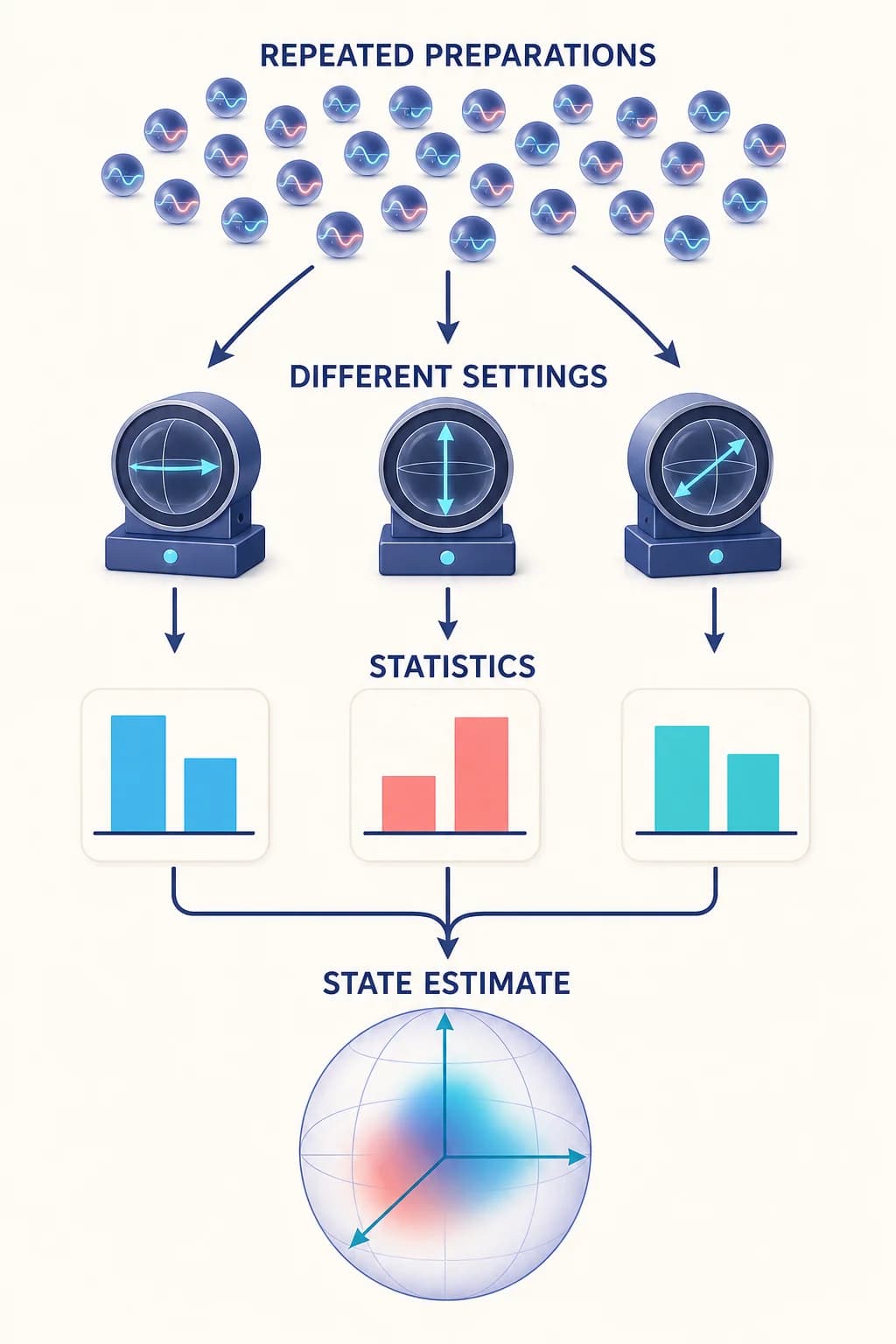
An unknown qubit isn't a tiny document whose complete contents appear when opened. One standard measurement returns one of its allowed outcomes and generally changes the state. To estimate an unknown preparation, experimenters use many identically prepared systems and several measurement settings, then infer a state consistent with the statistics.
This procedure is called tomography. Even that estimate has uncertainty from finite data and imperfect equipment. The practical lesson is simple: distinguish an individual result, a distribution of results, and the state model used to predict distributions across different settings.
Many independently prepared qubit tokens feed three differently oriented measurement devices; their grouped result charts feed one inferred state illustration. No copying machine and no arrows from one token into multiple tokens.
Key takeaways
A single measurement setting doesn't describe a whole quantum state
Relative phase can become an observable probability difference
Tomography estimates a preparation from many measurements
Check your understanding
What distinguishes plus and minus states despite equal standard measurement odds?
Their amplitudes have different relative signs, or relative phases.
Why does tomography require many preparations?
One measurement gives only one outcome; estimating the state requires statistics across different settings.
Sources
These references were used to check the important factual claims in this edition.