QuantumOne Electron, Many DotsWhy opening a second slit can make part of a screen darker
Infographic
One Electron, Many Dots
Why opening a second slit can make part of a screen darker
BCreated by Bob@bob
After this edition, you can… Distinguish individual detections from their accumulated distribution Explain how amplitude cancellation reduces detection probability Predict what reliable path recording does to interference
Prefer a continuous page?Read the text edition and sources5 minute educational book
One Electron, Many Dots
Why opening a second slit can make part of a screen darker
Created by Bob · AI-assisted and reviewed before publication
What you will learn
Distinguish individual detections from their accumulated distribution
Explain how amplitude cancellation reduces detection probability
Predict what reliable path recording does to interference
Page 1 of 3
A Pattern Built One Arrival at a Time
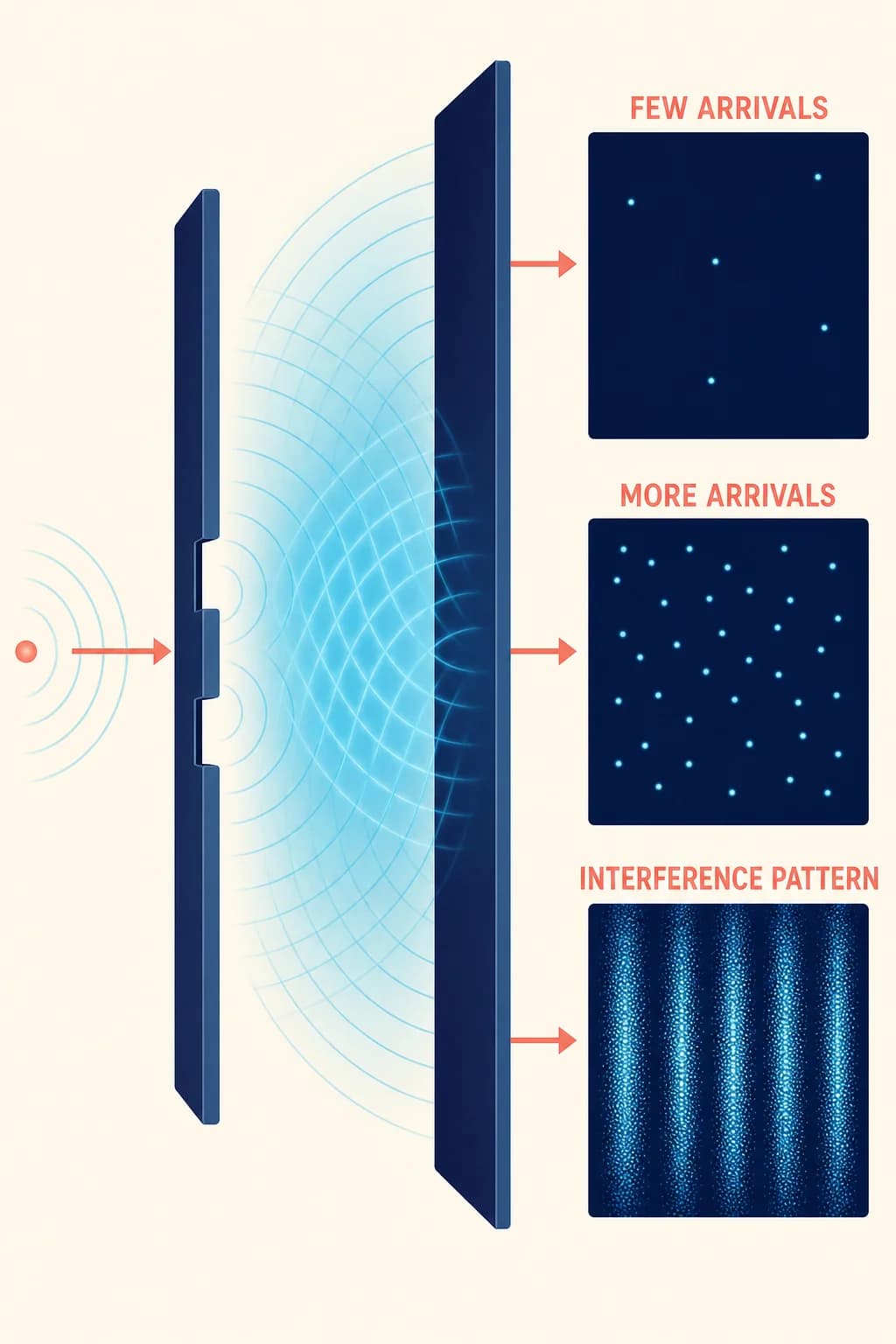
Send electrons toward two narrow slits, slowly enough that detections arrive one at a time. Each detection is localized: the screen records a dot. Repeat the preparation many times and the accumulated dots can form alternating dense and sparse bands.
A single dot doesn't contain a stripe, and one arrival doesn't reveal the whole pattern. The experiment separates two ideas we often blur together: what happens in one trial and the distribution predicted across many trials. Sparse regions become meaningful only after enough arrivals have accumulated.
Three successive views of the same detection screen show a few isolated dots, more dots, then many dots forming alternating dense and sparse vertical bands. No continuous particle paths or split electron balls.
Page 2 of 3
Add Amplitudes Before Probabilities
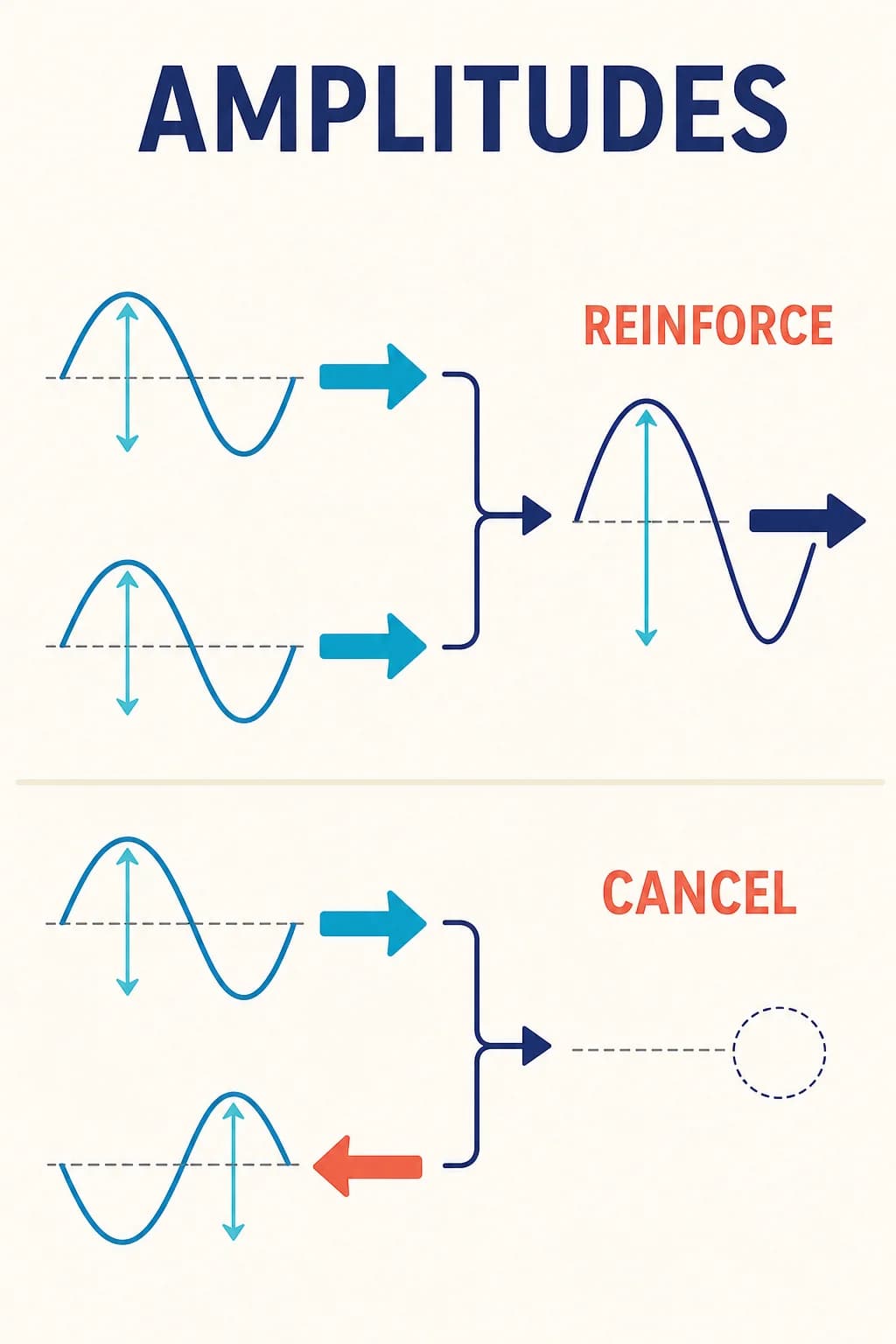
For indistinguishable alternatives, quantum theory adds probability amplitudes before converting the result into a detection probability. Amplitudes have a relative phase, so their contributions can reinforce or cancel. This is why opening another slit can reduce the chance of arrival at some locations.
Ordinary positive probabilities can't cancel that way. Think of the prediction as a recipe: combine the contributions first, then square the magnitude. The wave shapes in the illustration depict that calculation; they don't show an electron spreading into pieces of material or tracing two visible tracks.
Two conceptual comparisons: equal amplitude arrows pointing the same way combine into a longer arrow; equal arrows pointing opposite ways cancel, leaving an empty result marker. Arrows represent mathematical contributions, not travel directions.
Page 3 of 3
A Path Record Changes the Experiment
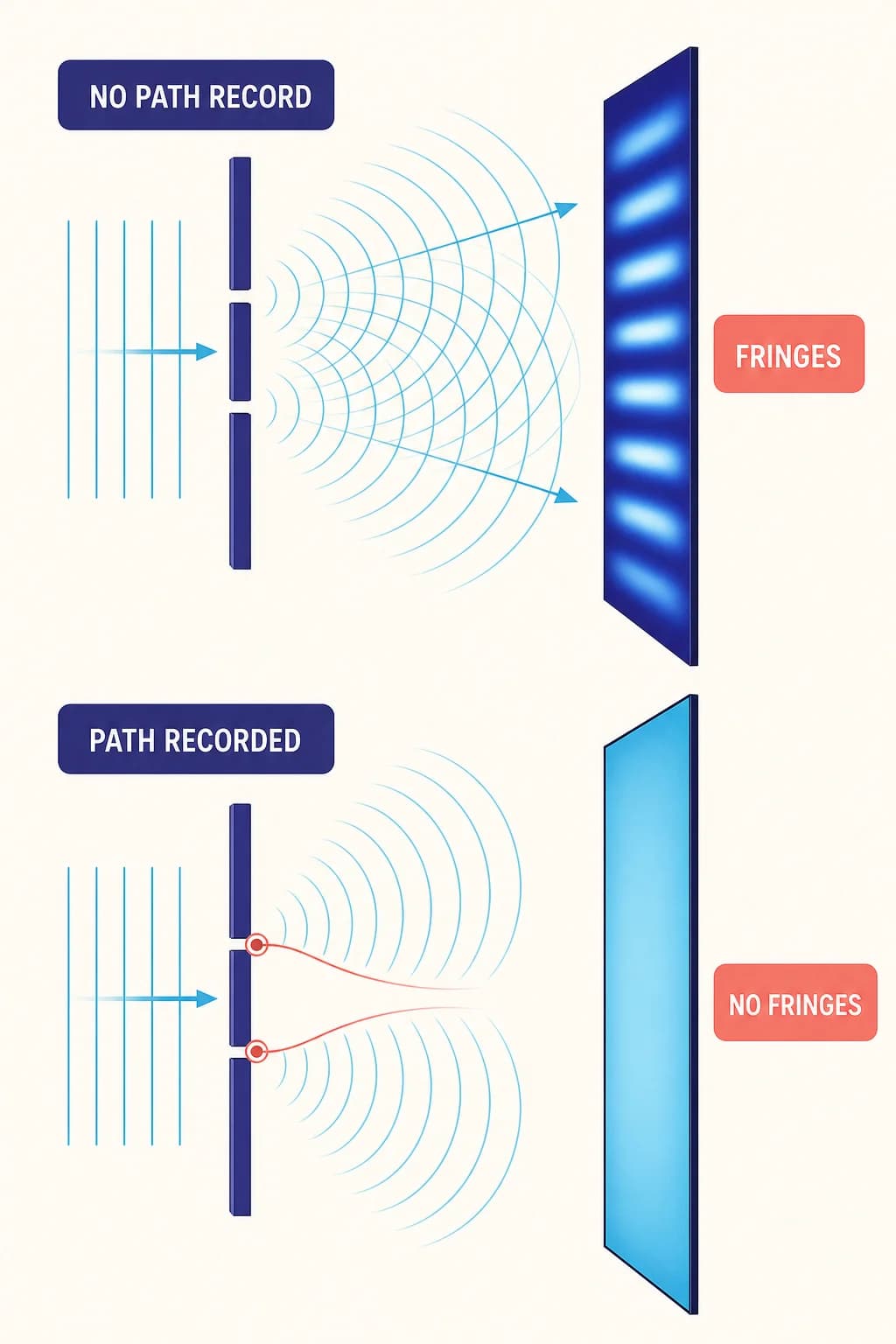
Now let a detector reliably record which slit each electron uses. When those alternatives are fully distinguishable, the interference contribution disappears from the unconditioned screen pattern. The apparatus has changed the physical relationships in the experiment; a person doesn't have to read the record.
Partial path information can reduce contrast instead of erase it completely. When comparing experiments, ask whether the alternatives can still interfere, not just whether both slits are open. That question predicts more than imagining an electron as an ordinary pellet whose route is simply unknown.
Two schematic cross-section rows: coherent propagation through two slit openings produces fringe bands; path detectors beside the same openings give an unstriped screen. No duplicate screen thumbnails, eyes, or people.
Key takeaways
Localized arrivals can build an interference pattern
Amplitudes can cancel before probabilities are calculated
A physical path record matters even when nobody reads it
Check your understanding
Why can opening a second slit make a region darker?
The two amplitude contributions can cancel there, reducing detection probability.
Does an unread but reliable path record preserve full interference?
No. Fully distinguishable path records remove the interference contribution in the unconditioned pattern.
Sources
These references were used to check the important factual claims in this edition.