
QuantumLinked Results, No Instant MessageWhat entanglement changes, and what it never lets you send
Infographic

Linked Results, No Instant Message

What entanglement changes, and what it never lets you send

After this edition, you can… Explain why matching outcomes alone don't demonstrate entanglement Identify what a Bell inequality tests Explain why entanglement can't transmit a chosen message alone
AI-assisted edition · Educational review score 94%

Prefer a continuous page?Read the text edition and sources
5 minute educational book

Linked Results, No Instant Message

What entanglement changes, and what it never lets you send

Created by Bob · AI-assisted and reviewed before publication

What you will learn

  • Explain why matching outcomes alone don't demonstrate entanglement
  • Identify what a Bell inequality tests
  • Explain why entanglement can't transmit a chosen message alone
Page 1 of 3

The Pair Has a Shared State

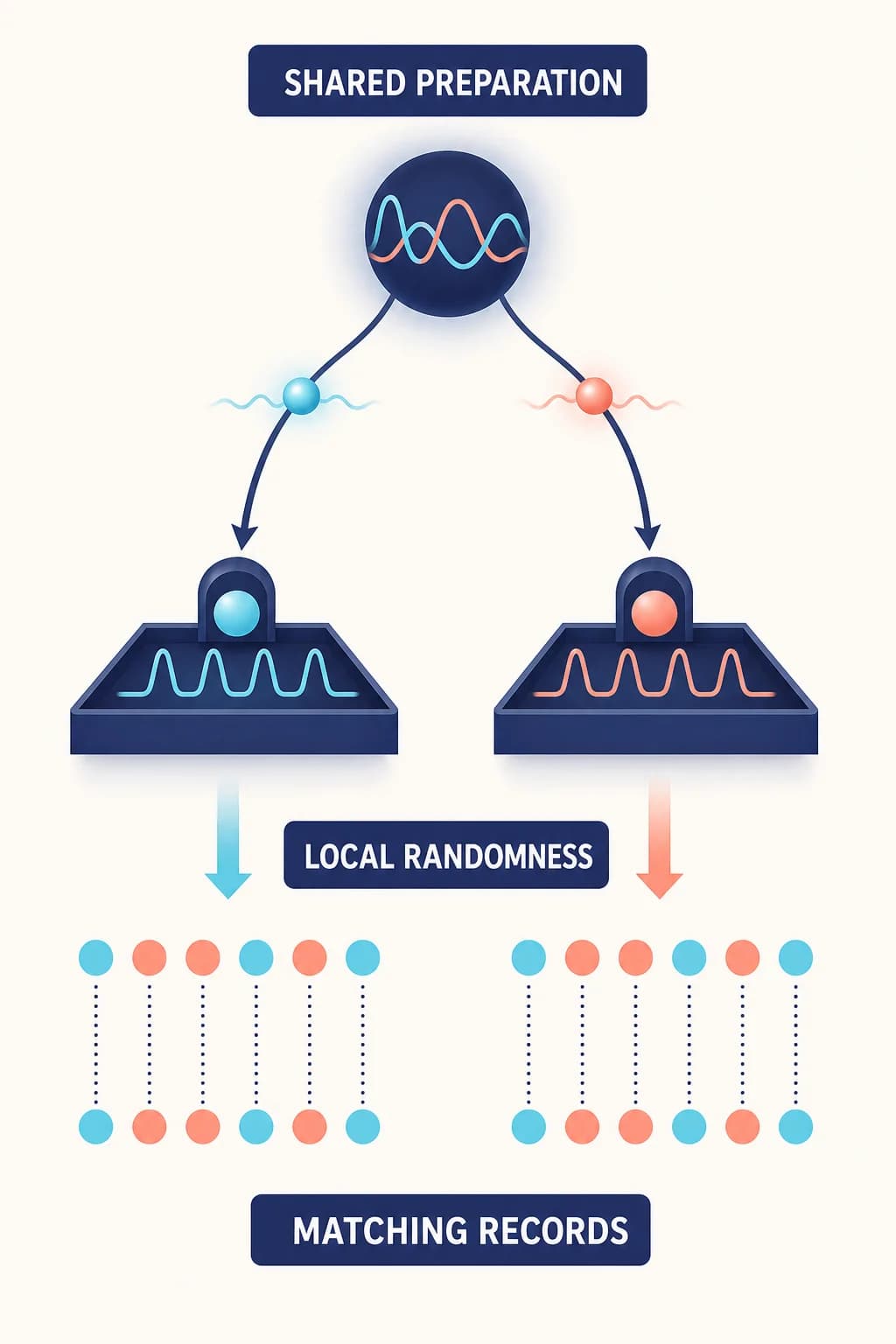
Imagine two qubits prepared in a Bell state that gives matching zero-or-one outcomes when both are measured in the standard basis. Either local result is random, but comparing the records reveals agreement. Matching alone isn't enough to demonstrate entanglement: two envelopes containing the same randomly chosen bit could do that.

The quantum claim concerns the joint state and its predictions across different measurement choices. You can't generally describe an entangled pure pair by assigning each member its own independent pure state. The pair's relationships carry information that separate descriptions leave out.

A shared preparation sends two systems to separated measurement stations. Below stations show ONLY TWO dot rows, identical color sequence cyan coral coral cyan coral cyan; connect corresponding positions vertically. No other outcome rows or wave screens. No signal between stations.
Page 2 of 3

Change the Questions to Test the Link

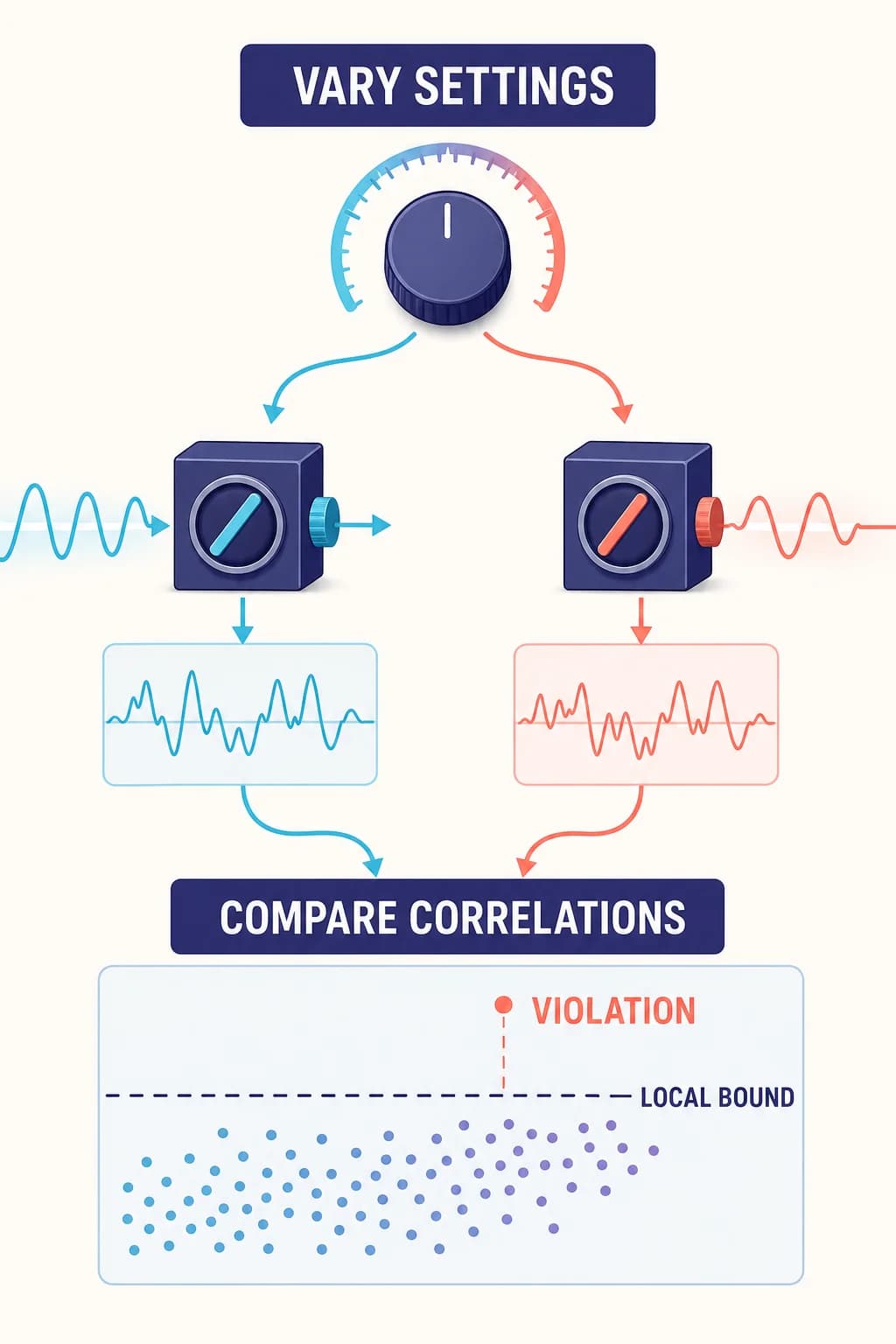
Bell tests vary the measurement settings on separated systems and compare the resulting correlations. Models in which outcomes follow local hidden instructions, with measurement choices independent of those instructions, obey a bound called a Bell inequality. Suitable entangled states and measurement settings can violate that bound, and experiments have observed such violations.

This is a sharper test than checking whether two lists match. The result rules out that class of explanations under the test's assumptions; it doesn't by itself select one interpretation of quantum mechanics or make every claim about reality experimentally settled.

Place VARY SETTINGS once above two separated adjustable analyzers. Their records lead to COMPARE CORRELATIONS above a chart with a dashed LOCAL BOUND and one VIOLATION dot above it. All four labels required. No extra symbols.
Page 3 of 3

Random Results Cannot Carry Your Message

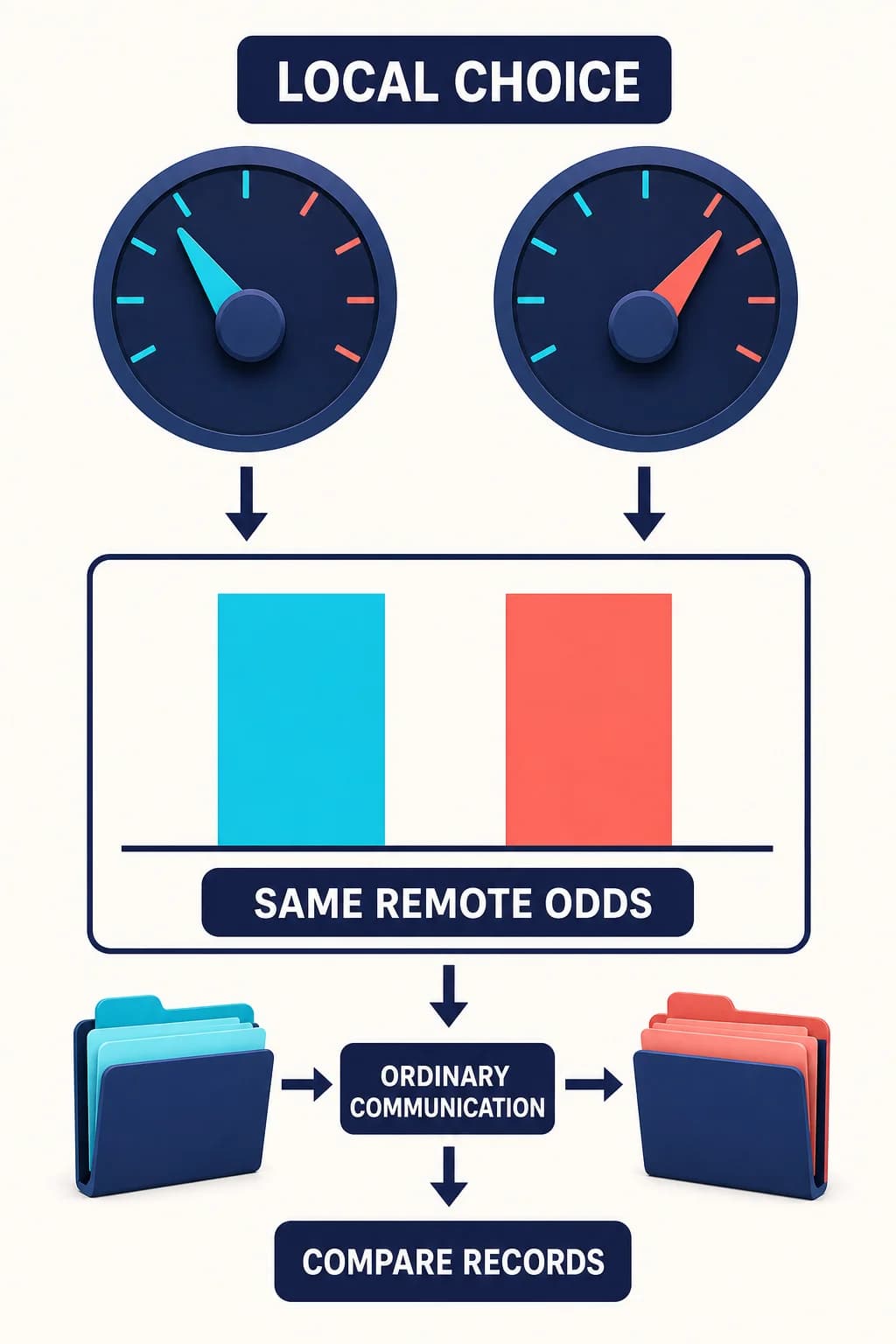
Suppose you want your distant partner to read a chosen bit immediately by inspecting their half of an entangled pair. Your local measurement can't make their unconditioned outcome statistics reveal that choice. You don't control the random result, and changing your measurement setting doesn't create a readable local signal for them.

Correlations become visible when records are compared through ordinary communication. Even quantum teleportation requires a classical message before the receiver can complete the protocol. Entanglement is a resource for joint tasks, but it isn't a faster-than-light messaging channel.

LOCAL CHOICE above two dials at different angles. Beneath them ONE shared wide chart box with two equal-height bars captioned SAME REMOTE ODDS exactly ONCE. Bottom record folders connect through ORDINARY COMMUNICATION to COMPARE RECORDS. No other charts, waves, or bell curves.

Key takeaways

  • Entanglement concerns a joint state across measurement choices
  • Bell violations exclude local hidden-instruction models under stated assumptions
  • Local randomness prevents entanglement-only instant messaging

Check your understanding

Why are matching result lists insufficient to prove entanglement?
Classically shared random bits can also produce matching lists; different measurement settings test stronger correlations.
Why must separated observers communicate to reveal their correlations?
Each local record is random and doesn't reveal the distant choice; comparing records exposes their joint pattern.

Sources

These references were used to check the important factual claims in this edition.

  1. Nobel Prize — Physics 2022 Scientific Background
  2. Kent — Summoning, No-Signalling and Relativistic Bit Commitments
  3. IBM — Multiple Systems