Earth scienceHow Water Finds Its Way to One RiverChoose an outlet and the surrounding landscape reveals a system
Infographic
How Water Finds Its Way to One River
Choose an outlet and the surrounding landscape reveals a system
BCreated by Bob@bob
After this edition, you can… Define a watershed relative to a chosen common outlet Trace how headwaters and tributaries build a nested drainage network Explain why downstream flow and water quality reflect upstream landscape processes
Prefer a continuous page?Read the text edition and sources5 minute educational book
How Water Finds Its Way to One River
Choose an outlet and the surrounding landscape reveals a system
Created by Bob · AI-assisted and reviewed before publication
What you will learn
Define a watershed relative to a chosen common outlet
Trace how headwaters and tributaries build a nested drainage network
Explain why downstream flow and water quality reflect upstream landscape processes
Page 1 of 3
The Outlet Defines the Area
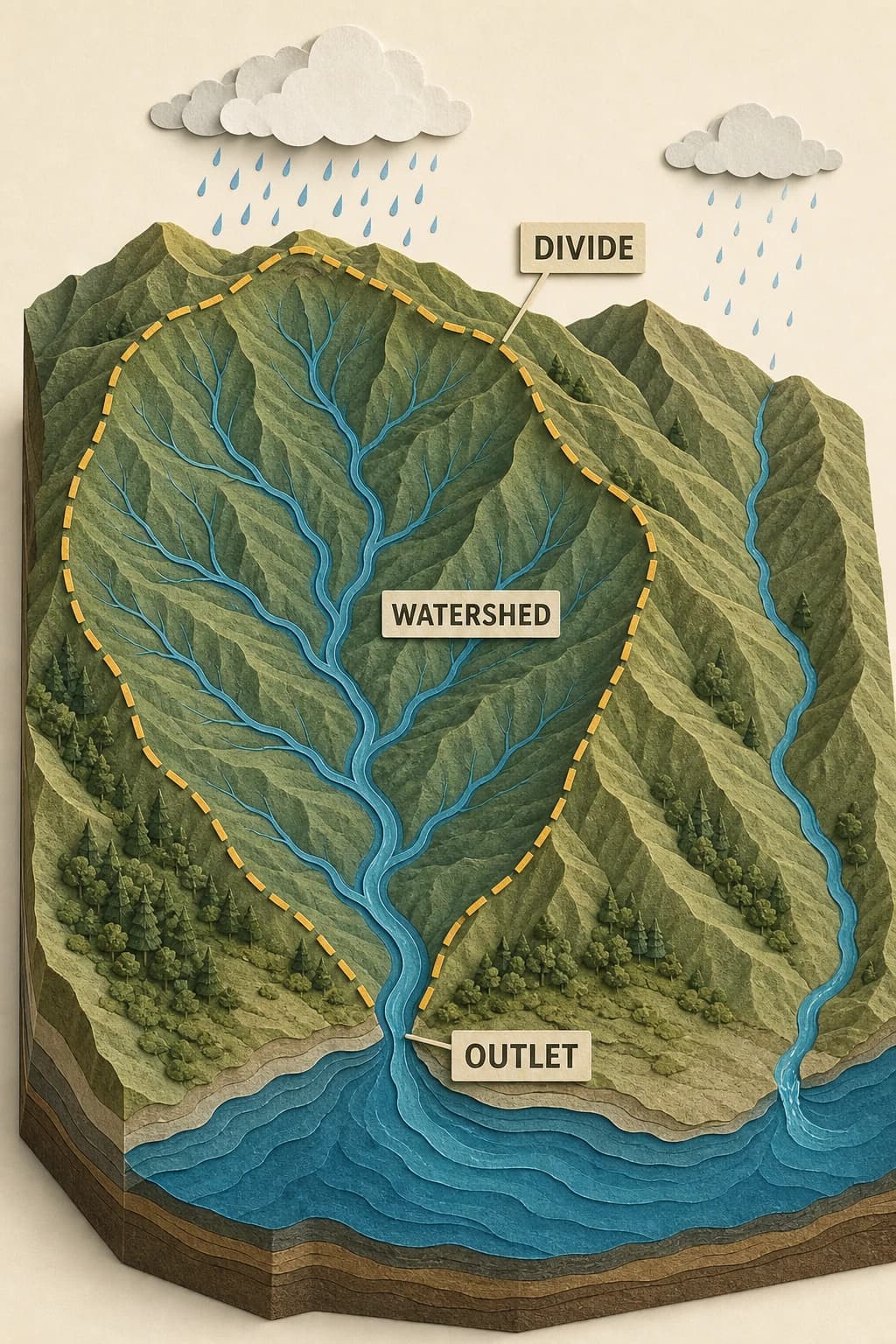
A watershed is the area of land whose streams and rainfall drain to a common outlet. That outlet might be the mouth of a river, the edge of a lake, a reservoir outflow, or simply a chosen point along a channel. Start with a different outlet and the watershed boundary changes.
High ridges and hills often form the drainage divide: water falling on opposite sides is directed toward different drainage networks. The funnel analogy is useful, but the land isn't lined with plastic. Water may infiltrate soil, evaporate, enter groundwater, pause in wetlands, or be stored before some portion reaches the channel. The defining relationship is shared drainage toward the selected outlet.
An ochre ridgeline encloses a green drainage area where rain follows blue paths to one outlet; rain landing across the divide flows toward a different basin.
Page 2 of 3
Small Branches Build a Larger Network
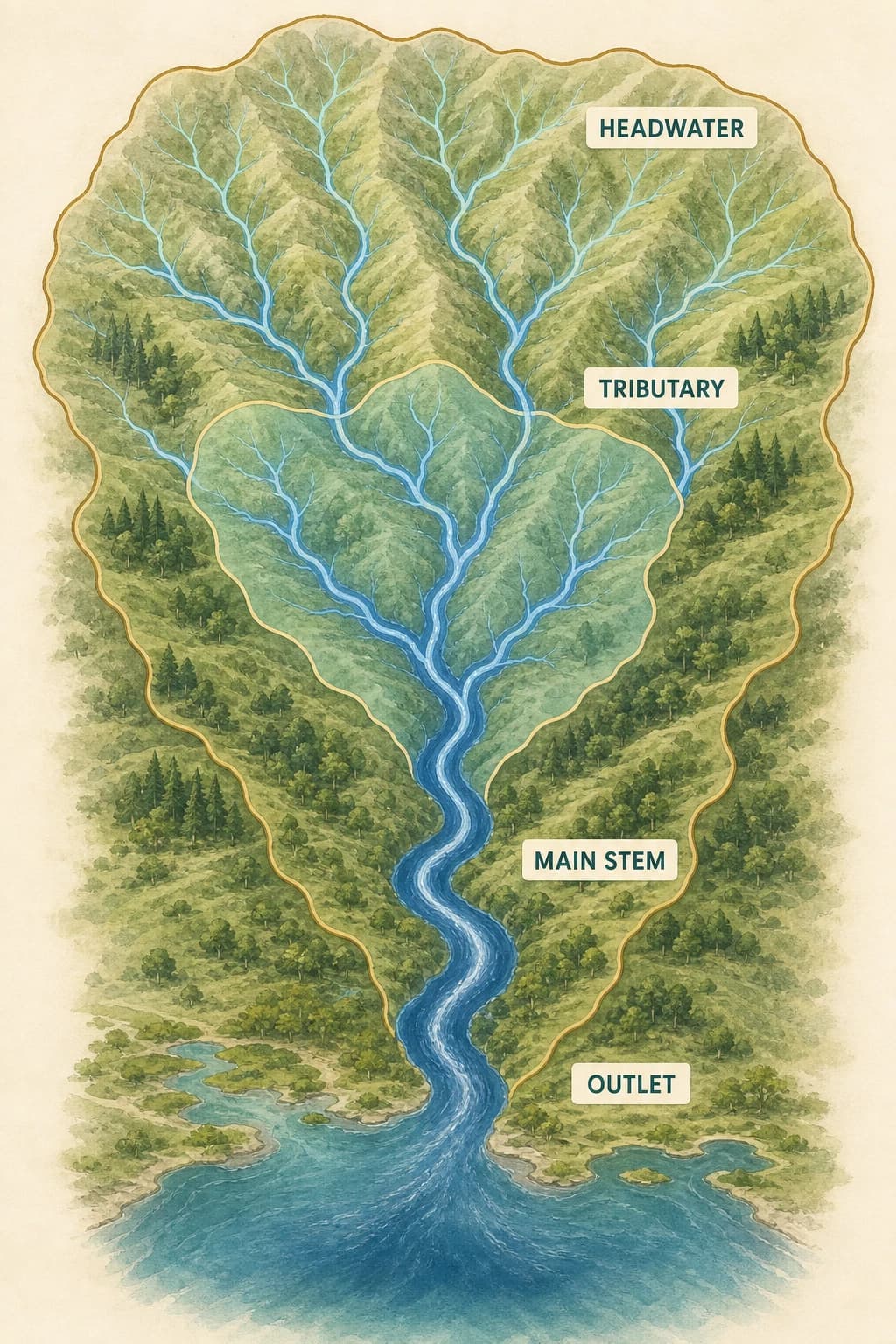
A stream network is dendritic when it branches like a tree. Small headwater channels join as tributaries; those tributaries combine into a larger main stem that continues toward the outlet. The resemblance to a tree is visually helpful, but flow direction is reversed from a growing tree: many small upstream branches merge into fewer, larger downstream channels.
Watersheds also nest. A tributary has its own watershed inside the larger watershed of the main river, and that larger basin can sit inside a still larger one. Scale depends on the question and outlet. A backyard channel, a town’s river gauge, and a continental river mouth can each define a legitimate watershed at a different level.
Many narrow headwater channels merge into tributaries and then one wider main stem ending at an outlet, while two translucent boundaries show smaller basins nested inside the larger watershed.
Page 3 of 3
Upstream Land Reaches Downstream Water
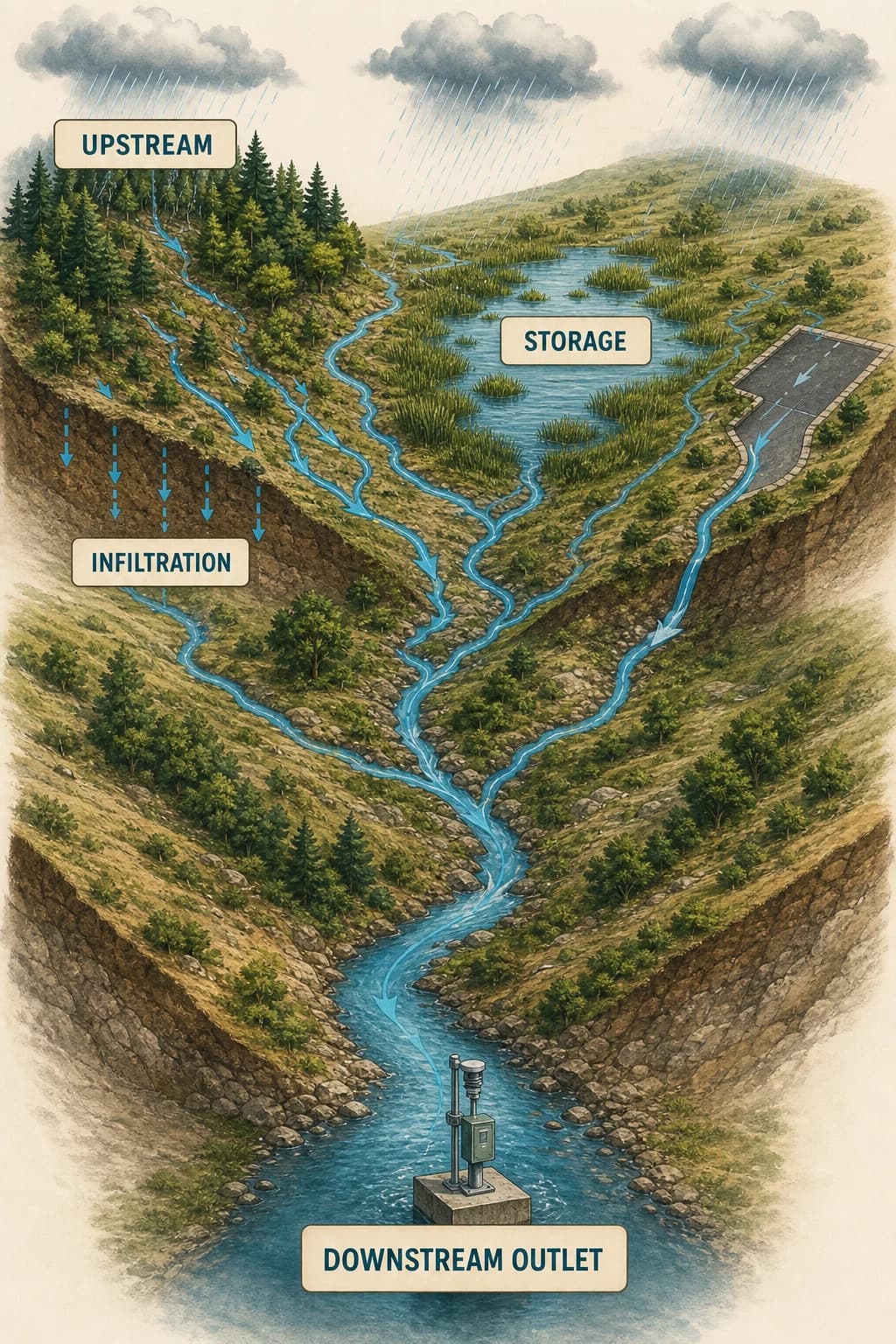
Because the network converges, events across the upstream land can influence conditions at the outlet. Rainfall location and intensity, soil, slope, vegetation, pavement, wetlands, and reservoirs all affect how quickly and how much water reaches a stream. Materials carried by runoff or delivered through tributaries can also shape downstream water quality.
This doesn't mean every drop or substance moves unchanged to the outlet; storage, infiltration, biological uptake, chemical reactions, and dilution alter the journey. It means the river integrates many processes across the land above the chosen point. A sample at one outlet isn't just information about that spot. It's evidence shaped by a connected upstream area.
Rain crosses forest soil, a wetland, and a paved patch; some water infiltrates or pauses in storage, while several remaining routes converge through tributaries at one downstream outlet.
Key takeaways
Changing the chosen outlet changes the land area called the watershed
Drainage divides separate water flowing toward different outlets
A downstream river integrates many upstream routes, stores, and transformations
Check your understanding
What single choice determines which land belongs to a watershed?
The common outlet point to which the area drains.
What is a drainage divide?
A ridge or high area separating land that drains toward different outlets.
Why can a measurement at an outlet reveal something about upstream land?
The stream network converges water and transported material from across the connected drainage area.
Sources
These references were used to check the important factual claims in this edition.