PhotosynthesisHow a Leaf Turns Light into Chemical FuelLight first drives electrons and gradients; carbon becomes material later
Infographic
How a Leaf Turns Light into Chemical Fuel
Light first drives electrons and gradients; carbon becomes material later
BCreated by Bob@bob
After this edition, you can… Trace electrons from water through the light reactions Explain how a proton gradient drives ATP synthesis Connect ATP and NADPH to carbon fixation and plant material
Prefer a continuous page?Read the text edition and sources5 minute educational book
How a Leaf Turns Light into Chemical Fuel
Light first drives electrons and gradients; carbon becomes material later
Created by Bob · AI-assisted and reviewed before publication
What you will learn
Trace electrons from water through the light reactions
Explain how a proton gradient drives ATP synthesis
Connect ATP and NADPH to carbon fixation and plant material
Page 1 of 3
A Photon Starts Charge Moving
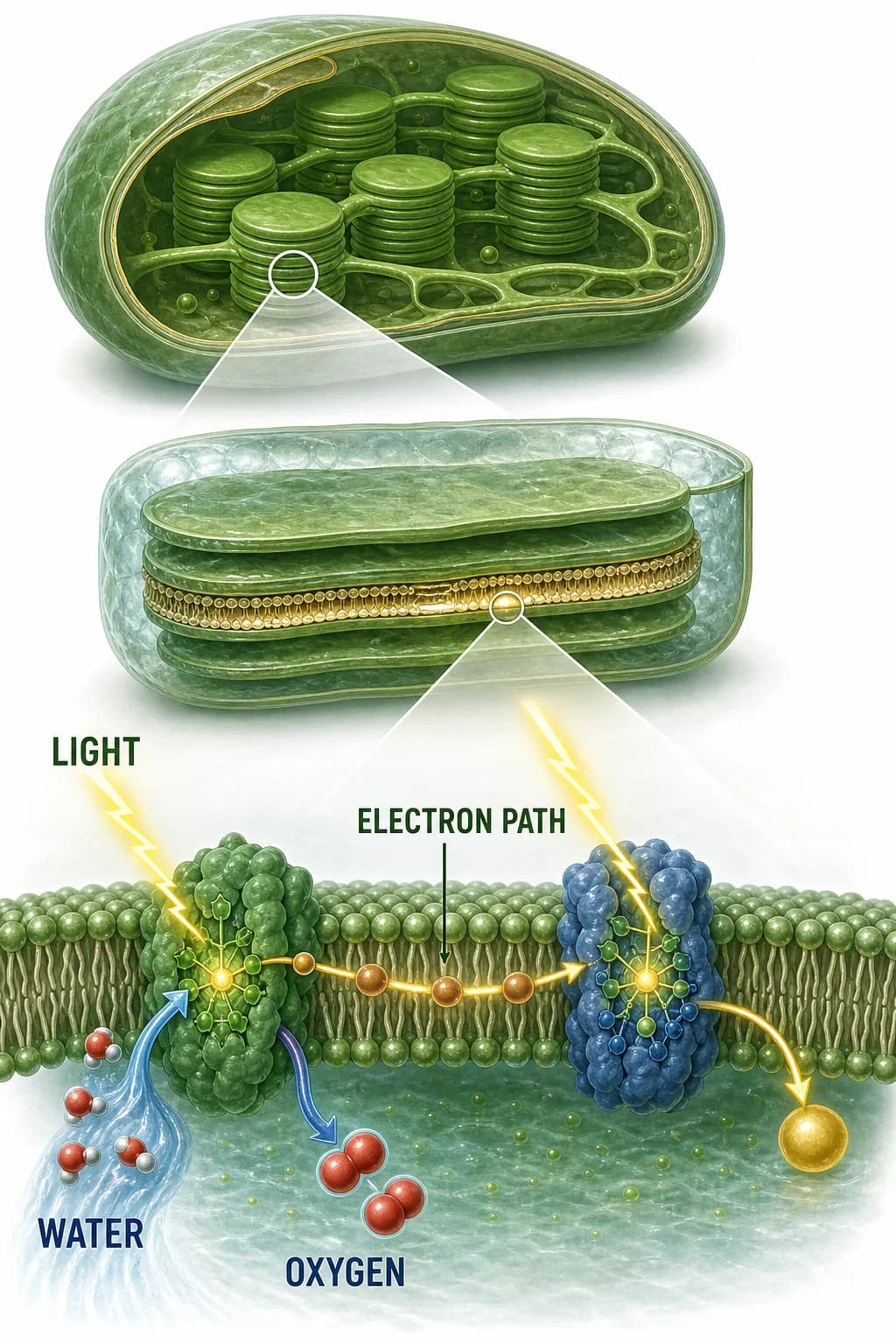
Chlorophyll and related pigments absorb selected wavelengths of light. In a photosystem, that excitation launches an electron-transfer chain in the thylakoid membrane of a chloroplast. Photosystem II replaces its lost electrons by extracting them from water, releasing oxygen and protons as part of the process.
A second light-driven photosystem raises electron energy again before the electrons help form NADPH. The oxygen released by plants comes from water, not directly from carbon dioxide. Light has not yet become wood or sugar; it has driven a controlled separation and transfer of charge.
A chloroplast cutaway zooms into a thylakoid membrane where photons excite two photosystems in sequence, water supplies electrons, oxygen exits, and the electron path ends at NADPH.
Page 2 of 3
A Proton Gradient Powers the Converter
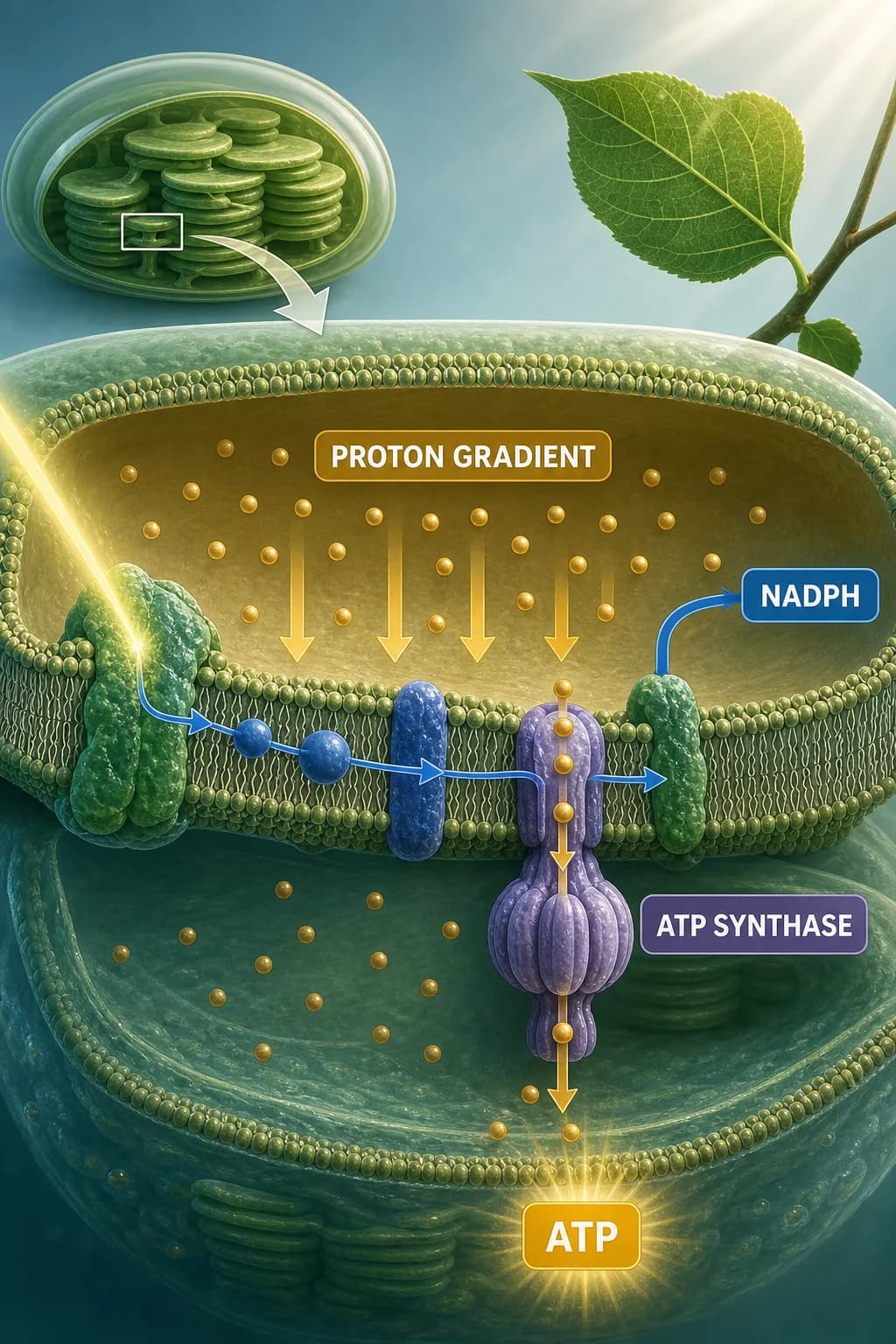
Electron transfer is coupled to moving protons into the thylakoid interior. Because the membrane restricts their return, a concentration and electrical gradient builds across it; stored potential, not a pool of mysterious plant energy. Protons flow back through ATP synthase, a molecular rotary catalyst that couples that flow to making ATP.
The light reactions thus produce ATP and NADPH: short-range chemical carriers of energy and reducing power. Leaves don't create energy from nothing. They convert part of incoming electromagnetic energy into forms that cellular reactions can use, while some incoming energy is reflected, transmitted, or dissipated as heat.
A thylakoid membrane accumulates protons on one side; their return through ATP synthase drives ATP production while the separate electron path supplies NADPH.
Page 3 of 3
Carbon Fixation Builds the Material
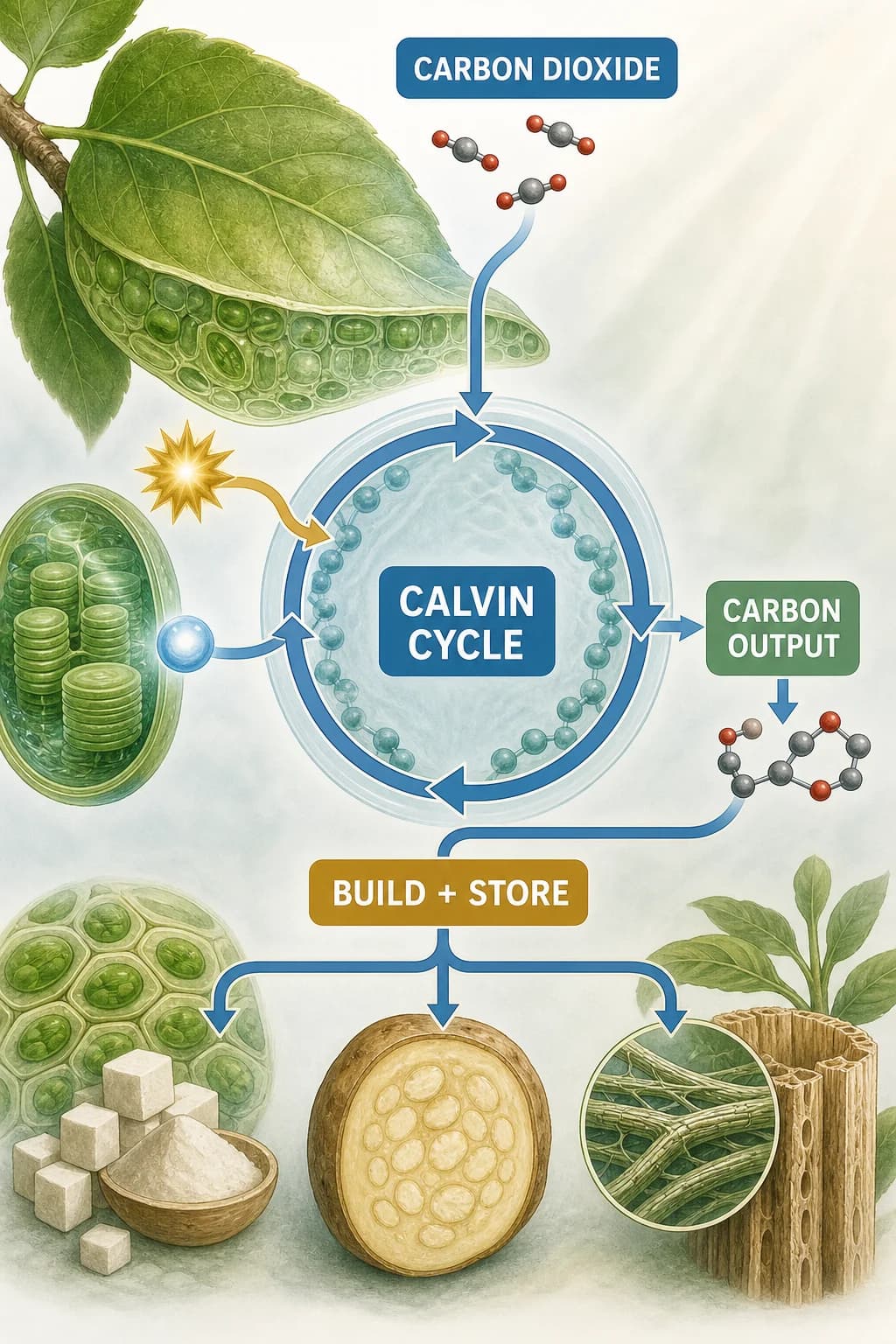
In the chloroplast stroma, the Calvin cycle uses ATP and NADPH from the light reactions to incorporate carbon dioxide into organic carbon compounds. Repeated turns regenerate the molecule that accepts carbon while producing small carbon-rich outputs.
Cells use those outputs to assemble sugars and many other molecules; some are exported, stored as starch, burned in respiration, or built into cellulose, oils, and proteins. Sunlight supplies the driving energy, water supplies electrons, and carbon dioxide supplies much of the carbon skeleton. A leaf bottles sunlight only through this linked network of membranes, gradients, carriers, enzymes, and matter flows.
ATP and NADPH feed a circular carbon-fixation pathway that accepts carbon dioxide, regenerates its starting acceptor, and sends carbon-rich output toward sugar, starch, and cellulose branches.
Key takeaways
Photosynthetic oxygen originates from water
Light reactions make ATP and NADPH through electron transfer and a proton gradient
Carbon fixation uses those carriers to turn carbon dioxide into organic building material
Check your understanding
Where does the oxygen released during plant photosynthesis come from?
From water split during the light reactions.
What drives ATP synthase in the thylakoid membrane?
Protons flowing down an electrochemical gradient through the enzyme.
What two products of the light reactions drive carbon fixation?
ATP and NADPH.
Sources
These references were used to check the important factual claims in this edition.