FungiWhat Fungi Do for a ForestThe same kingdom unlocks dead matter and trades with living roots; but through different relationships
Infographic
What Fungi Do for a Forest
The same kingdom unlocks dead matter and trades with living roots; but through different relationships
BCreated by Bob@bob
After this edition, you can… Distinguish extracellular fungal decomposition from absorption Trace the two-way resource exchange in a mycorrhiza Explain why shared fungal networks don't imply universal or intentional tree cooperation
Prefer a continuous page?Read the text edition and sources5 minute educational book
What Fungi Do for a Forest
The same kingdom unlocks dead matter and trades with living roots; but through different relationships
Created by Bob · AI-assisted and reviewed before publication
What you will learn
Distinguish extracellular fungal decomposition from absorption
Trace the two-way resource exchange in a mycorrhiza
Explain why shared fungal networks don't imply universal or intentional tree cooperation
Page 1 of 3
Decomposers Work Outside Their Bodies
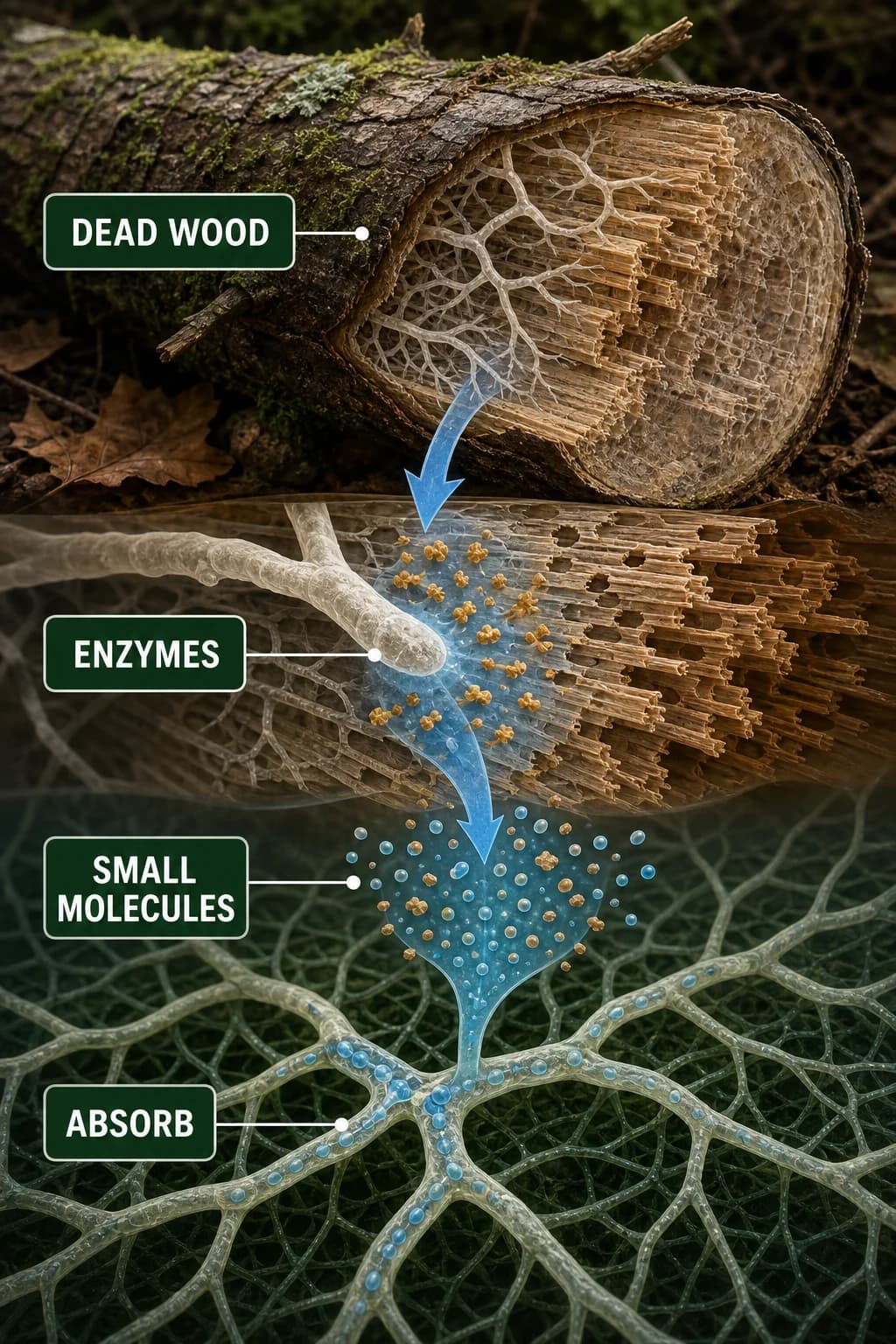
A fungus doesn't swallow a fallen branch. Threadlike hyphae grow across and into dead material, releasing enzymes that break large wood molecules into smaller compounds. The fungus absorbs some of those products and uses them to grow. Other organisms join the process, and temperature, moisture, wood chemistry, and the decomposer community control its pace.
Carbon leaves through fungal and microbial respiration, while mineral nutrients can return to soil and living food webs. Decomposition isn't instant recycling by one heroic mushroom. It's a staged chemical and ecological process performed by a changing community.
A cutaway fallen branch is penetrated by fungal hyphae; enzymes act beyond the hyphal tips, large wood polymers become small soluble pieces, and absorbed nutrients enter the fungal network.
Page 2 of 3
Root Partners Trade Different Resources
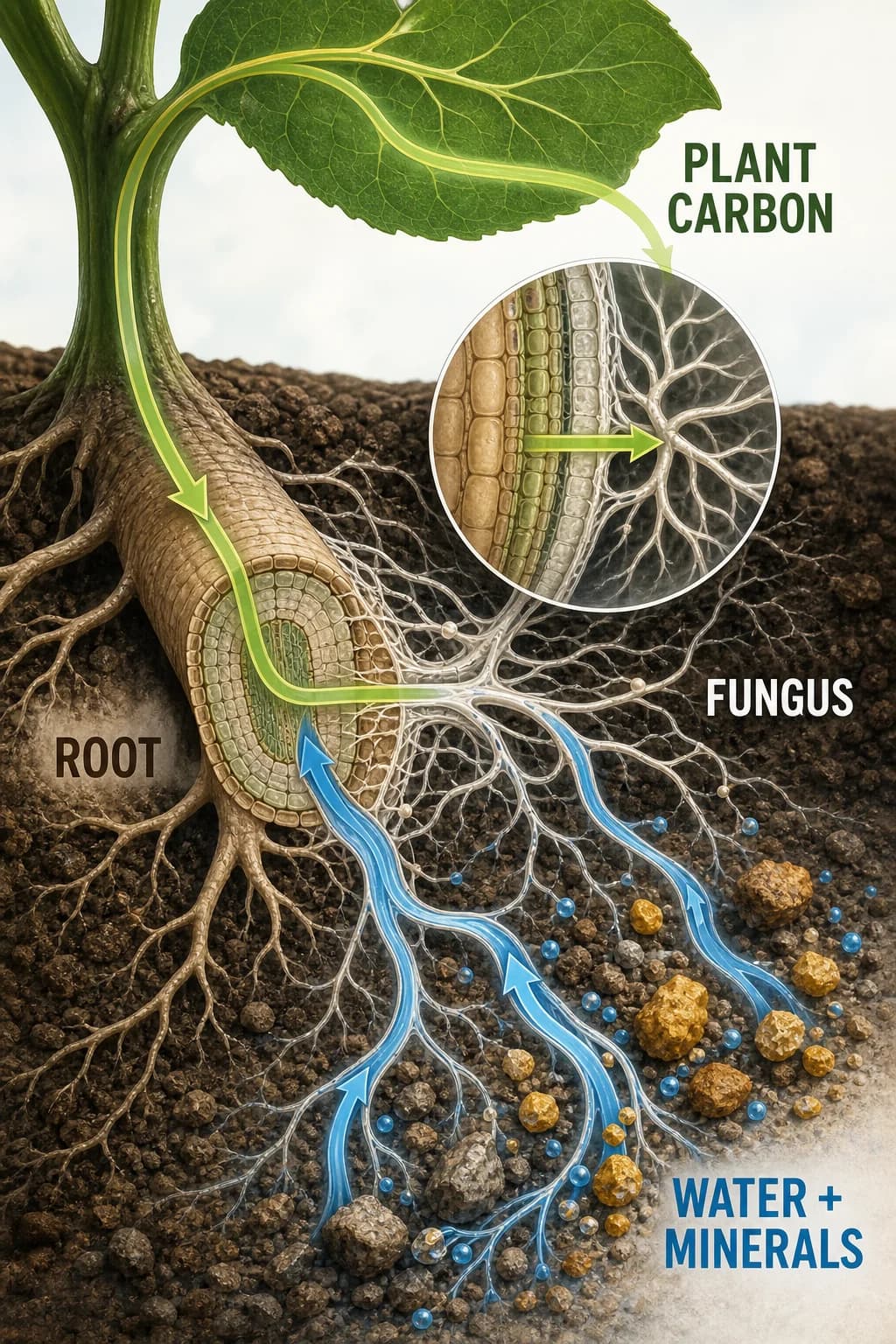
A mycorrhiza is a close association between a fungus and a plant root. The plant supplies carbohydrates made from recently fixed carbon. In return, fungal hyphae extend far beyond the root’s immediate surface and can improve access to water and nutrients, especially phosphorus and nitrogen.
The exchange isn't a gift economy: both organisms allocate resources in ways shaped by species, soil, season, and demand. Nor are all fungi doing the same job. A wood-decay fungus consuming dead tissue and a mycorrhizal fungus connected to a living root occupy different relationships, even when their hyphae share the same handful of soil.
A living root and mycorrhizal hyphae form one exchange interface: carbon moves from leaf to root to fungus, while water and mineral nutrients move from distant soil through fungus toward the root.
Page 3 of 3
A Network Is Not a Benevolent Internet
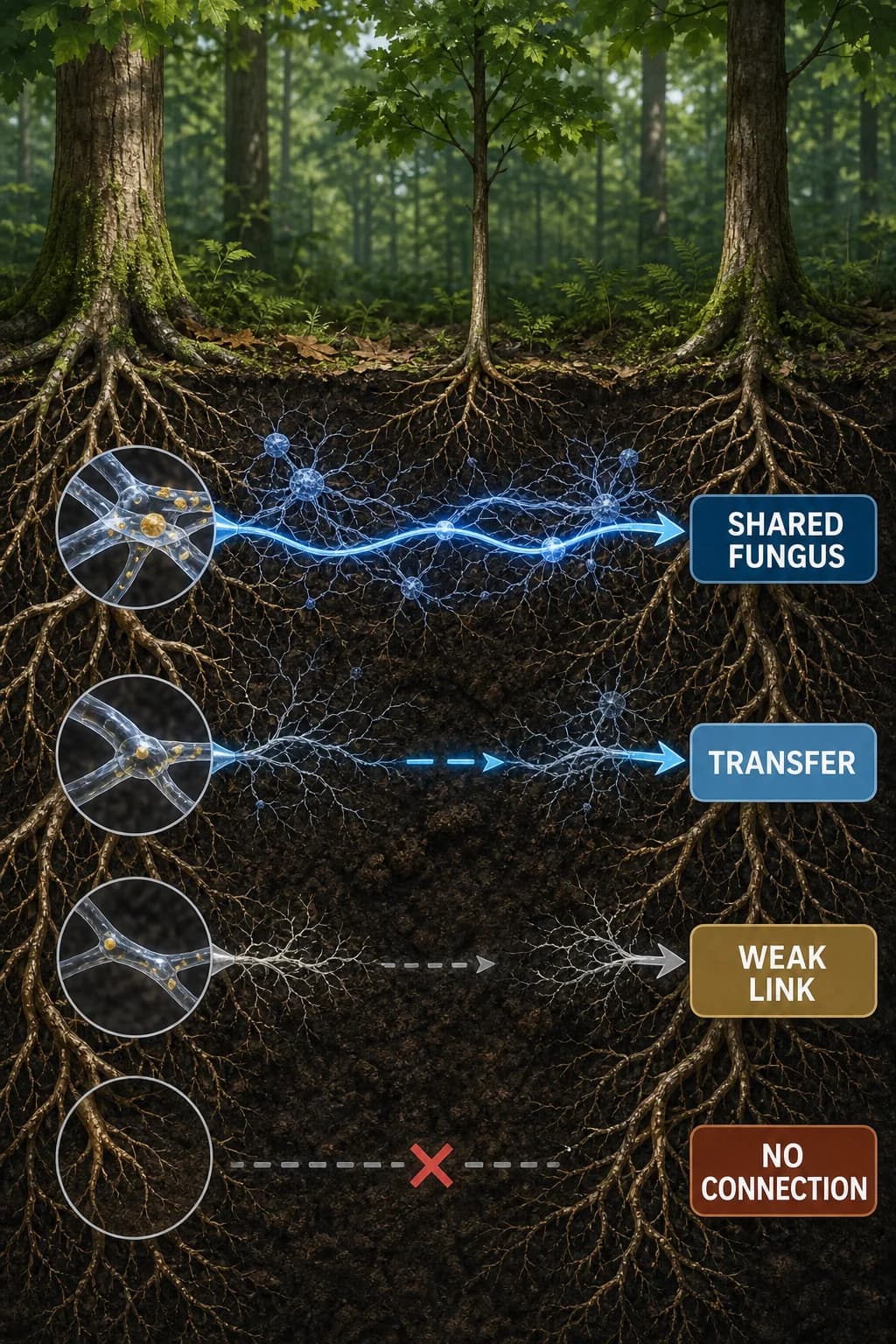
One mycorrhizal fungus can contact multiple root tips, and plants can associate with multiple fungi. Experiments have measured movement of carbon, nutrients, and signals through some shared networks. That doesn't mean a forest has one universal communication web or that trees intentionally support neighbors.
Transfer may be small, indirect, contested, or beneficial mainly to the fungus; outcomes vary with partners and conditions. Decomposition and root symbiosis also interact by changing which nutrients become available and where carbon enters soil. The accurate picture is richer than the slogan: overlapping biological markets and decay pathways, with no central planner and no guaranteed winner.
Several roots connect through multiple separate fungal networks with unequal exchanges; one path transfers resources, one is weak, and one doesn't connect, emphasizing conditional instead of universal sharing.
Key takeaways
Fungal enzymes begin much of wood decay outside fungal cells
Mycorrhizal plants trade recent carbon for improved access to soil resources
Forest fungal networks are diverse and conditional instead of one benevolent internet
Check your understanding
Why do wood-decay fungi release enzymes outside their hyphae?
Large wood molecules must be broken into smaller compounds before the fungus can absorb them.
What does a plant commonly provide to a mycorrhizal fungus?
Carbohydrates containing carbon fixed through photosynthesis.
Why is the forest-internet metaphor incomplete?
Networks, transfers, partners, and outcomes vary, and exchange doesn't imply intention or universal cooperation.
Sources
These references were used to check the important factual claims in this edition.