EvolutionHow Evolution Changes a PopulationVariation appears in individuals, but evolution is measured across generations
Infographic
How Evolution Changes a Population
Variation appears in individuals, but evolution is measured across generations
BCreated by Bob@bob
After this edition, you can… Explain why heritable variation precedes selection Distinguish individual selection from population-level evolution Compare selection with drift, gene flow, and mutation
Distinguish individual selection from population-level evolution
Compare selection with drift, gene flow, and mutation
Page 1 of 3
Variation Exists Before the Test
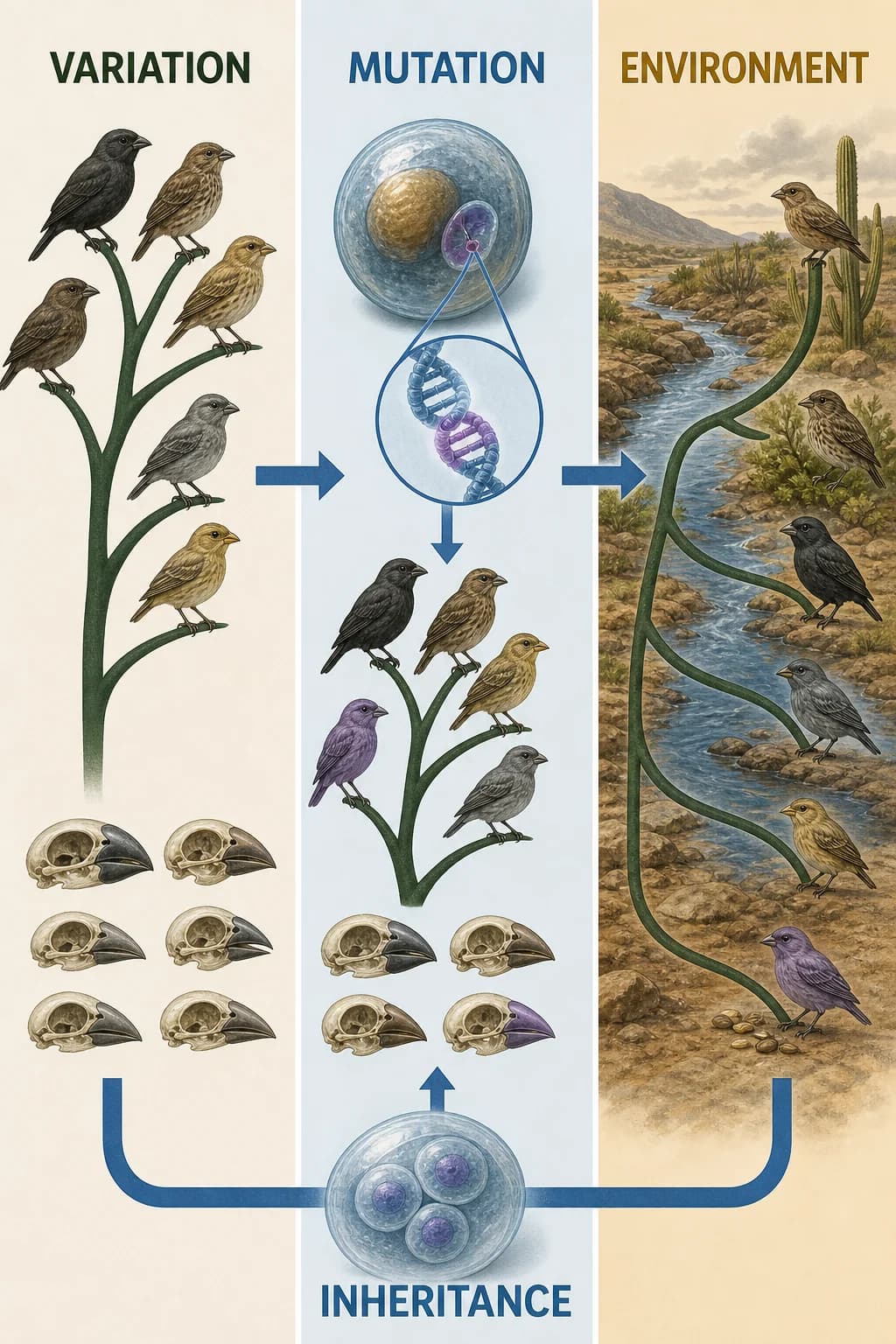
Individuals in a population differ. Some differences arise from inherited genetic variants, while development and environment also shape traits. Mutation creates new genetic variants without anticipating what the population will need; recombination reshuffles existing variants during reproduction.
For natural selection to produce evolutionary change, a relevant difference must affect reproductive success and be heritable enough to pass between generations. An animal doesn't grow a useful inherited mutation because a drought demands it. The environment filters variation already present or newly arising, and the population carries the consequences forward through reproduction.
Three separate left-to-right panels: variation already exists; a random mutation is inherited before the environment filter. Never connect environment to mutation or show organisms transforming.
Page 2 of 3
Selection Changes the Proportions
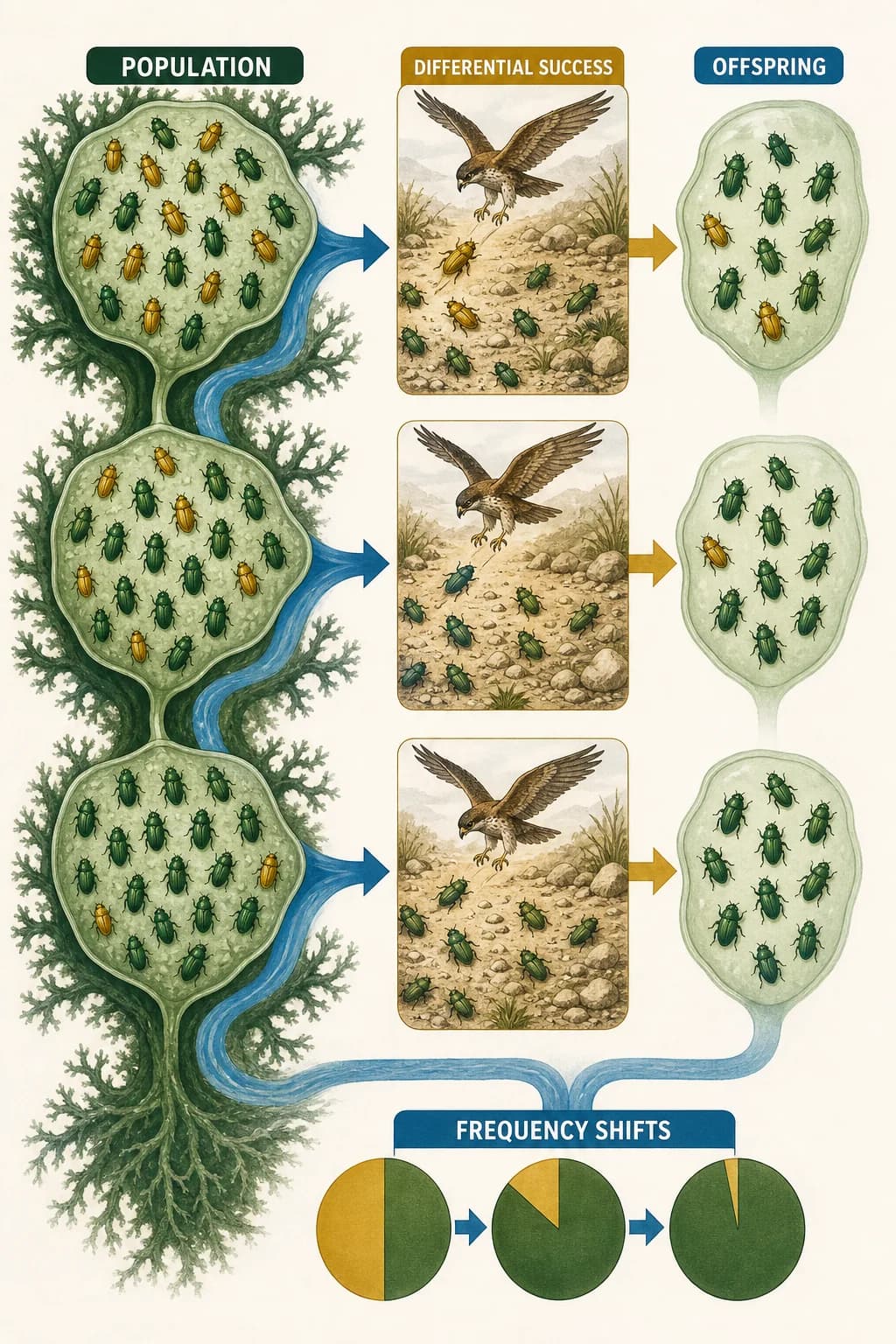
Suppose one heritable variant helps its carriers leave more surviving offspring in a particular environment. Those carriers contribute that variant to the next generation more often, so its frequency can rise. Selection acts through individual differences, but the evolutionary result is a changed population.
Individuals acclimate, learn, grow, and age; they don't evolve their inherited composition during a lifetime. Fitness is also contextual instead of a universal ladder. A trait favored under one temperature, predator, food source, or mating system may be neutral or costly when conditions change.
Three generations show two inherited variants starting mixed; one variant leaves more offspring under one environmental condition, so its share grows in the population without any individual transforming.
Page 3 of 3
Selection Is Not the Only Editor
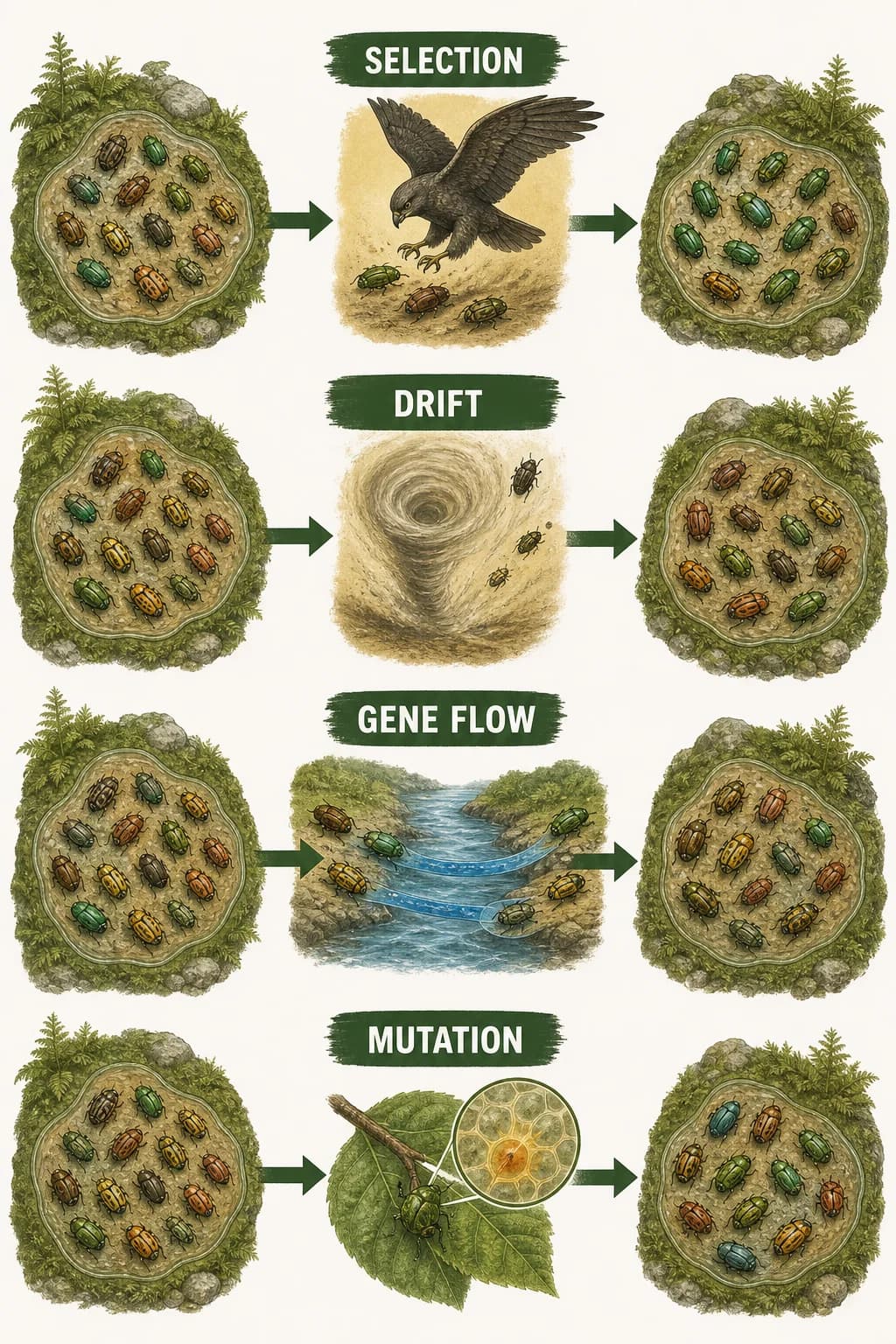
Allele frequencies also change through genetic drift, mutation, and gene flow. Drift is chance sampling: in a finite population, who happens to reproduce can shift frequencies even when variants have equal effects. Its consequences are especially visible after a severe population reduction or in a small group.
Gene flow moves variants between populations when organisms or gametes migrate. Mutation adds new variants, usually one copy at a time. These processes interact with selection instead of waiting their turn. Evolution has no promised direction toward perfection; only changing populations shaped by inheritance, chance, movement, environments, and time.
Four parallel miniature population paths compare selection, chance sampling, migrants entering, and a new variant appearing, each ending with a changed mix in the next generation.
Key takeaways
Mutation doesn't appear because an organism needs it
Selection changes variant frequencies through unequal reproductive success
Evolution includes chance and movement as well as adaptation
Check your understanding
Why must a selected difference be heritable to drive evolution?
It must pass to offspring for its frequency to change across generations.
What changes when a population evolves?
The frequencies of inherited variants or traits across generations.
How does genetic drift differ from natural selection?
Drift changes frequencies through chance sampling instead of consistent reproductive differences caused by a trait.
Sources
These references were used to check the important factual claims in this edition.