Carbon cycleWhere Carbon Goes and How Long It StaysThe same atom can race through life or wait millions of years in rock
Infographic
Where Carbon Goes and How Long It Stays
The same atom can race through life or wait millions of years in rock
BCreated by Bob@bob
After this edition, you can… Distinguish carbon reservoirs from the fluxes connecting them Compare fast biological and slow geologic carbon pathways Explain why rapidly moving fossil carbon changes atmospheric concentration
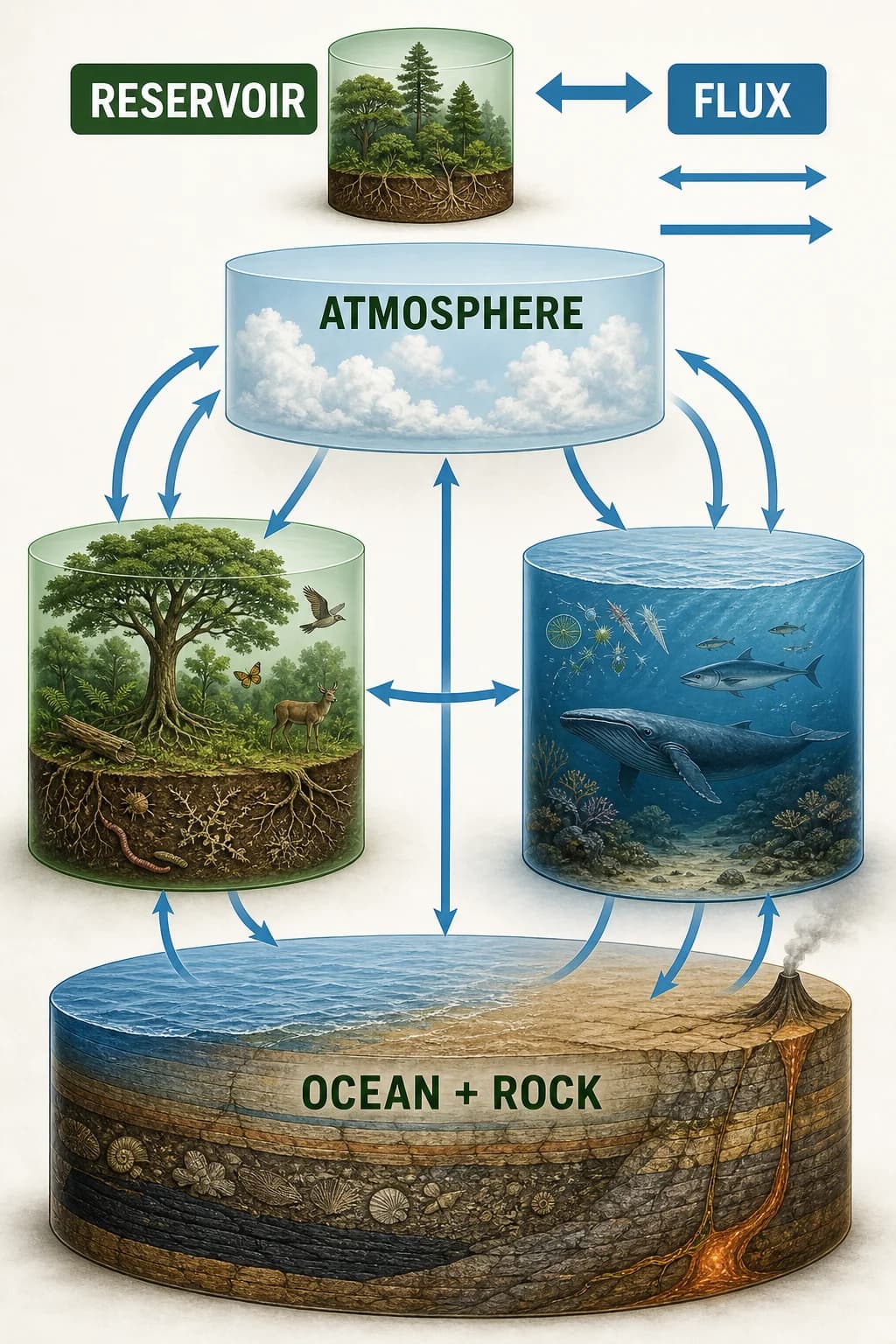
The carbon cycle is easier to read as reservoirs connected by fluxes. The atmosphere, vegetation, soils, surface ocean, deep ocean, sediments, rocks, and fossil fuels hold different amounts for different lengths of time. Photosynthesis moves carbon dioxide into organic matter; respiration, decomposition, and fire return some carbon to air and water.
Ocean exchange moves carbon in both directions, while currents carry it away from the surface. A reservoir can be large without exchanging quickly, and a small reservoir can change rapidly. Following one arrow isn't enough; the balance depends on all incoming and outgoing fluxes together.
A network map separates carbon reservoirs from the arrows between them; atmosphere, life, ocean, and rock are containers of different sizes linked by two-way and one-way flux paths.
Page 2 of 3
One Element Runs on Two Clocks
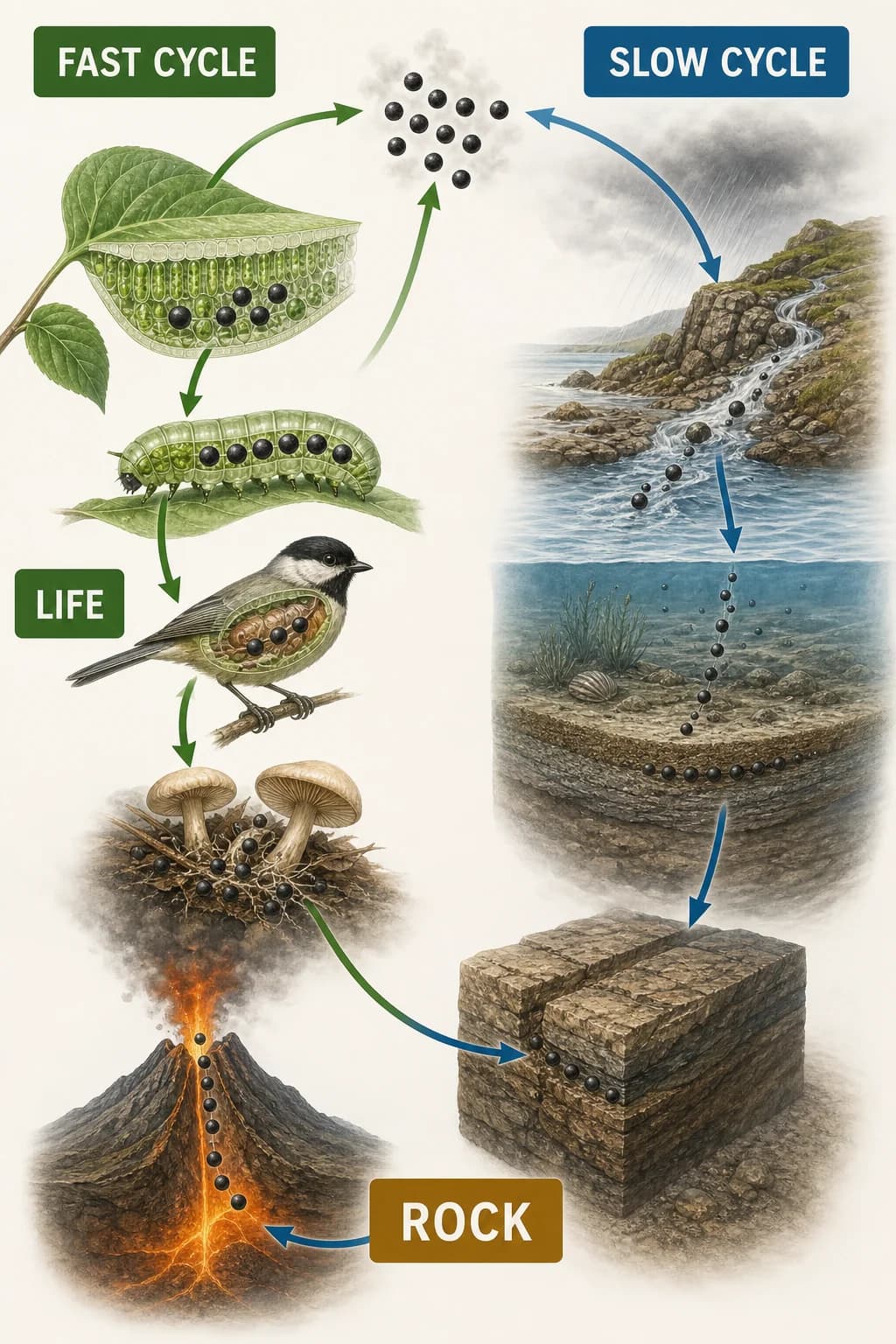
In the fast cycle, plants and phytoplankton fix carbon, food webs move it, and respiration and decay return it over seasons to lifetimes. The slow cycle carries carbon through weathering, dissolved ocean chemistry, seafloor burial, rock formation, tectonic movement, and volcanic release over thousands to millions of years.
These are coupled instead of separate machines: organic carbon can be buried, rocks can weather into ocean chemistry, and the ocean exchanges with the air. The crucial insight is residence time. Carbon identity stays the same while the pathway determines whether its next move takes an afternoon or a geologic age.
Two synchronized paths follow identical carbon beads: a compact fast loop through air, leaf, food web, and decay beside a long slow arc through weathering, ocean burial, rock, and volcano.
Page 3 of 3
Fossil Burning Crosses the Clocks
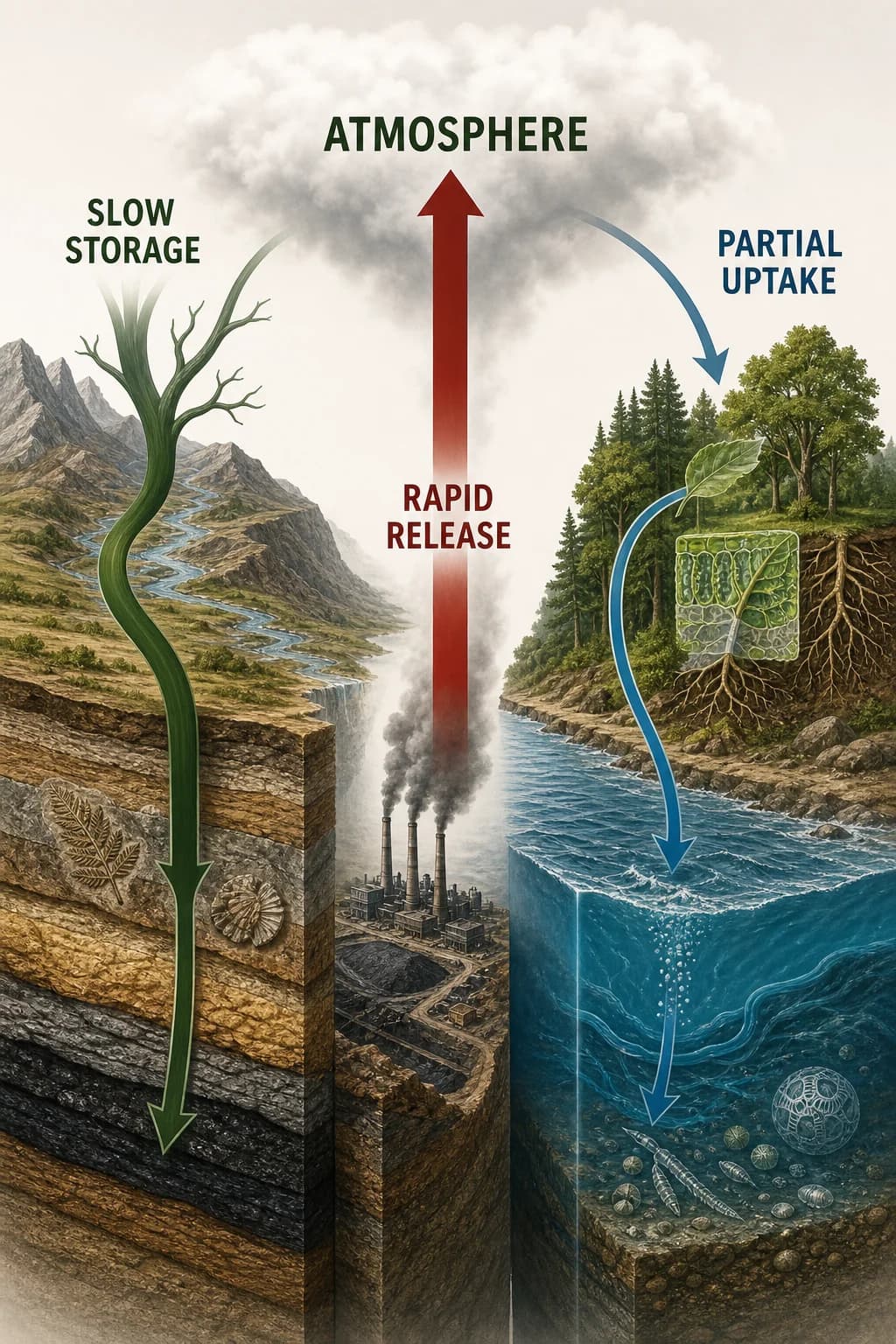
Coal, oil, and natural gas contain carbon accumulated and stored through geologic processes. Burning them transfers a large flow from a slow reservoir into the atmosphere on human timescales. Land clearing can also release stored carbon and remove living uptake.
Plants and oceans absorb some added carbon, but those responses operate at different rates and have limits and side effects; uptake doesn't make the transfer vanish. This is why conserving total carbon atoms isn't the same as preserving climate balance. Moving carbon rapidly between reservoirs changes atmospheric concentration even though the element remains somewhere in the Earth system.
A thin natural return from geologic carbon contrasts with a thick rapid human transfer into the atmosphere; slower plant and ocean uptake arrows absorb only part of the pulse over different timescales.
Key takeaways
Reservoir size and exchange speed are different properties
Fast and slow carbon cycles are coupled across radically different timescales
Burning fossil fuels moves carbon from slow storage into the active atmosphere quickly
Check your understanding
What is the difference between a reservoir and a flux?
A reservoir holds carbon; a flux is a process that transfers carbon between reservoirs.
Name one slow-cycle pathway.
Examples include weathering, ocean burial, rock formation, tectonic movement, or volcanic release.
Why doesn't carbon conservation prevent atmospheric carbon dioxide from rising?
The same total carbon can be redistributed rapidly from slow storage into the atmosphere.
Sources
These references were used to check the important factual claims in this edition.