ZippersHow One Slider Opens and Closes a ZipperOne moving channel forces a repeated chain to choose between interlocked and separated states
Infographic
How One Slider Opens and Closes a Zipper
One moving channel forces a repeated chain to choose between interlocked and separated states
BCreated by Bob@bob
After this edition, you can… Describe how repeated elements share closure load Trace engagement through a slider's Y-shaped channel Explain how reverse travel uses the same geometry to separate the chain
Prefer a continuous page?Read the text edition and sources5 minute educational book
How One Slider Opens and Closes a Zipper
One moving channel forces a repeated chain to choose between interlocked and separated states
Created by Bob · AI-assisted and reviewed before publication
What you will learn
Describe how repeated elements share closure load
Trace engagement through a slider's Y-shaped channel
Explain how reverse travel uses the same geometry to separate the chain
Page 1 of 3
The Chain Is Many Small Interlocks
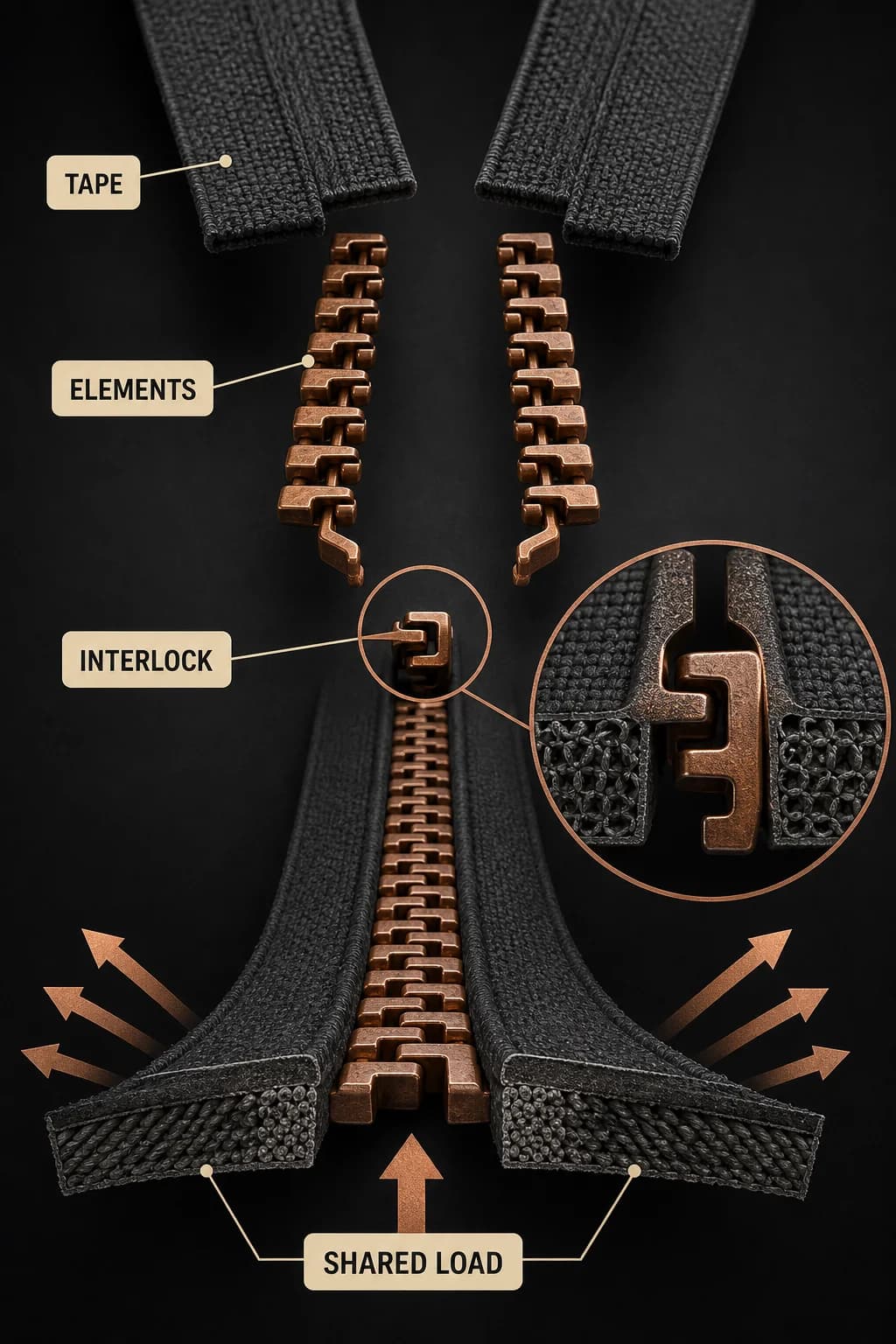
A zipper has two flexible stringers attached to tapes. Each stringer carries repeated elements; discrete teeth or a shaped coil; with features that can nest with counterparts from the other side. One pair alone carries little of the closure; a long engaged sequence distributes opening load across many local contacts and transfers it into the tapes and surrounding material.
The chain must remain aligned closely enough for those shapes to meet. Missing elements, damaged tape, or sideways distortion can concentrate load and let neighboring contacts disengage even when the slider itself is intact.
An exploded zipper chain shows two fabric tapes, two aligned element rows, one pair nesting, and a long engaged sequence sharing an opening load into both tapes.
Page 2 of 3
The Slider Is a Moving Y-Shaped Constraint
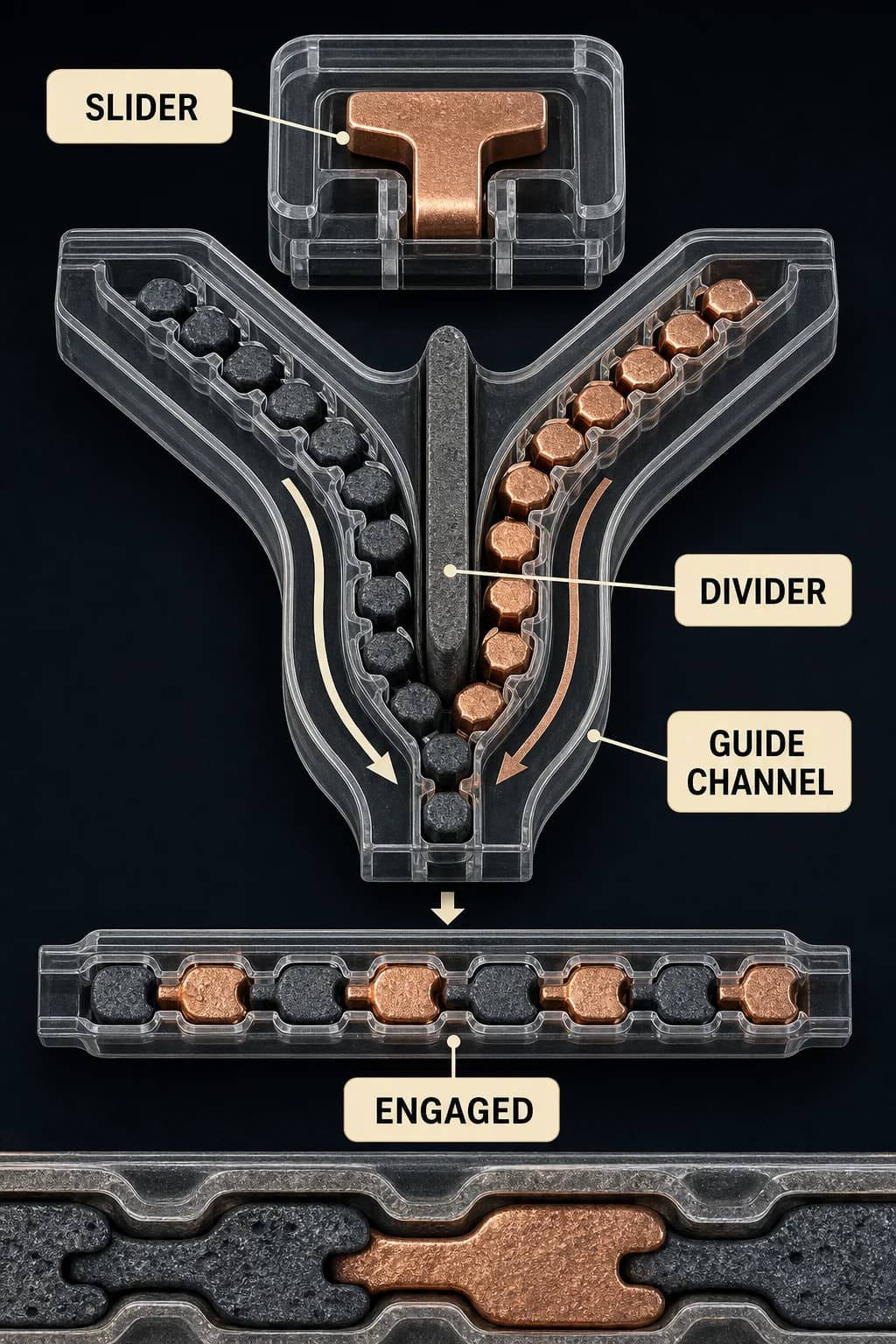
Inside the slider, flanges and a central divider form channels that set the stringers' spacing and angle. Moving toward closure brings the two rows around the divider and squeezes their elements into the relative position needed to engage.
The slider doesn't glue or permanently deform every tooth; it applies geometry and force locally, one pair after another. The pull tab merely gives the user leverage over this guided motion. A worn or spread slider may no longer compress the rows enough, causing a zipper to separate behind it even when the elements look undamaged.
A transparent slider cutaway shows two separated element rows entering the branches of a Y-shaped channel, curving around a central divider, and leaving as one engaged chain.
Page 3 of 3
Reverse the Travel and the Channel Separates
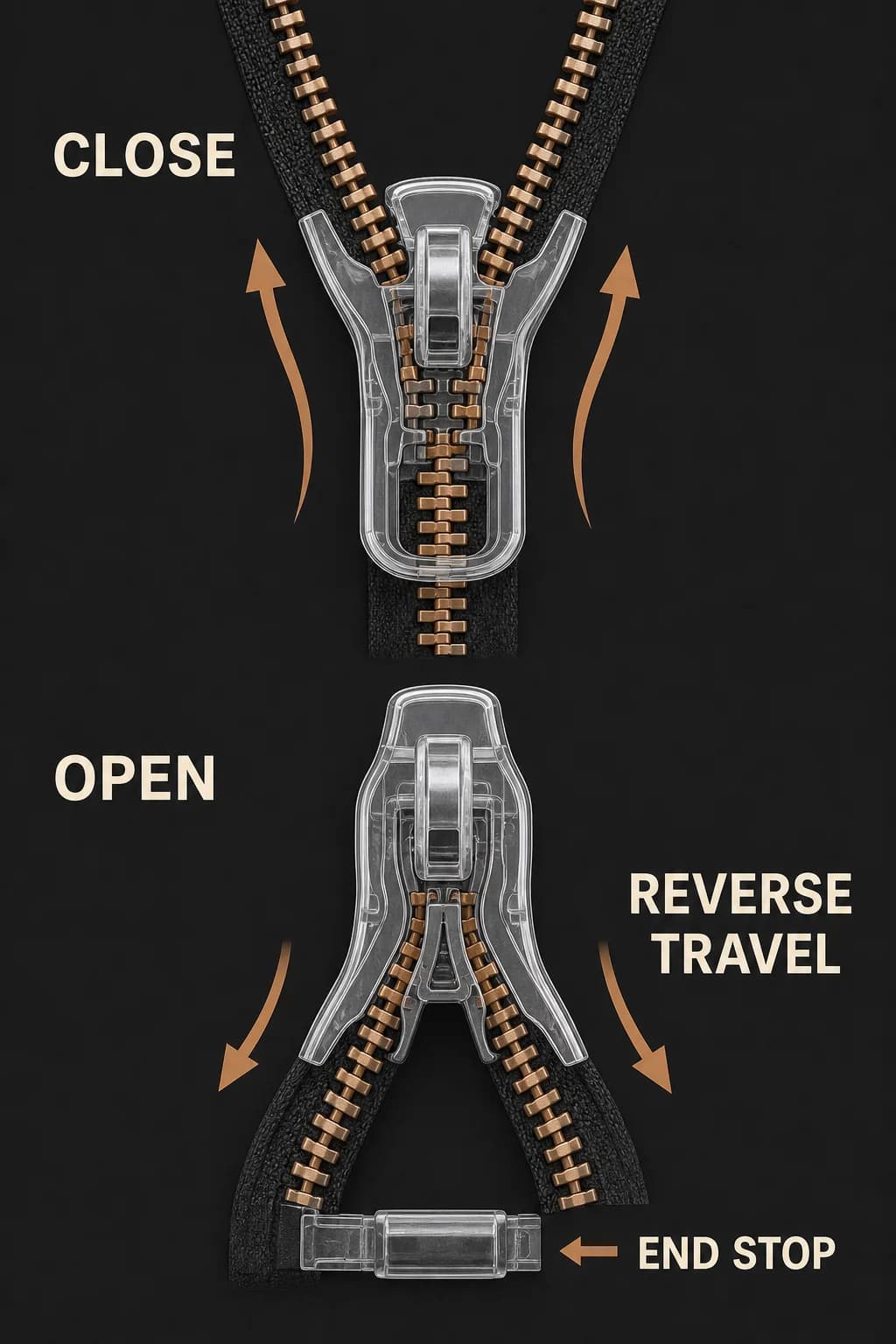
Pull the slider the opposite way and the engaged chain enters the narrow end. The central divider then forces the stringers apart into separate channels, disengaging successive pairs. The same rigid geometry performs opposite operations because the material approaches it from opposite directions.
Bottom boxes, pins, and stops align separable zippers and prevent the slider from leaving the chain; top stops end travel. Reliable closure depends on a complete system: element geometry, slider dimensions, flexible tape, terminal hardware, alignment, and loading direction. The reversible machine is simple only because every part constrains the next.
The same slider is shown in opposite travel directions: one direction merges two rows into an engaged chain; reversed travel sends the chain into the divider and separates it, with end stops constraining motion.
Key takeaways
A zipper is a distributed chain of local interlocks
The slider guides and compresses instead of gluing
Direction reverses whether the central channel merges or separates the stringers
Check your understanding
What carries opening load away from interlocked elements?
The repeated contacts distribute it into both stringer tapes and the attached material.
What does the slider's central divider do during closure?
It guides the two rows around separate channels so they meet in the geometry needed to engage.
Why can the same slider both open and close a zipper?
Reversing travel changes whether rows enter separate branches and merge or enter engaged and are forced apart.
Sources
These references were used to check the important factual claims in this edition.