GlassWhy Tempered Glass Shatters into Tiny PiecesIts strong surface and dramatic breakup are two consequences of the same trapped forces
Infographic
Why Tempered Glass Shatters into Tiny Pieces
Its strong surface and dramatic breakup are two consequences of the same trapped forces
BCreated by Bob@bob
After this edition, you can… Describe the residual stress profile of thermally tempered glass Explain how surface compression delays crack opening Relate tensile-core penetration to rapid fragmentation
Prefer a continuous page?Read the text edition and sources5 minute educational book
Why Tempered Glass Shatters into Tiny Pieces
Its strong surface and dramatic breakup are two consequences of the same trapped forces
Created by Bob · AI-assisted and reviewed before publication
What you will learn
Describe the residual stress profile of thermally tempered glass
Explain how surface compression delays crack opening
Relate tensile-core penetration to rapid fragmentation
Page 1 of 3
Cooling Locks the Outside and Inside Together
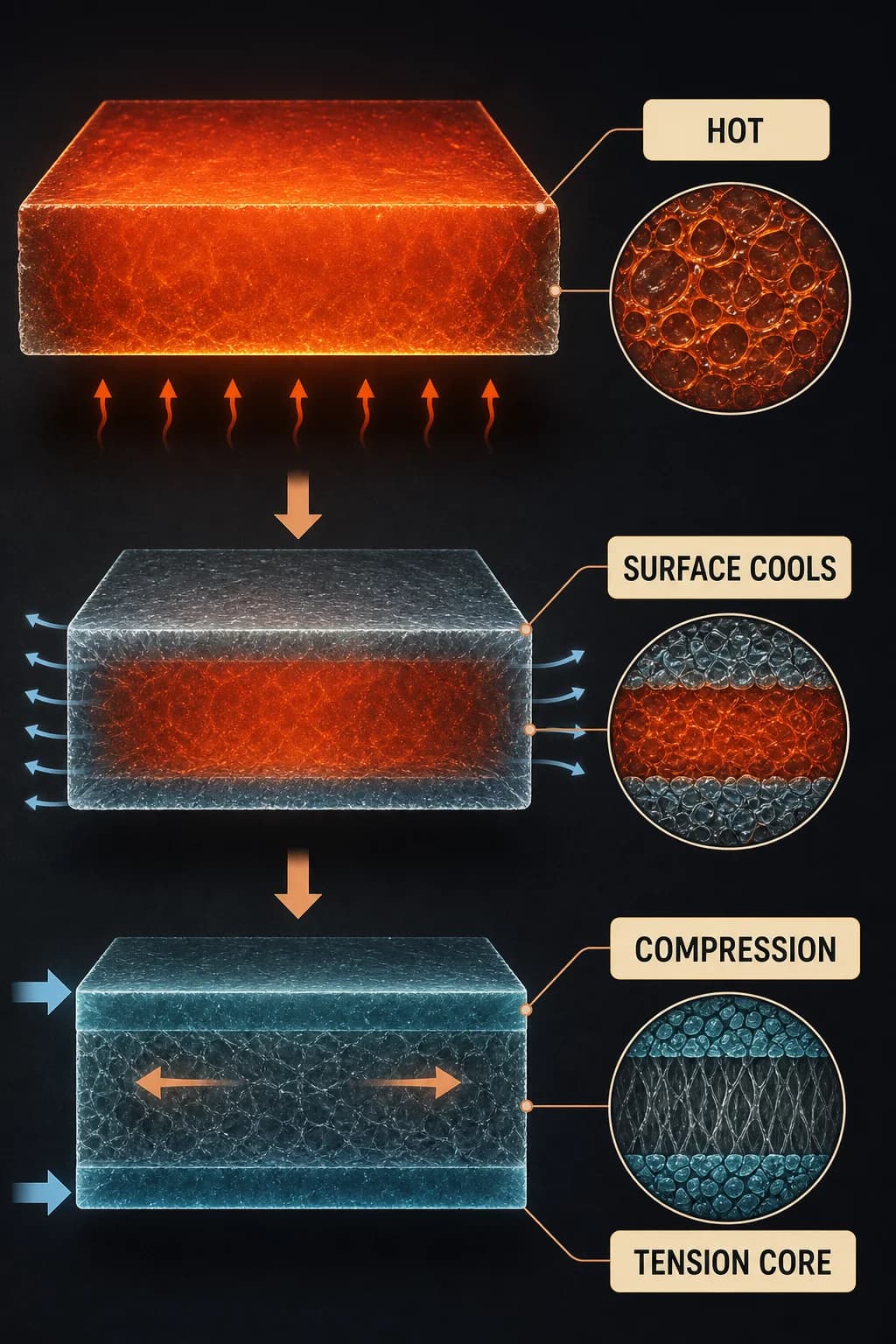
Thermal tempering heats a shaped glass article and then cools its surfaces rapidly. The outer layers stiffen first while the interior remains hotter and continues contracting later. Because the layers are bonded, they can't reach their preferred dimensions independently.
The final plate contains a balanced residual-stress profile: both surfaces are in compression and the central region is in tension. No external load is required for these stresses to exist. The glass stores elastic energy in an internal push-pull arrangement, with compressive surface stress typically larger in magnitude than the compensating average tensile stress inside.
A three-stage through-thickness cutaway shows hot uniform glass, surfaces cooling and locking first, then the final symmetric profile with both outer skins compressed and the interior stretched.
Page 2 of 3
Compression Makes a Surface Crack Work Harder
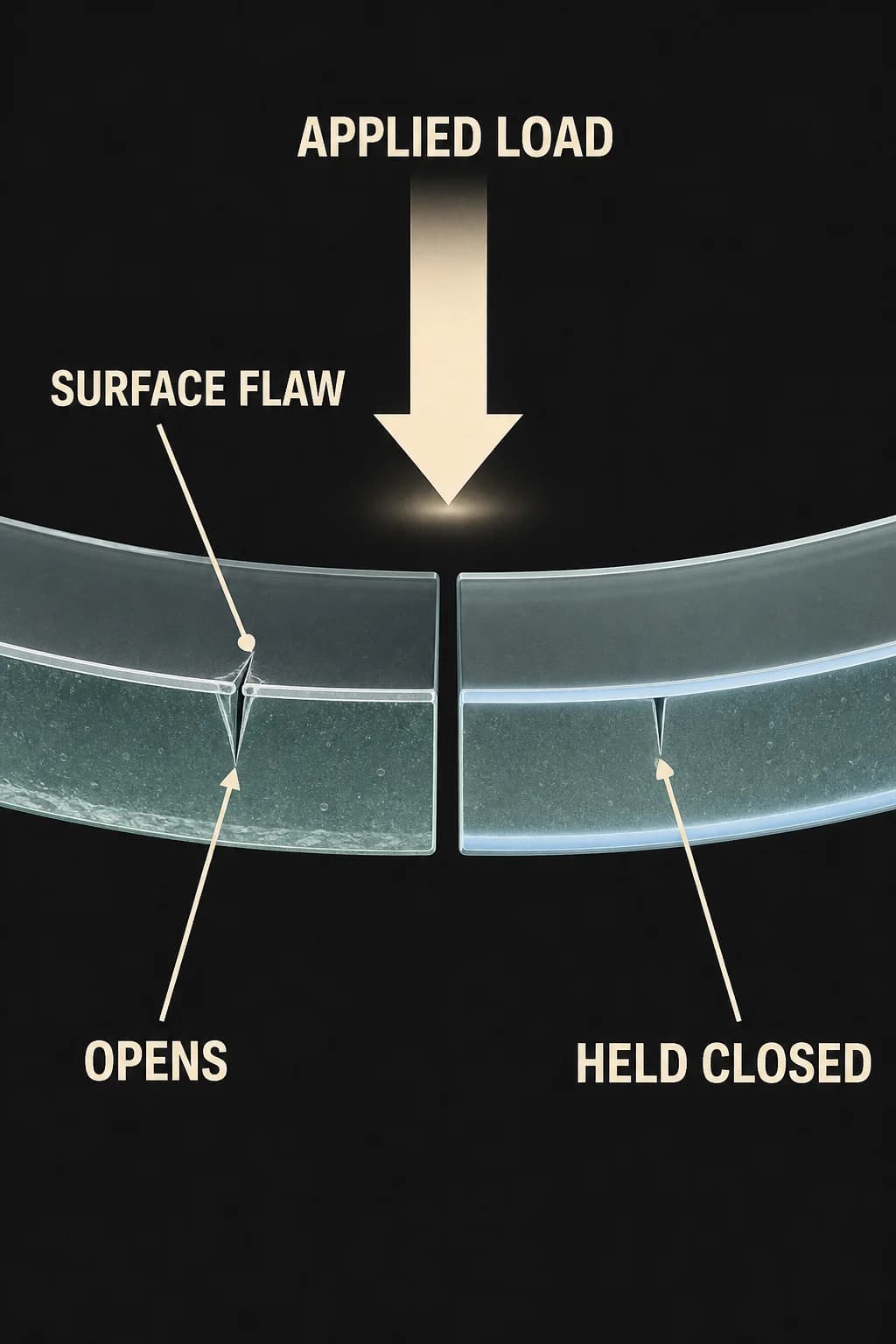
Glass is vulnerable when a tensile stress opens a flaw. In tempered glass, an applied bending load must first overcome the built-in surface compression before the surface can enter net tension and a crack can open. This raises resistance to many impacts and bending loads compared with similar annealed glass.
The protection has a depth, however. Edge damage, deep scratches, drilled holes, or inclusions can penetrate the compressed layer or create local stress concentrations. Tempering doesn't make glass unbreakable, and machining is normally completed before tempering because cutting afterward disrupts the finished stress field.
The same surface flaw is compared in annealed and tempered plates under bending: it opens immediately in the annealed surface but remains closed until applied tension exceeds the compressed skin.
Page 3 of 3
Reach the Core and the Pattern Unloads
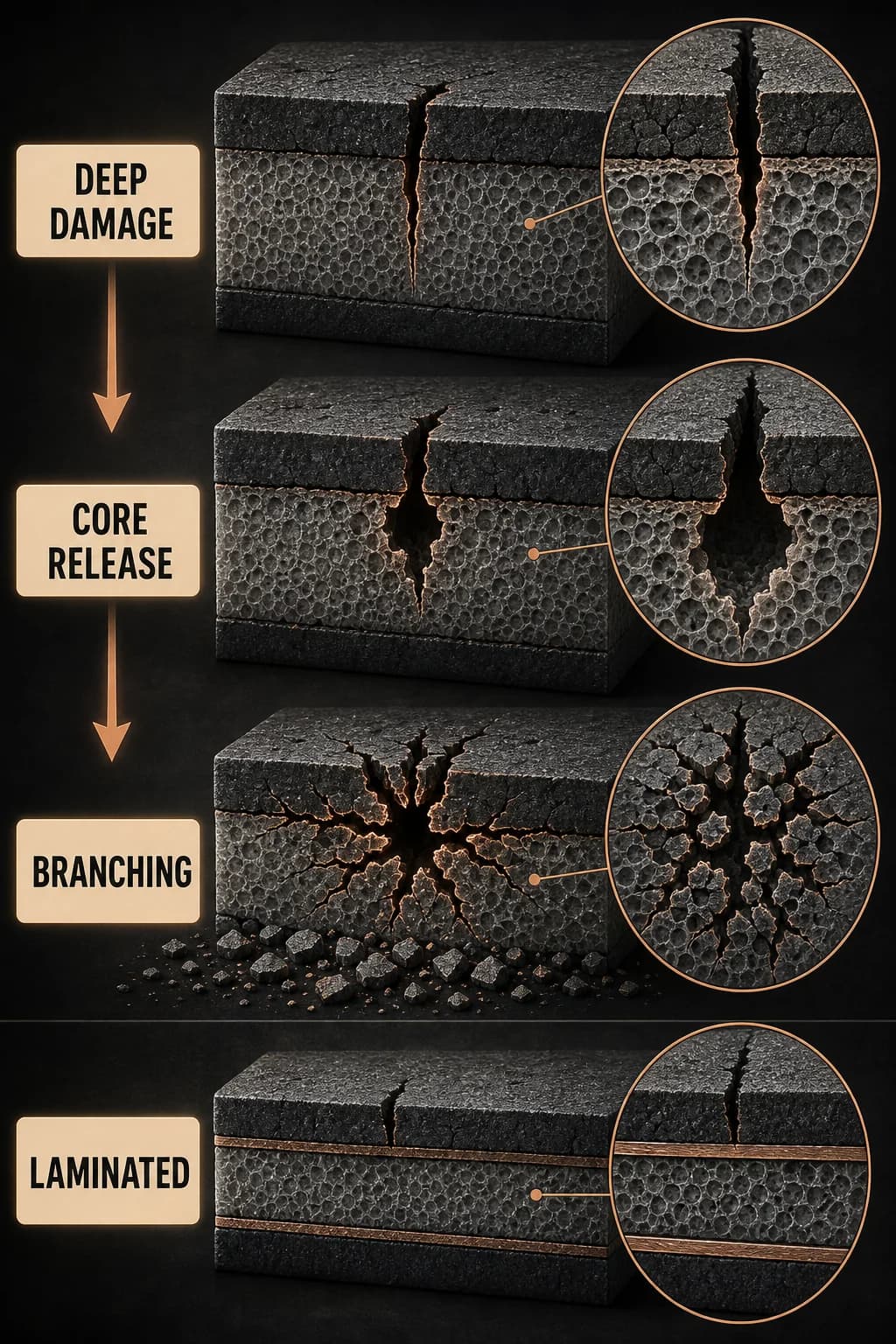
When a crack reaches the tensile interior, the stored stress can drive rapid branching through the plate. Fully tempered glass often disintegrates into many relatively small, blunt-edged pieces instead of a few long, sharp shards. The breakup is a consequence of released elastic energy, not a separate coating or hidden mesh.
Fragment pattern depends on thickness, stress level, damage location, and product design. Laminated safety glass solves a different problem by bonding broken pieces to an interlayer. Tempered glass is strong before fracture and designed to break in a characteristic way; it doesn't remain a load-bearing pane afterward.
An edge crack crosses the compressed skin into the tensile core, then a branching fracture front rapidly releases the balanced stress field into many small fragments; a laminated comparison remains held by an interlayer.
Key takeaways
Tempered glass contains balanced stress without an external load
Surface compression protects shallow flaws from opening
The same stored pattern that adds strength can drive energetic breakup
Check your understanding
Which parts of a tempered plate are in compression?
The outer surface layers on both sides.
Why must an applied load overcome surface compression?
A glass crack opens under net tension, so the built-in compression must be canceled first.
What can happen when a crack reaches the tensile core?
Stored elastic energy can drive rapid branching and disintegration into many fragments.
Sources
These references were used to check the important factual claims in this edition.