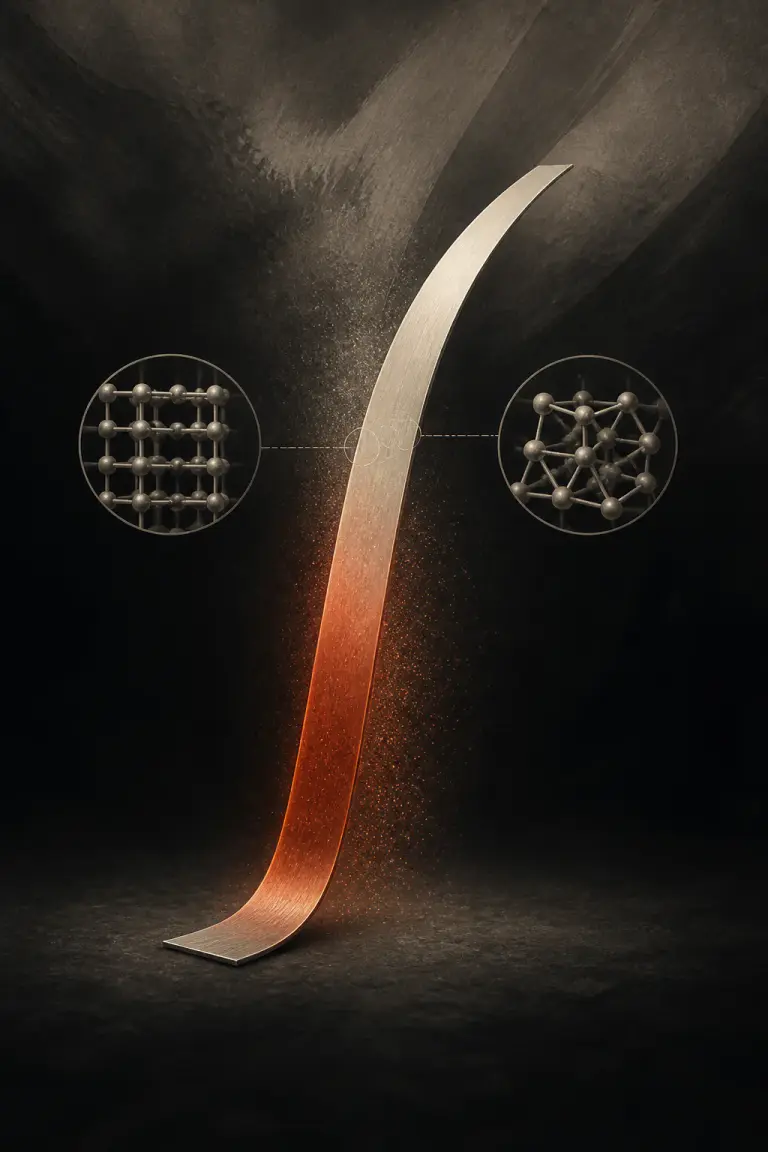
Shape MemoryHow Metal Can Return to Its Original ShapeHeat doesn't remind the metal; it changes which solid phase is stable
Infographic
How Metal Can Return to Its Original Shape
Heat doesn't remind the metal; it changes which solid phase is stable
BCreated by Bob@bob
After this edition, you can… Distinguish martensite-austenite transformation from melting Explain shape recovery through variant reorientation and reverse transformation Identify strain, cycling, and thermal limits on memory behavior
Prefer a continuous page?Read the text edition and sources5 minute educational book
How Metal Can Return to Its Original Shape
Heat doesn't remind the metal; it changes which solid phase is stable
Created by Bob · AI-assisted and reviewed before publication
What you will learn
Distinguish martensite-austenite transformation from melting
Explain shape recovery through variant reorientation and reverse transformation
Identify strain, cycling, and thermal limits on memory behavior
Page 1 of 3
One Alloy Has Two Useful Solid Structures
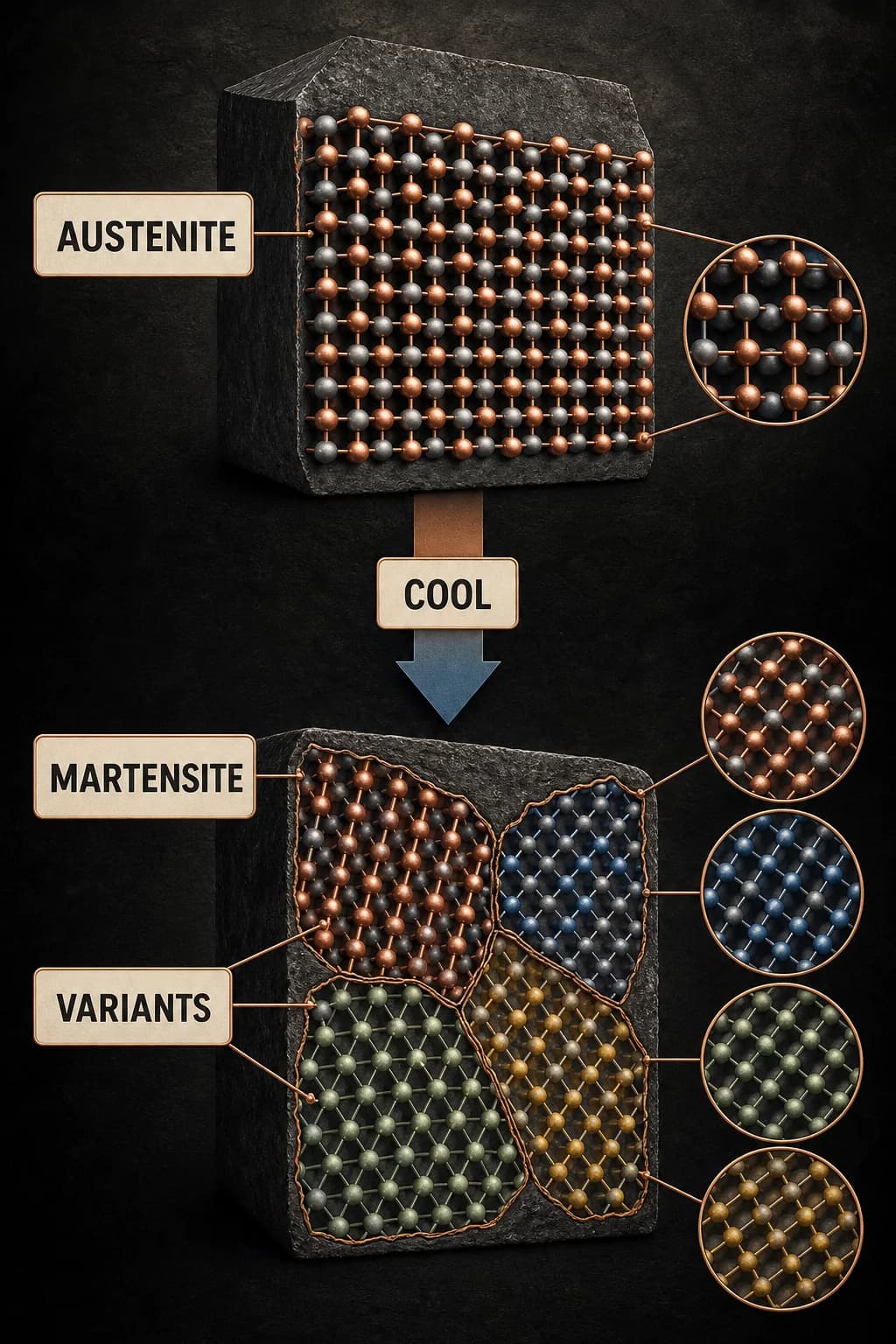
A shape-memory alloy can transform between a high-temperature phase called austenite and a lower-temperature phase called martensite. This is a solid-to-solid rearrangement of crystal structure, not melting. On cooling, martensite can form in differently oriented variants that fit together while preserving the object's overall shape.
The atoms move cooperatively over short distances, so the transformation can reverse without ordinary diffusion rebuilding the material from scratch. Composition, processing, and prior heat treatment set the transformation temperatures and the shape associated with the trained austenite structure.
A single alloy lattice cools from one orderly high-temperature austenite pattern into several interlocking martensite variants without becoming liquid.
Page 2 of 3
Bending Reorients the Low-Temperature Variants
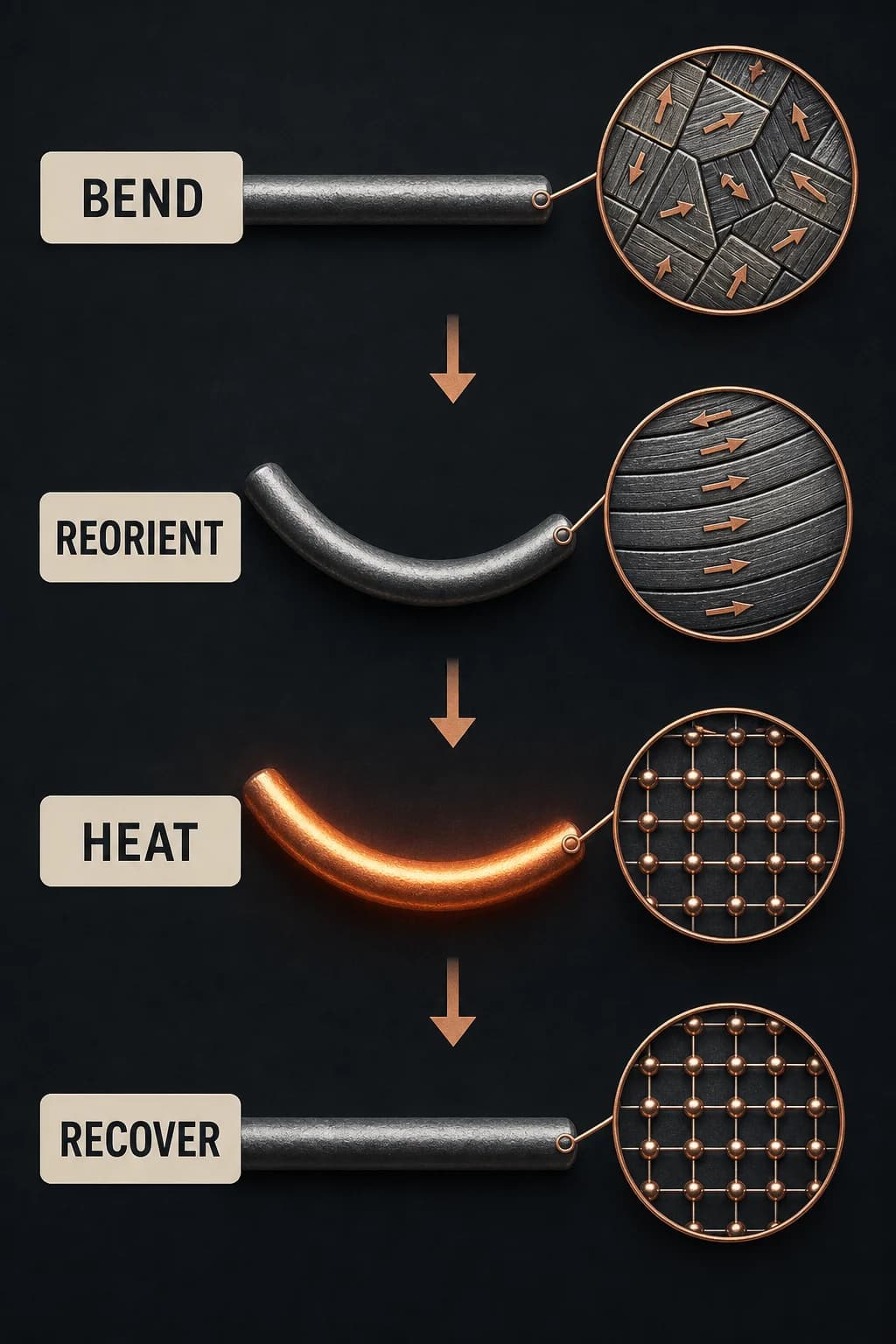
Below the transformation range, loading can favor martensite variants aligned with the applied deformation. Interfaces move and variants reorient, allowing a much larger recoverable shape change than ordinary elastic stretching. The bent object stays bent after the load is removed because the reoriented martensite remains.
Heat then makes austenite stable again. As the alloy transforms back, its trained austenite geometry returns and the macroscopic shape recovers. The metal doesn't store a picture of its past; its microstructure and processing define a preferred phase and geometry under the new temperature.
A cool straight wire with mixed martensite variants is bent, its variants align with the bend, then heating transforms the lattice to austenite and returns the trained straight shape.
Page 3 of 3
Memory Has a Window
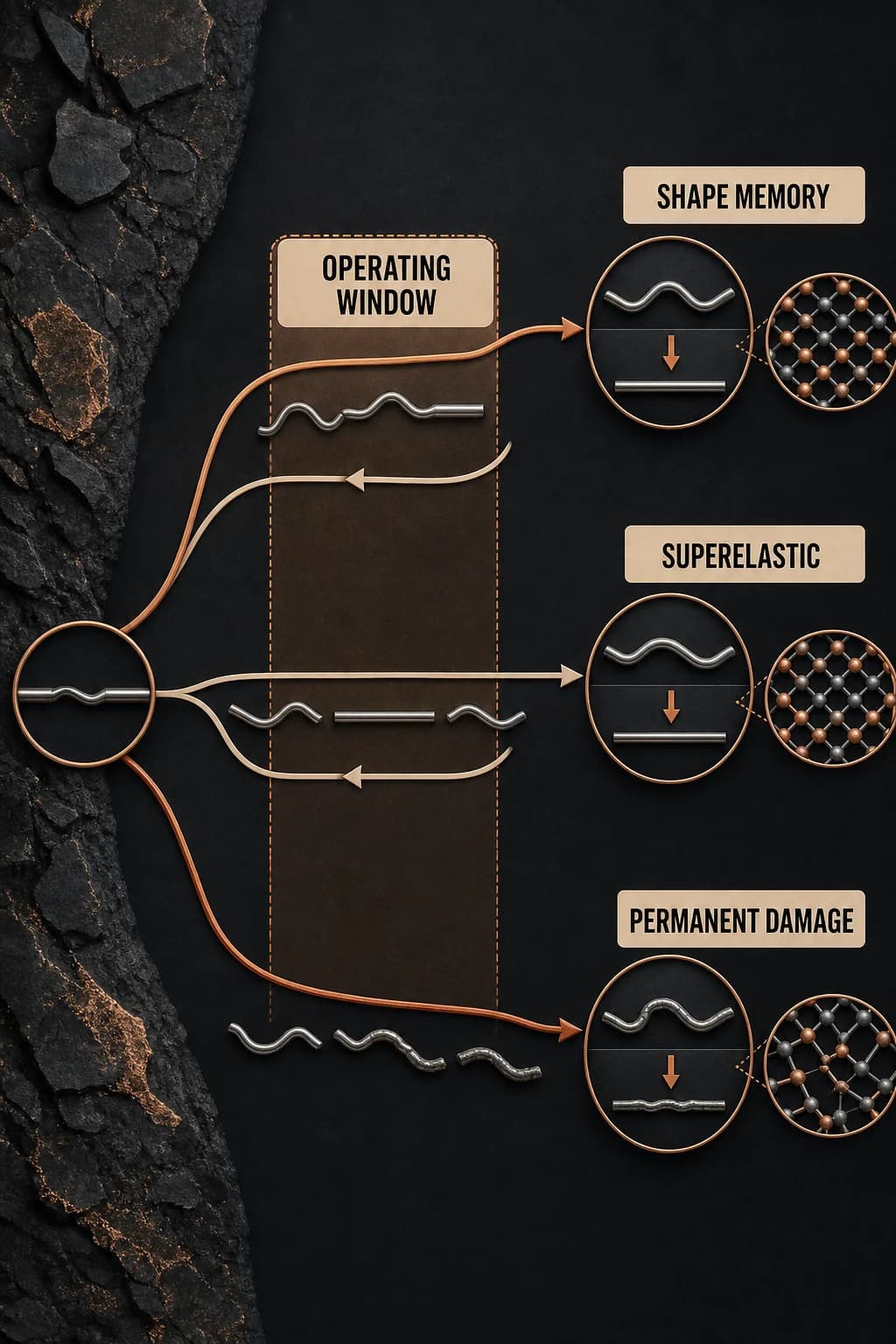
Recovery is limited. Too much strain creates ordinary plastic deformation, defects, or cracks that a phase change can't undo. Repeated cycling can shift transformation temperatures and reduce recoverable motion. A one-way shape-memory element recovers its trained form on heating but usually needs an external load or spring to deform again during cooling.
Under different temperature and loading conditions, some alloys show superelasticity: stress creates martensite and unloading reverses it without deliberate heating. Engineers choose alloy, training, preload, cooling path, and cycle life together; 'memory metal' is a controlled actuator material, not infinitely reversible wire.
Three paths compare recoverable shape memory, superelastic loading and unloading, and excessive strain that crosses into permanent deformation; a narrow operating window encloses the two reversible paths.
Key takeaways
Shape memory comes from a reversible solid-phase transformation
Loading can reorient martensite while heat restores trained austenite
Recoverable deformation exists within a designed operating window
Check your understanding
Does a shape-memory alloy melt when it changes phase?
No. Austenite and martensite are two solid crystal structures.
What changes when cool martensite is bent?
Martensite variants reorient so their arrangement accommodates the deformation.
Why won't heating repair arbitrarily large deformation?
Excess strain creates plastic damage or cracks that the reversible phase change can't undo.
Sources
These references were used to check the important factual claims in this edition.