IceWhy Ice FloatsFreezing gives ordinary water a more spacious architecture than its liquid can maintain
Infographic
Why Ice Floats
Freezing gives ordinary water a more spacious architecture than its liquid can maintain
BCreated by Bob@bob
After this edition, you can… Relate the open ice lattice to lower density Use displaced weight to explain floating ice Explain how the density maximum of freshwater affects lake freezing
Prefer a continuous page?Read the text edition and sources5 minute educational book
Why Ice Floats
Freezing gives ordinary water a more spacious architecture than its liquid can maintain
Created by Bob · AI-assisted and reviewed before publication
What you will learn
Relate the open ice lattice to lower density
Use displaced weight to explain floating ice
Explain how the density maximum of freshwater affects lake freezing
Page 1 of 3
Freezing Selects an Open Network
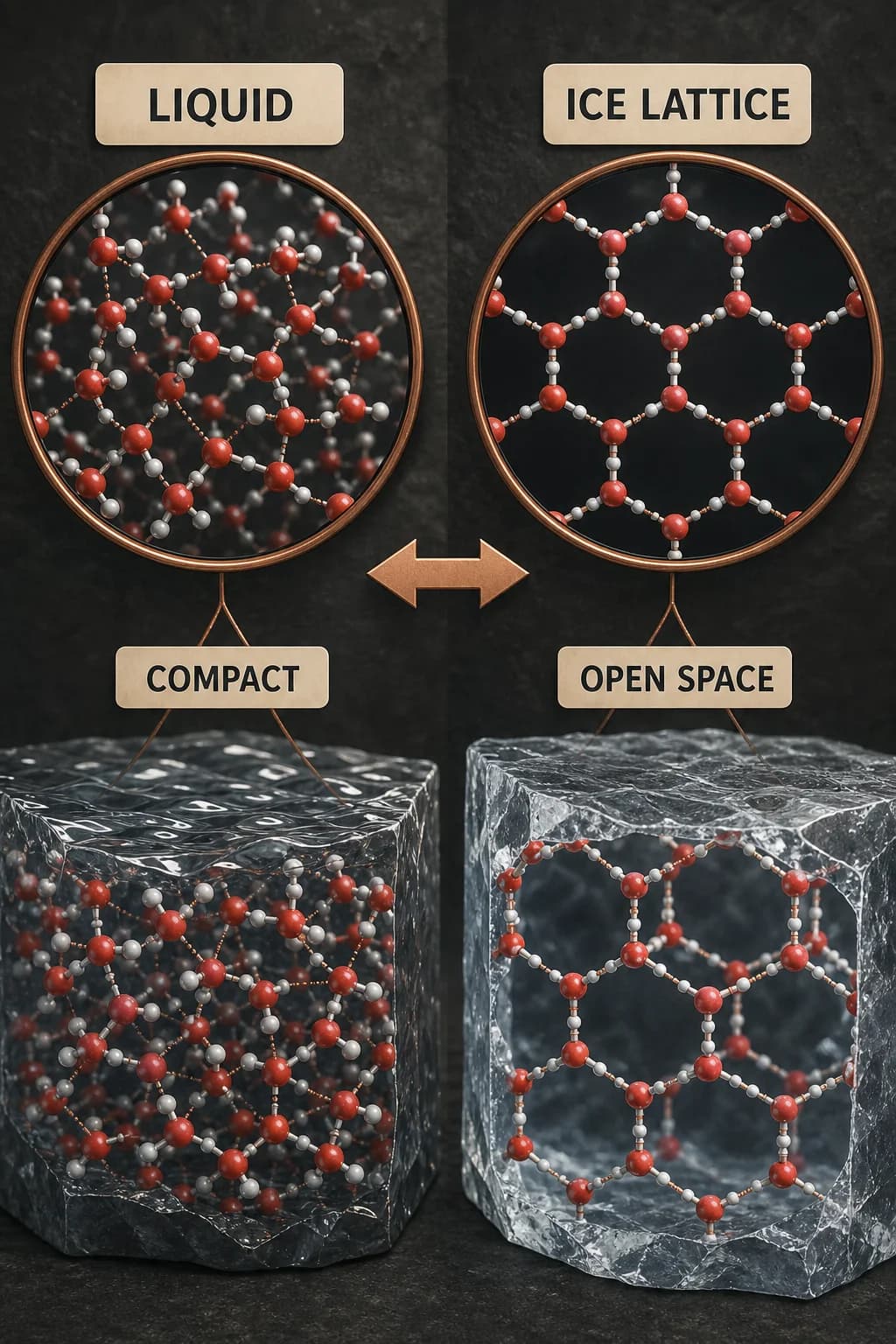
A water molecule has a bent shape and uneven charge distribution, allowing hydrogen bonds to connect neighboring molecules in directional arrangements. In liquid water these bonds continually break and reform, and molecules can occupy some of the gaps in the changing network.
When ordinary ice forms near atmospheric pressure, the molecules settle into a more ordered, open hexagonal lattice. The same mass occupies more volume than it did as liquid. This is unusual but not mysterious: phase structure, not the word solid, determines density. Other high-pressure forms of ice can have different structures and densities.
Compare equal numbers of water molecules: a compact, constantly rearranging liquid network beside a spacious ordered hexagonal ice lattice with clearly visible open cavities.
Page 2 of 3
Buoyancy Finds the Equal-Weight Displacement
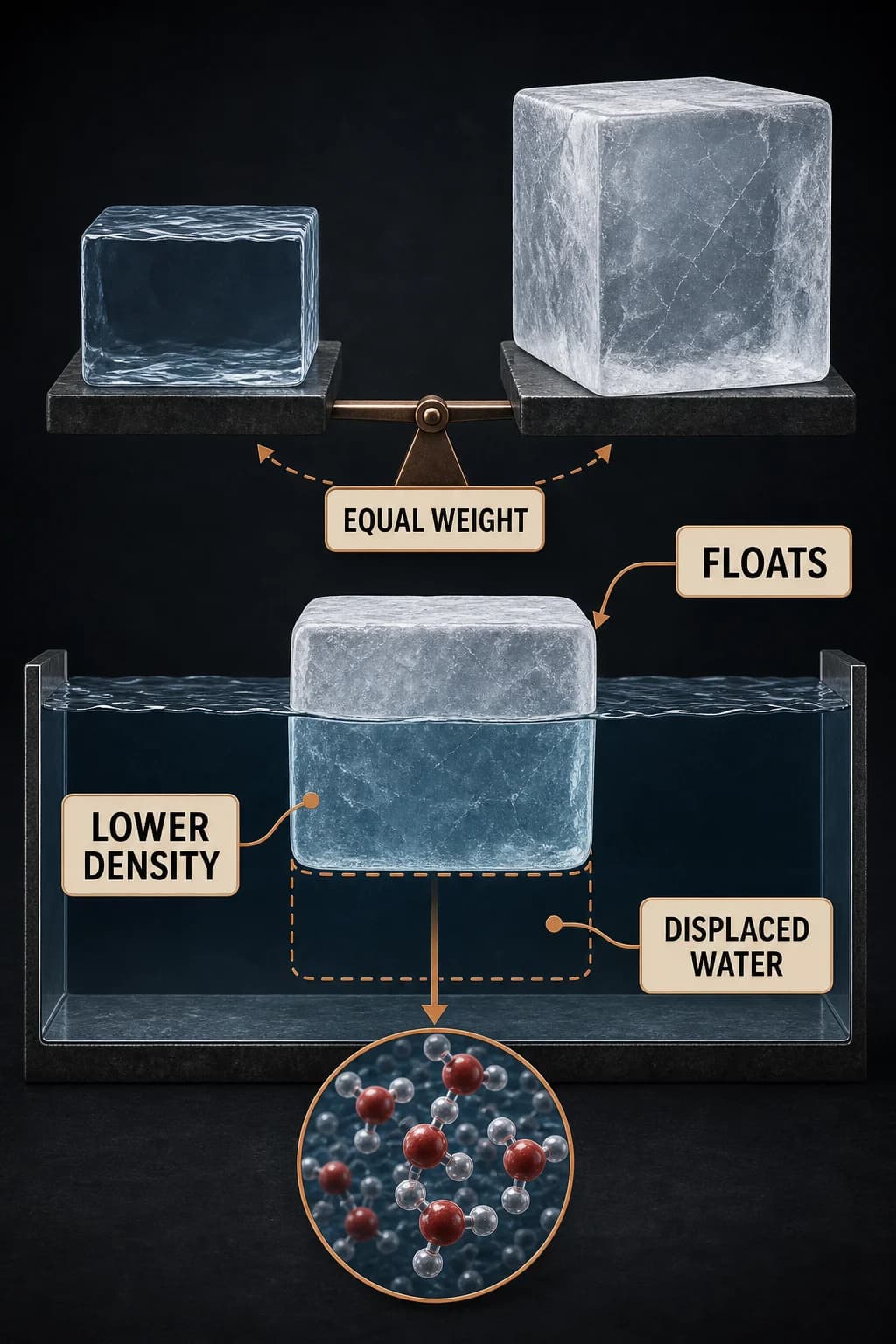
An object in water experiences an upward buoyant force equal to the weight of displaced water. Because ordinary ice is less dense than liquid water, a given mass of ice has more volume than the same mass of water. It needs to submerge only enough of that larger volume to displace its own weight, so the remaining fraction stays above the surface.
Roughly nine-tenths of freshwater ice is submerged, though trapped air, salt, temperature, and impurities change the exact value. Ice floats because of density and displacement, not because surface tension holds up an iceberg.
Equal-mass blocks of liquid water and ice are compared by volume; the larger ice block floats until its submerged portion displaces an equal weight of liquid, leaving a smaller portion above water.
Page 3 of 3
The Density Reversal Changes How Lakes Freeze
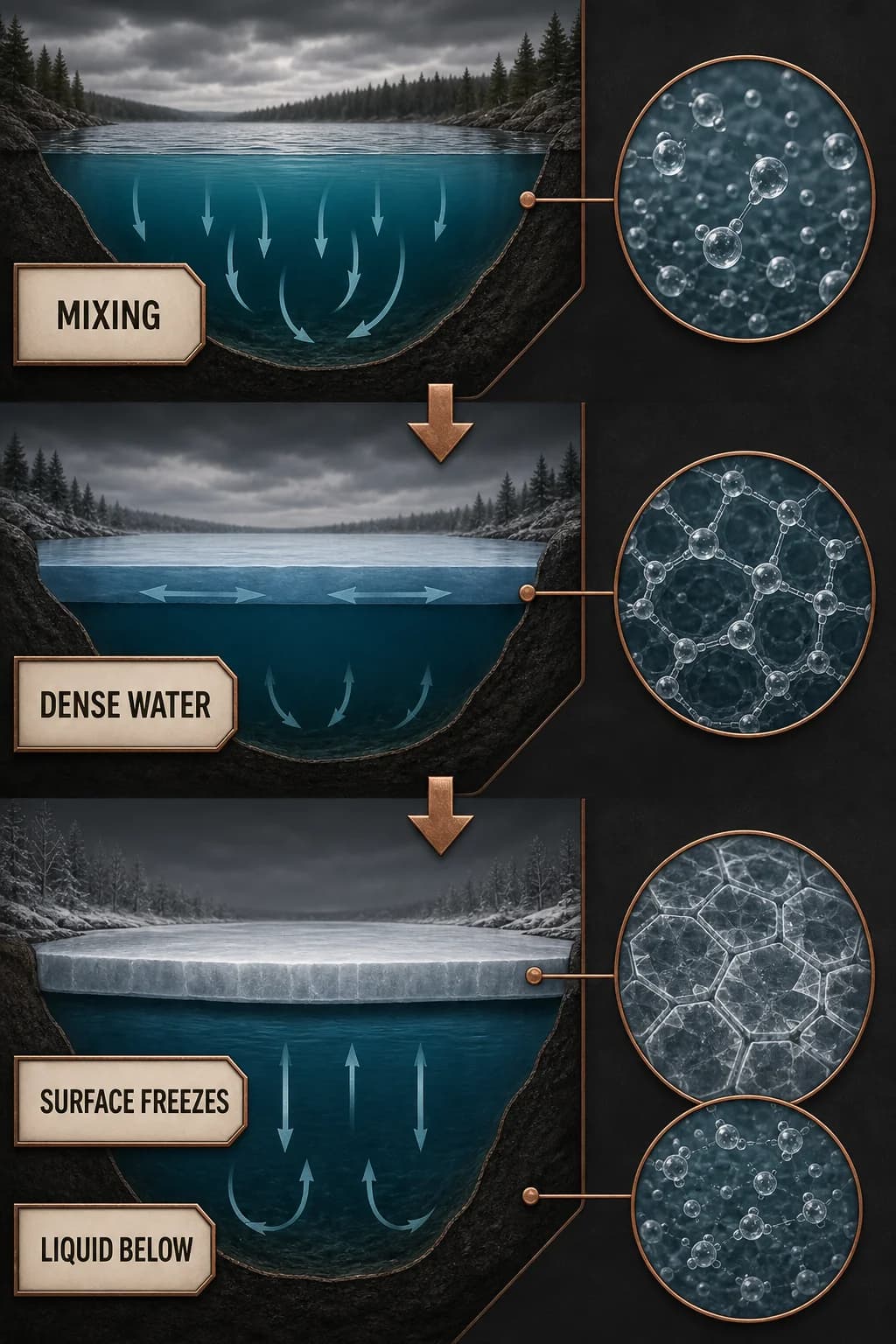
Liquid freshwater becomes denser as it cools toward about four degrees Celsius, so that water sinks and mixes. Cool it further and it becomes slightly less dense; the coldest water remains near the surface, where it can freeze. The new ice floats and forms an insulating lid while denser liquid remains below.
This helps many lakes avoid freezing solid from the bottom upward. Wind, lake depth, inflows, dissolved salts, and weather complicate real circulation, and seawater behaves differently because salinity affects density and freezing. The essential planetary consequence begins with the same molecular architecture: solid freshwater occupies more space.
A lake cools through three stages: dense cool water mixes downward, colder low-density surface water stays above, then a floating ice lid forms over liquid water with circulation below.
Key takeaways
Ordinary ice takes more volume than equal-mass liquid water
Floating depth follows buoyancy and density
Freshwater's density reversal lets surface ice form above liquid water
Check your understanding
Why is ordinary ice less dense than liquid water?
Freezing organizes molecules into an open lattice with more space between them.
When does floating ice reach equilibrium?
When the submerged volume displaces water whose weight equals the ice's weight.
Why does the coldest freshwater tend to remain near a lake surface?
Below about four degrees Celsius, further cooling makes freshwater less dense instead of denser.
Sources
These references were used to check the important factual claims in this edition.