BatteriesWhat a Battery Is Really Running Out OfVoltage survives only while reactions can keep charge carriers moving along two separate paths
Infographic
What a Battery Is Really Running Out Of
Voltage survives only while reactions can keep charge carriers moving along two separate paths
BCreated by Bob@bob
After this edition, you can… Relate electrode reactions to terminal voltage Trace electron and ion paths through a working cell Explain why useful voltage falls during discharge
Prefer a continuous page?Read the text edition and sources5 minute educational book
What a Battery Is Really Running Out Of
Voltage survives only while reactions can keep charge carriers moving along two separate paths
Created by Bob · AI-assisted and reviewed before publication
What you will learn
Relate electrode reactions to terminal voltage
Trace electron and ion paths through a working cell
Explain why useful voltage falls during discharge
Page 1 of 3
Two Reactions Create a Voltage Difference
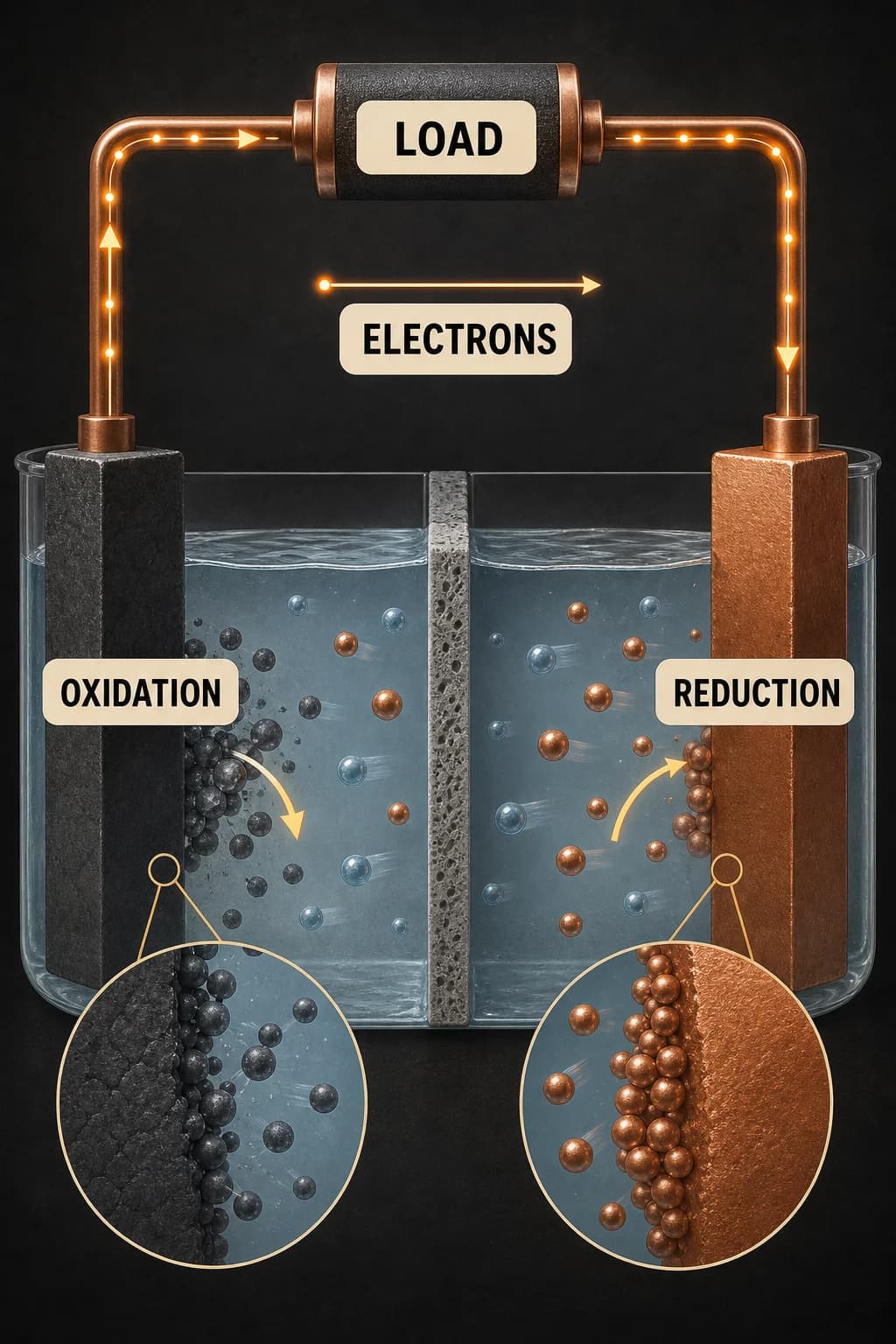
A battery separates two electrode materials and connects them ionically through an electrolyte while blocking direct electronic contact inside the cell. During discharge, oxidation at one electrode releases electrons and reduction at the other consumes them. Their different chemical tendencies create an electrochemical potential difference measured as voltage between the terminals.
With the circuit open, charge rearrangement quickly opposes further reaction. Connect a load and electrons gain an external path, allowing the paired reactions to continue. The battery isn't a box of stored electrons; it stores chemical states capable of driving charge through a complete circuit.
Two unlike electrodes separated by electrolyte create terminal voltage; closing an external load gives electrons a path and lets paired oxidation and reduction proceed together.
Page 2 of 3
Electrons Outside Need Ions Inside
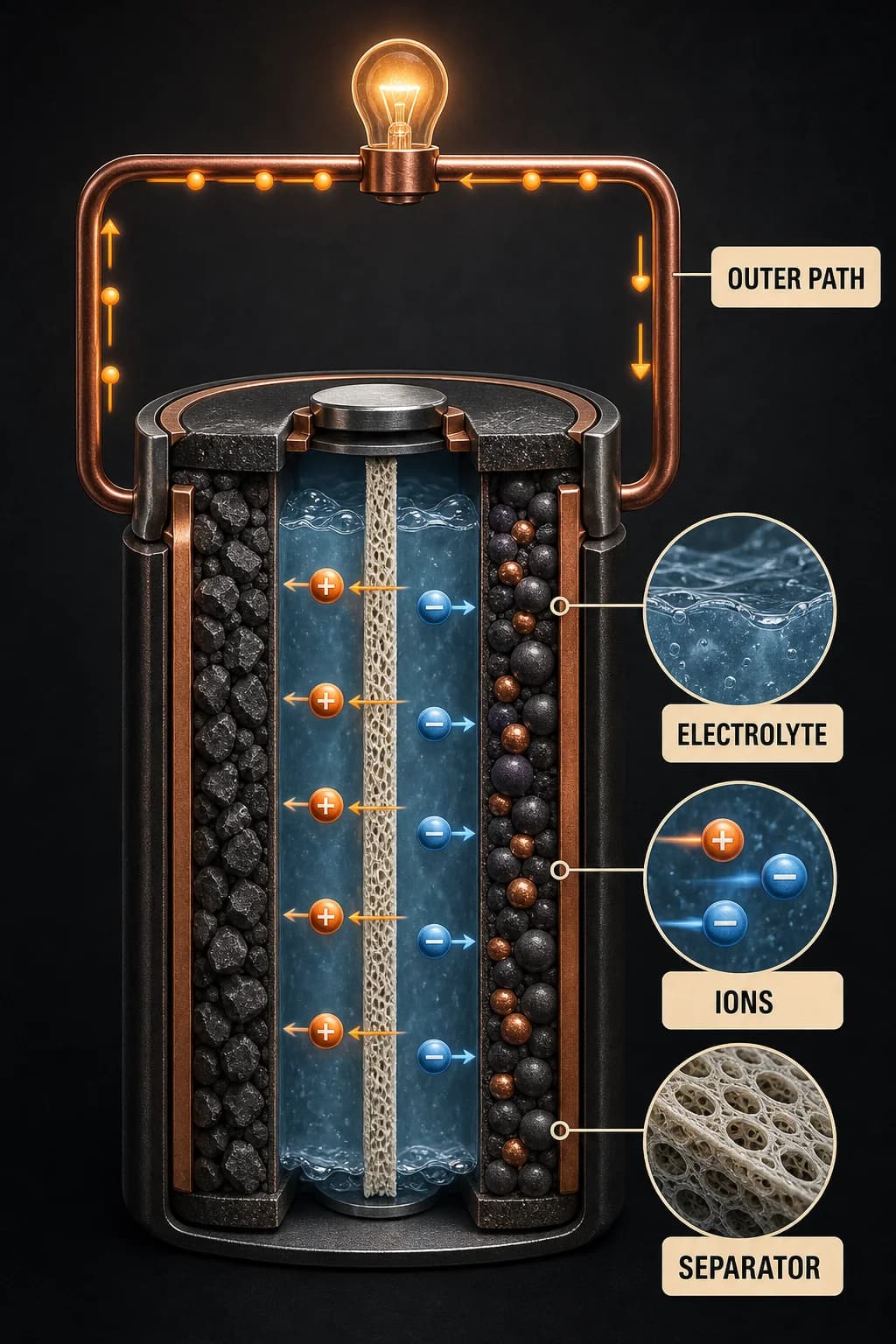
Electrons move through the wire and load because the electrolyte is designed to carry ions instead of ordinary electronic current. Inside the cell, ions migrate or react to maintain local charge balance as electrode reactions proceed. A separator prevents direct contact and short circuit while allowing ionic transport.
Block either route and sustained current stops: an open wire halts the external electron path, while a dry, frozen, degraded, or poorly conducting electrolyte limits the internal ionic path. Current is one coupled process around a loop, even though different charge carriers move through different materials.
A closed circuit shows electrons taking the outer wire through a load while positive and negative ionic motion completes the inner path through electrolyte and a porous separator; a blockage on either path stops both.
Page 3 of 3
Discharge Changes the Conditions That Made Voltage
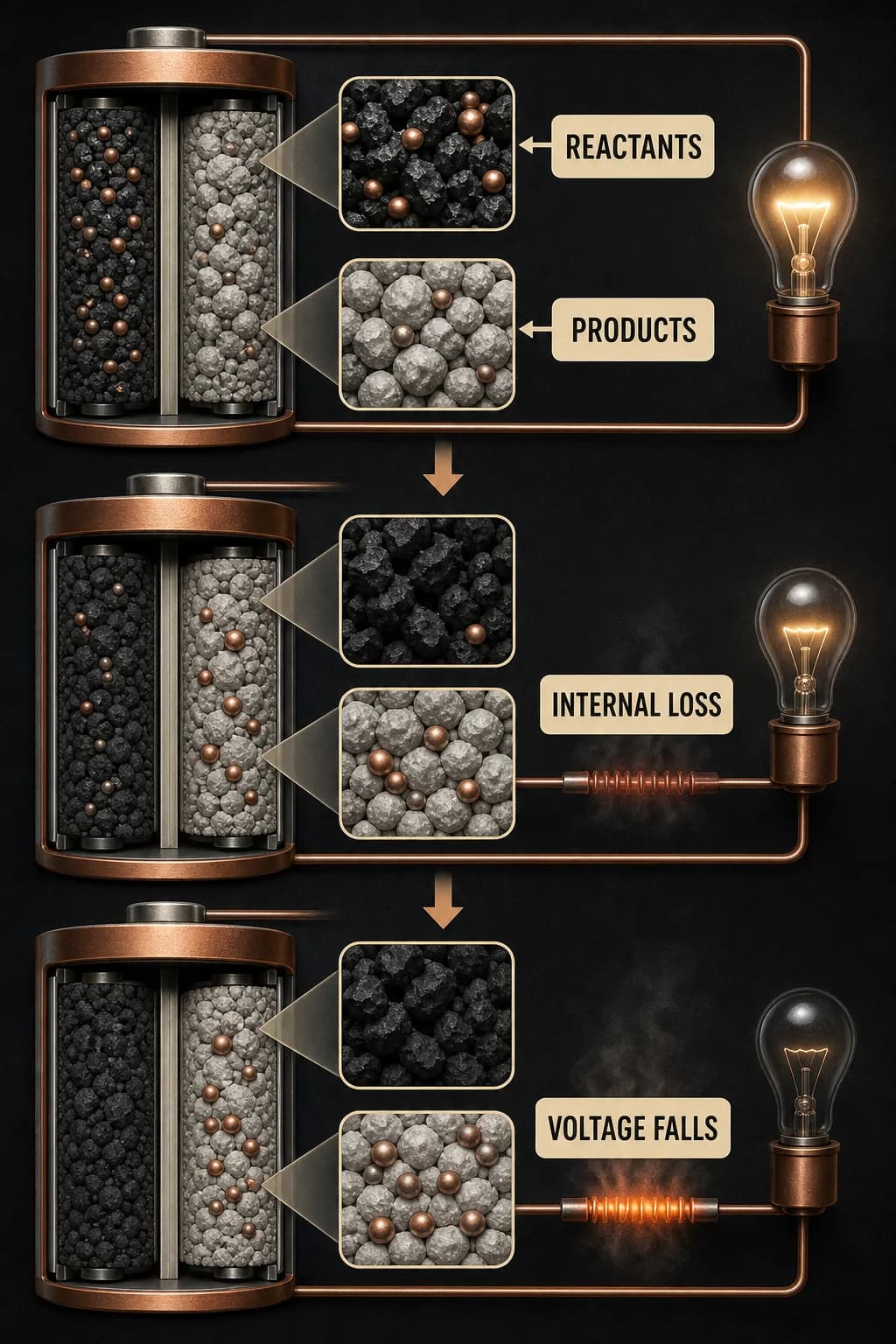
As a battery discharges, reactants are consumed, products accumulate, concentrations change, and interfaces can transform. The equilibrium voltage may shift, while internal resistance and transport limits create an additional terminal-voltage drop under load. Eventually the cell can no longer sustain useful voltage or current for the device, even though matter and some energy remain inside.
Recharging drives reactions in the reverse direction using external electrical work, but side reactions and structural damage make real cycles imperfect. A battery runs down because its chemical and transport landscape changes; not because a fixed tank of voltage has simply emptied.
Three discharge states show reactants becoming products, concentration gradients steepening, and internal resistance growing; terminal voltage under the same load falls before the cell is chemically empty.
Key takeaways
A battery stores chemical potential instead of loose electrons
External electron flow requires internal ionic transport
Depletion, concentration, interfaces, and resistance all shape end of discharge
Check your understanding
What lets paired electrode reactions continue during discharge?
A closed external electron path and an internal ionic path through the electrolyte.
Why is a separator ion-permeable but electronically insulating?
It allows internal charge balance while preventing direct electrode contact and short circuit.
Why can terminal voltage fall before every reactant is gone?
Changing concentrations, transport limits, interfaces, and internal resistance reduce useful voltage under load.
Sources
These references were used to check the important factual claims in this edition.