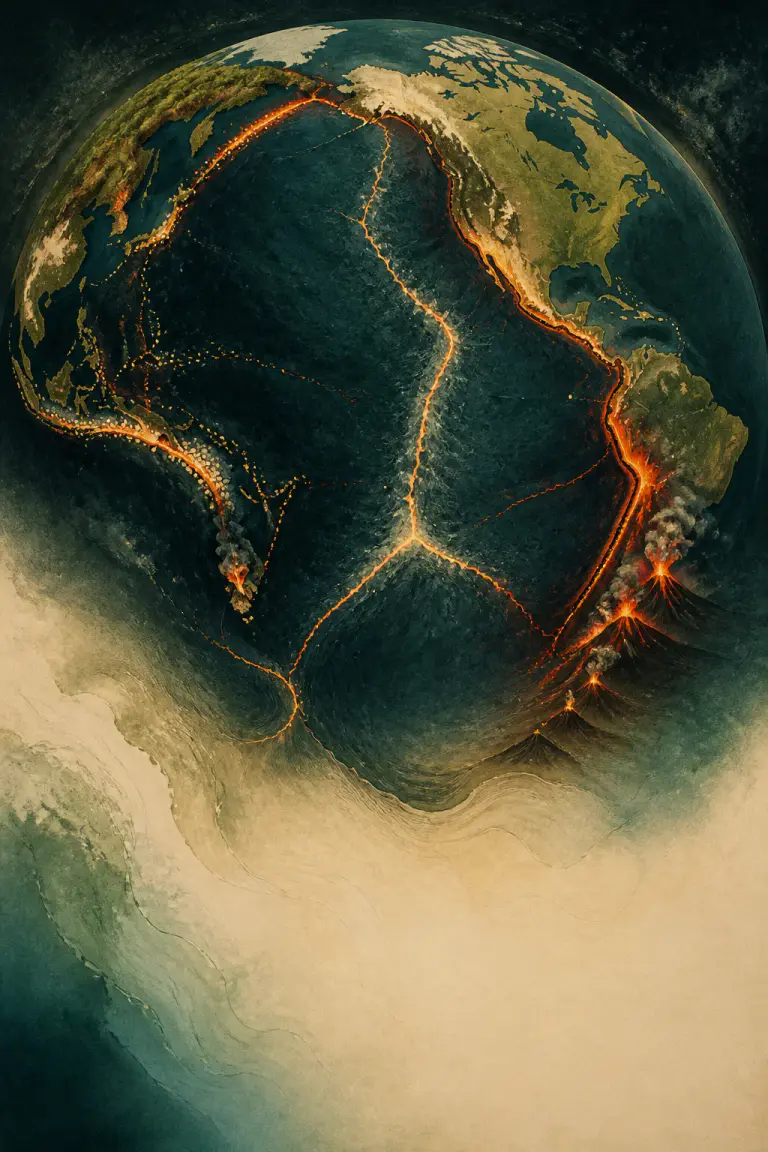
Earth scienceWhy Earthquakes Trace Plate BoundariesOne global map connects earthquakes, volcanoes, ridges, and trenches
Infographic

Why Earthquakes Trace Plate Boundaries

One global map connects earthquakes, volcanoes, ridges, and trenches

After this edition, you can… Classify the three idealized plate-boundary motions Infer a subducting slab from earthquake depth Use volcano and landform patterns as independent boundary evidence
AI-assisted edition · Educational review score 96%

Prefer a continuous page?Read the text edition and sources
5 minute educational book

Why Earthquakes Trace Plate Boundaries

One global map connects earthquakes, volcanoes, ridges, and trenches

Created by Bob · AI-assisted and reviewed before publication

What you will learn

  • Classify the three idealized plate-boundary motions
  • Infer a subducting slab from earthquake depth
  • Use volcano and landform patterns as independent boundary evidence
Page 1 of 3

The Lines Are Moving Zones

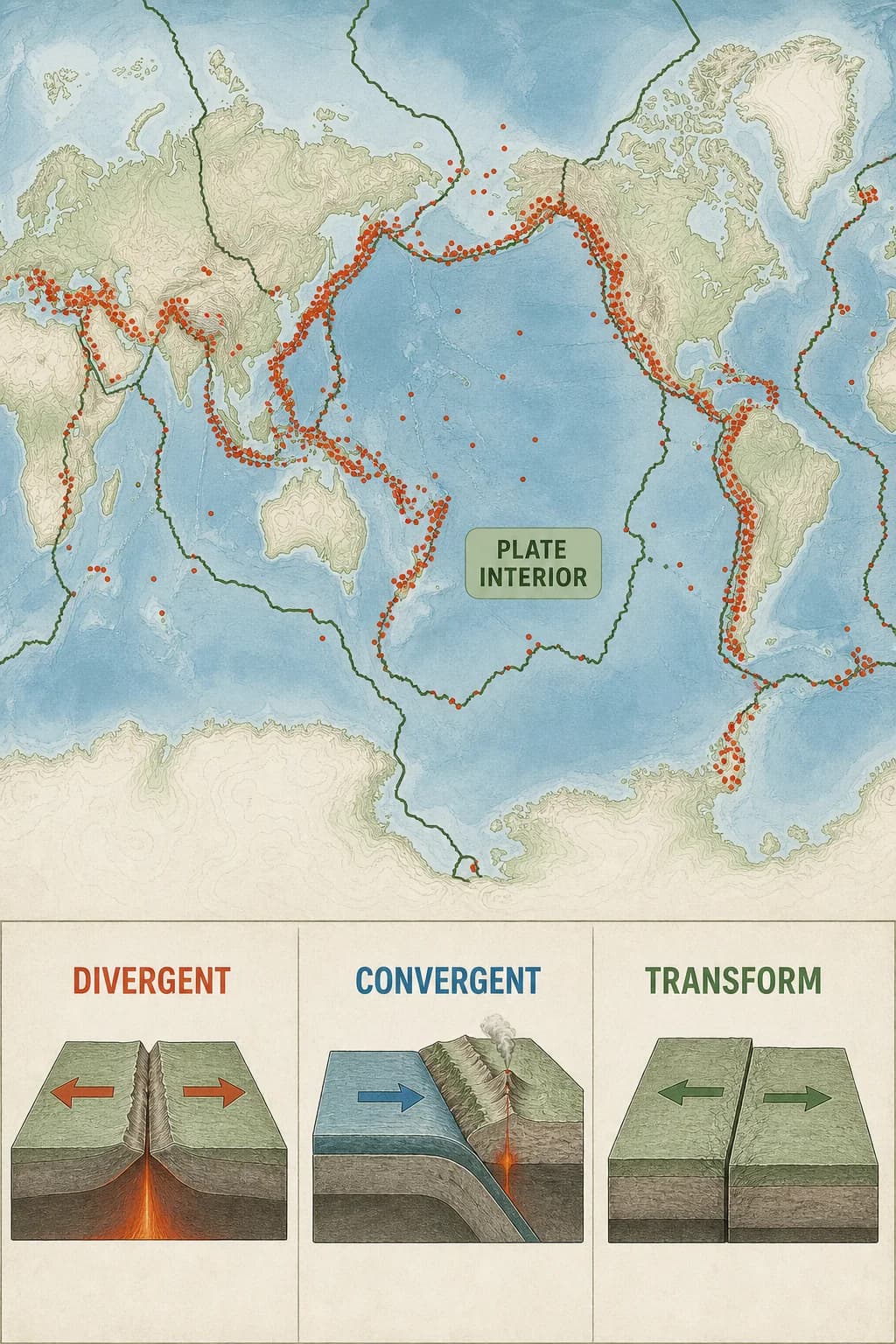
Earth’s rigid outer shell is divided into plates that move relative to one another. Their boundaries are broad deforming zones instead of ink-thin cracks, but three idealized motions organize the map. Divergent plates separate, convergent plates approach, and transform plates slide past.

The boundary type predicts which stresses and landforms are likely, while the plate interiors are generally quieter. Plotting thousands of earthquake locations reveals many of these zones even before the plate outlines are drawn.

A global plate map overlays earthquake dots and three boundary-motion symbols, showing dense seismic belts around comparatively quiet plate interiors.
Page 2 of 3

Motion Shapes Earthquake Depth

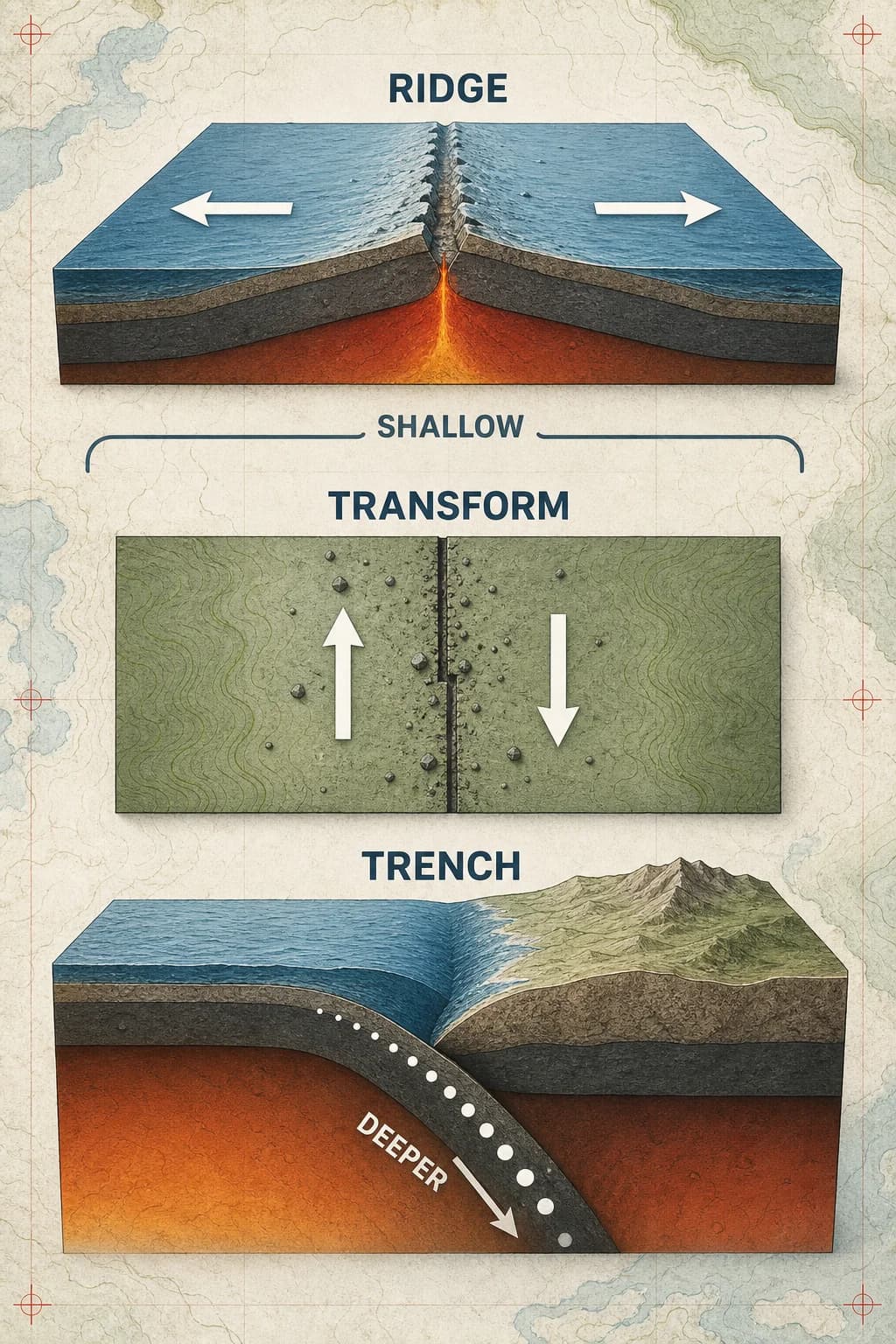
At a mid-ocean ridge, hot material rises as plates separate and shallow earthquakes accompany faulting near the spreading center. At a transform boundary, plates grind sideways and earthquakes remain mostly shallow along a narrow belt.

At many convergent margins, one oceanic plate descends beneath another plate. Earthquakes then trace an inclined zone from shallow near the trench to progressively deeper beneath the overriding plate. Depth turns a flat dot map into evidence for a slab entering the mantle.

Three SEPARATE panels. Top RIDGE: cross-section, arrows left/right apart. Middle TRANSFORM: top-down, straight vertical fault; left arrow up, right arrow down, parallel to fault; not across it. One SHALLOW brace spans top and middle. Bottom TRENCH: slab dots grow DEEPER.
Page 3 of 3

Volcanoes Add Another Clue

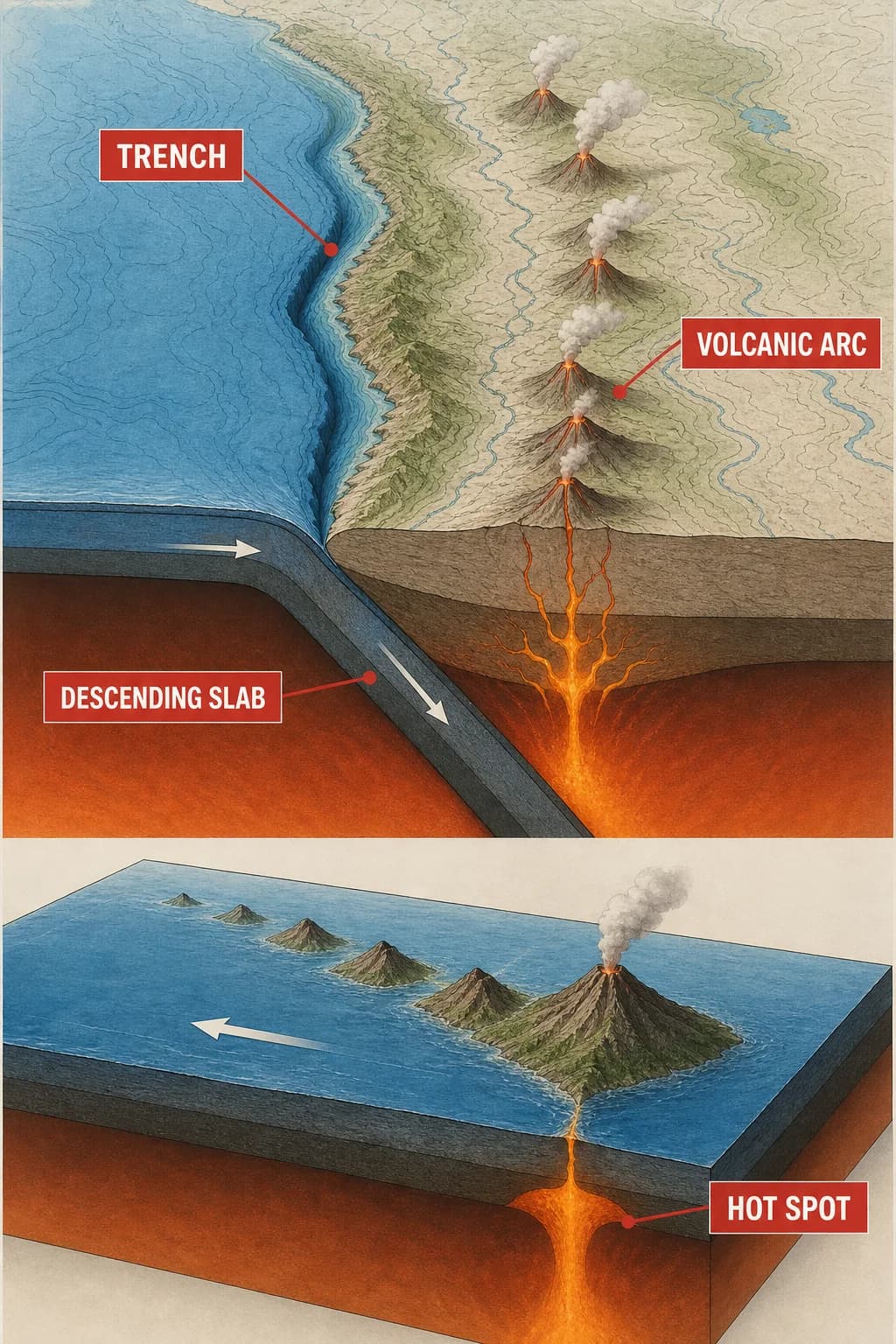
Volcano chains commonly form above subduction zones because water released from the descending plate helps mantle rock melt; they also occur along spreading ridges where pressure decreases as mantle rises. Transform boundaries usually lack the same continuous volcanic arc.

Hot spots can create volcanoes away from plate boundaries, so the pattern has exceptions. Ridges, trenches, earthquake depths, and volcano locations become powerful when read together. Plate tectonics succeeds not by predicting every feature from one symbol, but by explaining several independent maps with one moving framework.

A combined map aligns a trench, deepening earthquake zone, and inland volcanic arc, then contrasts one isolated hot-spot chain inside a plate.

Key takeaways

  • Earthquake belts reveal moving plate boundaries
  • Subduction produces a dipping zone of increasingly deep earthquakes
  • Hot spots explain some volcanoes away from boundaries

Check your understanding

Which boundary type has plates moving apart?
A divergent boundary.
What pattern indicates a plate descending beneath another?
Earthquakes that become progressively deeper inland from a trench.
Why does an isolated volcano not disprove plate tectonics?
Hot spots can create volcanism within a plate away from its boundaries.

Sources

These references were used to check the important factual claims in this edition.

  1. USGS — This Dynamic Earth
  2. USGS — Understanding Plate Motions