NavigationWhy Navigators Never Stop Correcting CourseEvery position estimate drifts until another observation pulls it back
Infographic
Why Navigators Never Stop Correcting Course
Every position estimate drifts until another observation pulls it back
BCreated by Bob@bob
After this edition, you can… Describe how dead reckoning propagates a position Explain why bias creates drift Explain how an external fix updates both position and uncertainty
Prefer a continuous page?Read the text edition and sources5 minute educational book
Why Navigators Never Stop Correcting Course
Every position estimate drifts until another observation pulls it back
Created by Bob · AI-assisted and reviewed before publication
What you will learn
Describe how dead reckoning propagates a position
Explain why bias creates drift
Explain how an external fix updates both position and uncertainty
Page 1 of 3
Move the Last Estimate Forward
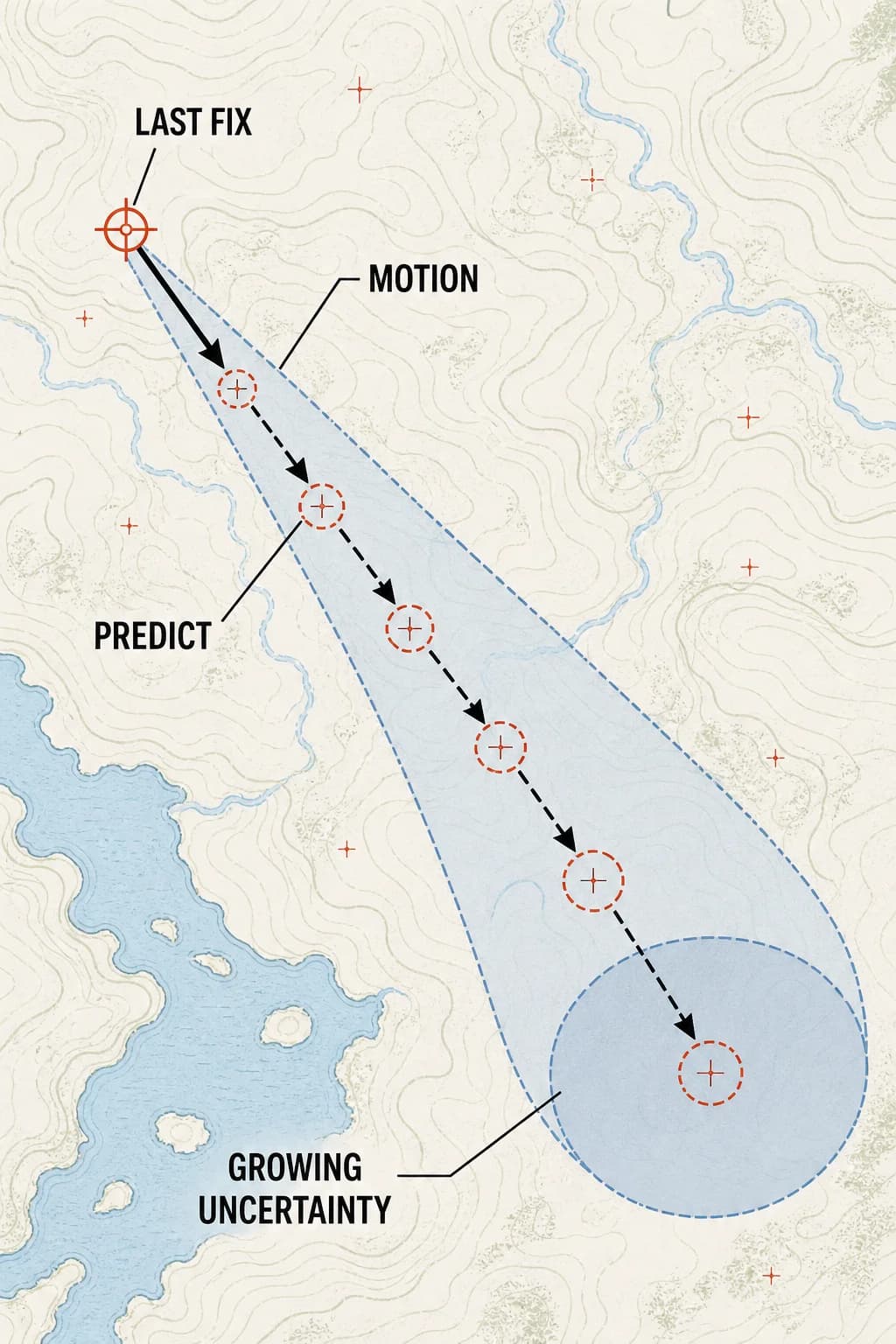
Dead reckoning begins with a known or estimated position, then advances it using measured direction, speed, and elapsed time. A walker counts steps and heading; a ship combines course and speed; an inertial system integrates acceleration and rotation.
Between outside observations, this prediction is often the only available position. It's useful precisely because it continues through darkness, tunnels, or signal loss. But the new point inherits every error in the old point and adds errors from the motion measurements.
A known starting fix advances through successive motion arrows into predicted positions while an uncertainty ribbon widens with every step.
Page 2 of 3
Small Biases Accumulate
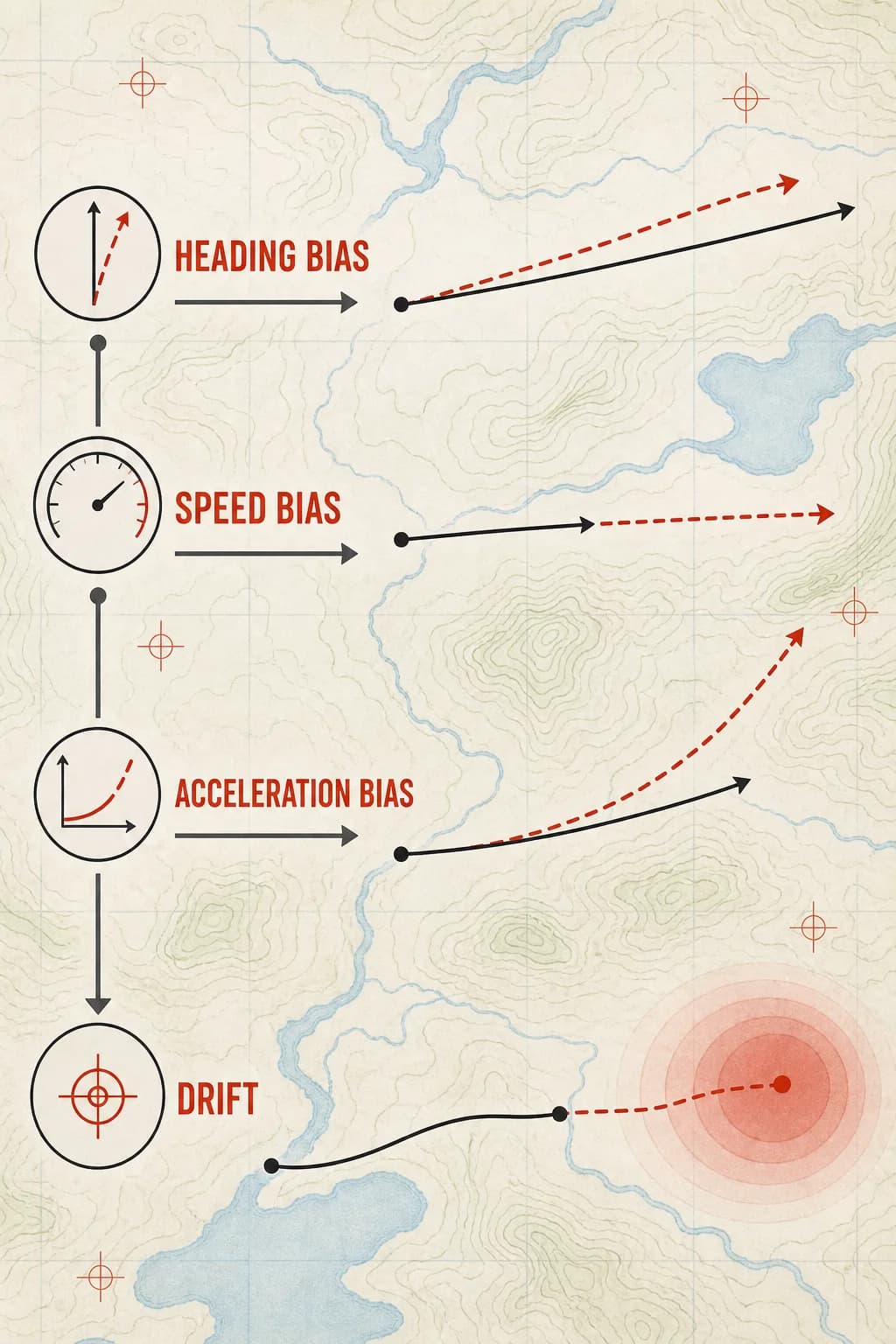
Random noise may partly average out, but a persistent bias pushes the estimate in one direction. A compass offset bends the route; a speed error stretches it; an accelerometer bias becomes velocity error and then position error when integrated over time.
Wind, current, wheel slip, and human steering add unmeasured motion. The navigator may know the estimate is becoming less trustworthy even without knowing the exact direction of the error. Uncertainty expands with time and movement since the last reliable fix.
Three tiny sensor biases propagate through time: heading bias curves a route, speed bias stretches it, and acceleration bias grows from velocity error into large position error.
Page 3 of 3
A Fix Narrows the Possibilities
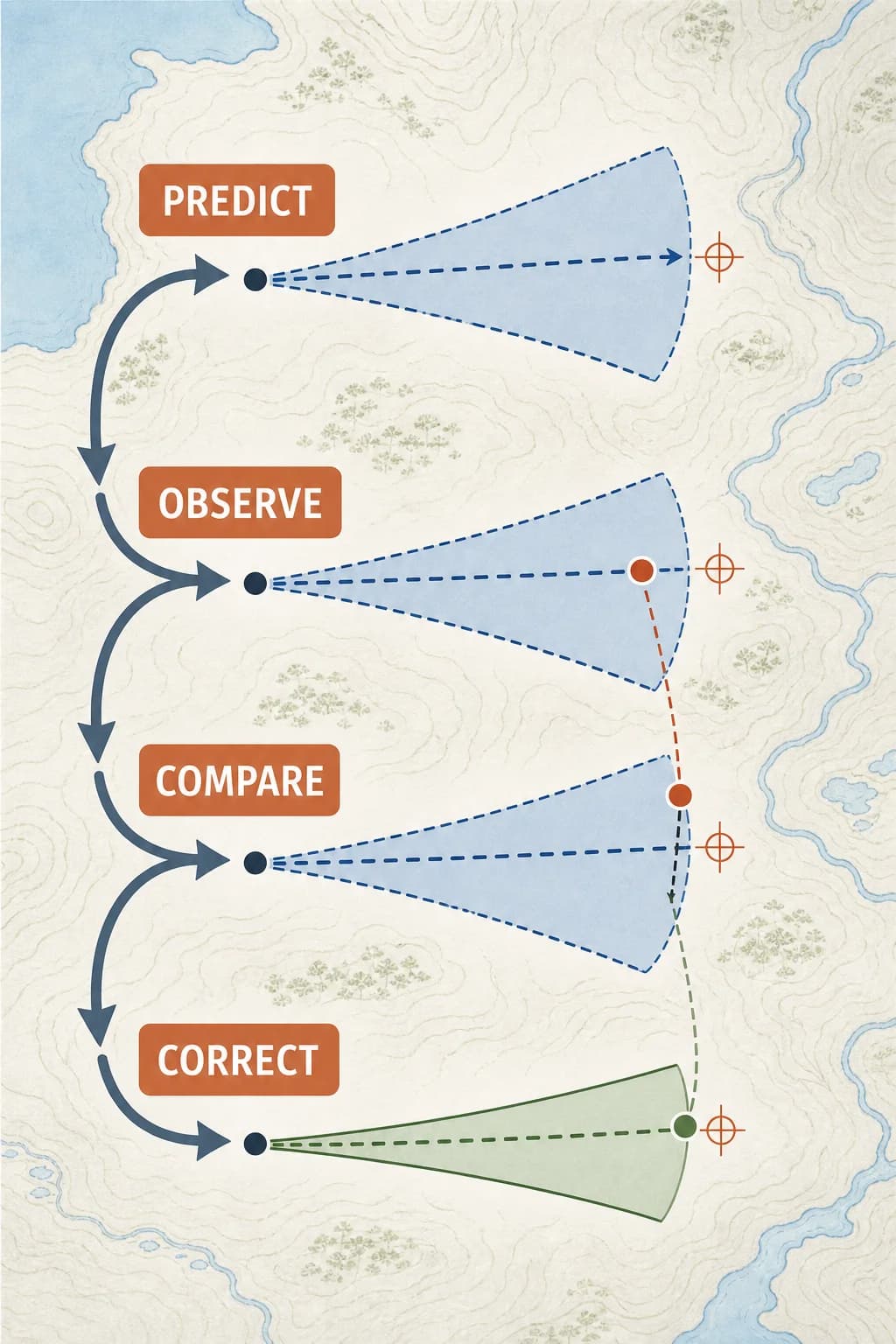
An external observation; landmark bearing, radio range, GPS position, map match, or star sight; compares the prediction with evidence tied to the world. A navigation filter weighs both according to their uncertainty, moves the estimate toward agreement, and reduces the range of plausible positions.
The correction isn't perfect because the observation also has noise and possible bias. Navigation repeats this cycle: predict motion, observe, compare, correct, and carry the revised uncertainty forward. A route is maintained, not just known once.
A repeating loop predicts a widening position region, receives an external fix, compares the two, and produces a narrower corrected region for the next cycle.
Key takeaways
Dead reckoning works without continuous outside signals
Integrated sensor bias can grow rapidly
A fix narrows uncertainty but doesn't make it vanish
Check your understanding
What information does dead reckoning need?
A previous position plus measured movement such as direction, speed, and elapsed time.
Why is a persistent accelerometer bias especially damaging?
It's integrated into velocity error and then again into position error.
What does a navigation filter do with an external fix?
It weighs the fix against the prediction and produces a corrected estimate with revised uncertainty.
Sources
These references were used to check the important factual claims in this edition.