GlaciersHow Glaciers Leave Their Tracks in StoneScratches, valleys, and dumped debris preserve the movement of vanished ice
Infographic
How Glaciers Leave Their Tracks in Stone
Scratches, valleys, and dumped debris preserve the movement of vanished ice
BCreated by Bob@bob
After this edition, you can… Infer glacier direction from erosion marks Distinguish river and glacial valley forms Interpret moraines as evidence of former ice extent and pauses
Prefer a continuous page?Read the text edition and sources5 minute educational book
How Glaciers Leave Their Tracks in Stone
Scratches, valleys, and dumped debris preserve the movement of vanished ice
Created by Bob · AI-assisted and reviewed before publication
What you will learn
Infer glacier direction from erosion marks
Distinguish river and glacial valley forms
Interpret moraines as evidence of former ice extent and pauses
Page 1 of 3
Moving Ice Abrades and Plucks
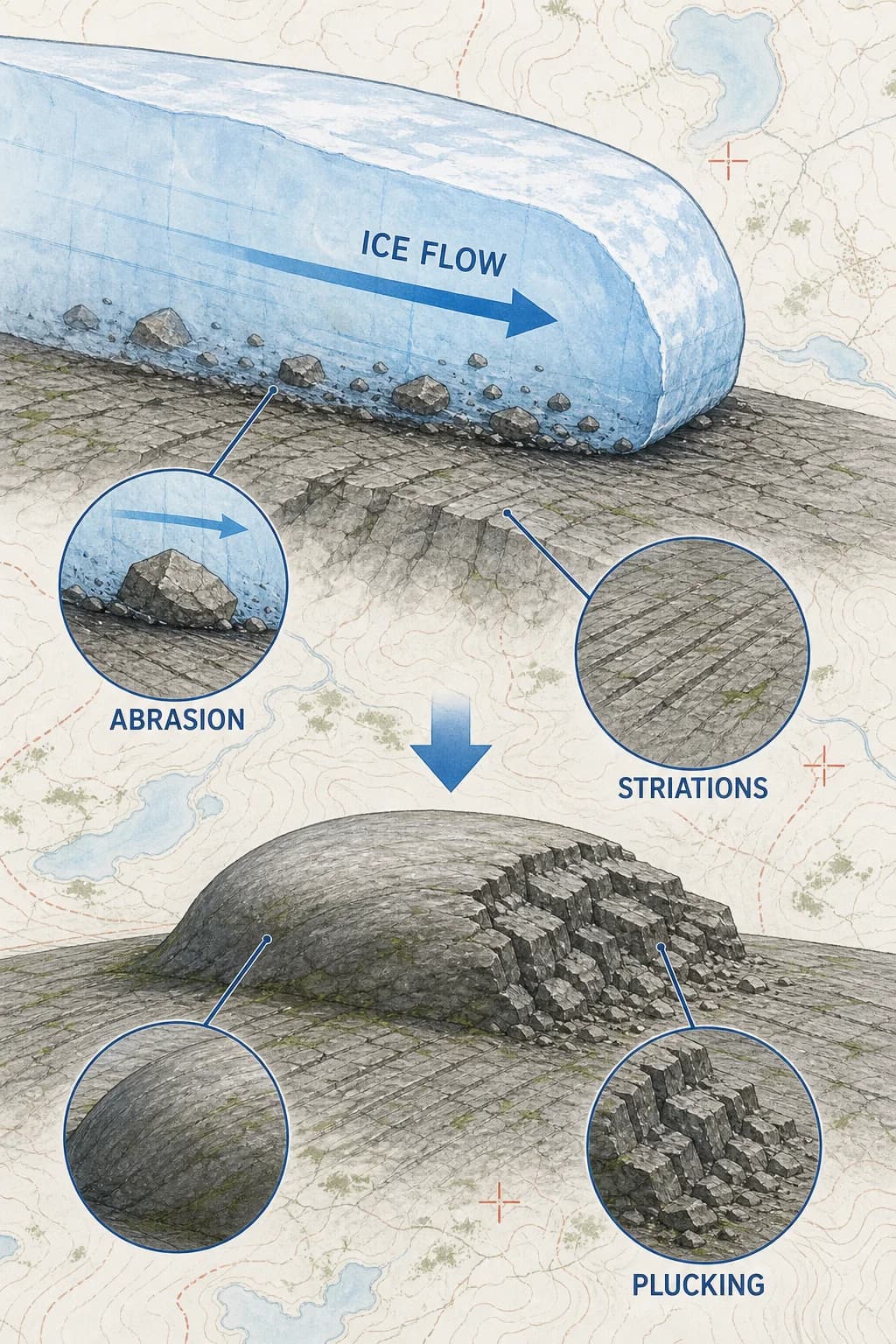
A glacier deforms and slides under its own weight. Rock fragments frozen into its base scrape bedrock, leaving polished surfaces and parallel striations aligned with flow. Water pressure and freeze-thaw processes help loosen blocks that moving ice can pluck away.
Obstacles may become smoother on the upstream side and rougher where ice pulls rock from the downstream side. No single scratch proves an entire history, but repeated orientations across a landscape record the direction in which basal ice once moved.
Basal ice carrying rock fragments moves across bedrock, creating parallel striations and an asymmetrical rock knob with a smooth upstream face and plucked downstream face.
Page 2 of 3
Valley Shape Records Repeated Erosion
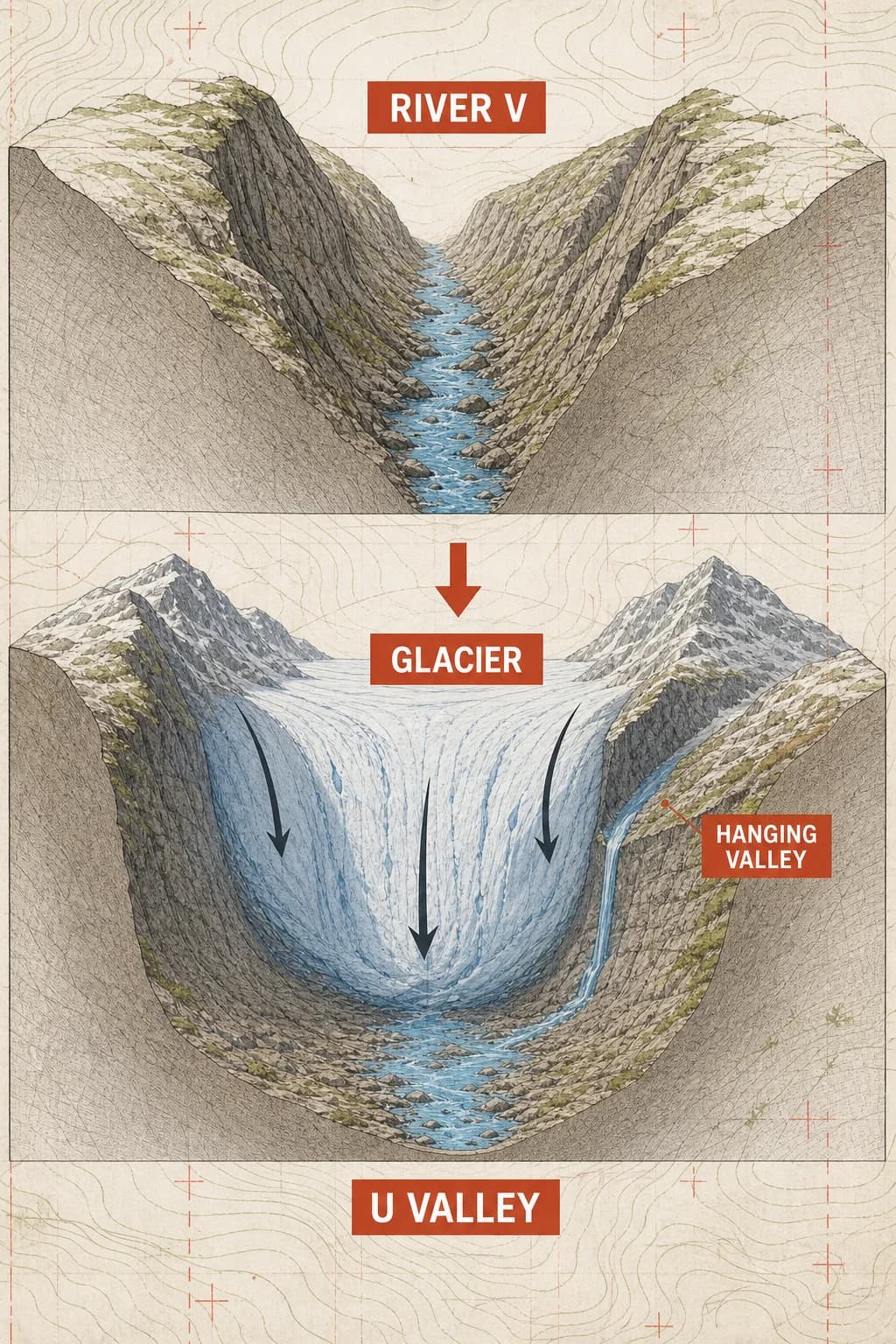
A river usually concentrates erosion near a narrow channel and tends to cut a V-shaped valley. A valley glacier fills much more of its trough, abrading the floor and sides and removing projecting spurs. Repeated glaciation can leave a broad U-shaped cross-section, steep walls, hanging tributary valleys, and overdeepened basins.
These forms reveal substantial ice occupation, but later rivers, landslides, and weathering modify them. Geologists combine valley geometry with scratches, transported boulders, and sediments instead of relying on one dramatic silhouette.
A paired cross-section transforms a narrow river-cut V valley into a broad glacial U valley, with ice contacting both floor and sidewalls and a hanging tributary above.
Page 3 of 3
Dropped Debris Marks Pauses and Limits
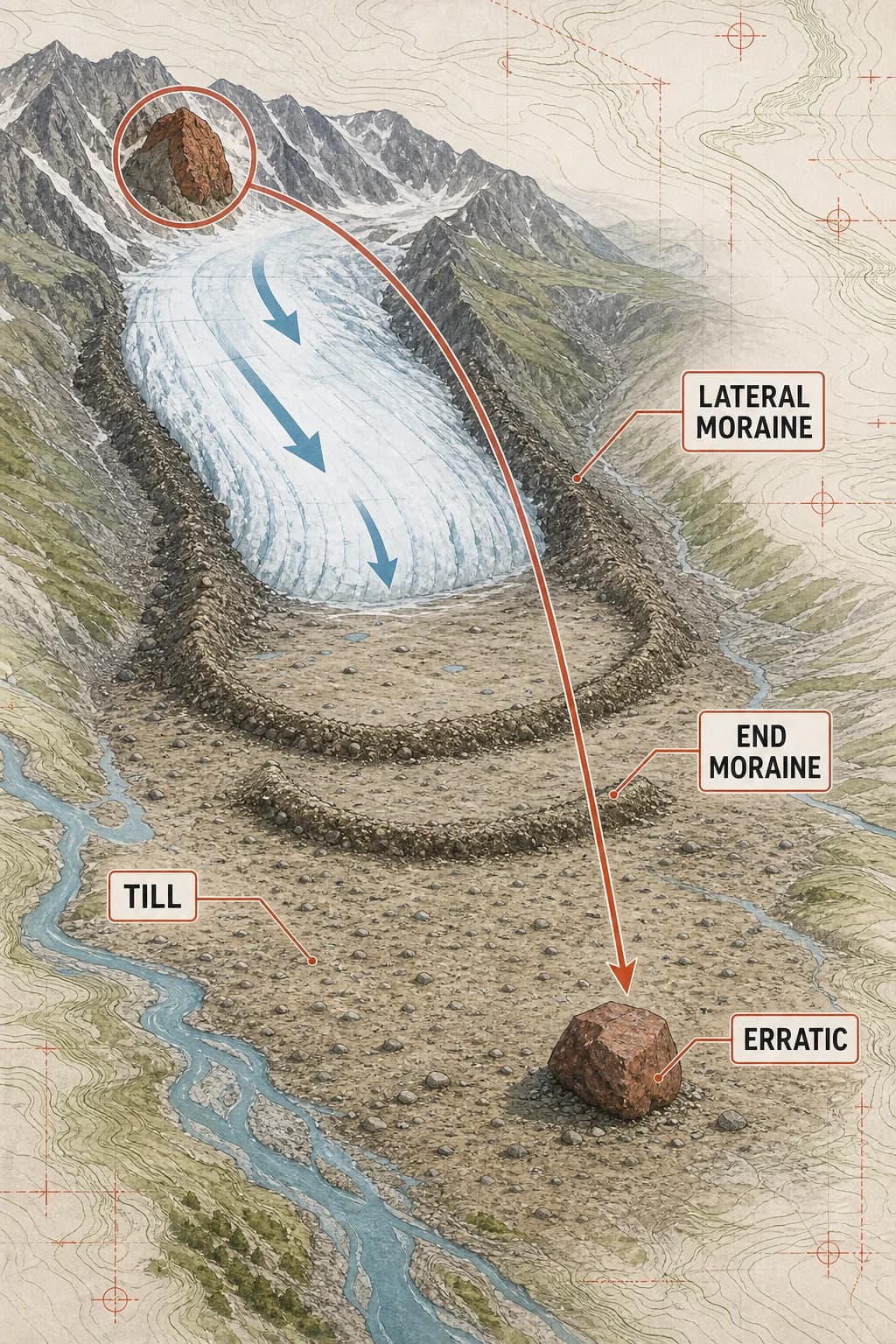
Ice can transport particles from clay to house-sized boulders. When it melts, unsorted till is released without the size sorting typical of flowing water. Ridges of till called moraines may accumulate along glacier sides, between merging glaciers, or near a stable front.
A sequence of end moraines can mark pauses or small readvances during overall retreat; scattered erratics can link a destination to distant source rock. Moraines can be eroded or reused by later ice, so their age and relation require mapping and dating. Together they outline former extent instead of a single continuous speed record.
A retreating glacier leaves side moraines, three end-moraine ridges, unsorted till, and a transported erratic that links back to a distinct upstream source rock.
Key takeaways
Basal debris can polish and scratch bedrock parallel to flow
Glaciers reshape entire valley cross-sections
Till, moraines, and erratics map where ice once carried debris
Check your understanding
What direction do glacial striations commonly record?
The direction of basal ice movement.
How does till differ from river sediment?
Till is generally unsorted because melting ice drops mixed particle sizes together.
What can a sequence of end moraines indicate?
Pauses or small readvances during an overall glacier retreat.
Sources
These references were used to check the important factual claims in this edition.