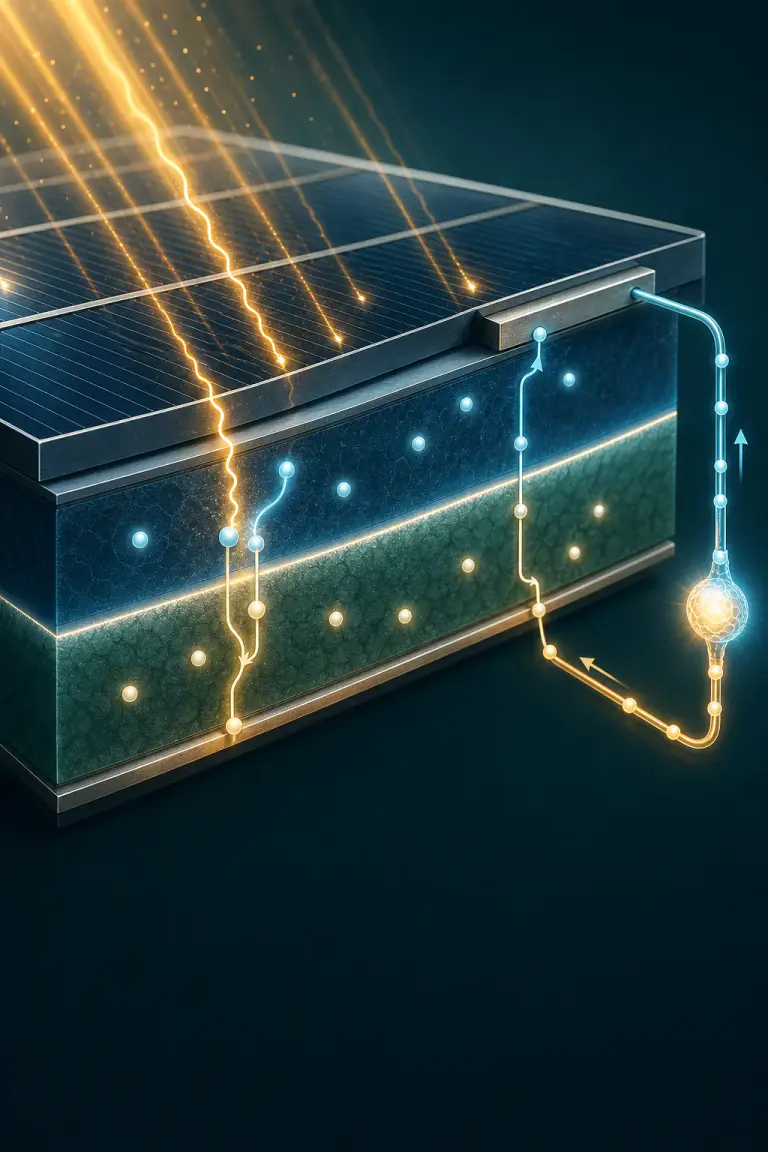
Solar CellsHow a Solar Cell Turns Light into Electric CurrentAbsorption starts the process; a junction and contacts keep carriers from simply recombining
Infographic
How a Solar Cell Turns Light into Electric Current
Absorption starts the process; a junction and contacts keep carriers from simply recombining
BCreated by Bob@bob
After this edition, you can… Relate semiconductor bandgap to selective photon absorption Explain how a junction and contacts separate and collect carriers Identify recombination and resistance as conversion losses
Prefer a continuous page?Read the text edition and sources5 minute educational book
How a Solar Cell Turns Light into Electric Current
Absorption starts the process; a junction and contacts keep carriers from simply recombining
Created by Bob · AI-assisted and reviewed before publication
What you will learn
Relate semiconductor bandgap to selective photon absorption
Explain how a junction and contacts separate and collect carriers
Identify recombination and resistance as conversion losses
Page 1 of 3
Only Some Photons Create Mobile Carriers
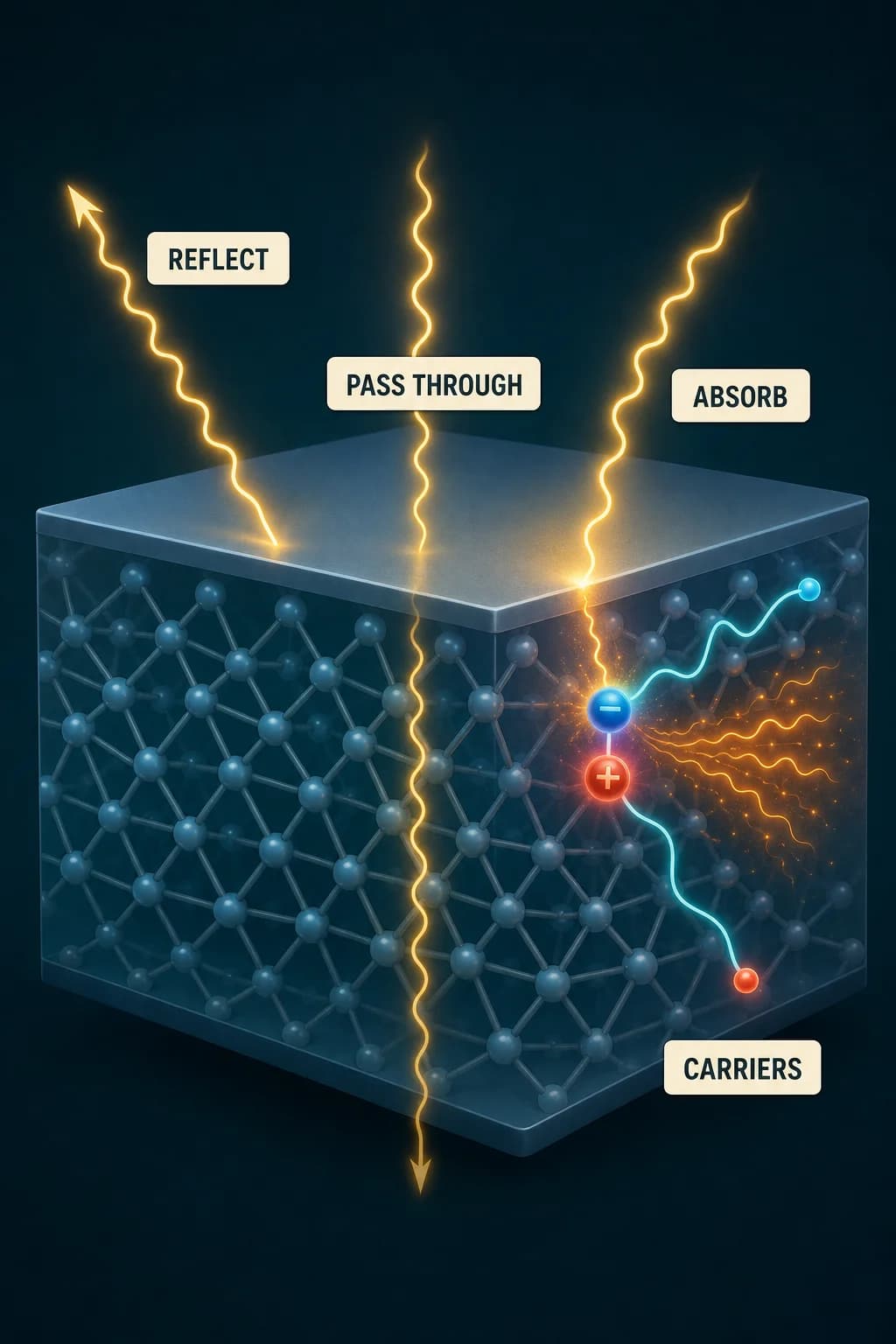
A photovoltaic cell is made from semiconductor material with an energy bandgap. Light below that threshold may pass through without creating a mobile electron-hole pair. An absorbed photon with enough energy can raise an electron into a mobile state, leaving a hole that behaves as a positive carrier.
Energy far above the bandgap isn't fully preserved as extra voltage; much of the excess relaxes into heat. Other light is reflected before entering. Absorption is selective, and producing carriers is only the first conversion step. A cell still needs a way to separate and collect them before they recombine.
Three photon routes strike a semiconductor bandgap cutaway: reflected light leaves, low-energy light passes through, and suitable absorbed light creates one mobile electron-hole pair while excess energy branches to heat.
Page 2 of 3
The Junction Gives Charge a Preferred Direction
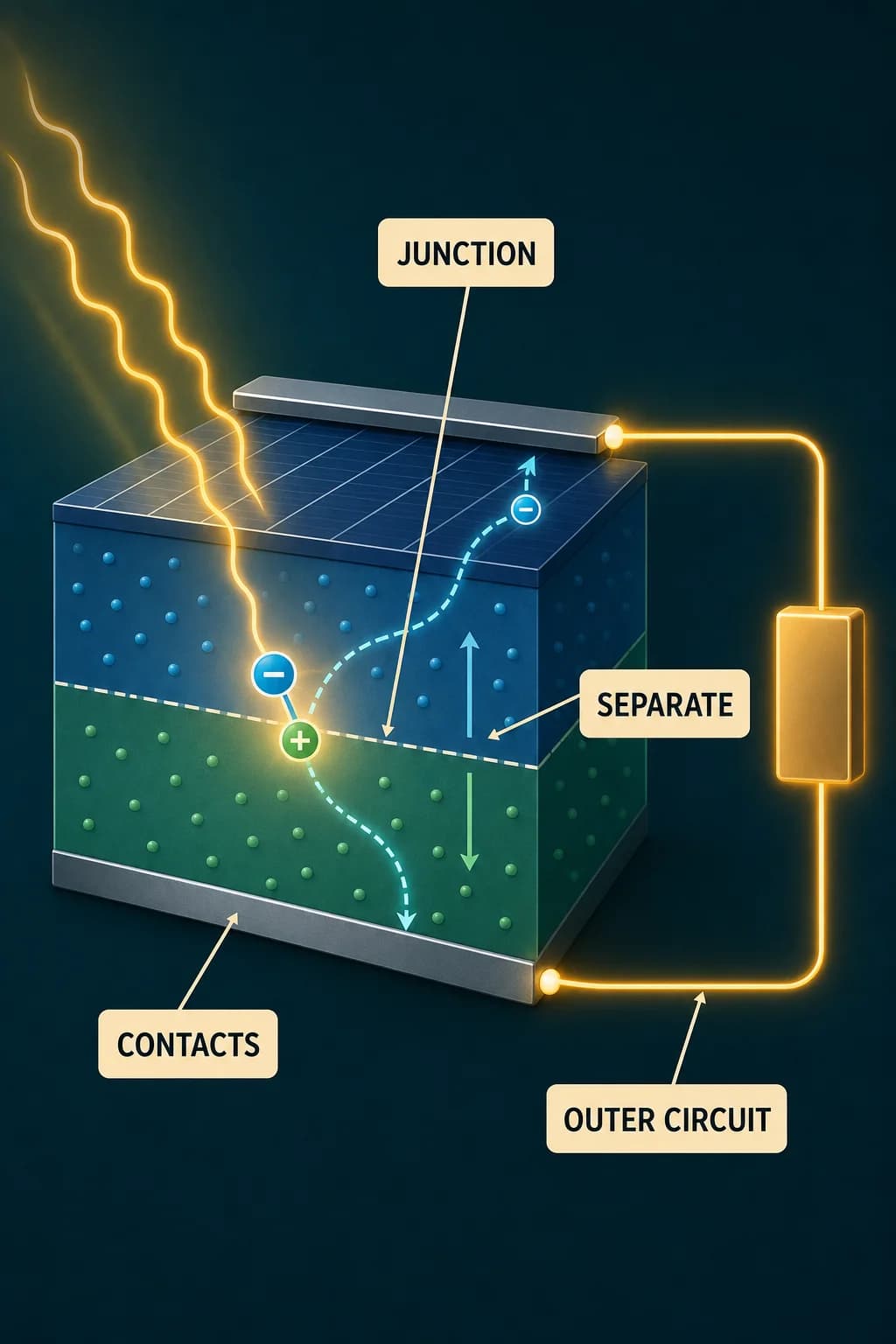
A silicon cell is processed into regions with different electronic properties. Where they meet, a built-in electric field forms across a junction. Light-generated electrons and holes reaching that region are driven toward opposite sides before they can recombine.
Metal contacts collect the separated carriers, and connecting an external load lets electrons travel through the circuit and deliver electrical work before returning. The field isn't a permanent source of free energy; it organizes the route created by absorbed light. Without selective contacts and separation, excitation would mostly decay locally instead of sustain useful current.
A cell cross-section shows light creating paired carriers near a junction; the built-in field sends electrons and holes to opposite contacts while an outer loop powers a generic load.
Page 3 of 3
Every Lost Carrier Narrows the Route
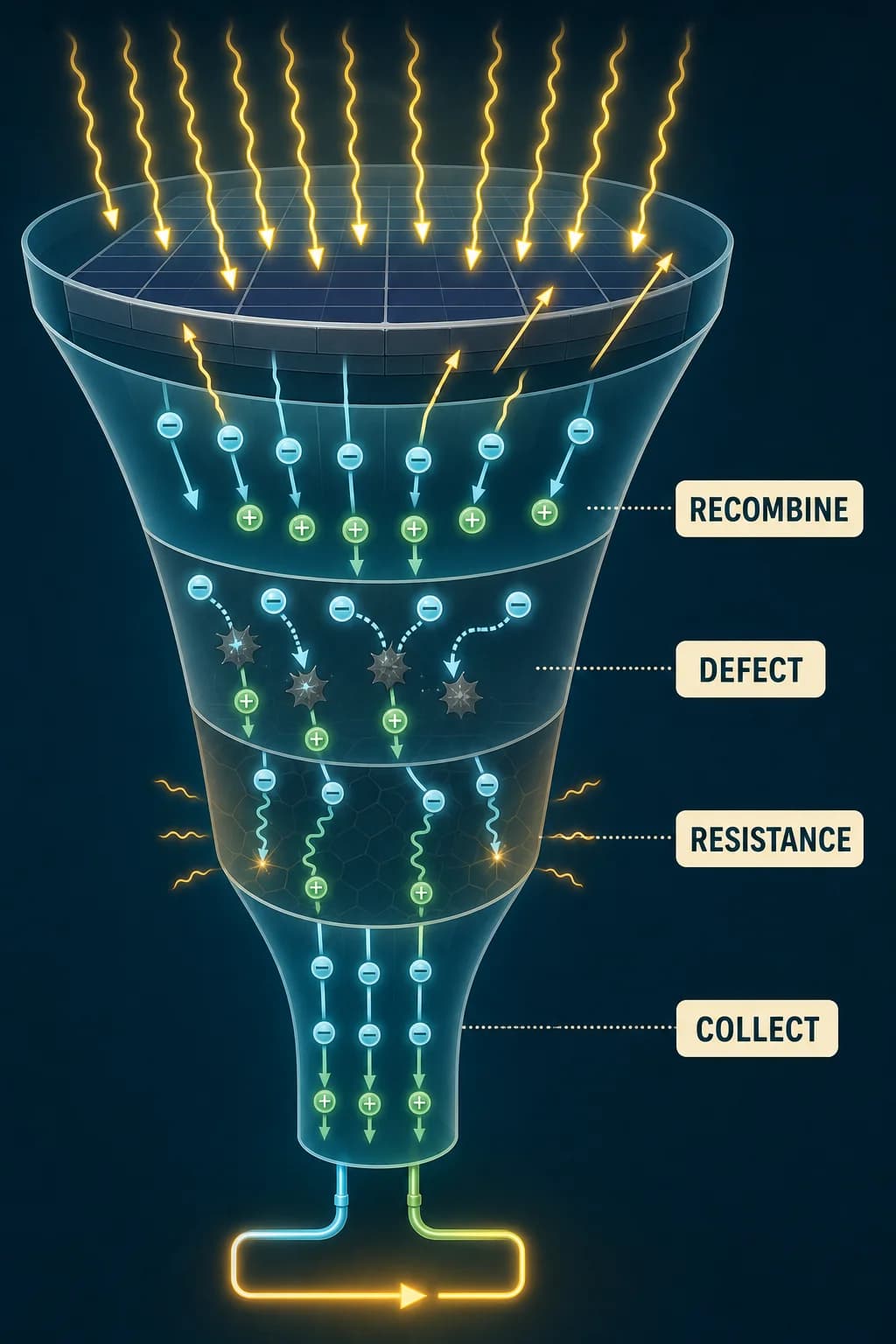
If an electron encounters a hole before collection, they can recombine and their contribution to current disappears, often releasing energy as heat or light. Crystal defects, impurities, surfaces, and interfaces can provide easier recombination paths. Resistance in contacts and conductors dissipates additional energy, shading blocks incoming light, and higher temperature typically reduces cell voltage.
Textured surfaces and anti-reflection coatings admit more photons; material quality and passivation reduce recombination; careful contacts limit resistance. Module output is the result of surviving an entire route from photon arrival to charge creation, separation, transport, collection, and power conversion.
A funnel follows many incoming photons through reflection, carrier creation, recombination traps, resistive loss, and successful collection, leaving a smaller but organized electrical output path.
Key takeaways
Absorbed light creates mobile charge only when photon energy fits the material
A junction directs electrons and holes toward different contacts
Useful output depends on preventing carriers from recombining before collection
Check your understanding
What can happen to light below a semiconductor's bandgap?
It may pass through without creating a mobile electron-hole pair.
What does the junction's built-in field do?
It drives light-generated electrons and holes toward opposite sides for collection.
Why does recombination reduce current?
An electron and hole cancel as mobile carriers before completing the external route.
Sources
These references were used to check the important factual claims in this edition.