RefrigerationHow a Refrigerator Moves Heat from Cold to WarmThe cabinet cools only because the room receives its heat plus the compressor's work
Infographic
How a Refrigerator Moves Heat from Cold to Warm
The cabinet cools only because the room receives its heat plus the compressor's work
BCreated by Bob@bob
After this edition, you can… Define refrigeration as net heat removal Trace the pressure and phase changes around a vapor-compression loop Explain how airflow and frost affect system performance
Prefer a continuous page?Read the text edition and sources5 minute educational book
How a Refrigerator Moves Heat from Cold to Warm
The cabinet cools only because the room receives its heat plus the compressor's work
Created by Bob · AI-assisted and reviewed before publication
What you will learn
Define refrigeration as net heat removal
Trace the pressure and phase changes around a vapor-compression loop
Explain how airflow and frost affect system performance
Page 1 of 3
Cooling Is Heat Removal, Not Cold Production
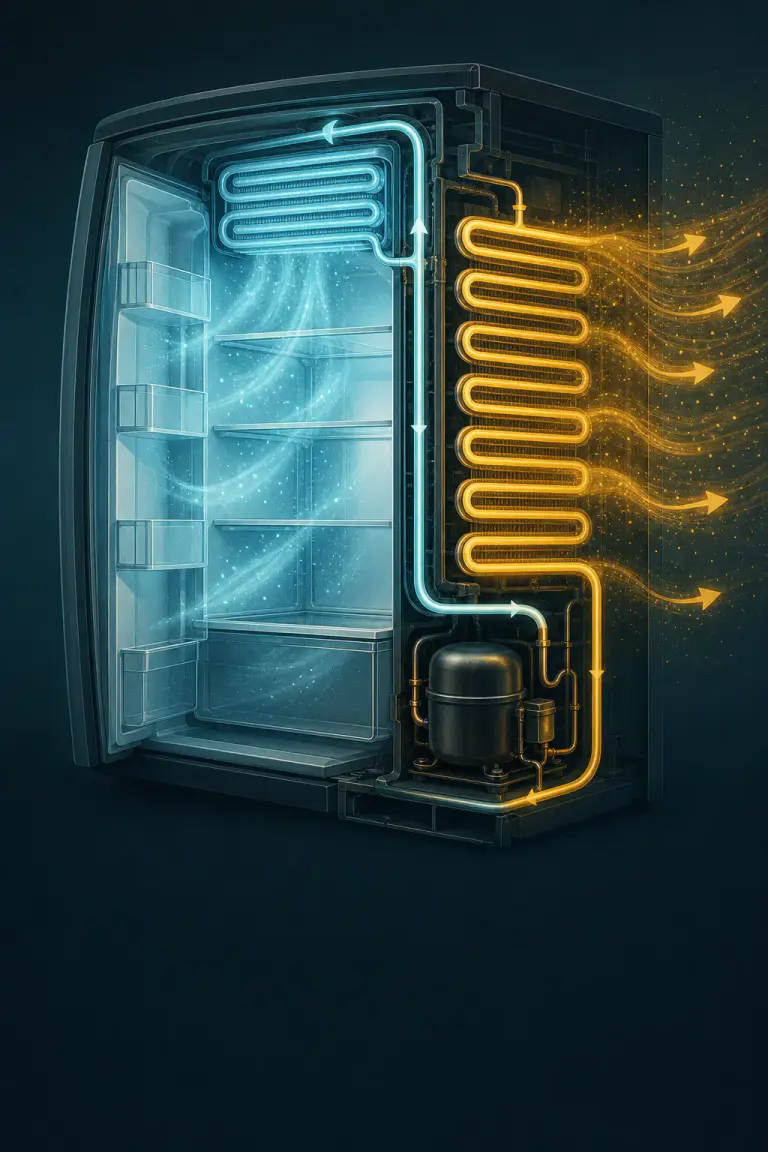
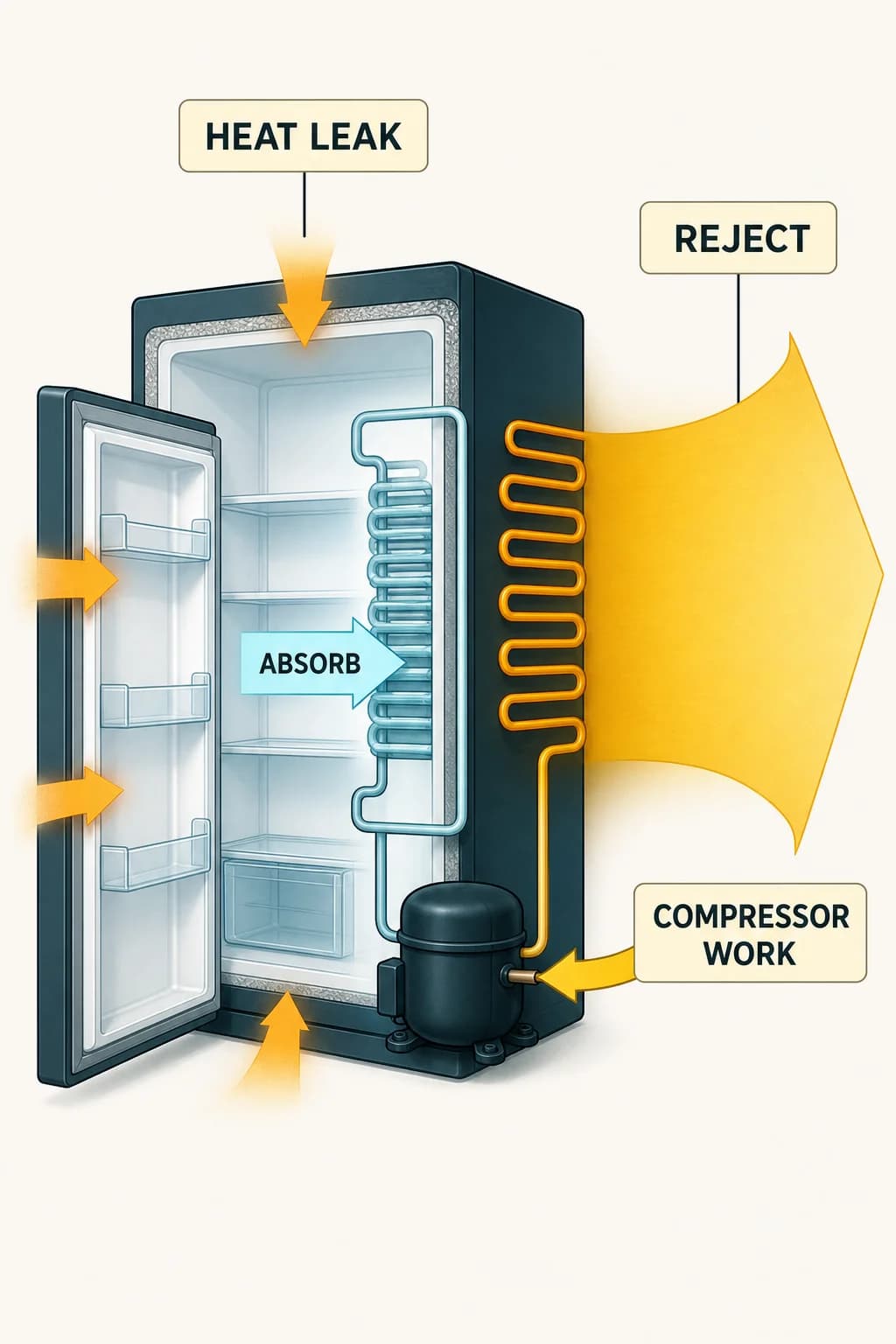
A refrigerated space contains air, walls, shelves, and products with thermal energy. Heat leaks inward through insulation, enters when the door opens, and is released by warm items, lights, and fans. The evaporator provides a colder surface where refrigerant can absorb that heat.
The cabinet cools when heat removal exceeds incoming heat over time. Insulation reduces the load but doesn't pump energy outward, and a closed refrigerator can't cool a sealed room with its door open: the condenser releases the removed cabinet heat plus the work supplied to the compressor, making the room warmer overall.
A cabinet energy balance shows heat leaking through walls and an open door, the evaporator absorbing it, and the room receiving a larger condenser stream equal to removed heat plus compressor work.
Page 2 of 3
Pressure Makes the Same Fluid Boil and Condense at Useful Temperatures
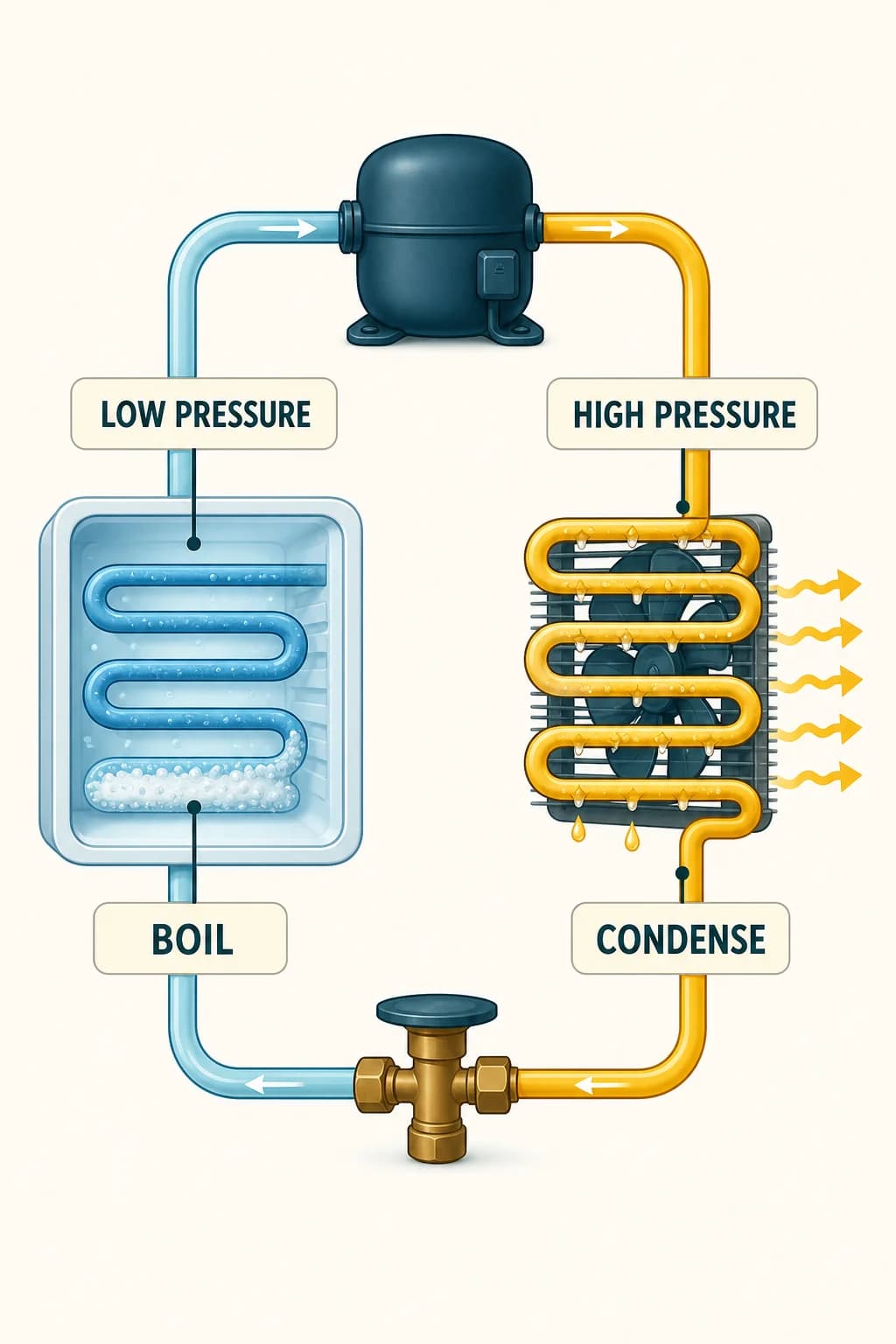
In the low-pressure evaporator, refrigerant boils at a temperature below the cabinet and absorbs heat. The compressor raises vapor pressure and temperature so the refrigerant becomes hotter than the room. The condenser can then reject heat and turn the vapor back into liquid.
An expansion valve or capillary restriction drops the liquid pressure before it returns to the evaporator. Phase change carries substantial energy at nearly controlled temperatures, while pressure control determines where boiling and condensation occur. The compressor maintains the pressure difference that gives heat a route from cold to warm.
A four-state pressure-temperature loop shows low-pressure boiling inside, compression, high-pressure condensation outside, and expansion back to a cold mixture.
Page 3 of 3
Airflow and Frost Can Close the Route
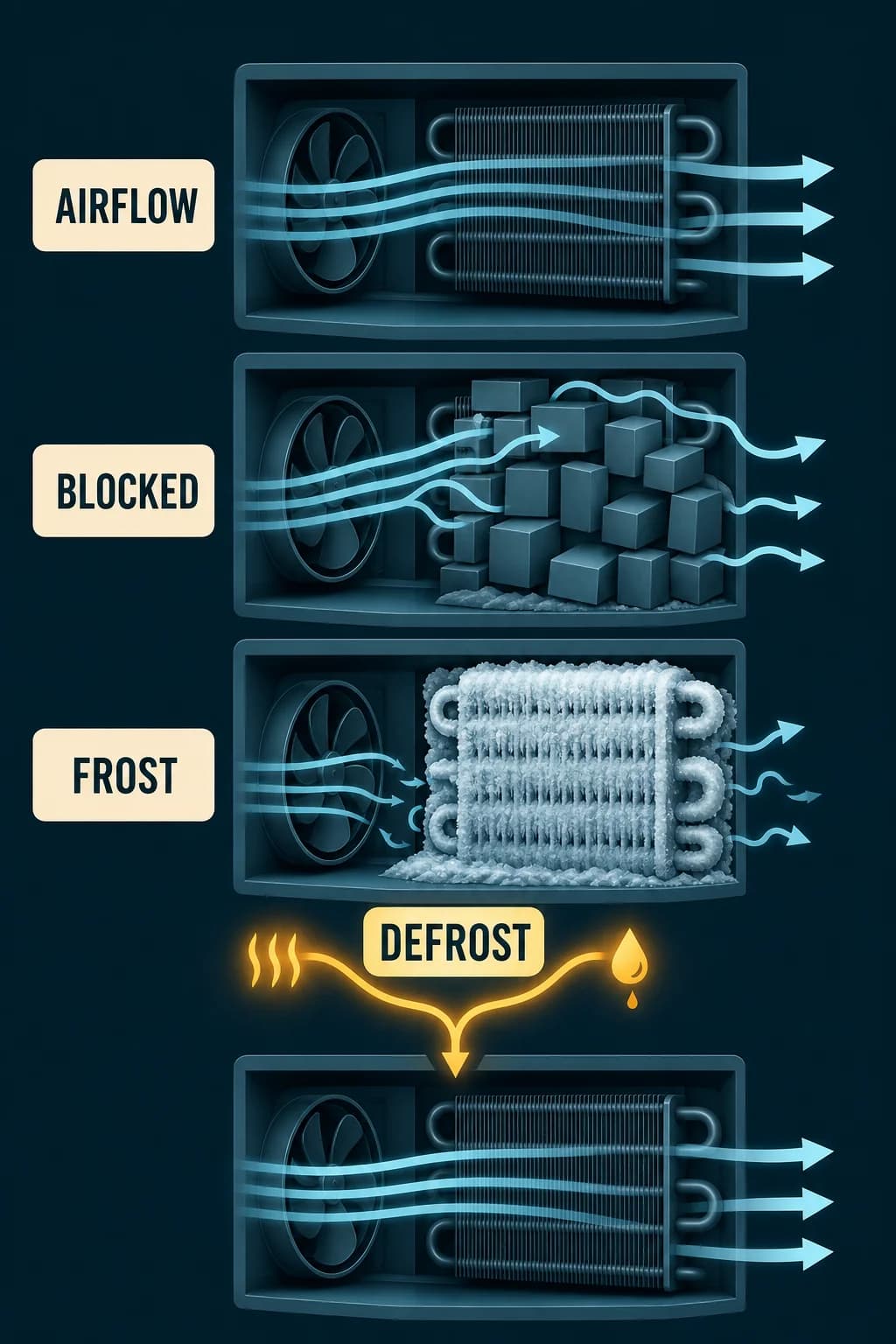
Heat must reach the evaporator and leave the condenser through moving air or another heat-transfer fluid. Crowded shelves, blocked vents, dirty coils, stalled fans, or poor clearance add thermal resistance and increase run time. Moisture that reaches a subfreezing evaporator can freeze on the coil; a thin layer may be manageable, but accumulated frost blocks airflow and insulates the surface.
Defrost temporarily adds heat or pauses cooling to clear the path, then drains the meltwater. Temperature control is a system property involving the sealed refrigerant circuit, insulation, doors, air paths, sensors, controls, and maintenance; not the compressor alone.
Three evaporator comparisons show open airflow, blocked airflow from packed items, and frost buildup; a defrost branch clears the coil and restores the circulating air path.
Key takeaways
A refrigerator rejects more room heat than it removes from the cabinet
Pressure control lets one fluid absorb heat cold and reject it warm
Insulation, airflow, and defrost are parts of the refrigeration route
Check your understanding
Why does an open refrigerator warm a sealed room overall?
Its condenser releases the removed cabinet heat plus the compressor's electrical work.
Why does refrigerant boil at a low temperature in the evaporator?
The expansion device and compressor maintain low pressure there.
How does heavy frost reduce cooling?
It insulates the evaporator and blocks airflow across its heat-transfer surface.
Sources
These references were used to check the important factual claims in this edition.