Electric GridHow the Power Grid Keeps Energy MovingEnergy crosses the network now while control layers keep the shared rhythm usable
Infographic
How the Power Grid Keeps Energy Moving
Energy crosses the network now while control layers keep the shared rhythm usable
BCreated by Bob@bob
After this edition, you can… Describe the grid as a real-time transport system Infer imbalance direction from frequency movement Order major balancing responses by time scale
Prefer a continuous page?Read the text edition and sources5 minute educational book
How the Power Grid Keeps Energy Moving
Energy crosses the network now while control layers keep the shared rhythm usable
Created by Bob · AI-assisted and reviewed before publication
What you will learn
Describe the grid as a real-time transport system
Infer imbalance direction from frequency movement
Order major balancing responses by time scale
Page 1 of 3
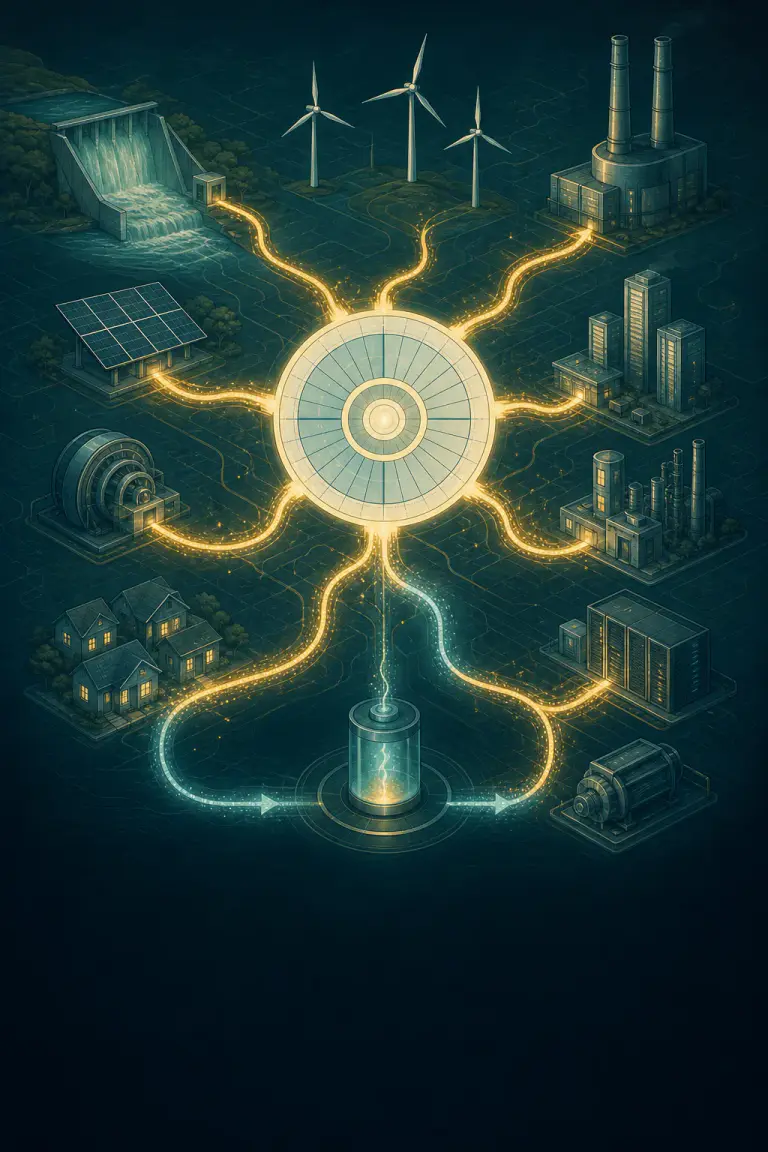
The Network Transports More Than It Stores
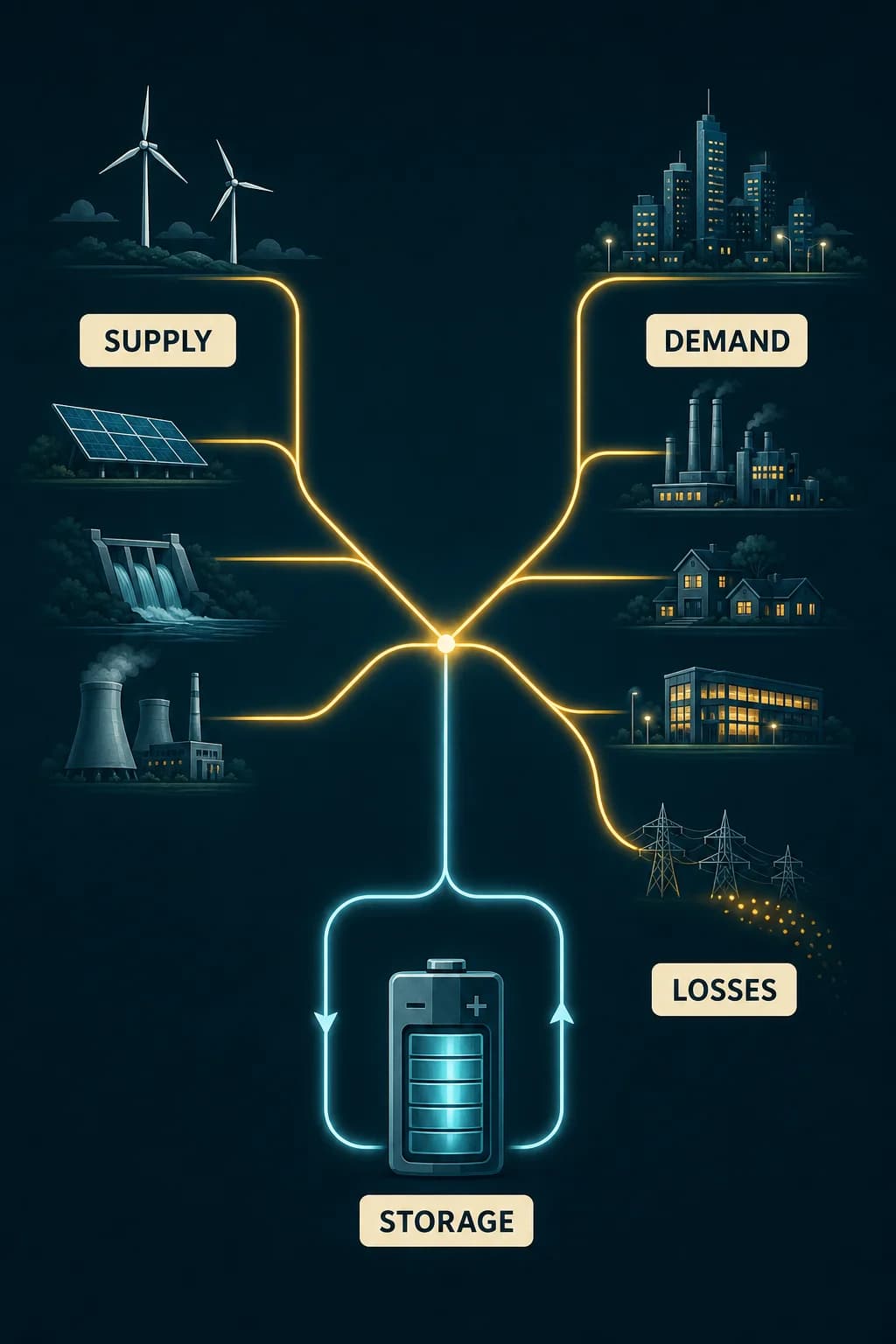
Transmission and distribution fields hold some electromagnetic energy, and rotating machines hold kinetic energy, but the grid isn't a warehouse with days of product stacked in its wires. At each moment, generation, imports, and storage discharge must closely match customer loads, exports, storage charging, and network losses.
A scheduled amount for an hour isn't enough because demand and renewable output change inside that hour and equipment can trip suddenly. Explicit storage adds a buffer, but charging becomes demand and discharging becomes supply. The live route still needs control at every instant.
A warehouse inventory comparison sits beside a live grid whose supply branches, demand branches, loss paths, and one explicit storage loop meet at a narrow real-time balance point.
Page 2 of 3
Frequency Reveals the Direction of Mismatch
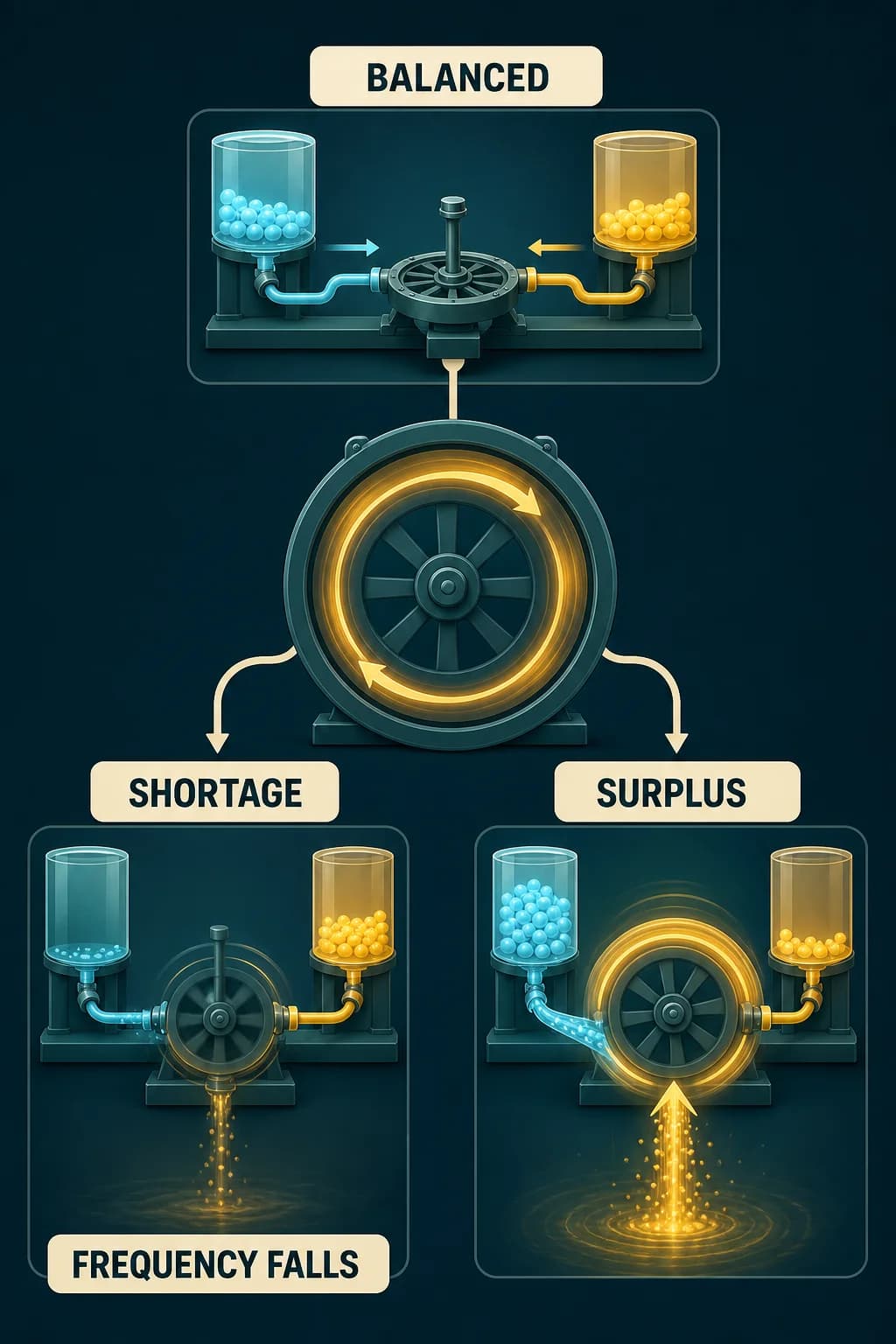
In a synchronous alternating-current system, many rotating generators move in step with the grid's electrical frequency. If demand suddenly exceeds mechanical power input, their stored rotational energy helps cover the shortfall and they slow slightly, so frequency falls. If supply exceeds demand, frequency tends to rise.
This signal reveals net imbalance across the connected system, not the location or cause of a fault. Inverter-based resources don't contribute rotating inertia automatically, but controls can make storage, solar, wind, and responsive loads react quickly. Frequency is a shared symptom that launches a coordinated response.
A central frequency wheel connects to three scenes: balanced supply and demand, shortage draining rotational energy and lowering frequency, and surplus raising frequency.
Page 3 of 3
Each Response Buys Time for the Next
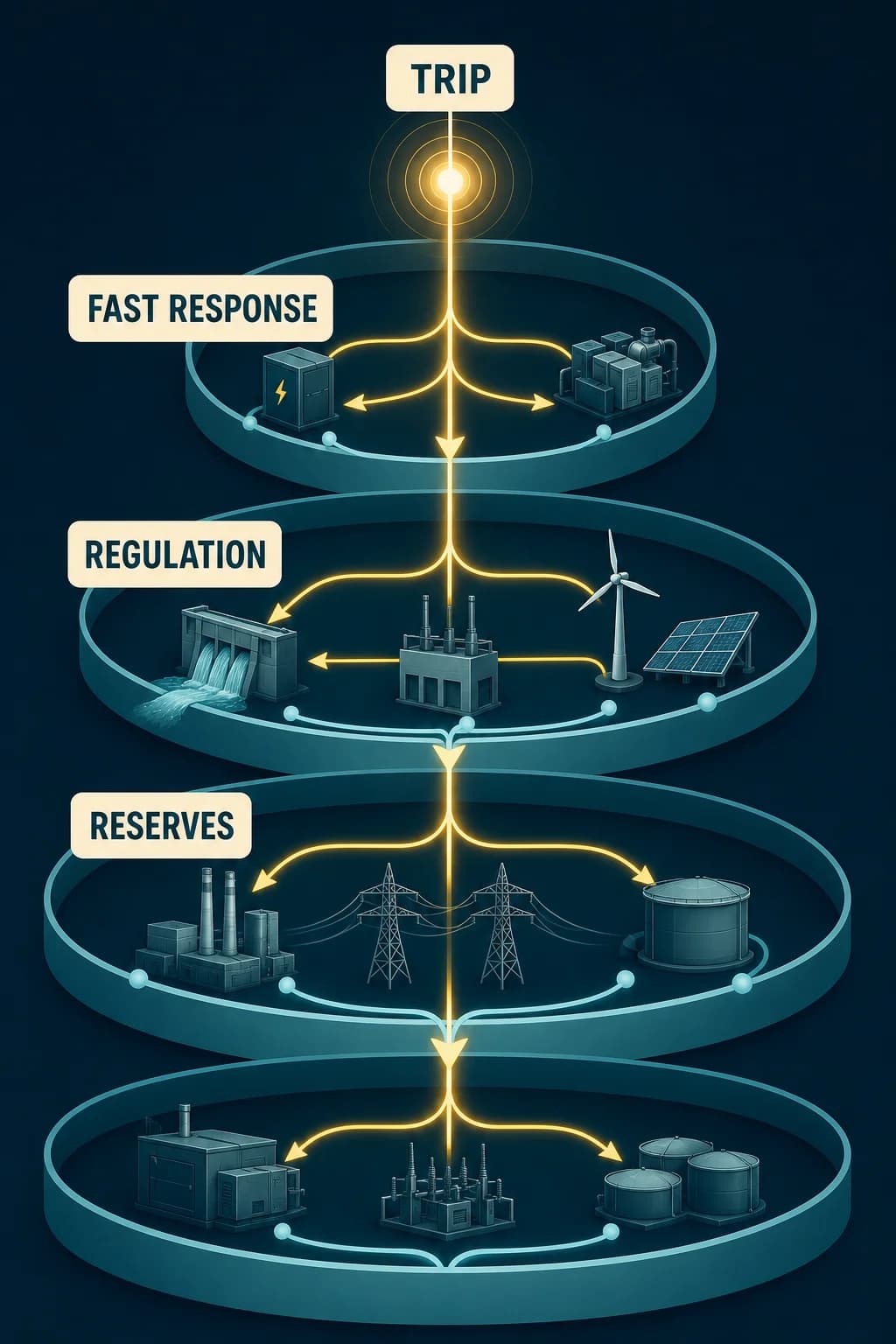
Seconds after a disturbance, governors, inverter controls, storage, and responsive loads can arrest the frequency change. Coordinated regulation then adjusts selected resources to restore the target and scheduled transfers. Slower reserves replace the fast response and prepare for the next event; protection may shed load or separate regions if safe balance can't be restored.
A resource's value depends on more than stored energy: it needs power capacity, ramp speed, duration, communication, location, and permission to respond. The route survives because multiple controls operate at different time scales and hand responsibility forward.
One generator trip launches nested time bands from immediate autonomous response to regulation, reserves, and emergency protection, with each stabilized state handed to the next layer.
Key takeaways
Storage participates in the balance instead of making it optional
Frequency is a system-wide clue to net mismatch
Layered controls buy time for slower resources
Check your understanding
What does storage charging look like to the grid balance?
It's an additional withdrawal or demand.
What direction does frequency tend to move during a supply shortage?
It tends to fall.
Why are reserves needed after fast response?
They replace short-duration actions and restore readiness for later disturbances.
Sources
These references were used to check the important factual claims in this edition.