EntropyWhy Energy Spreads Out and Becomes Less UsefulTotal energy can remain accounted for while the differences that could drive change disappear
Infographic
Why Energy Spreads Out and Becomes Less Useful
Total energy can remain accounted for while the differences that could drive change disappear
BCreated by Bob@bob
After this edition, you can… Distinguish energy quantity from a useful energy difference Relate entropy increase to more accessible microscopic arrangements Explain how local entropy decrease is compatible with the second law
Prefer a continuous page?Read the text edition and sources5 minute educational book
Why Energy Spreads Out and Becomes Less Useful
Total energy can remain accounted for while the differences that could drive change disappear
Created by Bob · AI-assisted and reviewed before publication
What you will learn
Distinguish energy quantity from a useful energy difference
Relate entropy increase to more accessible microscopic arrangements
Explain how local entropy decrease is compatible with the second law
Page 1 of 3
A Difference Is a Resource
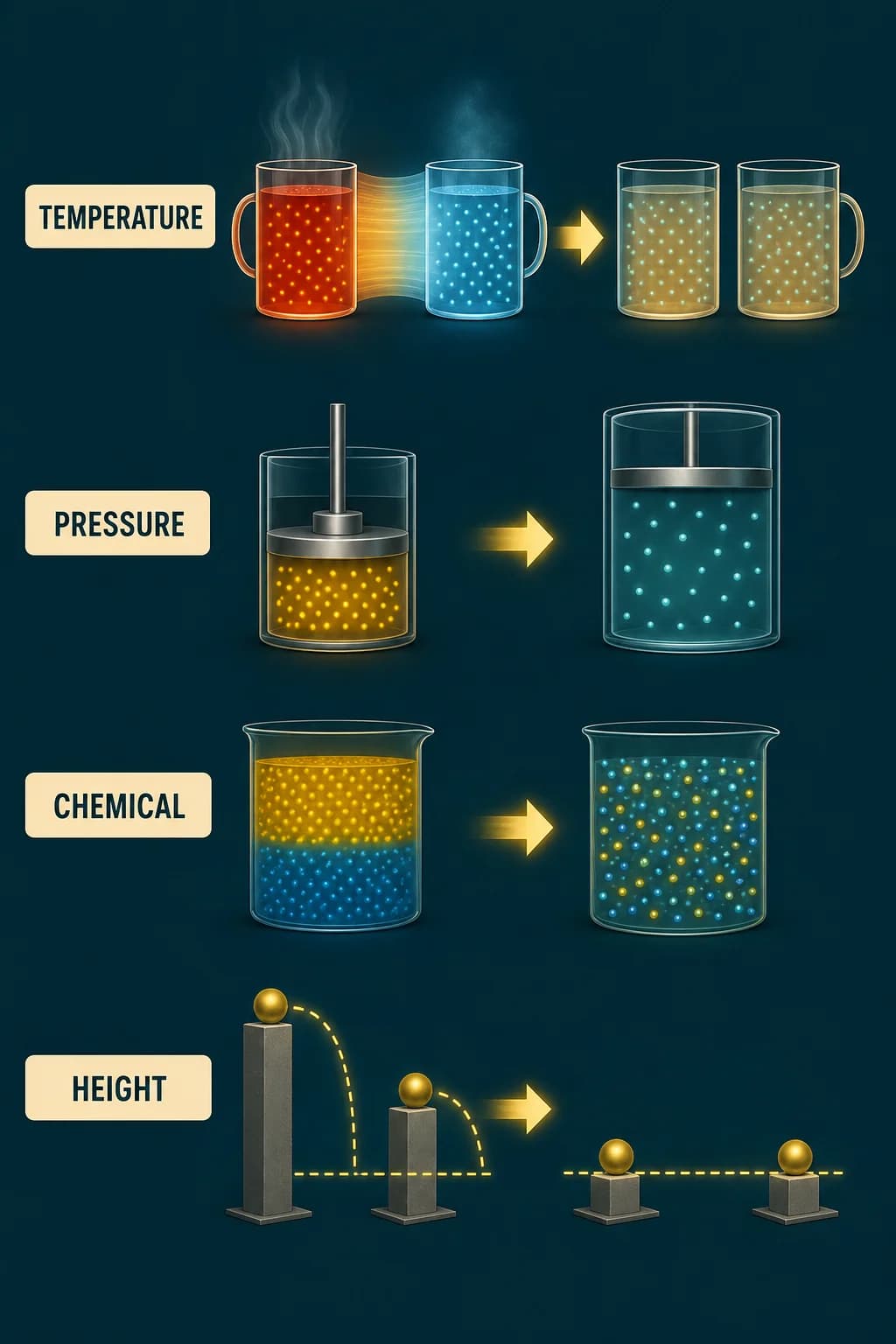
A hot object beside a cold one can drive heat flow; compressed gas can expand; separated chemicals can react; a raised mass can fall. In each case, energy is present in an uneven arrangement that constrains what can happen next. When the hot and cold objects reach one temperature, their total energy has not vanished, but that particular difference can no longer drive the same process.
Energy accounting answers how much remains. Entropy helps track how widely energy and matter can be arranged among microscopic states, and the second law constrains which macroscopic changes occur spontaneously in an isolated system.
Four paired systems begin with useful differences; hot and cold, compressed and expanded, separated chemicals, raised and lowered mass; then compare which differences remain after spontaneous change.
Page 2 of 3
Spreading Has Overwhelmingly More Microscopic Ways
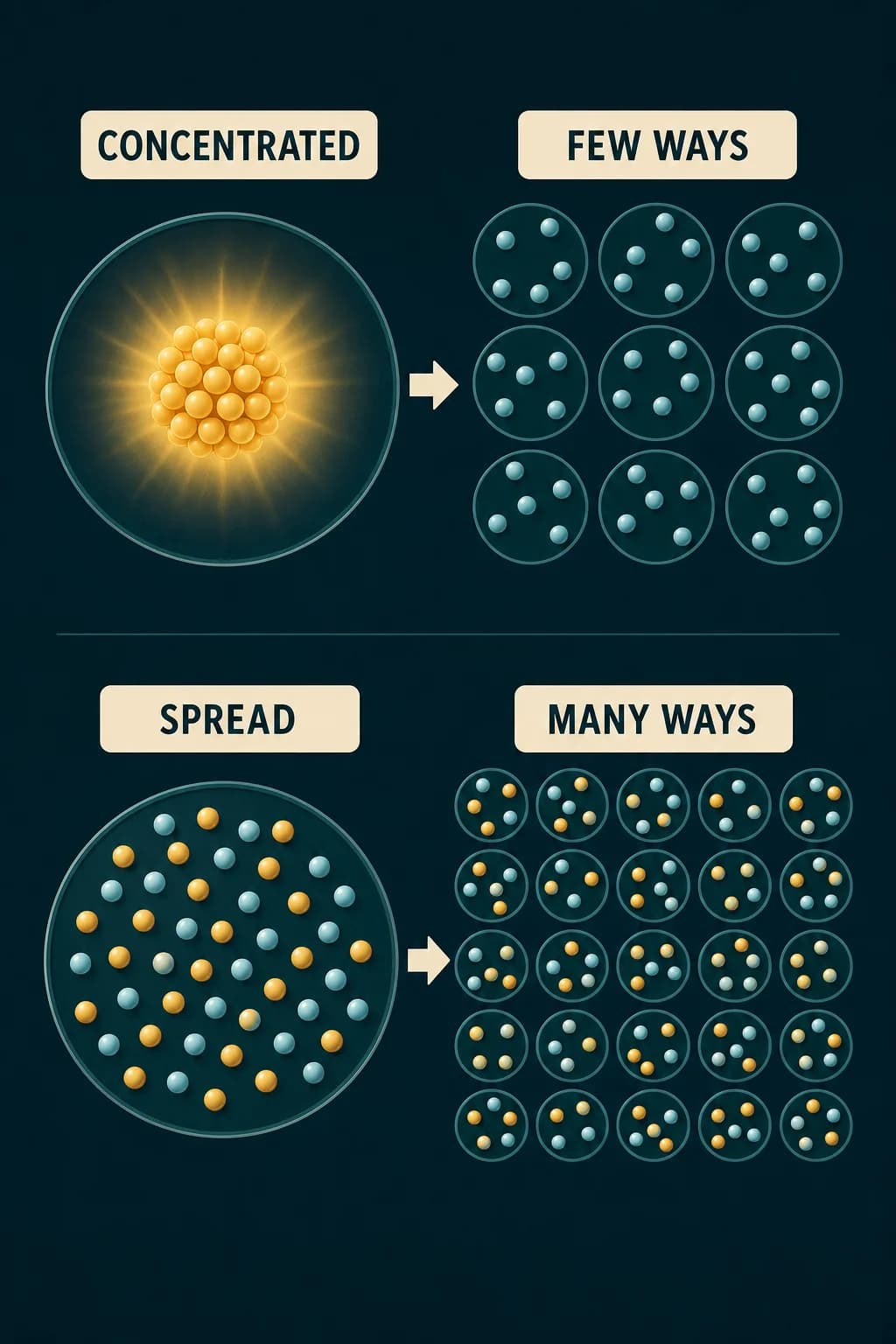
When a hot object touches a cold one, energy transfers through countless molecular interactions. There are vastly more microscopic arrangements corresponding to energy shared across both objects than arrangements with almost all the extra energy concentrated in one. Random motion can produce tiny local fluctuations, but an isolated macroscopic system almost never reconstructs the original hot-cold split by chance.
Mixing and diffusion follow the same statistical direction: dispersed arrangements occupy far more possible microstates than a carefully separated pattern. Entropy isn't just visible mess; it counts or measures accessible microscopic organization under stated constraints.
A two-compartment molecular view compares a rare concentrated-energy macrostate with many distinct dispersed microstates, followed by mixed particles occupying far more arrangements than separated particles.
Page 3 of 3
Local Order Requires a Larger Outside Change
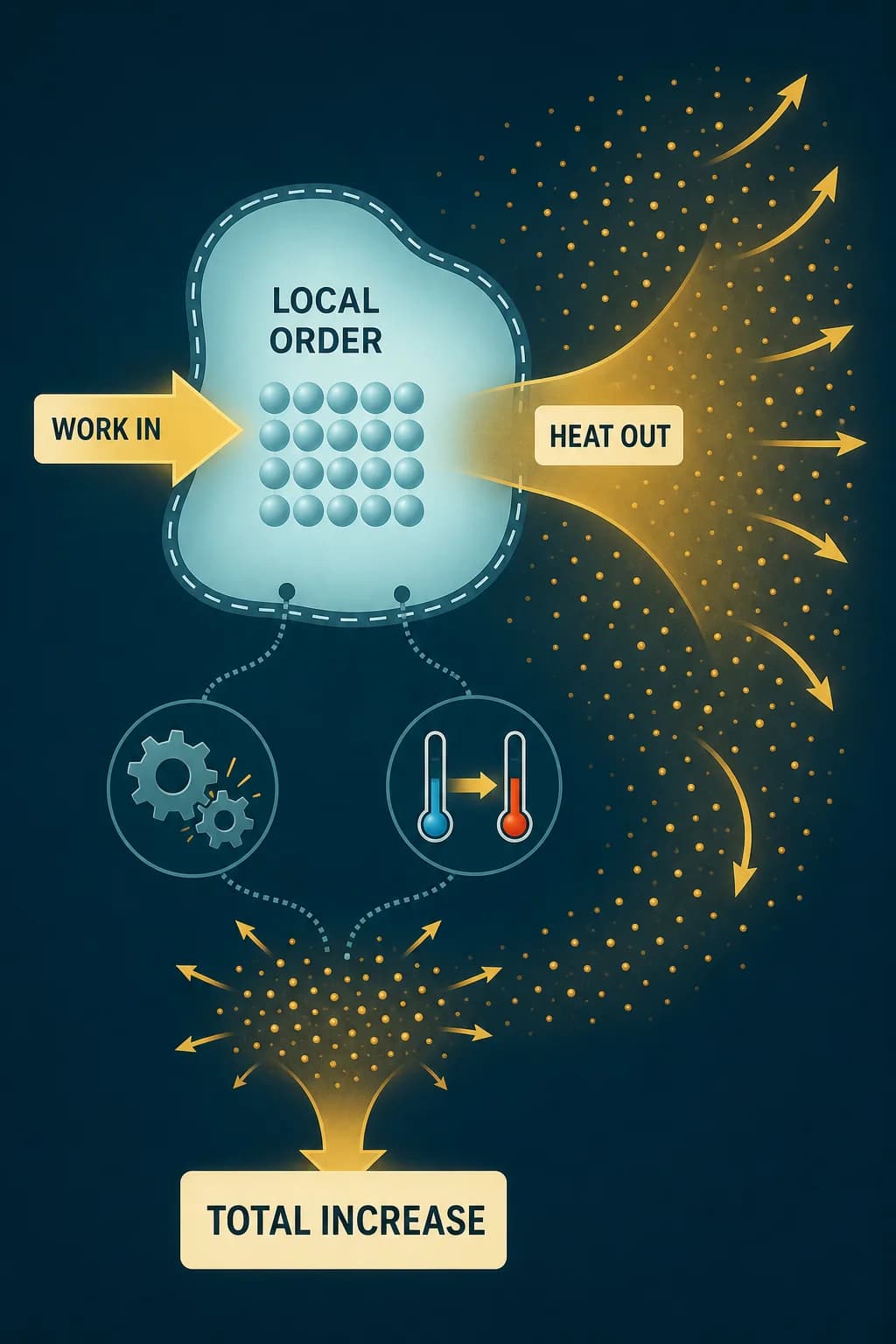
A refrigerator can make its cabinet colder and more ordered thermally, but the compressor consumes work and the condenser increases the surroundings' entropy by rejecting heat. A sorting machine can separate a mixture, but it uses energy and produces waste heat. The second law doesn't forbid local entropy decrease in an open system; it requires the total change, including surroundings, to satisfy the constraint.
Friction and finite-temperature heat transfer are irreversible because they spread organized mechanical energy or concentrated heat into less recoverable forms. Engineers reduce these entropy-generating processes, but no real conversion preserves every useful difference.
A local system becomes colder or more separated while a work arrow enters and a broader waste-heat path spreads into the surroundings; friction and finite temperature gaps branch to entropy generation.
Key takeaways
Energy can remain while its ability to drive change decreases
Dispersed macrostates correspond to overwhelmingly more microscopic arrangements
Restoring a difference requires work and greater entropy production elsewhere
Check your understanding
What is lost when two bodies reach the same temperature?
The temperature difference that could drive heat flow, not the total energy itself.
Why does energy spontaneously spread between many particles?
Dispersed energy corresponds to overwhelmingly more accessible microscopic arrangements.
How can a refrigerator lower entropy inside its cabinet?
It consumes work and rejects heat, increasing entropy in the surroundings by more than the local decrease.
Sources
These references were used to check the important factual claims in this edition.