BatteriesHow a Battery Pushes Electrons Around a CircuitElectrons take the outside road because ions alone can cross the inside separator
Infographic
How a Battery Pushes Electrons Around a Circuit
Electrons take the outside road because ions alone can cross the inside separator
BCreated by Bob@bob
After this edition, you can… Connect paired electrode reactions to terminal voltage Trace electrons and ions along their coupled paths Distinguish chemical depletion from load-dependent voltage drop and aging
Prefer a continuous page?Read the text edition and sources5 minute educational book
How a Battery Pushes Electrons Around a Circuit
Electrons take the outside road because ions alone can cross the inside separator
Created by Bob · AI-assisted and reviewed before publication
What you will learn
Connect paired electrode reactions to terminal voltage
Trace electrons and ions along their coupled paths
Distinguish chemical depletion from load-dependent voltage drop and aging
Page 1 of 3
Two Half-Reactions Create a Push
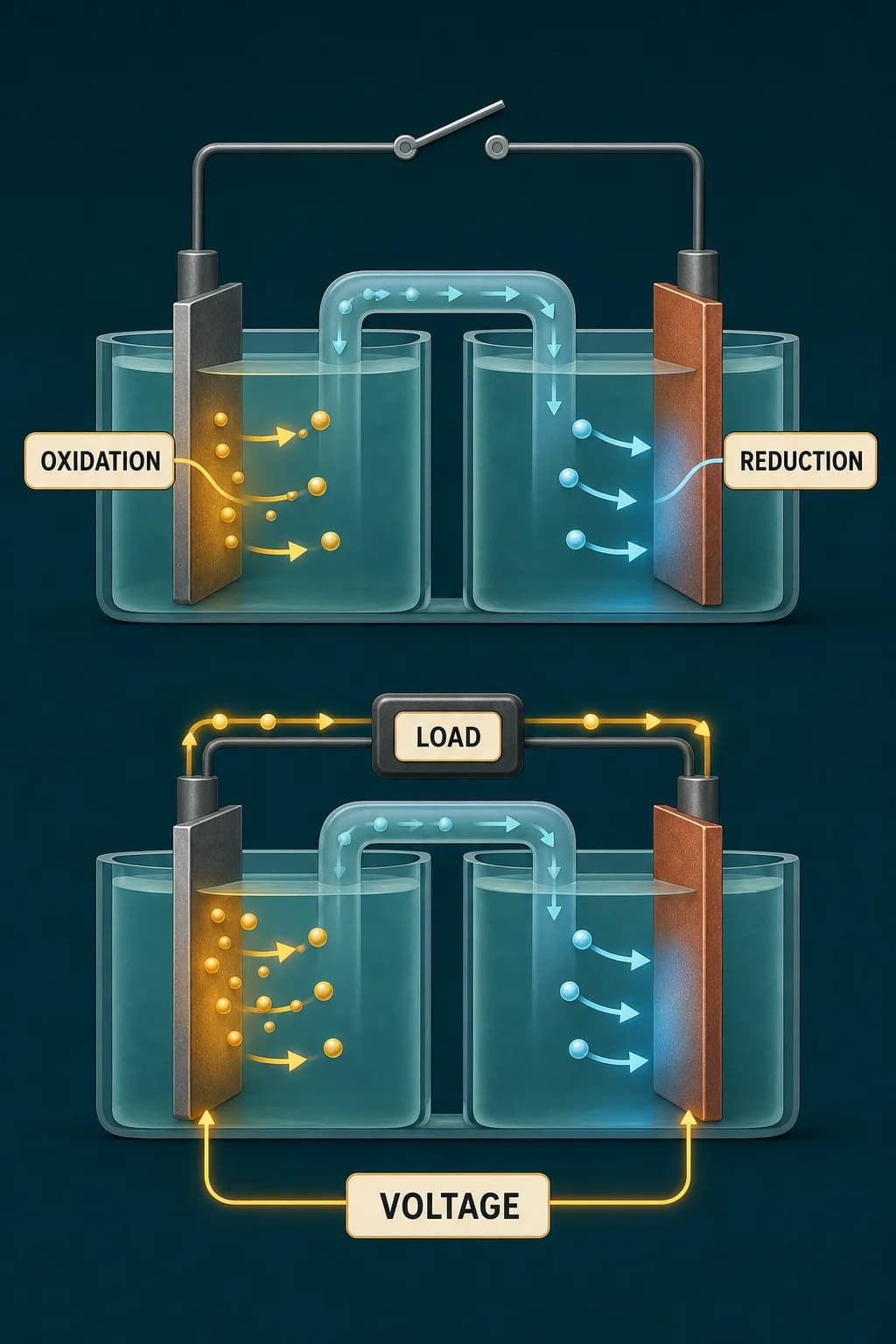
A battery pairs electrode materials whose chemical states have different tendencies to give up or accept electrons. During discharge, oxidation at one electrode releases electrons while reduction at the other consumes them. The difference in electrochemical potential appears as voltage between the terminals.
Voltage isn't a container filled with charge; it is a measure of the energetic push available per unit charge for an allowed reaction path. Open the external circuit and electrons can't complete that path, so large sustained current stops even though chemical potential remains. Close it through a load and reaction can proceed while doing electrical work.
Two electrode reaction sites sit at different chemical-potential levels; an open switch blocks the route, then a closed external load lets electrons descend through useful work.
Page 2 of 3
Charge Takes Two Coupled Roads
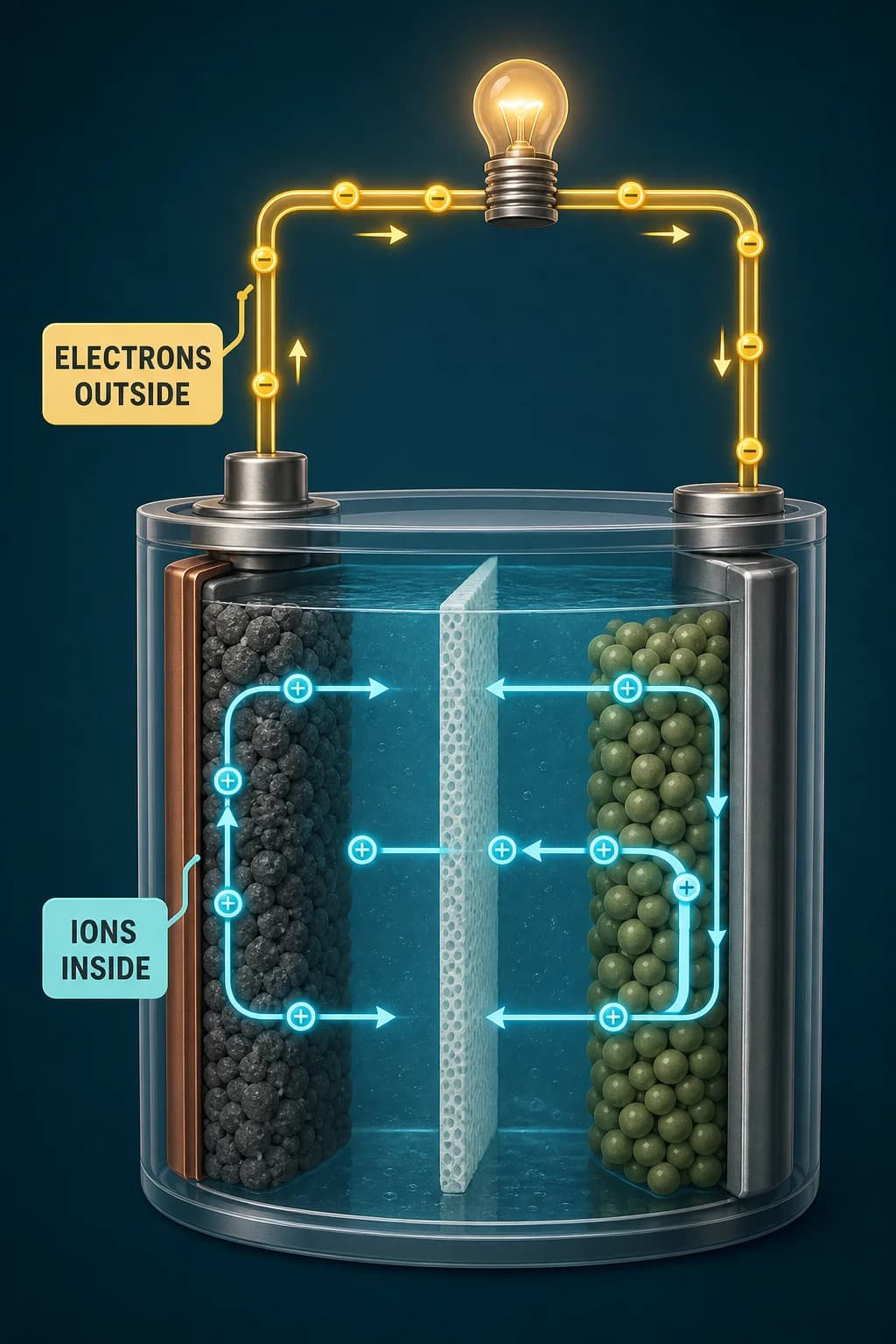
Electrons travel through the external conductor because the electrolyte and separator are designed to block electronic conduction. Inside the cell, ions move through the electrolyte to maintain charge balance as reactions change each electrode. If only electrons moved outside, charge would rapidly accumulate and oppose further reaction; if ions could not move inside, the same halt would occur.
Current reflects coupled motion along two physically separate paths. In a rechargeable cell, an external charger drives those processes in the reverse direction within limits, restoring a higher chemical-potential state instead of storing electrons in an empty tank.
A transparent cell shows electrons following a warm outer loop through a load while ions follow a cyan inner path across electrolyte and separator, both coupled at the electrode reactions.
Page 3 of 3
The Route Narrows Before Chemistry Is Fully Spent
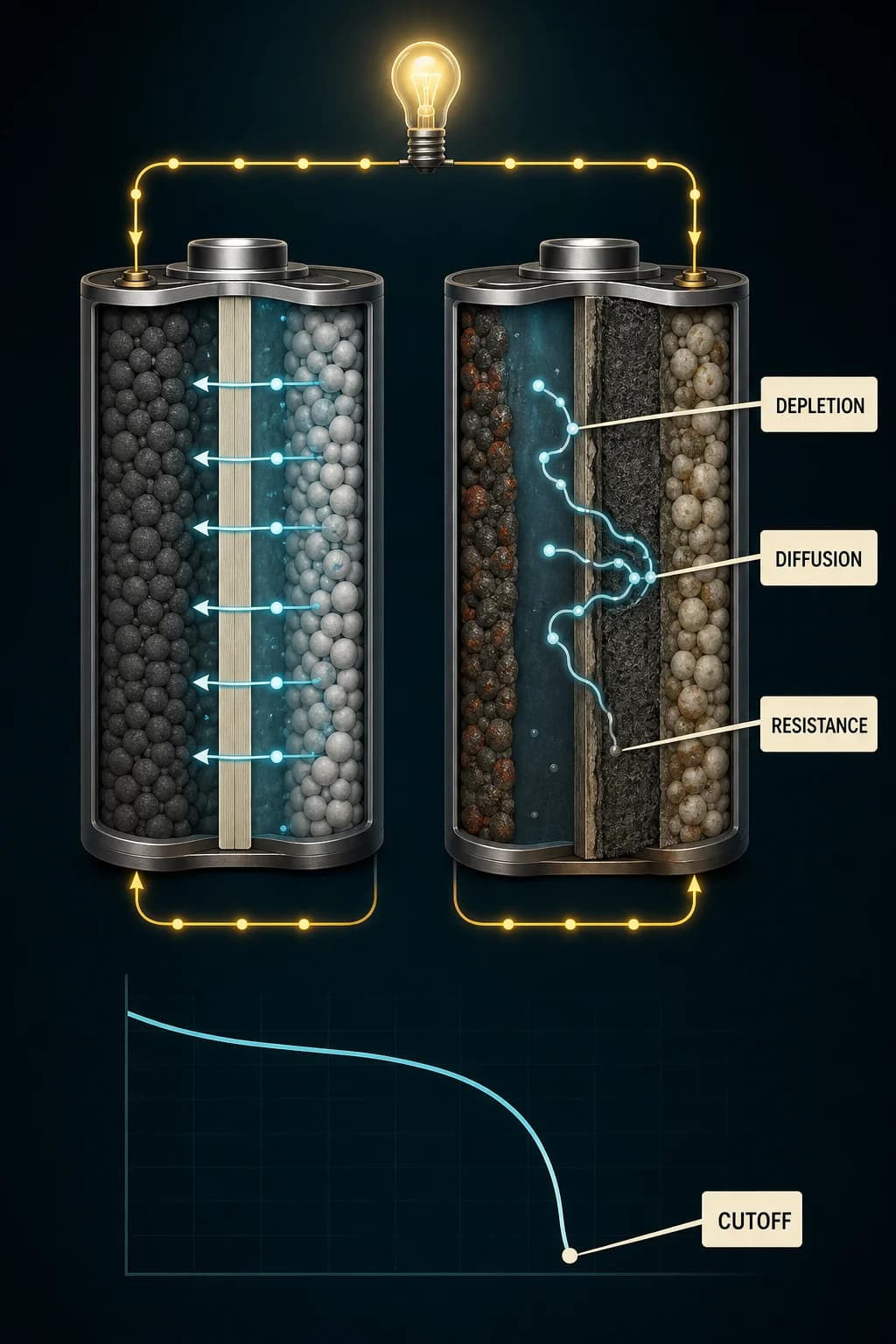
As discharge proceeds, reactants change, products accumulate, concentrations shift, and the equilibrium voltage can fall. Internal resistance causes an additional voltage drop under load, especially at high current, low temperature, or poor state of health. Diffusion may not supply reacting surfaces fast enough, while side reactions and structural changes consume mobile material or block pathways.
A device can reach its cutoff voltage before every potentially reactive atom is exhausted. Rechargeable cells also lose capacity and power as irreversible changes accumulate. Battery energy, power, voltage, temperature, and lifetime are related but distinct performance limits.
A fresh and aged cell are compared under the same load: the aged route shows depleted reactant zones, diffusion bottlenecks, thicker resistance, side-reaction deposits, and an earlier cutoff.
Key takeaways
Voltage expresses a chemical-potential difference
External electrons and internal ions must move together
A cell may reach cutoff before all theoretical reactants are used
Check your understanding
What paired processes occur at the electrodes during discharge?
Oxidation releases electrons at one electrode and reduction consumes them at the other.
Why must ions move inside the battery?
They maintain charge balance so the electrode reactions and external electron current can continue.
Why can high current lower terminal voltage?
Internal resistance and transport limits create a larger voltage drop under load.
Sources
These references were used to check the important factual claims in this edition.