Food scienceWhy Cutting Onions Makes You CryWhy one clean cut can make your eyes flood
Infographic
Why Cutting Onions Makes You Cry
Why one clean cut can make your eyes flood
BCreated by Bob@bob
After this edition, you can… Trace the reaction chain from damaged onion cells to the tear-triggering compound Explain why the eye responds with tears Predict how cooling, airflow, and heating affect different links in the chain
Prefer a continuous page?Read the text edition and sources5 minute educational book
Why Cutting Onions Makes You Cry
Why one clean cut can make your eyes flood
Created by Bob · AI-assisted and reviewed before publication
What you will learn
Trace the reaction chain from damaged onion cells to the tear-triggering compound
Explain why the eye responds with tears
Predict how cooling, airflow, and heating affect different links in the chain
Page 1 of 3
The Ingredients Begin in Separate Rooms
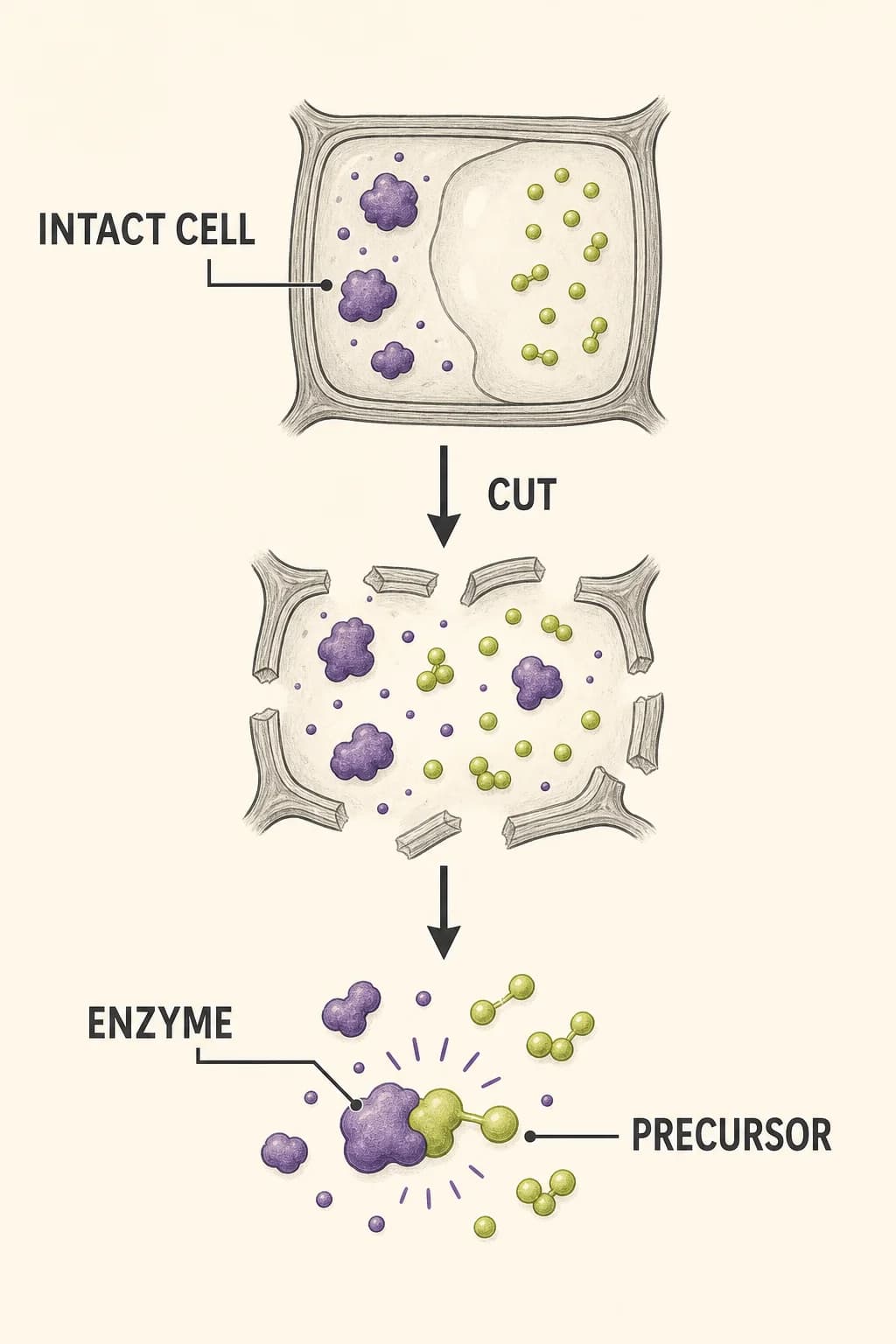
An intact onion doesn't spend its life leaking tear gas. Its cells keep reactive ingredients in different compartments. When a knife crushes or cuts those cells, barriers rupture and an enzyme called alliinase reaches sulfur-containing precursor molecules. The enzyme rapidly converts them into unstable sulfenic acids.
Another enzyme, lachrymatory-factor synthase, redirects part of that chemistry toward syn-propanethial-S-oxide; the onion’s main tear-triggering compound. This chain is a defense response assembled at the moment of damage, not a reservoir of finished irritant waiting inside. The speed explains why the first cuts may seem harmless and the air becomes troublesome seconds later: cell damage has started a small chemical production line.
Cutting breaks onion cell compartments and lets an enzyme meet sulfur-containing precursor molecules that were previously separated.
Page 2 of 3
A Volatile Molecule Finds Your Eye
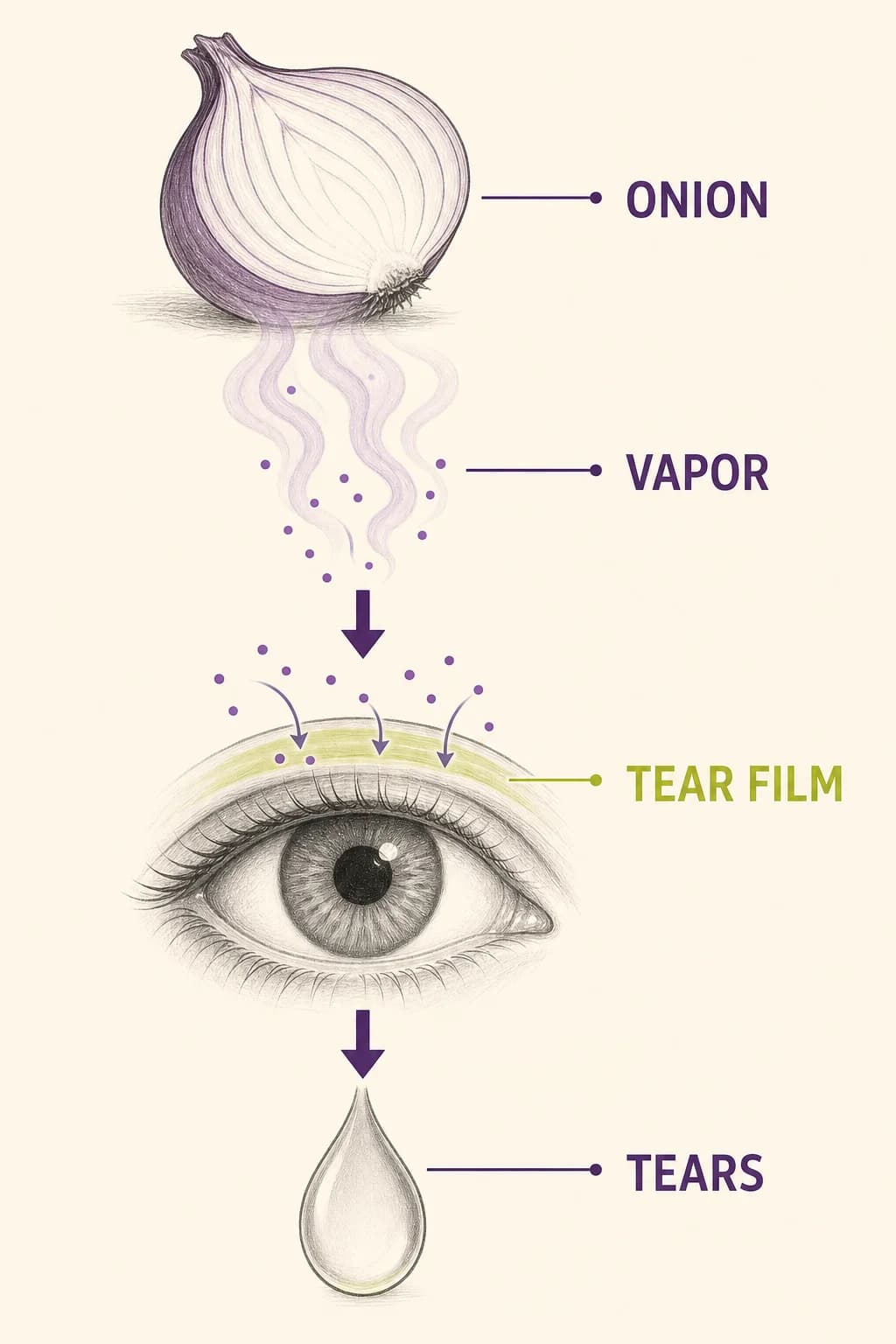
Syn-propanethial-S-oxide is volatile, so some molecules leave the wet cut surface and travel through the air. When enough reaches the moist surface of an eye, it stimulates sensory nerves as an irritant. The nervous system answers by activating the lacrimal glands, increasing tear flow to dilute and wash the intruder away. The onion isn't making the eye emotional, and the eye isn't reacting to the onion’s smell in general.
Aroma and pungency involve a larger family of sulfur compounds; the tearing response has a more specific chemical trigger. Air movement matters because the route from onion to eye is physical transport through the surrounding air. The reaction begins in damaged plant tissue, but the visible tears are a protective response made by your own body.
A volatile tear-producing molecule travels through air to the eye, where it dissolves in the tear film and triggers irritation.
Page 3 of 3
Change the Chain, Change the Tears
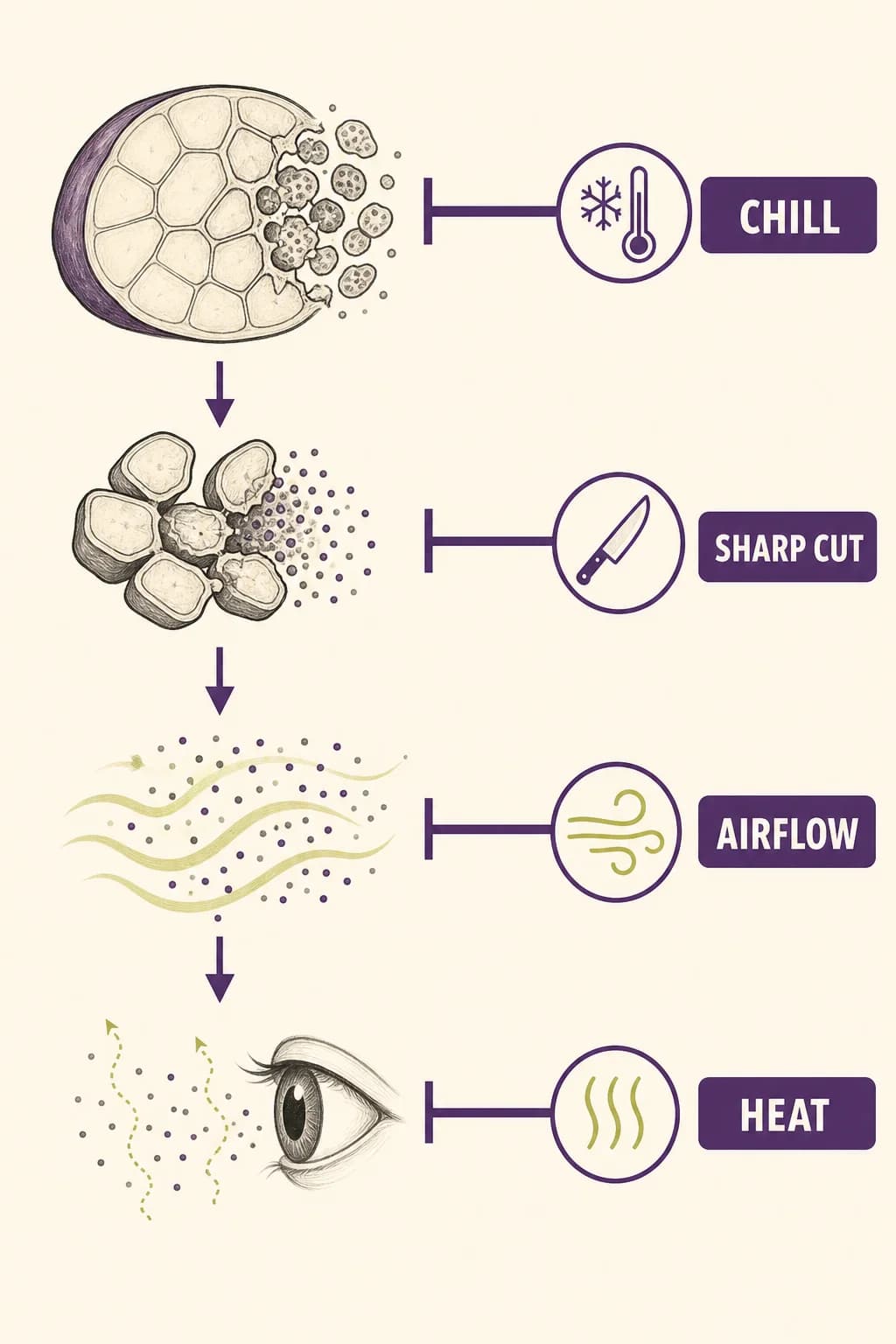
Every link in the chain suggests why conditions alter the experience. Less cellular damage means fewer enzyme and precursor compartments are mixed at once. Cooling slows many chemical reactions and reduces how quickly volatile material enters the air. Ventilation carries released molecules away before they accumulate near the face.
Heating changes the story more dramatically: enzymes lose their working shape, while reactive sulfur compounds transform into the different molecules that give cooked onions their sweeter, softer aroma. None of these effects makes an onion chemically inert; they change the rate, location, or products of its chemistry. The larger lesson is that a familiar nuisance is a timed system: rupture creates contact, enzymes rearrange sulfur compounds, a volatile product travels, and an eye launches a wash cycle.
Chilling, sharp cutting, airflow, and heating interrupt different stages of the chain from cell damage to eye exposure.
Key takeaways
An intact onion separates enzymes from sulfur-containing precursors
The main tear trigger is a volatile irritant produced after tissue damage
Tears are the eye’s protective wash response, not part of the onion reaction
Check your understanding
Why does an intact onion not constantly release its full tear-triggering chemistry?
Its cells keep the enzyme and sulfur-containing precursors in separate compartments until tissue damage mixes them.
What lets the onion’s tear-triggering compound reach an eye?
It's volatile, so it can leave the cut surface and travel through the air.
Why does heating change onion flavor and tearing?
Heat disables enzymes and transforms reactive sulfur compounds, changing both the reaction path and its products.
Sources
These references were used to check the important factual claims in this edition.