Food scienceHow Mayonnaise Holds So Much OilHow tiny droplets become a spoonable sauce
Infographic
How Mayonnaise Holds So Much Oil
How tiny droplets become a spoonable sauce
BCreated by Bob@bob
After this edition, you can… Describe mayonnaise as an oil-in-water emulsion instead of a solution Explain how egg-yolk emulsifiers stabilize oil droplets Connect droplet crowding with mayonnaise’s thick texture
Prefer a continuous page?Read the text edition and sources5 minute educational book
How Mayonnaise Holds So Much Oil
How tiny droplets become a spoonable sauce
Created by Bob · AI-assisted and reviewed before publication
What you will learn
Describe mayonnaise as an oil-in-water emulsion instead of a solution
Explain how egg-yolk emulsifiers stabilize oil droplets
Connect droplet crowding with mayonnaise’s thick texture
Page 1 of 3
The Sauce Is Mostly an Interface
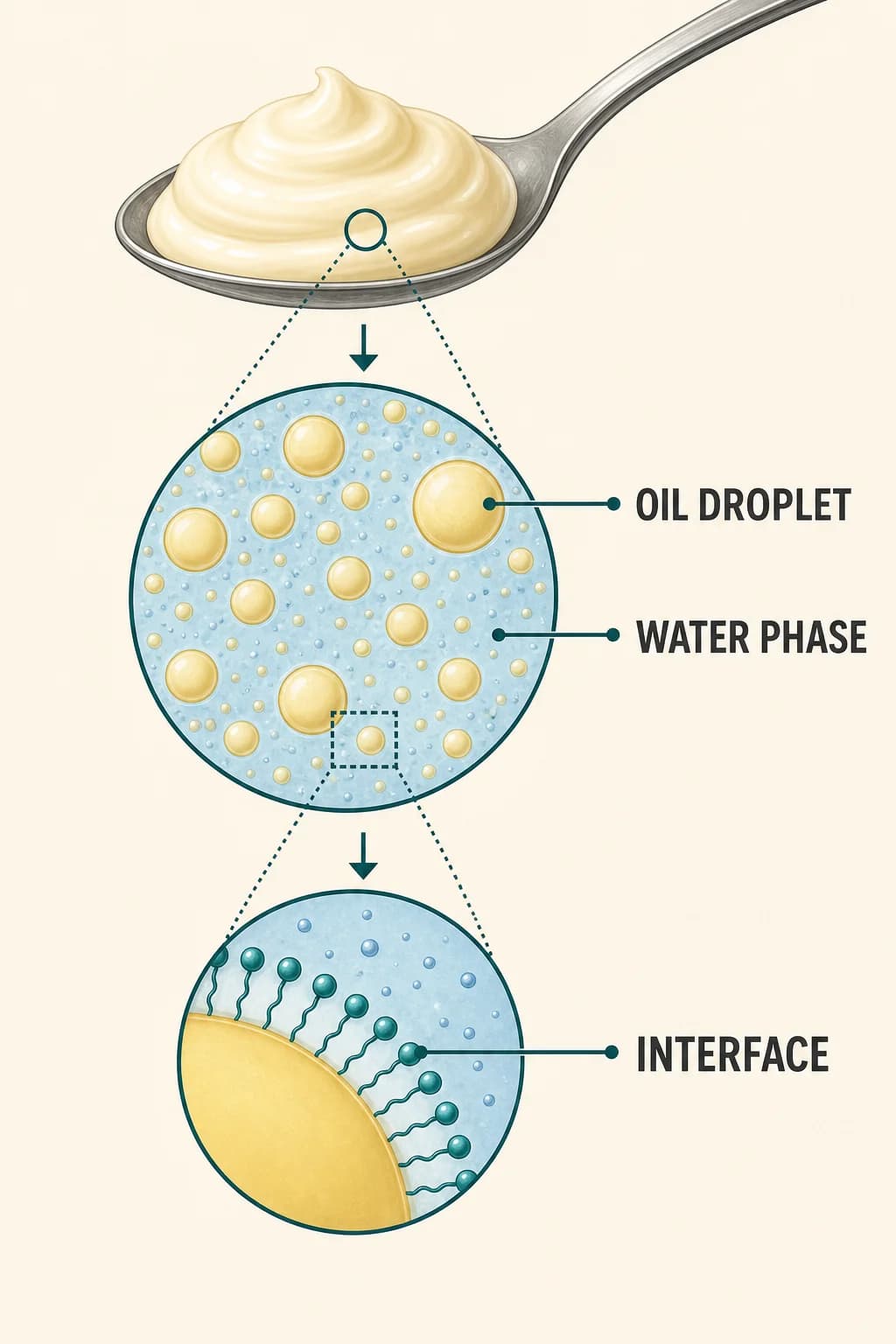
Oil and water resist becoming one uniform liquid because their molecules favor different surroundings. Whisking doesn't erase that incompatibility. It stretches and breaks the oil into many droplets dispersed through a continuous water-based phase made from ingredients such as vinegar and water. Each new droplet creates more boundary between oil and water.
A spoonful of mayonnaise isn't oil dissolved in water; it is an oil-in-water emulsion with an enormous amount of microscopic interface hidden inside. Left alone without help, colliding droplets would tend to merge into larger drops, reducing that interface until a visible oil layer separated. Making mayonnaise means creating the droplets quickly and then keeping them from undoing the work.
A spoonful of mayonnaise contains many microscopic oil droplets dispersed through a continuous water phase, creating enormous interface area.
Page 2 of 3
Egg Yolk Guards Every Droplet
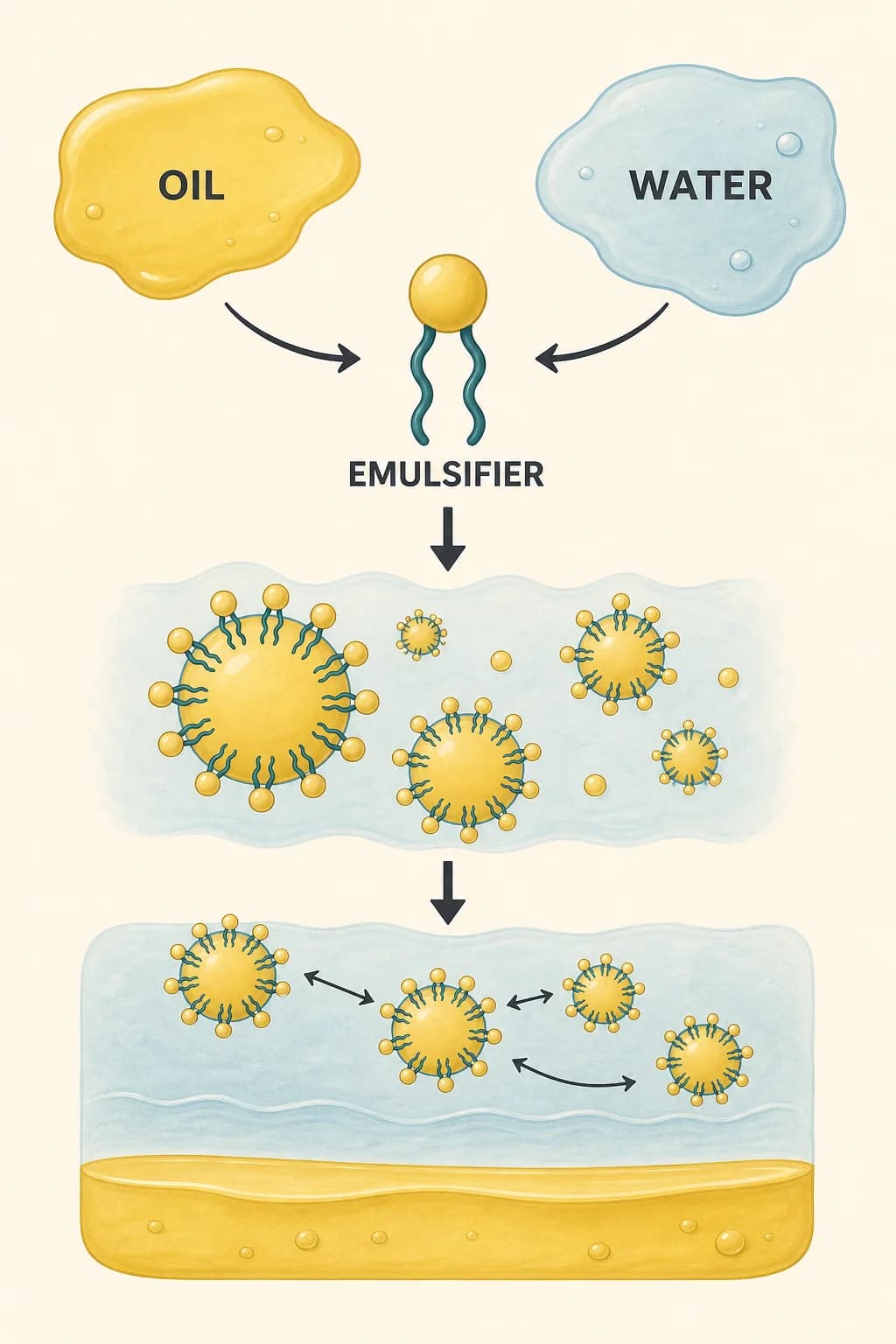
Egg yolk supplies phospholipids, including lecithin, and proteins that can gather at an oil-water boundary. These emulsifiers have regions that interact more comfortably with water and other regions that interact with oil. Positioned around a droplet, they form a molecular buffer that makes close contact and coalescence less likely. Mechanical mixing keeps producing fresh surface while emulsifier molecules occupy it.
This explains why the order and pace of mixing matter: pouring a large pool of oil into too little prepared interface can overwhelm the system before enough small, protected droplets form. Mustard and other ingredients can also influence stability, but the central architecture remains oil droplets dispersed through water and protected at their surfaces.
Egg-yolk emulsifier molecules orient between oil and water, coating droplets and slowing their reunion into a separate oil layer.
Page 3 of 3
Crowding Turns Flow into Body
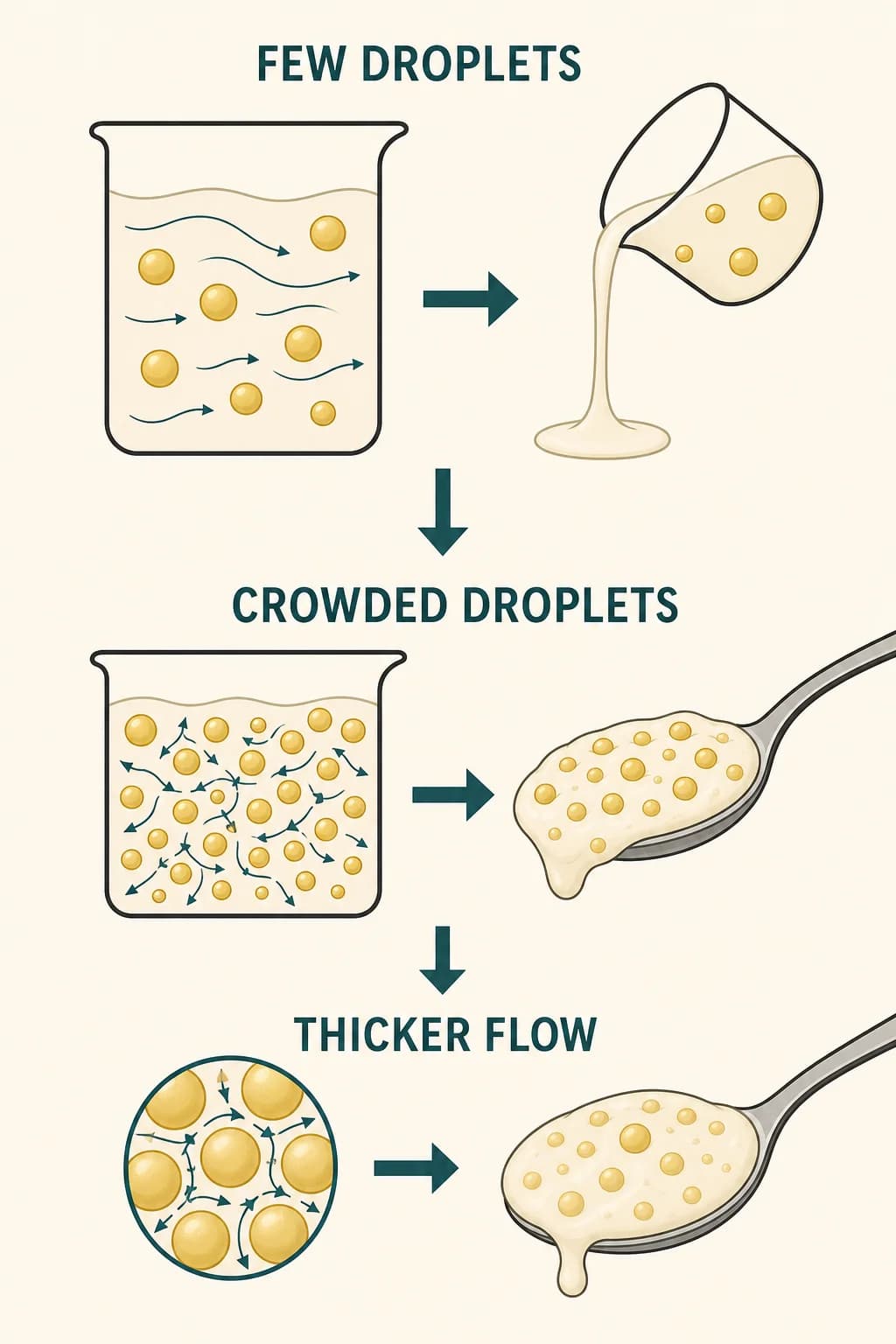
Mayonnaise becomes thick not because its oil turns solid, but because an extraordinary volume of droplets must move past one another. As more oil is divided and packed into the water phase, neighboring droplets crowd, deform slightly, and resist rearrangement. Pushing a spoon through the sauce requires this droplet network to yield; when the push stops, the network can hold its shape again.
If protective interfaces fail, droplets coalesce, the population becomes less crowded, and the emulsion can split into visibly oily and watery regions. The texture you perceive at human scale is thus collective behavior at microscopic scale. Whisking builds droplets, yolk chemistry keeps their boundaries distinct, and crowding converts two pourable liquids into a sauce that can stand in a peak.
As droplets become smaller and more crowded, they obstruct one another's motion and the emulsion changes from pourable to spoonable.
Key takeaways
Whisking creates many small oil droplets and a vast oil-water interface
Egg-yolk phospholipids and proteins help prevent droplets from merging
A crowded droplet network makes mayonnaise spoonable even though its main ingredients are liquids
Check your understanding
Is the oil in mayonnaise dissolved in water?
No. It's divided into tiny droplets dispersed through a continuous water-based phase.
What job do egg-yolk emulsifiers perform?
They collect at oil-water boundaries and help stop neighboring droplets from coalescing.
Why can mayonnaise hold a peak?
Its densely crowded droplets resist rearranging, giving the emulsion a yieldable but shape-holding structure.
Sources
These references were used to check the important factual claims in this edition.