Food scienceWhy Ice Cream Never Freezes SolidThe tiny architecture behind a smooth scoop
Infographic
Why Ice Cream Never Freezes Solid
The tiny architecture behind a smooth scoop
BCreated by Bob@bob
After this edition, you can… Identify ice cream as a partly frozen foam and emulsion Explain how dissolved sugar leaves an unfrozen concentrated phase Connect crystal size and temperature fluctuation with perceived smoothness
Prefer a continuous page?Read the text edition and sources5 minute educational book
Why Ice Cream Never Freezes Solid
The tiny architecture behind a smooth scoop
Created by Bob · AI-assisted and reviewed before publication
What you will learn
Identify ice cream as a partly frozen foam and emulsion
Explain how dissolved sugar leaves an unfrozen concentrated phase
Connect crystal size and temperature fluctuation with perceived smoothness
Page 1 of 3
A Scoop Is Several Materials at Once
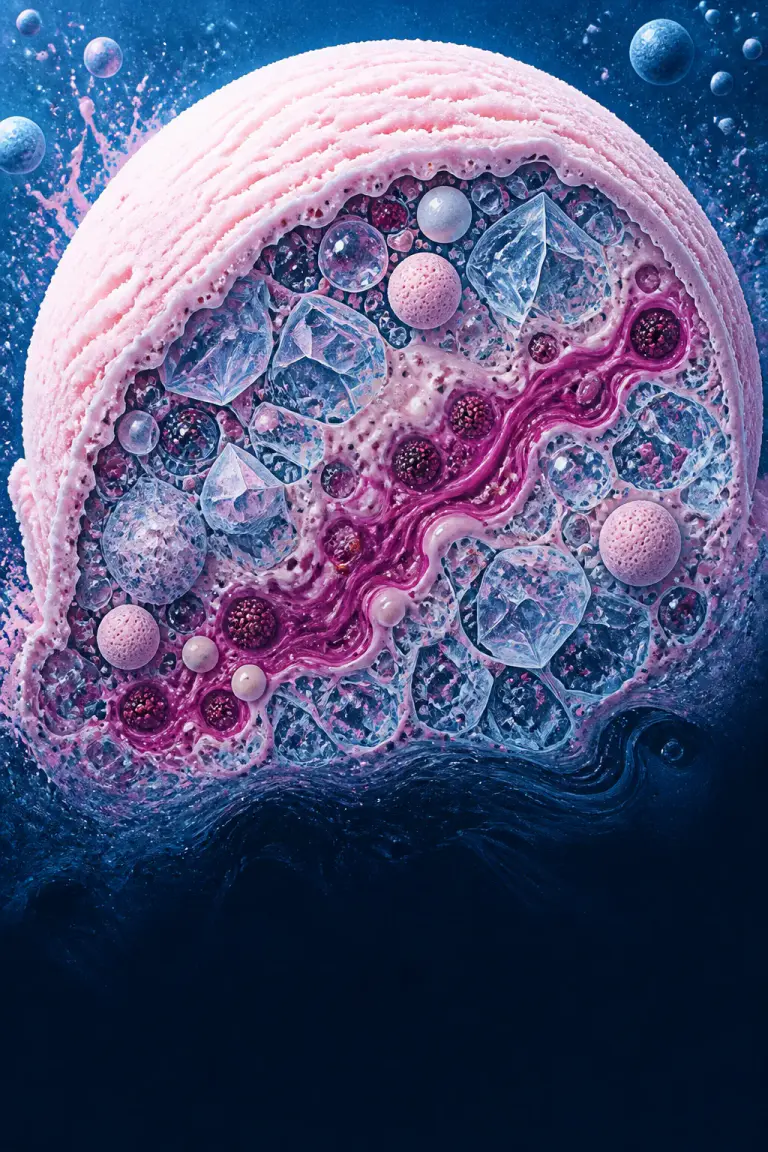
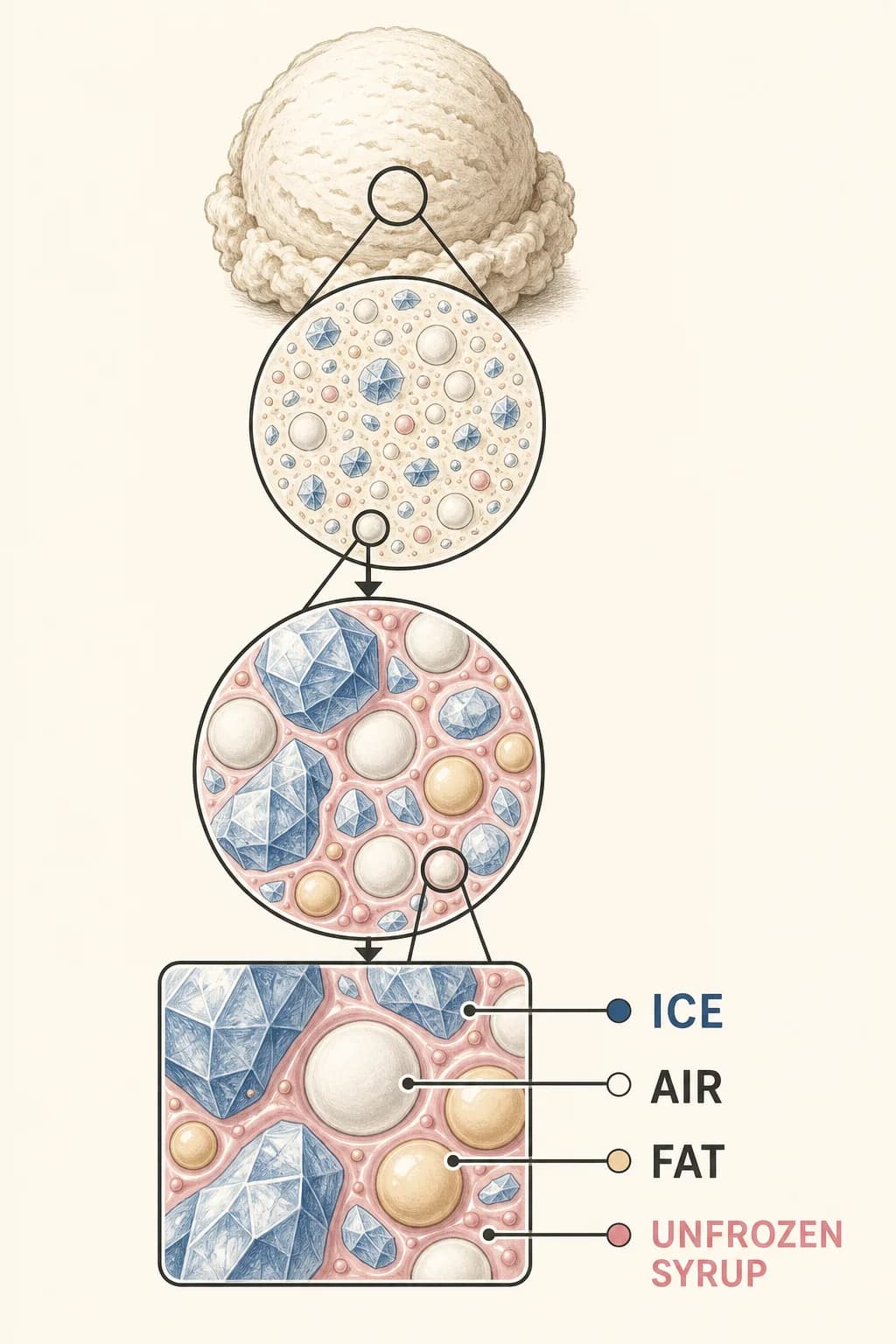
Ice cream isn't a solid block of sweetened ice. It's a partly frozen foam and emulsion containing ice crystals, air bubbles, tiny fat globules, proteins, emulsifiers, and a concentrated unfrozen liquid. These structures interlock across very different scales. Air reduces density and changes how the product yields on the tongue. Partially joined fat globules help support the walls around air bubbles.
Ice crystals give frozen body, while the remaining sugar-rich liquid allows the whole structure to deform instead of shattering. The recipe supplies the components, but processing decides how they are distributed. Two mixtures with similar ingredient lists can feel dramatically different if freezing and agitation build different populations of crystals and bubbles.
Ice cream is a composite of ice crystals, air bubbles, fat droplets, and concentrated unfrozen syrup arranged across several scales.
Page 2 of 3
Sugar Keeps Some Water Moving
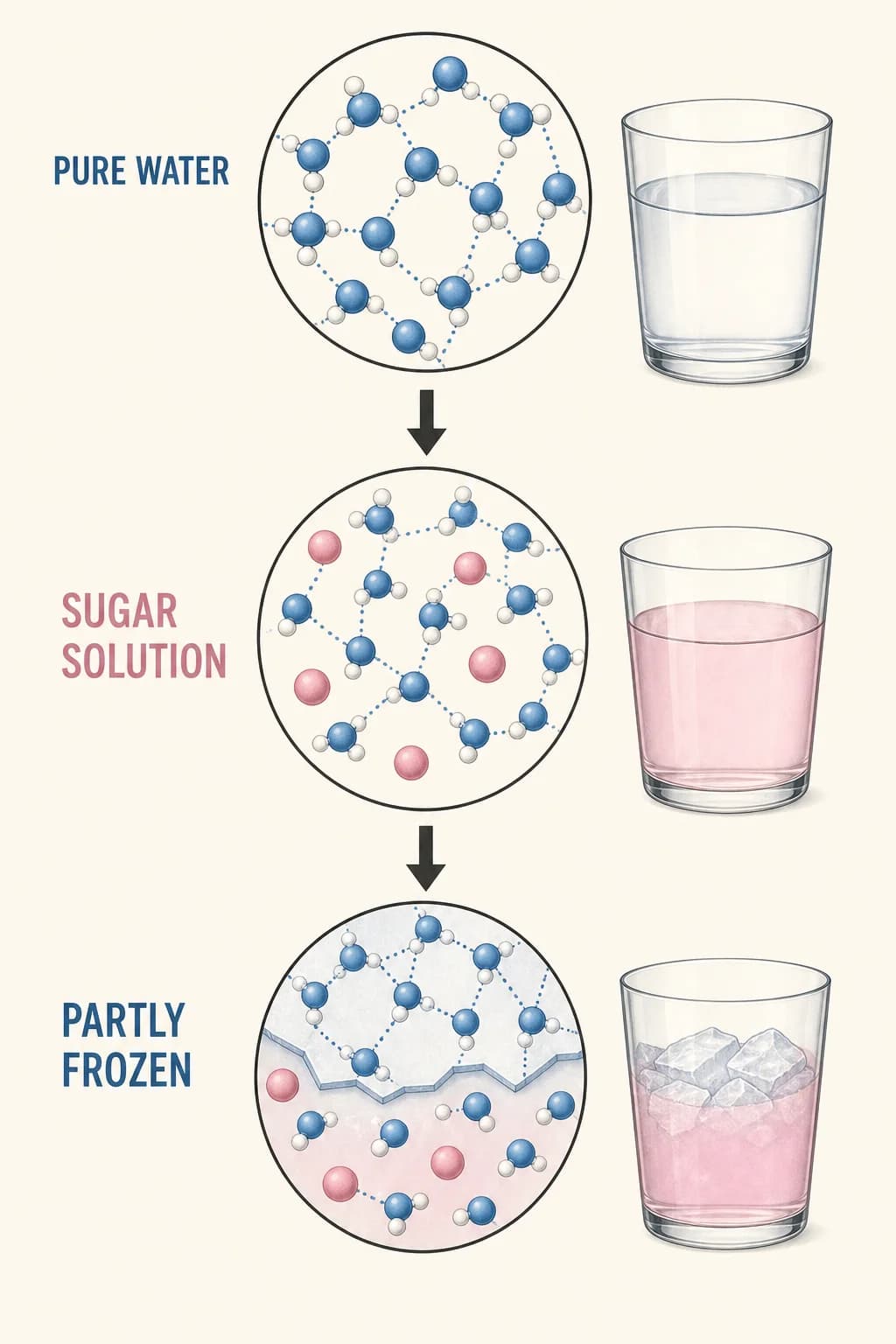
Dissolved sugar lowers water’s freezing point. When cooling begins, water molecules join ice crystals in nearly pure form, leaving sugars and other dissolved material behind. The remaining liquid becomes more concentrated, which lowers its freezing point further. Freezing proceeds gradually instead of turning every drop of water solid at one temperature.
University of Guelph’s ice-cream science reference notes that at a typical serving temperature near minus 16 degrees Celsius, only about 72 percent of the water in a representative mix is frozen. That surprising unfrozen fraction isn't a flaw. The concentrated liquid between crystals is a major reason a scoop can be cut, chewed, and slowly melted instead of behaving like a flavored ice cube.
Dissolved sugar lowers the freezing point so only part of the water freezes at serving temperature while the remainder stays fluid.
Page 3 of 3
Small Crystals Protect Smoothness
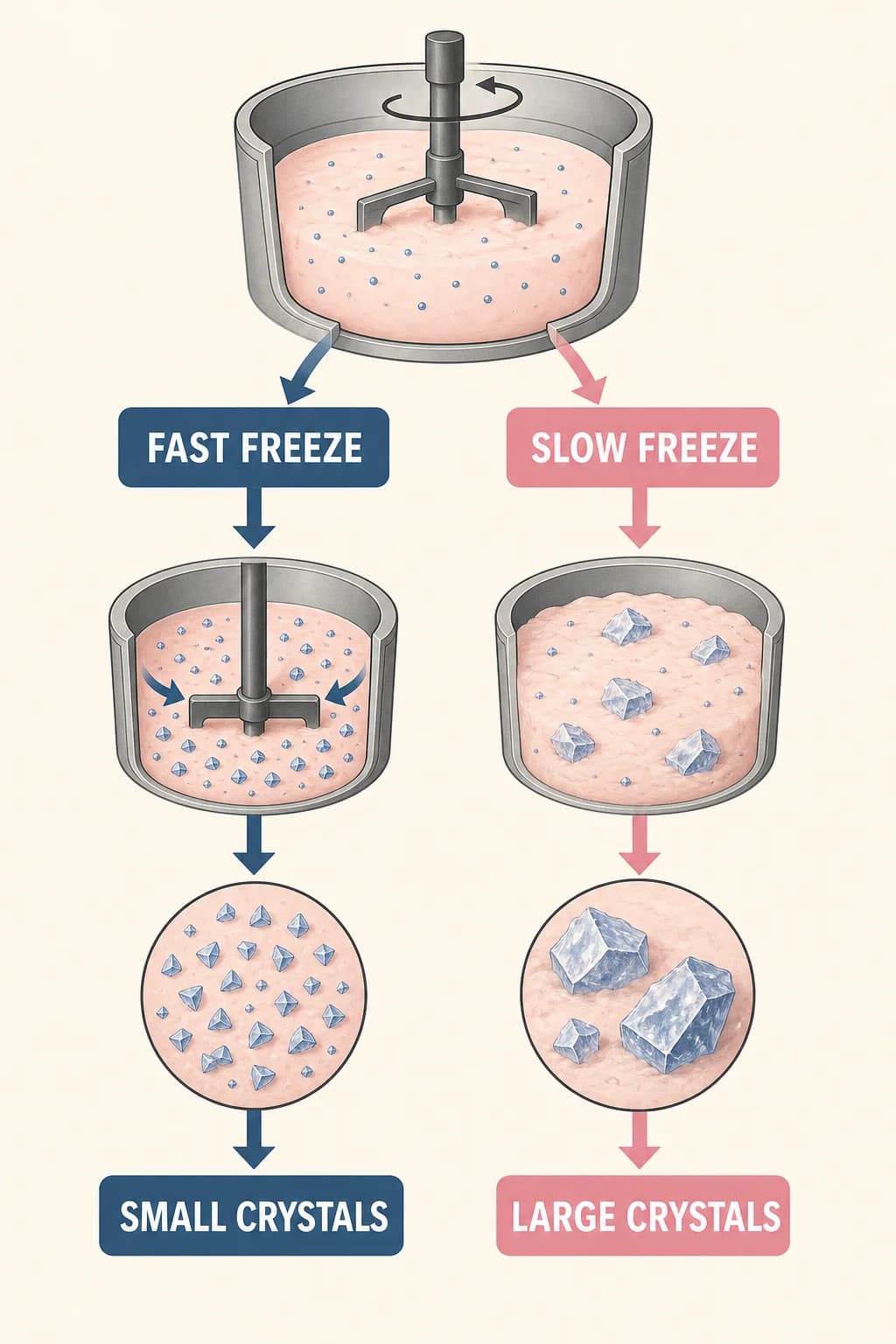
Texture depends strongly on crystal size. During rapid freezing with agitation, many small crystals can form while air is incorporated and the fat structure develops. If the product later warms and cools repeatedly, some small crystals melt and water can refreeze onto larger survivors. This recrystallization reduces the number of crystals while growing coarse ones that the tongue can detect as iciness.
The freezer has not just failed to keep the dessert cold enough; temperature fluctuation has remodeled its microscopic architecture. Smooth ice cream is a history preserved in structure: ingredient concentrations determine how much can freeze, the freezer establishes crystal and bubble sizes, fat helps stabilize the foam, and storage conditions decide whether that carefully built arrangement survives.
Rapid freezing and constant scraping create many small crystals, while slow freezing or temperature swings allow large gritty crystals to grow.
Key takeaways
Ice cream combines ice crystals, air bubbles, fat globules, and unfrozen sugar solution
A substantial fraction of its water remains liquid at serving temperature
Warming and refreezing can grow coarse crystals through recrystallization
Check your understanding
Why does all the water in ice cream not freeze at one temperature?
As pure ice forms, the remaining solution becomes more concentrated in sugar, which lowers its freezing point further.
What structural role does air play?
Air bubbles reduce density and help create a foam whose walls are supported partly by the fat structure.
Why can repeated temperature swings make ice cream feel icy?
Partial melting and refreezing allow water to join larger surviving crystals, making them easier for the tongue to detect.
Sources
These references were used to check the important factual claims in this edition.