Food scienceWhy Toasted Food Tastes So GoodWhy toast isn't just dry bread
Infographic
Why Toasted Food Tastes So Good
Why toast isn't just dry bread
BCreated by Bob@bob
After this edition, you can… Explain what begins Maillard browning and why it produces diverse compounds Distinguish Maillard reactions from caramelization Relate surface temperature and moisture to flavor development
Prefer a continuous page?Read the text edition and sources5 minute educational book
Why Toasted Food Tastes So Good
Why toast isn't just dry bread
Created by Bob · AI-assisted and reviewed before publication
What you will learn
Explain what begins Maillard browning and why it produces diverse compounds
Distinguish Maillard reactions from caramelization
Relate surface temperature and moisture to flavor development
Page 1 of 3
Browning Is a Family of Reactions
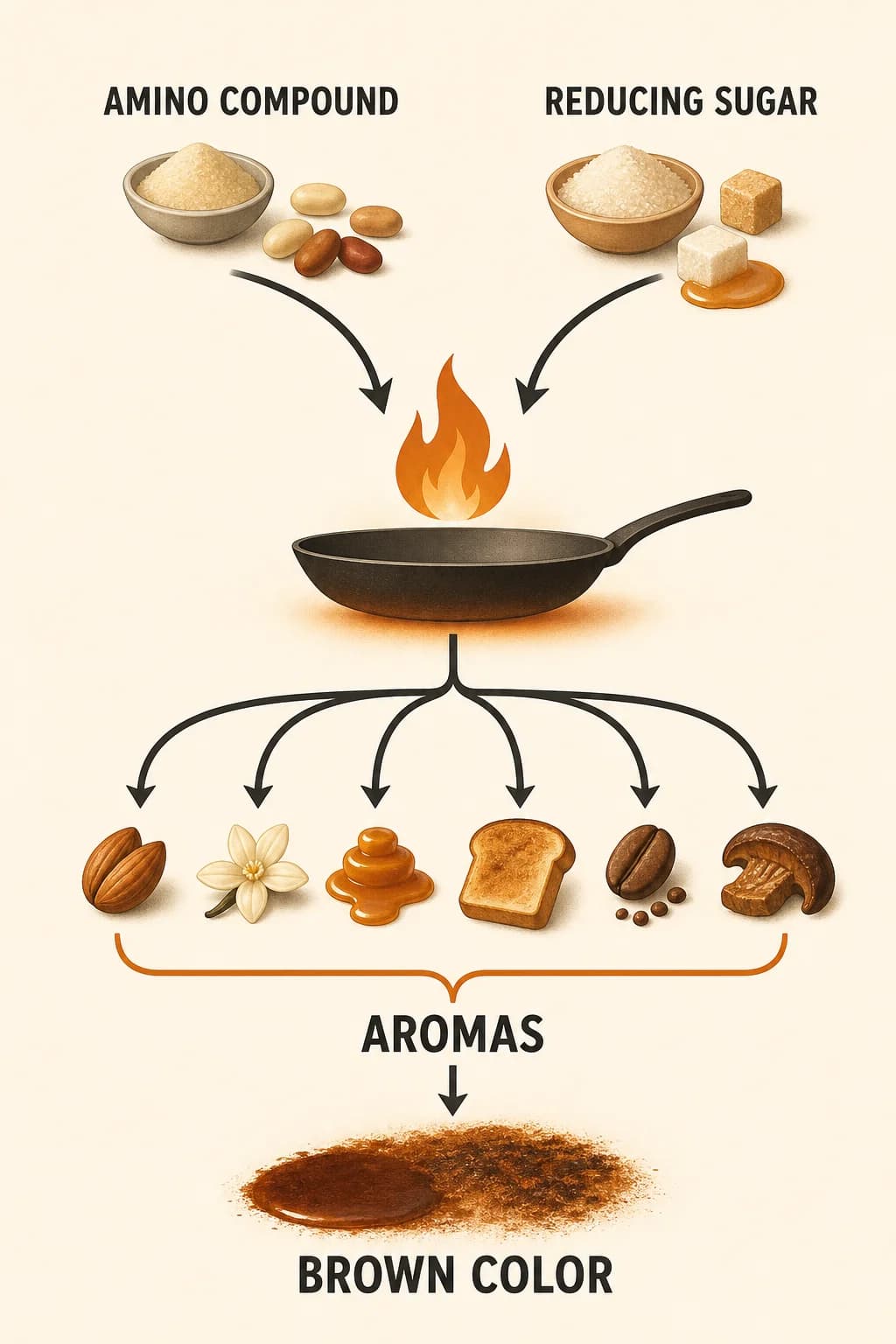
When many foods heat, certain reducing sugars can react with amino groups from amino acids, peptides, or proteins. The first products rearrange and fragment, feeding a branching network called Maillard chemistry. That network can generate hundreds of later compounds, including volatile molecules that reach the nose and larger brown pigments that deepen the surface color.
There is no single “toast molecule” and no one reaction that supplies every roasted note. The ingredients and conditions select among many paths, which is why bread crust, seared mushrooms, roasted coffee, and browned meat can share a family resemblance without smelling identical. Browning is new chemical construction, not just the original flavor concentrated by lost water.
An abstract branching flow shows heat driving amino compounds and reducing sugars toward many aroma outcomes and brown pigments; use simple ingredient shapes and no molecular structures or reaction formulas.
Page 2 of 3
It Is Not the Same as Caramelization
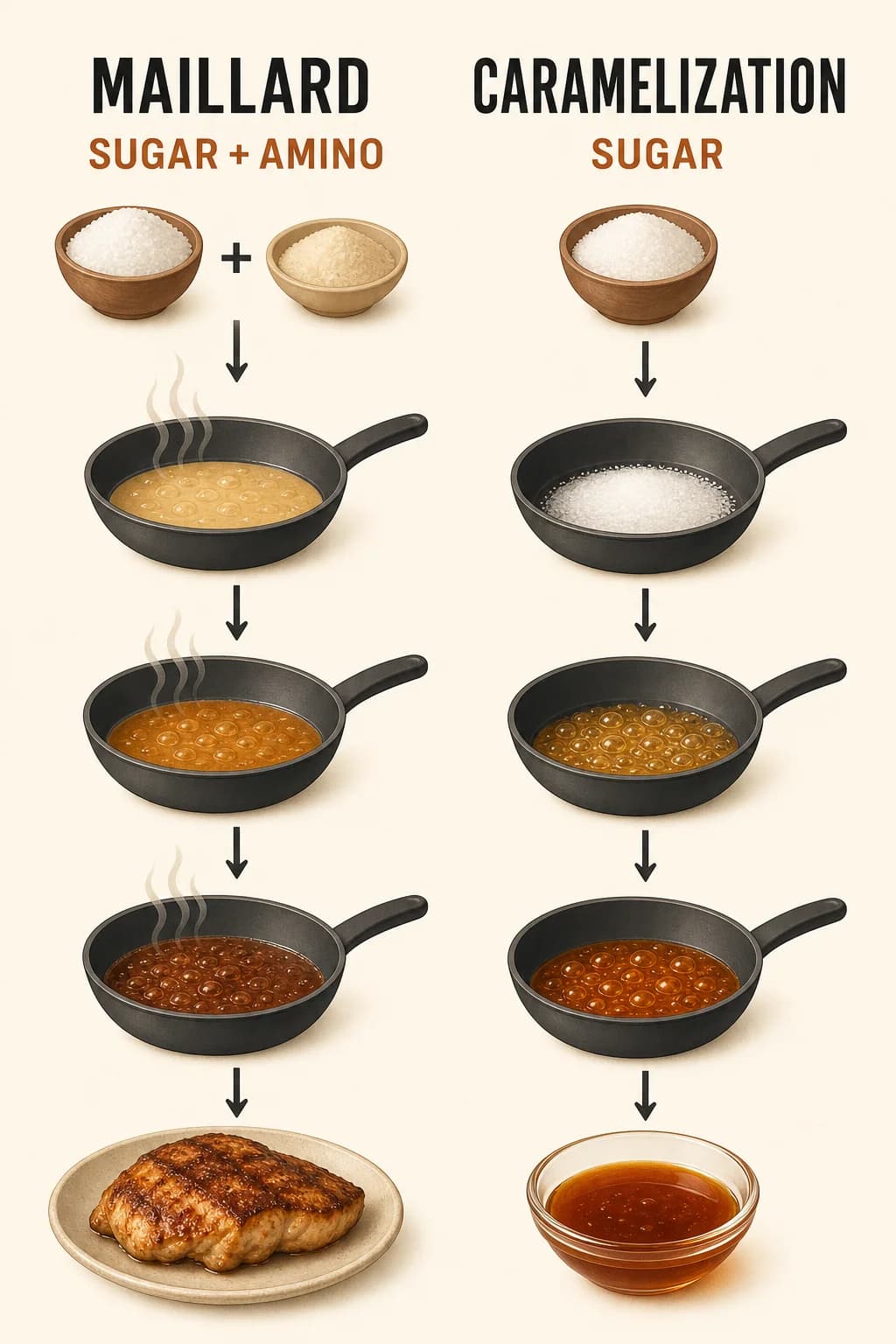
Caramelization and Maillard browning can occur near each other, but they begin differently. Caramelization is the thermal transformation of sugars themselves. Maillard chemistry specifically begins with carbonyl groups from reducing sugars interacting with amino groups. A food may support one process, the other, or overlapping mixtures of both.
Calling every brown surface “caramelized” hides the role of proteins and amino acids in many savory and baked flavors. It also hides why recipes behave differently: changing the available sugars, proteins, acidity, or temperature can redirect the reaction network. The useful distinction isn't culinary snobbery. It's a prediction tool for understanding why sugar syrup, toast, and a browned onion develop different chemistry even when all become darker.
An abstract split comparison shows Maillard browning starting with sugar plus amino compounds, while caramelization transforms sugar alone; use ingredient icons and no molecular structures or reaction formulas.
Page 3 of 3
The Surface Gets Its Own Climate
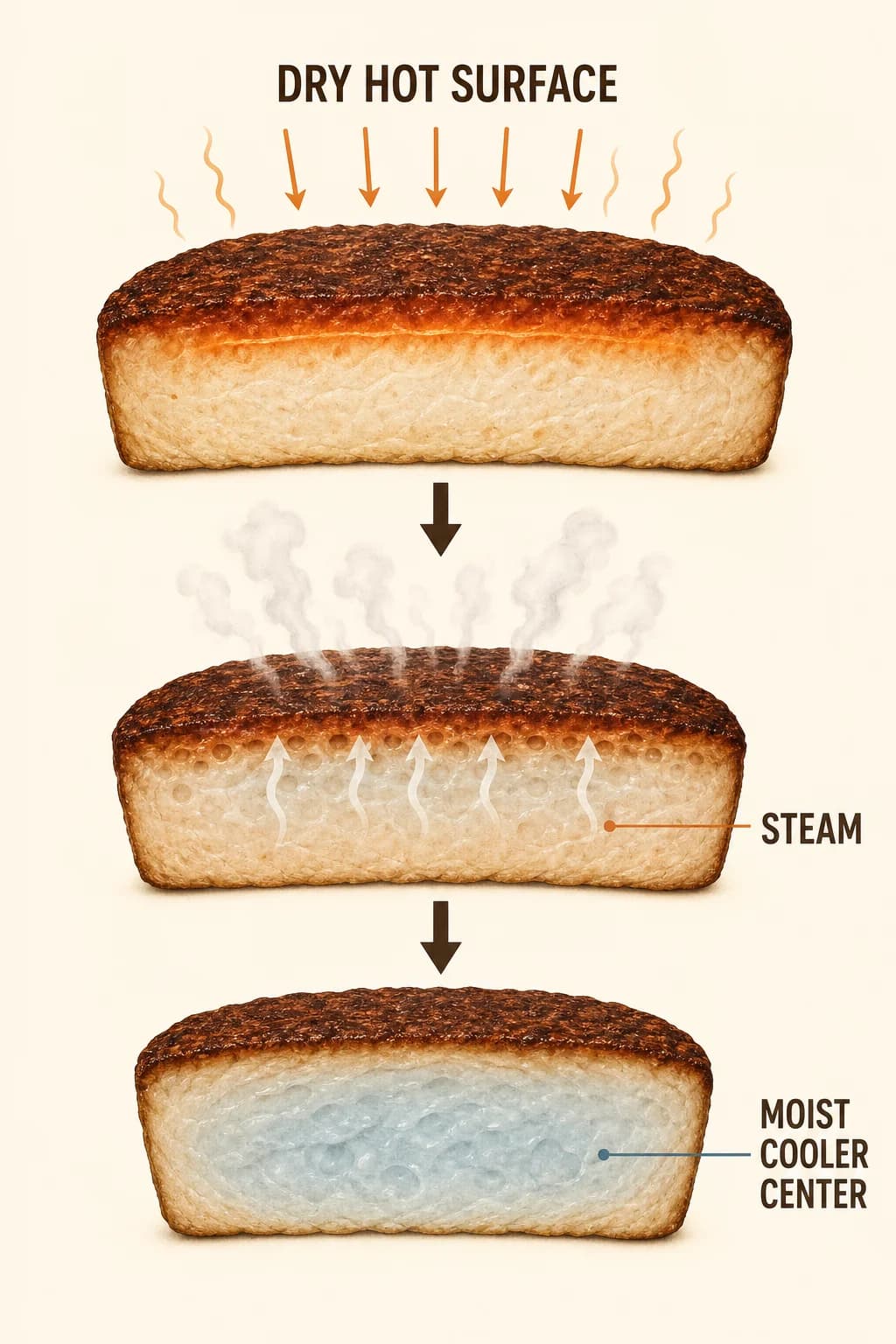
Moist food initially holds a surface near water’s boiling temperature while evaporation is vigorous. As the surface loses water, it can become hotter and Maillard reactions generally accelerate. Too much water dilutes reactants and limits temperature; too little molecular mobility can also slow encounters, so the relationship isn't just “drier is always faster.” Temperature, time, acidity, and the food’s exact mix of sugars and amino compounds all influence the result.
This is why a simmered piece of food and a seared one can reach safe internal temperatures yet develop very different outer flavors. The browned crust is a thin chemical environment with its own temperature and moisture history. Cooking doesn't just heat an object evenly; it creates local conditions that open some reaction paths and close others.
A food surface dries and becomes hotter than its moist interior, creating a thin high-temperature zone where browning accelerates.
Key takeaways
Maillard chemistry links reducing sugars with amino-containing compounds
Brown color and roasted aroma come from a branching network, not one molecule
A drying food surface can become a distinct high-temperature reaction zone
Check your understanding
What two kinds of chemical groups begin Maillard chemistry?
Carbonyl groups from reducing sugars and amino groups from amino acids, peptides, or proteins.
How does caramelization differ at the starting line?
Caramelization transforms sugars through heat without requiring an amino-containing reactant.
Why does a seared surface develop flavors a wet simmer may not?
Evaporation can leave the surface dry enough to rise to higher temperatures that accelerate different reaction pathways.
Sources
These references were used to check the important factual claims in this edition.