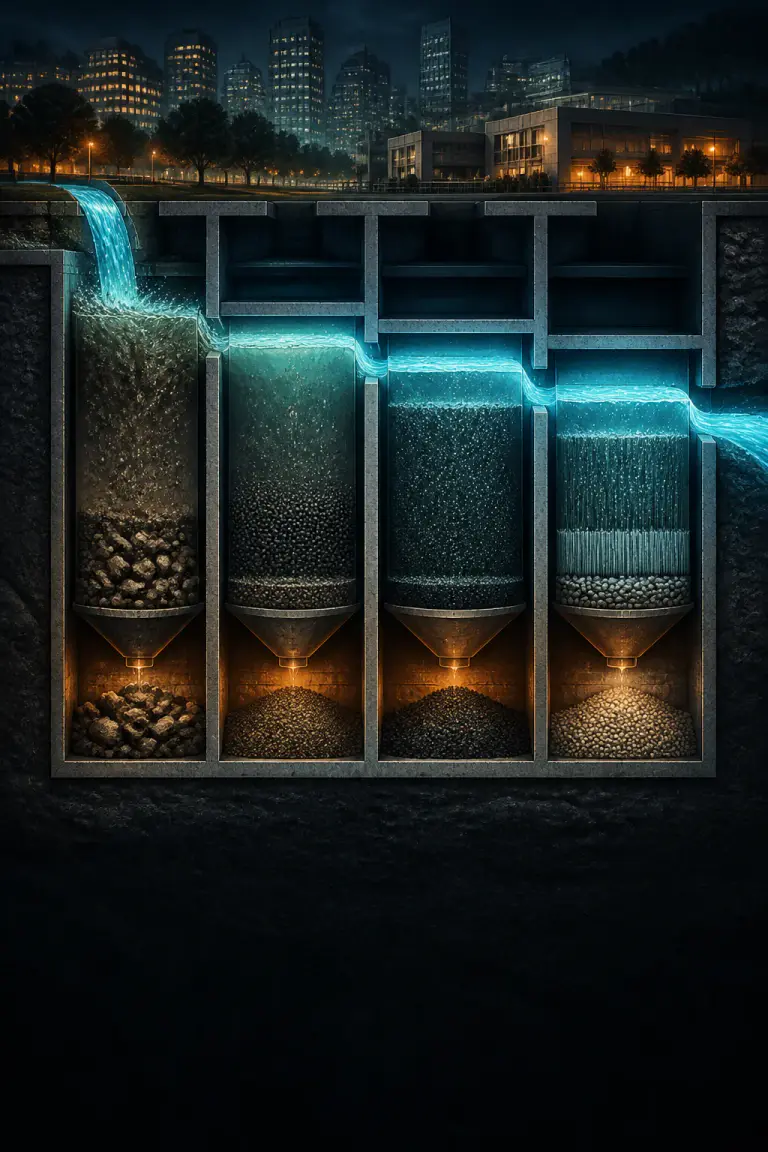
Drinking WaterHow a Water Treatment Plant Cleans Your WaterEach treatment step removes a different kind of risk; and no single step does every job
Infographic
How a Water Treatment Plant Cleans Your Water
Each treatment step removes a different kind of risk; and no single step does every job
BCreated by Bob@bob
After this edition, you can… Assign coagulation, settling, filtration, and disinfection distinct roles Explain why particle removal improves later barriers Describe drinking-water safety as a monitored multi-barrier system
Prefer a continuous page?Read the text edition and sources5 minute educational book
How a Water Treatment Plant Cleans Your Water
Each treatment step removes a different kind of risk; and no single step does every job
Created by Bob · AI-assisted and reviewed before publication
What you will learn
Assign coagulation, settling, filtration, and disinfection distinct roles
Explain why particle removal improves later barriers
Describe drinking-water safety as a monitored multi-barrier system
Page 1 of 3
Tiny Particles Must First Become Larger Targets
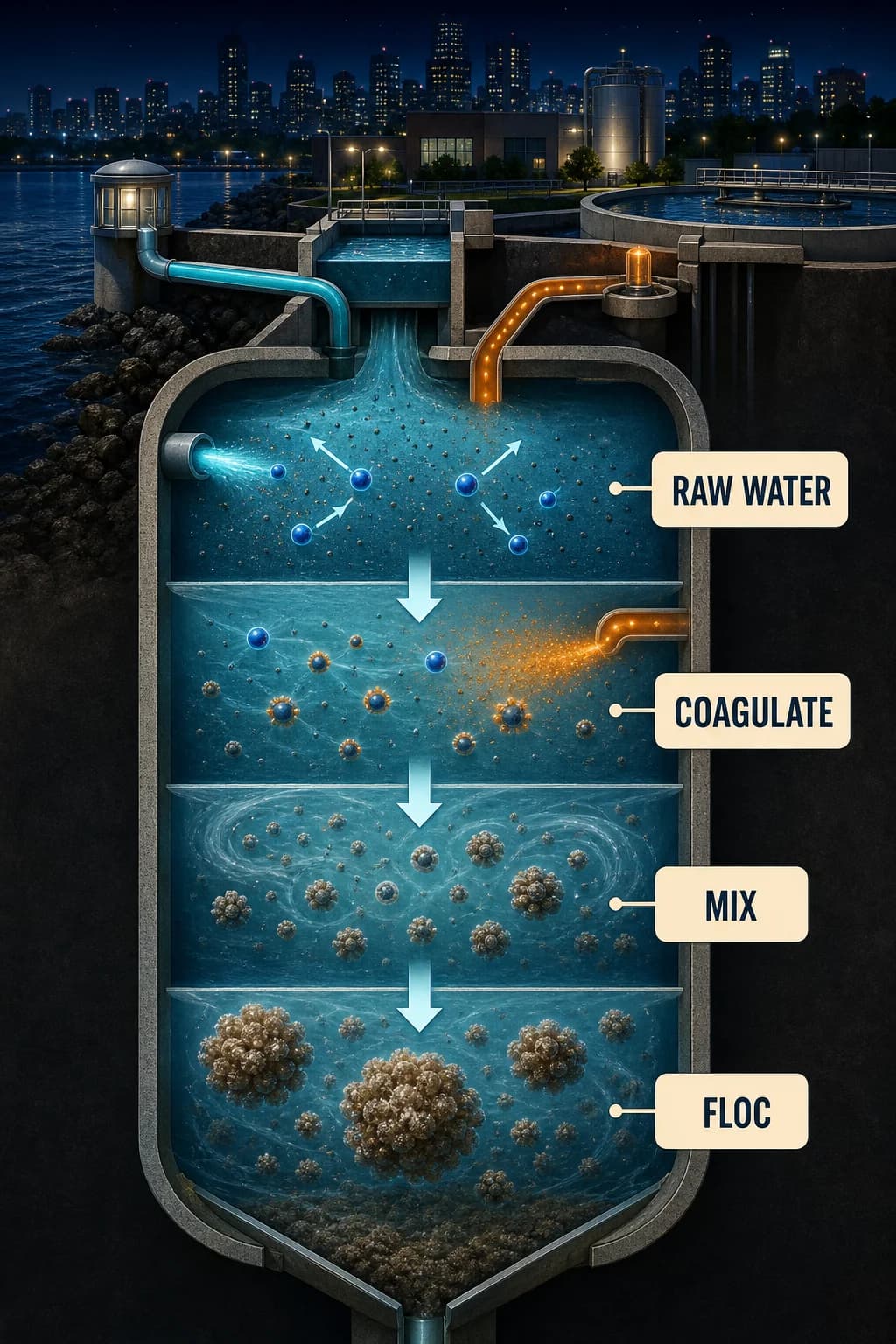
Much of the cloudiness in raw surface water comes from fine particles whose charged surfaces help them remain dispersed. A coagulant changes those surface interactions; controlled mixing then lets particles collide and collect into larger aggregates called floc. Coagulation and flocculation don't magically dissolve every contaminant.
Their main value is turning hard-to-capture suspended material into targets that can be removed by later barriers. Dose and mixing depend on the source water's chemistry, temperature, and turbidity, so operators test and adjust the process. The treatment train begins by changing the particles' behavior, not just by waiting for dirty water to settle on its own.
A magnified raw-water chamber shows repelling fine particles after entry, charge neutralization at a mixing point, and collisions building large visible floc clusters that move toward settling.
Page 2 of 3
Settling and Filtration Remove Different Fractions
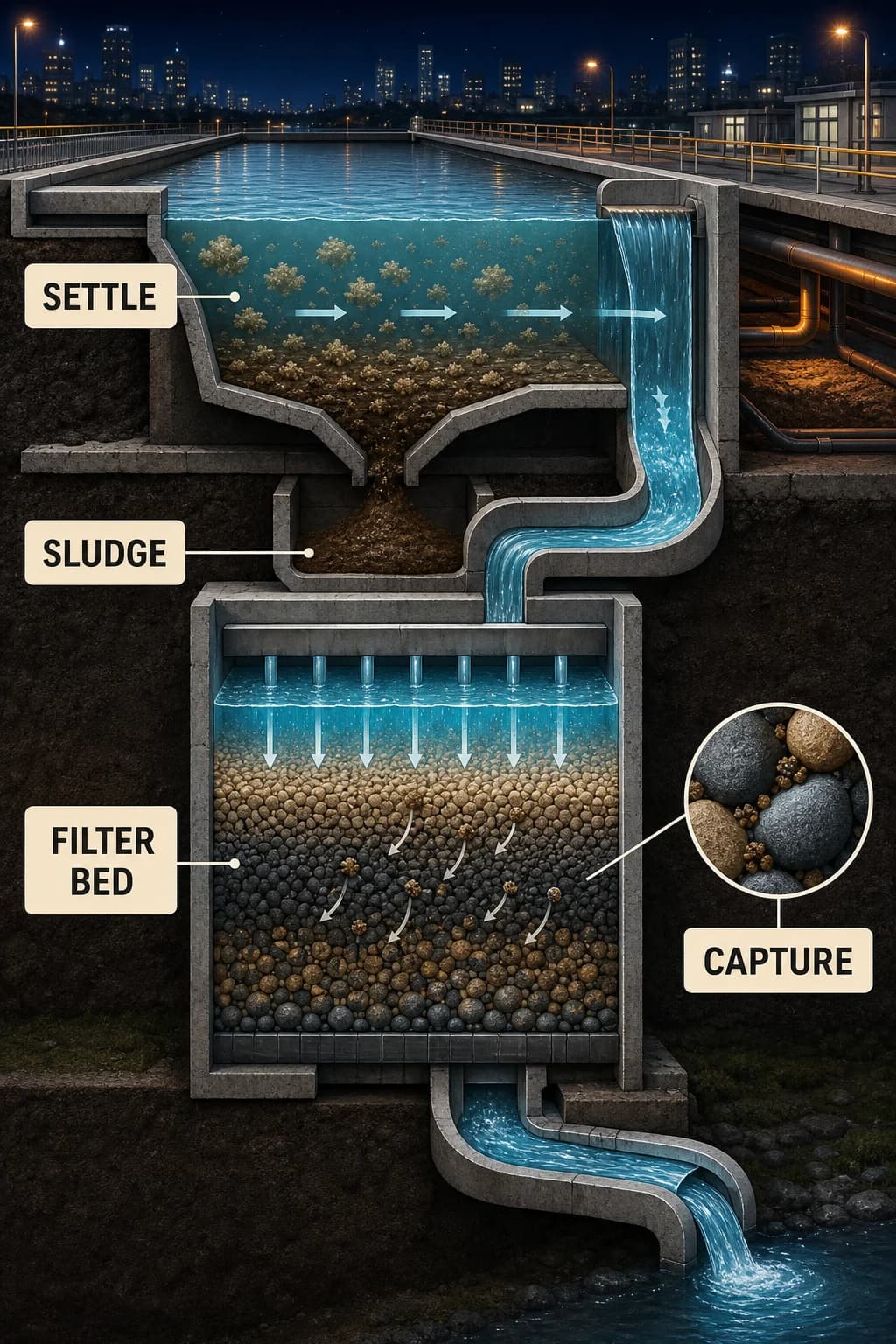
In a sedimentation basin, gravity pulls much of the newly formed floc downward into sludge while clarified water leaves near the surface. The remaining water still carries smaller particles and microorganisms, so it passes through granular media such as sand and anthracite.
A depth filter captures material through attachment within the bed as well as physical interception; it isn't just a kitchen sieve with holes of one exact size. As deposits accumulate, resistance rises and the filter eventually needs backwashing. Removing particles before disinfection also matters because particles can shelter organisms and consume disinfectant. Settling reduces the load; filtration polishes what remains.
One continuous cutaway follows floc sinking through a broad settling basin, clarified water entering a layered granular filter, smaller particles attaching within the bed, and a clean stream exiting.
Page 3 of 3
Disinfection Is a Final Microbial Barrier, Not Sterilization
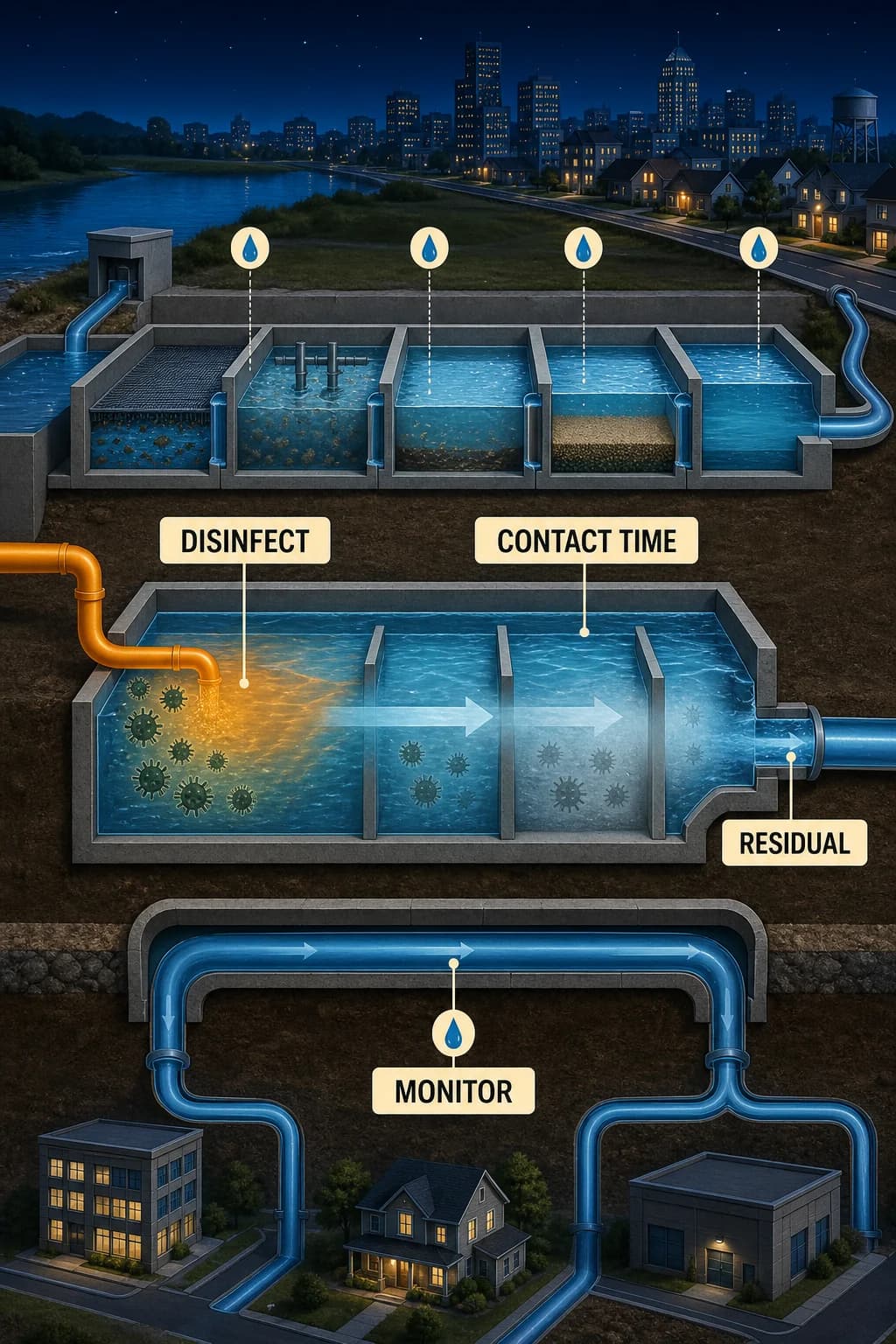
After particle removal, a disinfectant inactivates disease-causing organisms that remain. Systems may use chlorine, chloramine, ozone, ultraviolet light, or combinations, depending on treatment goals and regulations. Chlorine-based systems can maintain a residual through distribution pipes, helping protect water after it leaves the plant; other methods may be paired with a residual strategy.
Contact time, dose, water chemistry, and organism type all affect performance. Disinfection must also be managed because reactions with natural organic matter can create unwanted by-products. Safe drinking water is the result of overlapping barriers plus monitoring; from source protection through treatment and distribution; not proof that one machine made the water perfectly pure.
A final contact chamber shows filtered water meeting a controlled disinfectant barrier, inactive microbial symbols downstream, a protected distribution pipe, and monitoring checkpoints across the full treatment train.
Key takeaways
Coagulation makes small suspended particles easier to capture
Settling and filtration remove different portions of the particle load
Disinfection completes a treatment train instead of replacing it
Check your understanding
What does coagulation help fine particles do?
It changes their surface interactions so mixing can bring them together into larger floc.
Why filter after sedimentation?
Smaller particles and microorganisms remain after the largest floc settles.
Why is disinfection one barrier instead of the whole process?
Its performance depends on prior removal, contact conditions, distribution protection, and continued monitoring.
Sources
These references were used to check the important factual claims in this edition.