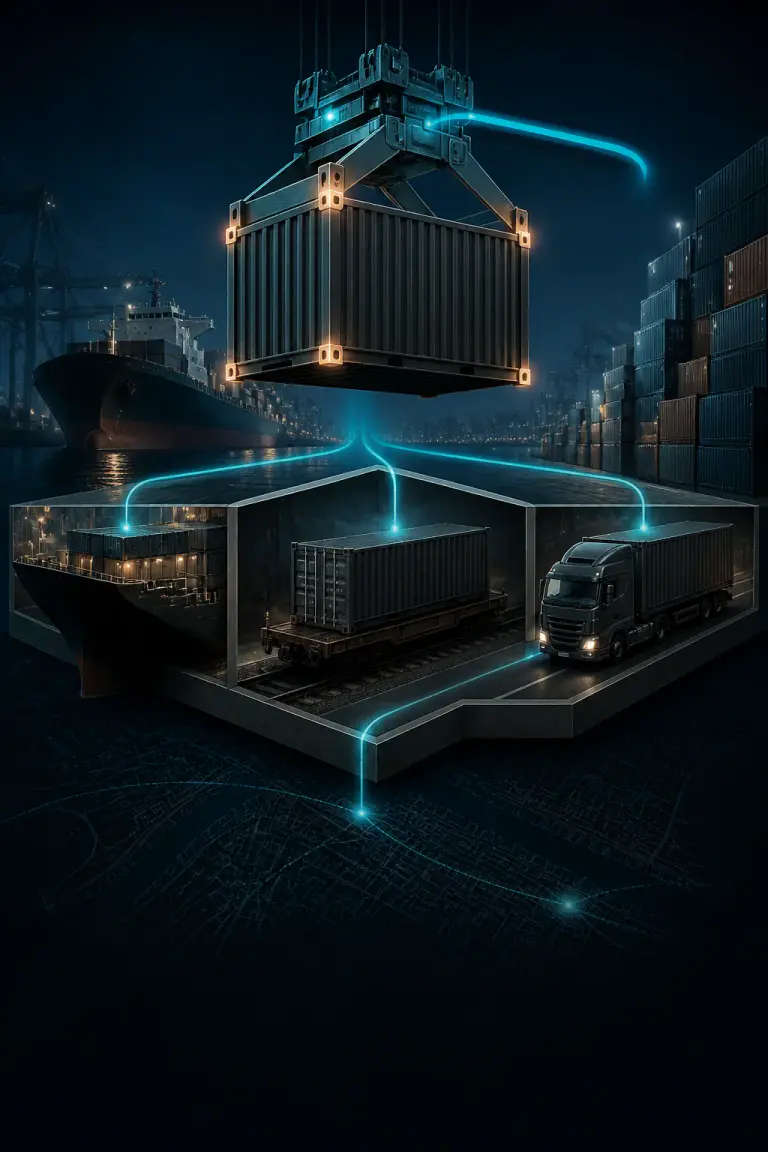
ContainersHow One Standard Box Changed Global ShippingThe container mattered because ships, cranes, trains, trucks, corners, and records agreed around it
Infographic
How One Standard Box Changed Global Shipping
The container mattered because ships, cranes, trains, trucks, corners, and records agreed around it
BCreated by Bob@bob
After this edition, you can… Explain how containerization reduces repeated cargo handling Identify dimensions and corner fittings as interoperability interfaces Describe a port as coordinated information and material flows
Prefer a continuous page?Read the text edition and sources5 minute educational book
How One Standard Box Changed Global Shipping
The container mattered because ships, cranes, trains, trucks, corners, and records agreed around it
Created by Bob · AI-assisted and reviewed before publication
What you will learn
Explain how containerization reduces repeated cargo handling
Identify dimensions and corner fittings as interoperability interfaces
Describe a port as coordinated information and material flows
Page 1 of 3
The Cargo Stays Inside While the Mode Changes
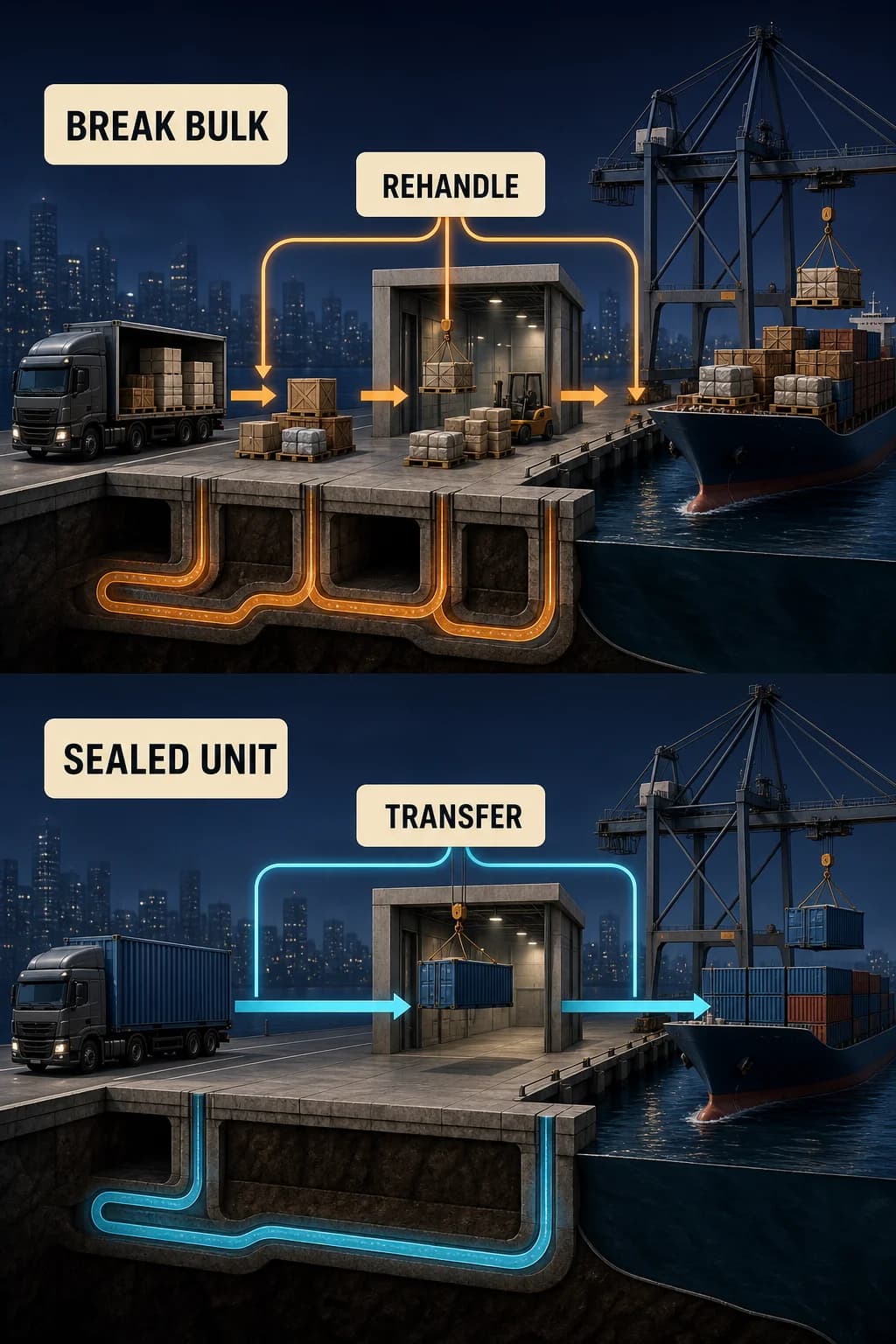
Break-bulk cargo is handled as bags, crates, drums, or irregular pieces when it moves between warehouse, truck, dock, and ship. A freight container groups many items into one durable handling unit. Cargo can be packed and sealed away from the port, then the entire box transfers between road, rail, terminal, and vessel without unloading every item at each boundary.
This reduces repeated handling and exposure, but it doesn't eliminate work; stuffing, securing, weighing, inspection, customs, and final unpacking still occur. The key change is that most mode transfers manipulate one standardized unit instead of rebuilding the load piece by piece.
A split comparison shows many loose cargo pieces repeatedly unloaded across truck, dock, and ship, while one sealed container follows a continuous path between the same modes.
Page 2 of 3
Compatibility Lives at the Edges
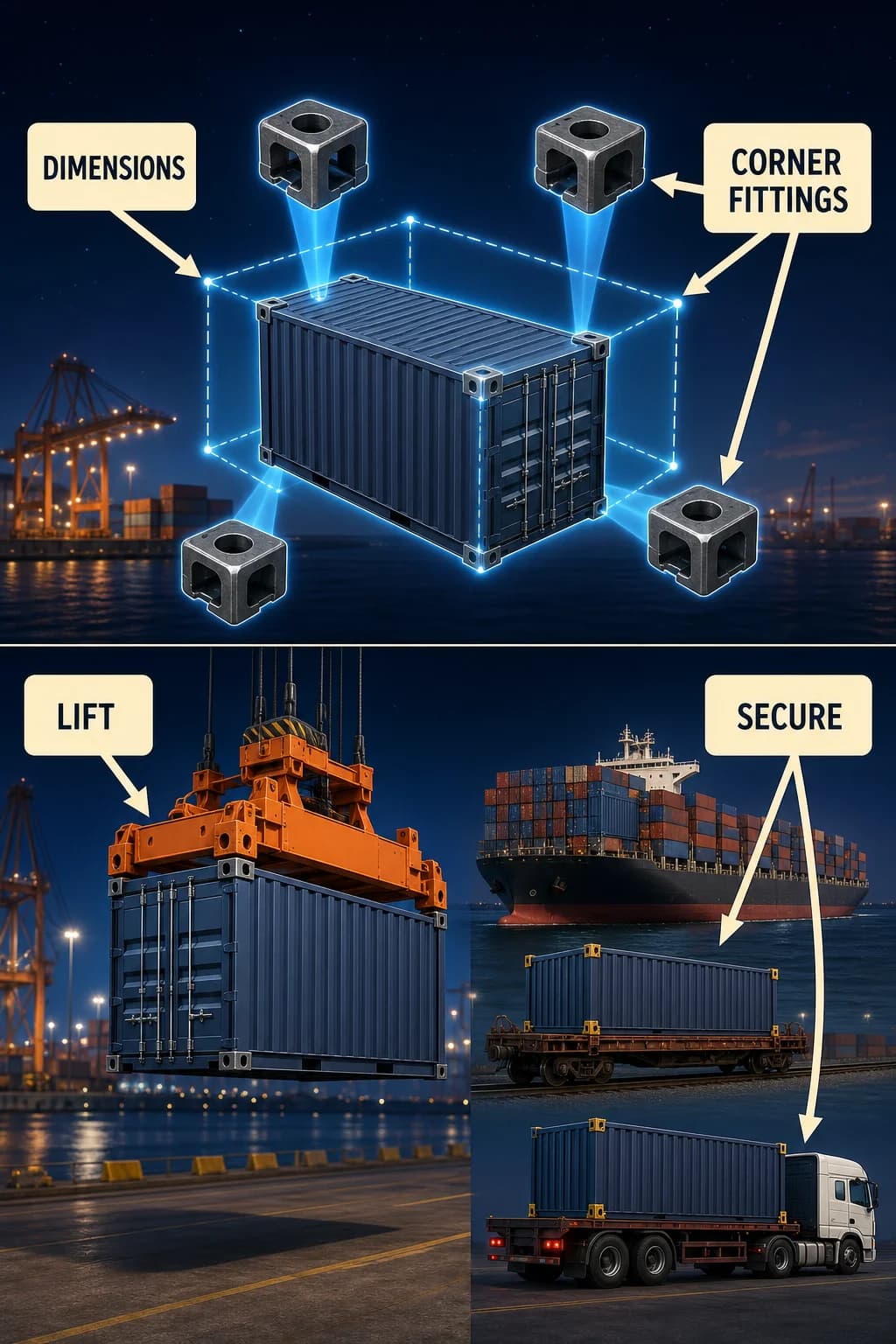
Standardization covers more than an approximate rectangular shape. ISO container families specify external dimensions and ratings, while standardized corner fittings provide defined interfaces for lifting, securing, stacking, and connecting. A crane spreader can engage the upper corners; twist locks and ship fittings restrain the lower corners; chassis, railcars, and stacking plans are designed around compatible geometry.
The usable system emerges from tolerances and strength requirements shared by equipment made in different places. If the corners, lifting gear, vehicle clearances, or load limits disagree, a box that looks correct can't move safely through the network.
One container is exploded into its dimensional envelope and four reinforced corner fittings, then the same interfaces connect in sequence to crane spreader, ship stack, railcar, and truck chassis.
Page 3 of 3
The Port Is a Scheduling Machine
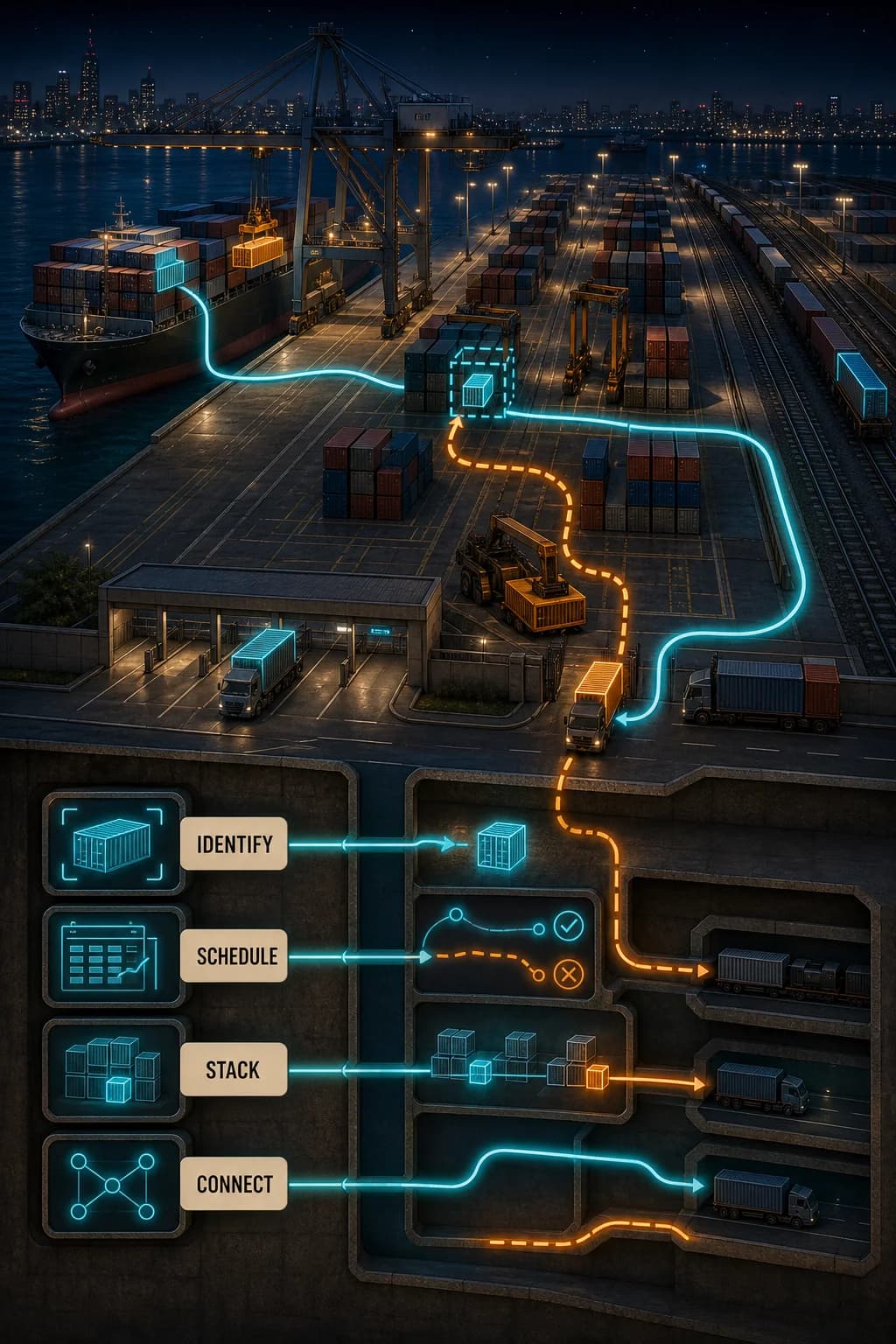
A container terminal must know which box is arriving, its destination, weight, status, allowed stack position, vessel bay, onward vehicle, and time window. Cranes, yard vehicles, storage blocks, gates, ships, trains, and trucks share constrained space. Stacking a box in the wrong place can force extra reshuffles before departure, so information determines physical motion.
Larger ships may reduce cost at sea yet create intense arrival peaks and demand deeper channels, bigger cranes, more yard capacity, and coordinated inland connections. The standardized box reorganized the port because it enabled mechanized transfer and data-driven choreography; not because every container follows a simple straight line.
A night terminal map links vessel bays, quay cranes, yard stacks, rail, and truck gates; one highlighted container's data path schedules its physical moves while a wrong stack position creates extra reshuffles.
Key takeaways
The cargo unit remains intact while transportation mode changes
Standardized edge interfaces make cranes, ships, trains, and trucks compatible
Container movement depends on records and scheduling as much as steel
Check your understanding
What handling does containerization avoid at most mode transfers?
Unloading and rebuilding the individual cargo pieces inside the sealed unit.
Why are standardized corner fittings important?
They give lifting, securing, stacking, and vehicle equipment compatible interfaces.
Why can poor yard placement create extra work?
Containers stacked above or away from the next needed box must be reshuffled before departure.
Sources
These references were used to check the important factual claims in this edition.